



Residential Treatment Centers Near Me in Portland, OR

Key Takeaways
- Portland-area residential treatment is a licensed OHA level of care that follows detox, providing 24/7 structure, therapy, and groups rather than acute medical treatment 4.
- Bed capacity across the tri-county metro is tight, so calling several licensed programs the same day and looping in a detox discharge planner protects the narrow post-detox window 1.
- Federal 42 CFR Part 2 blocks a program from disclosing your patient status to employers, family, or landlords without your written release, outside narrow legal exceptions 5, 6.
- Before saying yes, compare license status, current wait time, insurance or OHP coverage, medication support for buprenorphine or naltrexone, phone and family policies, and location relative to old contacts.
You Finished Detox. Now You Have About 72 Hours to Decide.
First, take a breath. If you're reading this, you (or someone you love) just did one of the hardest things a person can do: you got through detox. That counts. That is not a small thing.
Now comes the part nobody warned you about. The window between finishing detox and landing somewhere structured is short, and it matters more than most people realize. A few days without a plan, back in the same apartment, the same phone contacts, the same routines that got you here — that's the stretch where a lot of hard work gets undone. You already know this. That's probably why you're searching.
Here's the wider picture, so you know you're not alone in this. In 2024, an estimated 52.6 million people ages 12 and older in the United States needed substance use treatment, and only 10.2 million actually received any 7. That's a national number, not a Portland one — but the gap it describes is exactly the gap you're trying to close for yourself right now. Most people who need residential care never get there. You're trying to be someone who does.
The next few pages are practical. What Oregon calls "residential treatment" and how the state licenses it. What a real week inside a Portland-area program actually looks like. What a facility legally cannot tell your boss or your family. How people pay for it without stalling. And how to choose between the options in front of you this week — not someday. You don't have to figure all of it out tonight. You just have to keep moving forward, one decision at a time.
What 'Residential' Actually Means in Oregon
How Oregon Licenses Residential Treatment (and Why That Matters to You)
In Oregon, "residential treatment" isn't a marketing word. It's a licensed level of care. The Oregon Health Authority licenses residential substance use disorder programs under state rules, and every legitimate facility you're considering in the Portland area is on that list — or should be 4. If a program can't tell you its license number, that's your answer.
What licensing actually gives you: minimum staffing standards, clinical oversight, medication protocols, incident reporting, and a real complaint pathway if something goes wrong. OHA points people to the Oregon Substance Use Disorders Treatment Provider Directory to look up licensed programs, and for the Portland Metro region, licensing questions run through tri-county contacts covering Multnomah, Washington, and Clackamas counties 4. That's the paperwork side. What it means for you, sitting in a hospital lobby or a detox room waiting for a placement, is simpler: a licensed facility has already been vetted on the basics of safety and clinical standards. You're not the first person checking.
You can ask the intake coordinator directly: "Are you licensed by OHA for residential substance use disorder treatment?" A yes with the license number is what you want. Anything vague is worth a second look before you commit.
Residential vs. Detox vs. Inpatient vs. Sober Living
These four words get used interchangeably online, and that's part of why the search feels so confusing. Here's how they actually stack up, from most medical to least.
- Detox
- Short-term medical stabilization while your body clears substances. It's usually a few days, staffed with nurses, sometimes physicians, and it's where withdrawal is managed. In the Portland area, detox is typically delivered through a partner medical detox provider — for example, Pacific Crest Trail Detox — rather than by the residential program itself. If you're reading this, you've likely already been there.
- Inpatient
- In a strict medical sense means hospital-based care with 24/7 medical staff. Some people use "inpatient" as a synonym for residential, but clinically they're not the same thing.
- Residential
- Where you're going next. It's a licensed live-in program, staffed around the clock, focused on therapy, groups, structure, and skill-building — not acute medical treatment 4. You sleep there. You eat there. Your days have a schedule.
- Sober living
- A supportive housing environment without the same clinical intensity. It's often what comes after residential, not instead of it.
The one you want right now, coming off detox, is residential.
Bed Capacity Is Real, and It's Being Expanded
You may have already run into this: you call three programs and hear "we're full, try us Thursday." That's not you being unlucky. Oregon has been openly working on a residential bed shortage, and OHA now publishes a Behavioral Health Housing and Licensed Capacity Investments Dashboard that tracks where new capacity is being added, with funding sources, project types, and anticipated locations, updated monthly as plans evolve 1, 2.
Statewide, OHA has named behavioral health housing, workforce incentives, and drug treatment and recovery funding as priorities in its recent restructuring 3. That doesn't put a bed under you tonight, but it does mean the system you're trying to enter is actively growing, not shrinking.
The Portland Context: Overdose Trends, Neighborhoods, and Getting There
Why Local Demand Is High Right Now
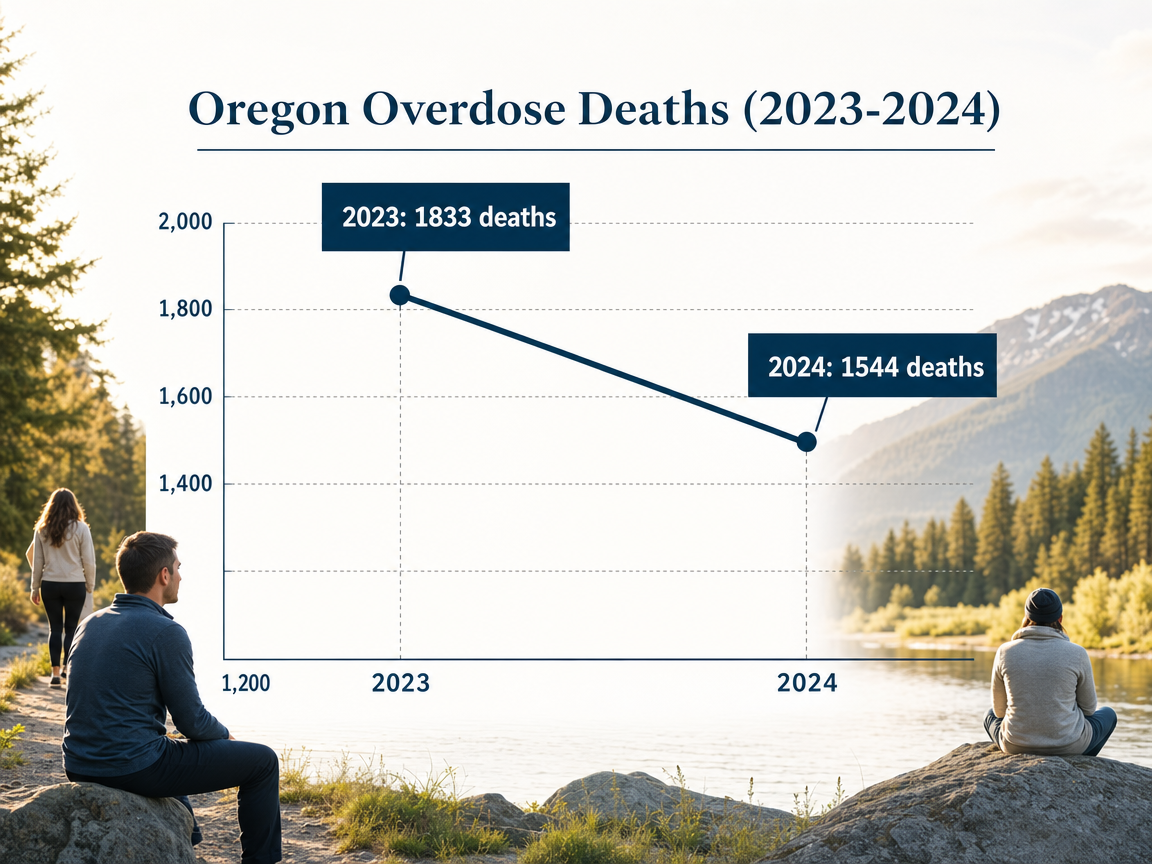
Here's some honest news, and it matters for you: Oregon's overdose deaths actually dropped last year. Statewide, OHA reported 1,544 overdose deaths in 2024, down from 1,833 in 2023 10. That's a real decline, and it's the first meaningful one in years. Something is working — harm reduction, medication access, expanded treatment, the whole tangled system pulling in the same direction.
But a lower death number doesn't mean the demand for residential beds has eased. It often means the opposite. More people are surviving overdoses, more are showing up in emergency rooms and detox units, and more of them are looking for the next step — the exact step you're trying to take right now. That's part of why Portland-area programs stay full and why the call-around you may already be doing feels harder than it should.
OHA's 2025 opioid report notes that the state's Behavioral Health Resource Networks alone conducted more than 2.6 million encounters between 2022 and 2025 — a rough measure of how much recovery activity is happening across Oregon 9. You're stepping into a system with a lot of movement in it. That's not a warning. It's context.
'Near Me' from Gresham, Beaverton, Hillsboro, or Vancouver-Adjacent Zips
"Near me" is doing a lot of work in that search box. If you're in inner Southeast, near might mean a bike ride. If you're in Gresham, Hillsboro, or a Vancouver-adjacent neighborhood, near might mean forty-five minutes and a MAX transfer. All of those are still Portland Metro. All of them count.
Portland proper had a 2020 population of 652,503, and the city's own neighborhood work — 95 neighborhood profiles built with Portland State University — documents real differences across the map in poverty, rent burden, English proficiency, and home-ownership 11, 12. What that means for you: a program in one neighborhood is not the same experience as a program in another, and the geography of getting there is part of the decision. A facility on a MAX line is easier to reach from Beaverton or Gresham than one tucked into a residential pocket in the West Hills.
A few practical filters that help. If a family member will visit on weekends, pick something they can actually get to without an hour of driving each way. If you're worried about walking distance from old contacts and old spots, that matters more than a specific ZIP code. And if you're coming out of a detox provider in one part of the metro, ask them which residential programs they most often hand people off to — those handoffs are usually smoother.
A Real Week Inside a Portland-Area Residential Program
Mornings, Groups, and One-on-Ones: The Weekday Rhythm
Weekdays start earlier than you probably want them to. Most Portland-area residential programs wake residents around 6:30 or 7:00 a.m. You make your bed, take any morning medications with staff, eat breakfast with the house, and head into a morning check-in — sometimes called a community meeting, sometimes a goals group. You say out loud what you're working on that day. It sounds simple. After detox, it's not.
Mid-morning is usually your first clinical group. Depending on the program, that might be cognitive behavioral therapy, dialectical behavioral therapy skills, relapse prevention, or a Seeking Safety group if trauma is part of your story. Groups run 60 to 90 minutes. You sit in a circle. You listen more than you talk at first, and that's okay.
Lunch, then more structured time in the afternoon. Somewhere in your week — usually once or twice — you'll have a one-on-one session with your primary counselor. That hour is where the individual work happens: your history, your triggers, what you're building toward, the plan for after residential. Between groups you might have chores, a walk, journaling, or quiet time. Nothing flashy. The point is that your day has a shape again, and someone is watching whether you show up for it.
Evenings, Weekends, Phones, and Family Contact
Evenings soften a little. Dinner with the house, then usually an evening meeting — often a 12-step or mutual-support group either on-site or a short drive away. Some programs bring speakers in. Some run a Wellbriety circle or another culturally grounded option. You wind down, and lights out is usually around 10 or 11.
Weekends are lighter but not empty. Expect one or two groups Saturday morning, family visitation windows on Saturday or Sunday, outings for approved activities, and more free time to read, rest, or work on step assignments.
Phone and family policies vary by program, and this is worth asking about before you arrive. Some facilities hold personal phones for the first week or two and give scheduled call windows on a house phone. Others allow monitored phone time in the evenings. Family contact usually opens up after an initial adjustment period — often a scheduled family session with your counselor once things settle. If you have kids, ask specifically how child contact is handled. Programs know that question is coming, and a good one will have a clear answer.
Medication Support Alongside Therapy
If you started medication during detox — buprenorphine, naltrexone, or something for alcohol use disorder — you can usually keep taking it in residential. SAMHSA notes that research shows combining medication with therapy can successfully treat substance use disorders, and that combination is the standard many Portland-area programs work from 13.
Practically, that means a nurse or medication tech manages your doses, a prescriber sees you on a set schedule, and adjustments happen through the program's medical team or in coordination with the provider who started you. If you take medication for a co-occurring condition — depression, anxiety, ADHD, bipolar — bring the bottles or a current pharmacy list to intake. Continuity matters. Stopping and restarting psychiatric medications in the first weeks of recovery is rough, and you don't have to do it.
Real Recovery Starts in Portland, Oregon
Call now or verify insurance to take the first step toward lasting recovery in Portland.
Privacy: What a Residential Facility Legally Cannot Share About You
One of the reasons people stall out at this stage is a very reasonable fear: if I check into residential treatment, who finds out? Your boss. Your ex. Your mom. The custody judge. That fear is worth taking seriously, and the law here is stronger than most people realize.
Substance use disorder treatment records get an extra layer of federal protection under 42 CFR Part 2, a rule that's separate from — and in some ways stricter than — HIPAA 5. HHS puts it plainly: Part 2 generally bars a treatment program from disclosing identifying information about you unless you sign a specific written consent, or unless a narrow exception applies like a court order, subpoena, or a medical emergency 6. That means the facility cannot confirm to your employer that you're a patient. It cannot tell your landlord. It cannot casually update a family member who calls the front desk, even a well-meaning one. Federal law requires the program to inform you of these protections at admission 5.
What you control: who gets a release of information. You decide, in writing, whether your partner can talk to your counselor, whether your primary care doctor gets updates, whether FMLA paperwork goes to HR. You can revoke a release later. If privacy is what's holding you back from picking up the phone, know that the walls around your care are real.
Paying for It Without Losing the Window
Insurance, OHP/Medicaid, Private Pay, and Sliding Scale
Money is the place a lot of people freeze. Don't. The intake coordinator you're calling has had this exact conversation a thousand times, and there are more pathways than you probably think.
If you have commercial insurance through work or a spouse, the program's admissions team will run a benefits check — usually within a few hours, sometimes while you're still on the phone. Ask what your deductible is, what your daily copay looks like, and whether the facility is in-network. In-network is cheaper. Out-of-network isn't automatically off the table, especially if the plan has out-of-network residential benefits.
If you're on the Oregon Health Plan (Medicaid) or think you might qualify, that opens a real door. OHP covers substance use disorder treatment, including residential care at licensed Oregon facilities 4. Many Portland-area programs work directly with OHP and can help you enroll if you're not already in. Bring your OHP ID number, or your Social Security card and a piece of mail if you're applying at intake.
Private pay is what it sounds like — you or your family pay directly. Rates vary widely. Some programs offer sliding-scale reductions based on income, or payment plans that spread the cost over months. Ask. Nobody volunteers a discount you don't request.
What to Ask Before You Say Yes
Before you commit to a bed, run through a short list on the phone. It takes ten minutes and it saves days.
- Are you licensed by OHA for residential substance use disorder treatment, and what's your license number? 4
- What's your current wait time, and do you hold a spot with a deposit or a signed intake?
- Do you take my insurance or OHP? What will I actually owe out of pocket?
- Do you accept people continuing buprenorphine, naltrexone, or medication for alcohol use disorder?
- What's your typical length of stay, and what does the step-down to outpatient or sober living look like?
- How do phones, family visits, and family sessions work?
- If I have a co-occurring condition, how is that supported alongside SUD care?
If any answer is vague or pushy, that's information too. A steady program will slow down and answer plainly. That's what you're looking for.
Choosing Between Options This Week
Matching Structure to Where You Actually Are
Here's the honest truth about choosing between programs: the "best" one on paper is not always the right one for you this week. What matters more is matching the level of structure to where your body and mind actually are right now, three or five or seven days out of detox.
If you're still sleeping badly, still shaky, still finding it hard to sit through a 60-minute group without checking out, you want more structure, not less. A program with tight daily schedules, staff you see often, and limited unstructured time is doing you a favor. That's not restriction. That's scaffolding while your nervous system settles.
If you've had prior treatment episodes and know the group work well, you might do better in a program that adds trauma-focused work, family sessions, or more intensive one-on-one time earlier in the stay. Ask about that specifically. Ask what the first two weeks look like versus the last two.
One more filter that gets overlooked: the vibe of the house on the phone. Call intake and pay attention to how you feel after you hang up. Rushed? Talked over? Or heard? You're going to live there. The first impression usually tells the truth.
Gender-Specific Residential as One Legitimate Choice
Portland-area residential options include mixed-gender programs and gender-specific ones — men's houses and women's houses that run their whole clinical program with one population. Neither is automatically better. They're different tools.
Gender-specific residential can lower the social noise of early recovery. Fewer new relationships to manage, more room to talk about the things that are harder to say in a mixed room — trauma histories, sexual shame, fatherhood or motherhood, the specific ways substance use tangled up with identity and role. For some people, especially men who have never talked openly with other men about any of this, that focus matters.
Mixed-gender programs offer different strengths, including a fuller picture of the community you'll rejoin. You know yourself. Pick the room where you're most likely to actually speak.
What to Pack and What to Leave Behind
Ask the program for their intake list — every facility has one — but the general shape is the same. Bring: two weeks of comfortable clothes, closed-toe shoes, basic toiletries without alcohol in the first three ingredients, a jacket for Pacific Northwest weather, a notebook, and any current medications in their original bottles with a pharmacy list.
Leave behind: mouthwash and hand sanitizer with alcohol, anything with a razor blade you didn't clear with staff, cash beyond a small amount, and any medication not on your list. Most programs hold your phone or limit it for the first stretch. Bring a few phone numbers written on paper. Old-school, but it works when your device is in a lockbox.
Moving Forward From Here
You've read a lot. Now the work is small and specific: pick up the phone, call two or three licensed Portland-area residential programs today, and ask the questions from the checklist above. If your detox provider has a discharge planner, loop them in this afternoon. Momentum is fragile in the days right after detox, and the fastest way to protect it is to hand the next decision off to people who do this every day.
You don't have to feel ready. Nobody does. Finishing detox already proved you can do hard things when the ground is moving. Residential is the next hard thing, and it's a lot more doable inside a house with a schedule and a counselor than it is alone in an apartment at 2 a.m. Programs like Oregon Trail Recovery in Portland can help you sort through the options, including gender-specific residential and the step-down into intensive outpatient once you're steadier. Whichever door you walk through, walk through one this week.
Frequently Asked Questions
Can I bring my phone into a Portland-area residential treatment center?
Usually yes, but expect limits. Most programs collect phones at intake and give scheduled call windows for the first week or two, then loosen up as you settle in. Ask the specific facility about their phone policy before you arrive, and write down a few key numbers on paper so you're not stuck if your device is in a lockbox.
What happens if there are no residential beds open the day I finish detox?
Don't wait it out at home. Ask your detox discharge planner about a bridge option: extended detox stay, a stabilization bed, sober living with intensive outpatient, or a waitlist hold at your top-choice residential program. OHA's capacity dashboard tracks new beds coming online across Oregon, and Portland-area intake coordinators often know which programs are admitting this week 1.
Will my employer or family find out I'm in residential treatment?
Not unless you say so in writing. Federal rule 42 CFR Part 2 bars a treatment program from disclosing that you're even a patient without your specific written consent, outside narrow exceptions like a court order or medical emergency 5. You choose who gets a release — a spouse, HR for FMLA, your primary care doctor — and you can revoke it later.
Can I keep taking medication for opioid or alcohol use disorder while in residential care?
Yes, at programs that support it — and that's most reputable ones in the Portland area. SAMHSA is clear that combining medication with therapy successfully treats substance use disorders, so continuing buprenorphine, naltrexone, or alcohol-use-disorder medication is standard, not an exception 13. Ask the intake coordinator directly whether the program admits people on your specific medication before you commit.
How long does residential treatment usually last, and can I leave early if I need to?
Portland-area residential stays commonly run 30 to 90 days, with some programs extending to six months depending on clinical need and payer coverage. You can legally leave at any time — it's voluntary care — but leaving against clinical advice often disrupts insurance coverage and step-down planning. If you're feeling pulled to go, tell your counselor before you pack. That conversation matters.
Does it matter if the residential program is inside Portland proper versus Gresham, Beaverton, or Hillsboro?
Clinically, no — Oregon licenses residential programs to the same standards across the tri-county Portland Metro area 4. Practically, it can matter a lot. Consider distance from old contacts, how easily family can visit on weekends, whether the location is reachable by MAX or bus for the step-down to outpatient, and which detox provider your admission is coming from. Convenience shapes follow-through.
References
- Behavioral Health Housing and Licensed Capacity Investments Dashboard. https://www.oregon.gov/oha/hsd/amh/pages/housing-dashboard.aspx
- Oregon Health Authority : Behavioral Health Reports and Data. https://www.oregon.gov/oha/HSD/AMH/Pages/Data.aspx
- Oregon Health Authority : Behavioral Health Division. https://www.oregon.gov/oha/hsd/amh/pages/index.aspx
- Oregon Health Authority : Residential Treatment Facilities. https://www.oregon.gov/oha/hsd/amh-lc/pages/rt.aspx
- 42 CFR Part 2 -- Confidentiality of Substance Use Disorder Patient Records. https://www.ecfr.gov/current/title-42/chapter-I/subchapter-A/part-2
- Understanding Confidentiality of Substance Use Disorder Patient Records. https://www.hhs.gov/hipaa/part-2/index.html
- Results from the 2024 National Survey on Drug Use and Health. https://www.samhsa.gov/data/sites/default/files/reports/rpt56287/2024-nsduh-annual-national-report.pdf
- Results from the 2024 National Survey on Drug Use and Health. https://www.samhsa.gov/data/sites/default/files/reports/rpt56287/2024-nsduh-annual-national/2024-nsduh-annual-national-html-071425-edited/2024-nsduh-annual-national.htm
- 2025 - Opioids and the Ongoing Drug Overdose Crisis in Oregon. https://www.oregon.gov/oha/PH/PREVENTIONWELLNESS/SUBSTANCEUSE/OPIOIDS/SiteAssets/Lists/feature/EditForm/2025%20Oregon%20Opioid%20Overdose%20Report.pdf
- Oregon overdose deaths declined in 2024, 2025. https://www.oregon.gov/oha/erd/pages/oregon-overdose-deaths-declined-in-2024-2025-05.13.2026.aspx
- City of Portland Population Demographics. https://www.portland.gov/civic/documents/portland-population-demographics-summary-1/download
- 95 Neighborhood Profiles Showcase Economic And Livability Issues. https://www.portland.gov/civic/news/2023/2/3/95-neighborhood-profiles-showcase-economic-and-livability-issues
- Treatment Options for Substance Use Disorder - SAMHSA. https://www.samhsa.gov/substance-use/treatment/options
Relapse Doesn't Mean the End Of Your Journey
Reach out today to explore programs that support real, long-term sobriety.