


How to Choose Addiction Center Treatment That Lasts

Key Takeaways
- Match the level of care to actual severity using ASAM criteria — intensive outpatient can rival residential outcomes at roughly one-third the cost for appropriate cases 7.
- Insist on a care arc extending past 90 days with a real step-down continuum, since shorter stays show limited effectiveness 6.
- Verify the clinical model names specific modalities like CBT, DBT, motivational interviewing, and relapse prevention delivered by credentialed clinicians, not vague 'evidence-based groups.'
- Treat family involvement as a clinical variable: structured, recurring sessions and skills training improve entry, completion, and long-term outcomes 3, 4.
- Confirm continuing care is built in with named providers, defined check-in cadence, and proactive outreach — ongoing support meaningfully reduces relapse rates 10.
Why the Last Program Didn't Hold
If you're reading this, there's a good chance you've already sat through one discharge meeting that felt more like a graduation than a plan. Your adult child came home with a certificate, a phone number for a therapist, and thirty days of sobriety. Weeks later, maybe months, the relapse arrived on schedule.
That outcome was not a personal failure. It's a predictable result of how many programs are structured. Short stays, thin aftercare, and family kept at arm's length are the profile of treatment built for a marketing cycle rather than the clinical reality of substance use disorder. National guidance is direct on this point: addiction responds to sustained, staged care, not to brief episodes that end when the calendar runs out 11.
Research on why people leave treatment early points to the same soft spots — low motivation at entry, untreated psychiatric symptoms, unstable housing, and weak social support 12. A program that doesn't actively work on those variables is a program betting on luck.
You don't need to become a clinician to choose better this time. You need a framework — five specific dimensions that separate durable programs from disappointing ones — and the language to ask about each one out loud.
Reframe: You're Evaluating a Chronic-Care Plan, Not Shopping for Rehab
Here's the reframe that changes everything about how you read admissions websites: substance use disorder behaves like a chronic condition, not an acute injury. It doesn't get set like a broken bone and heal on a fixed timeline. It has flare-ups, remissions, and maintenance needs — closer in shape to diabetes or hypertension than to a single surgical fix 11.
That distinction matters because most consumer-facing rehab marketing is still built around an acute-care metaphor: admit, treat, discharge, cured. When you read a program page through that lens, glossy amenities and short stays look reasonable. When you read the same page as the outline of a chronic-care plan, the questions change. How does this program monitor over time? How does it stage care from higher to lower intensity? How does it plan for the setbacks it knows are statistically likely?
Programs that adopt chronic-care principles — structured monitoring, active relapse prevention, proactive follow-up rather than passive alumni newsletters — produce better long-term outcomes than programs that treat one episode and move on 11. Your job in the coming weeks is not to pick a facility. It's to identify a team willing to stay in the game with your adult child for longer than the deposit clears.
The Five Dimensions That Predict Whether Treatment Lasts
Match the Level of Care to the Severity
Start with the placement question, because everything downstream depends on getting it right. The core NIDA principle is that no single treatment fits everyone — matching the setting, interventions, and services to the specific person is what predicts outcomes 5. That means the first honest conversation with a program isn't about amenities. It's about severity: how heavy the use, what the withdrawal profile looks like, whether housing is stable, whether there's a co-occurring mental health condition, and how much structure your adult child can hold onto when the door isn't locked behind them.
Programs commonly organize this decision around ASAM criteria — a clinical framework that sorts placement across levels from outpatient counseling up through medically managed inpatient care. You don't need to memorize the levels. You need to hear the admissions team use them.
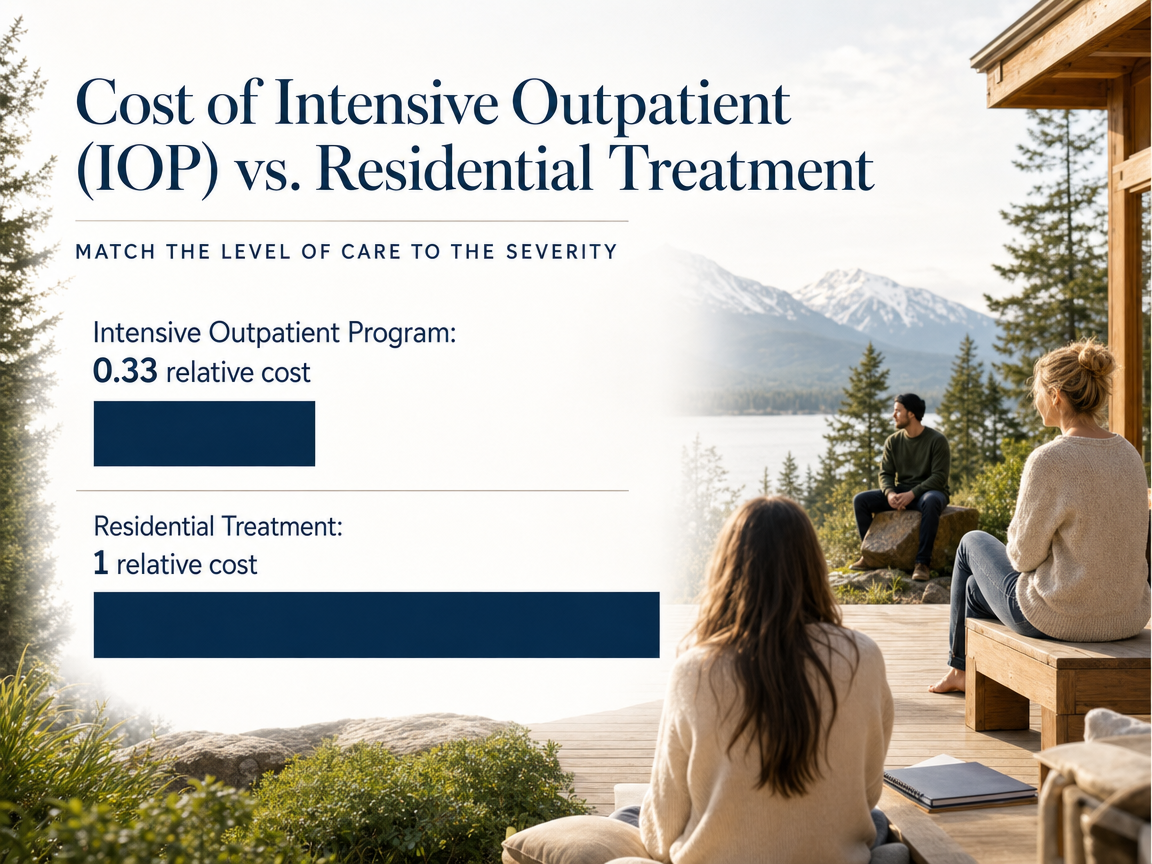
Here's the finding that changes the conversation for a lot of families. In a study of people with alcohol and cocaine dependence, intensive outpatient treatment (IOP) worked as a viable alternative to residential care — at roughly one-third the cost of residential placement, with few significant differences in relapse rates 7. The relative cost sits at about 0.33 against residential at 1.0, and outcomes tracked closely in that studied population.
Read that carefully. It doesn't mean IOP is always the right call. It means the automatic assumption that residential must be better — because it costs more, or because it feels more decisive — is not supported by the evidence for every case. For someone with severe withdrawal risk, an unstable living situation, active psychosis, or opioid dependence with a history of overdose, residential is often the right level. For someone with stable housing, family willing to participate, and moderate severity, a well-run IOP can produce comparable long-term outcomes for less money and less life disruption.
Ask the admissions clinician which level they're recommending and why — in ASAM terms — before you talk about anything else.
Insist on Adequate Duration and Step-Down Care
Duration is where marketing and clinical evidence part company most obviously. The 28-day stay became a fixture because insurance and inpatient economics converged on it — not because 28 days is what the research says people need.
NIDA's guidance is specific: for residential or outpatient treatment, participation for less than 90 days shows limited effectiveness, and treatment lasting significantly longer is recommended for maintaining positive outcomes 6. Ninety days is a floor, not a ceiling. And the ninety days don't have to be residential. They can be a shorter residential stay followed by intensive outpatient, then standard outpatient, then a longer arc of continuing care.
What you're listening for from a program is the step-down. A credible plan sounds like a staircase: this level for roughly this long, then this next level as certain milestones are met, then this maintenance phase. A weaker plan sounds like a countdown to a discharge date with a phone number attached.
Ask what the average total length of engagement looks like — including outpatient and alumni contact — not just the residential piece. Ask what triggers a step-down and what triggers stepping back up if things get shaky. Ask how the team handles a person who is technically doing well at day 30 but clearly needs more time. Programs anchored in criminal justice populations frame this bluntly: treatment has to last long enough to produce stable behavioral changes 9. That principle isn't specific to justice-involved clients. It's specific to how the brain and behavior actually change.
Verify the Clinical Model Is Evidence-Based
Every rehab website says "evidence-based." The phrase has been diluted to the point of meaning almost nothing. Your job is to make it mean something again by asking which specific therapies are delivered, by whom, and how often.
A credible clinical stack for substance use disorder usually includes cognitive behavioral therapy (CBT), motivational interviewing, relapse prevention skills training, and — for co-occurring depression, anxiety, or trauma — approaches like dialectical behavior therapy (DBT) or trauma-focused protocols such as Seeking Safety. Twelve-step facilitation is often integrated, but it isn't a substitute for structured clinical work.
Ask three concrete questions. Who provides individual therapy — a licensed clinician, and how often per week? What group therapies run on the weekly schedule, and what is each one actually doing? How does the program address readiness and motivation across the arc of treatment, not just at intake?
That last question matters more than most families realize. Higher readiness for change at treatment entry is associated with greater engagement and lower relapse rates across follow-up periods 14. But readiness isn't fixed. Good programs build it — through motivational interviewing, feedback loops, and honest reflection on ambivalence — rather than assuming a person who signed admission paperwork is fully committed.
What predicts longer stretches of abstinence, according to a 2024 study of people in cocaine use disorder treatment, is a bundle of variables the program can actively influence: fewer withdrawal symptoms, greater treatment engagement, and higher self-efficacy 8. Ask how the program measures and builds each of those. If the answer is vague, or if "evidence-based" turns out to mean "we do groups and 12-step," keep looking.
Treat Family Involvement as a Clinical Variable
You are not a bystander to your adult child's treatment. You are a variable in the outcome. Programs that understand this build family involvement into the clinical model. Programs that don't will send you a family weekend invitation and a bill.
The evidence here is clearer than most families realize. A systematic review of family-based interventions found consistent benefits for reducing substance use and improving family functioning, with effects that endured 12 to 18 months post-treatment 1. A scoping review of family-focused practices concluded that involving families increases treatment entry, enhances completion, and is linked with better long-term outcomes for the person with the substance use disorder 3. SAMHSA's synthesis puts it plainly: family involvement is associated with higher rates of entry, decreased dropout, and better long-term outcomes 4.
In the specific population most relevant to many parents reading this — transition-age youth 16 to 25 — family involvement produced a 5.7% reduction in substance use frequency, with effects sustained 12 to 18 months post-treatment. Translated into calendar time, that's roughly three fewer weeks per year of substance use 2. That's a modest effect size, but a durable one, from a variable the program controls by choosing to engage you.
What that means practically: ask when family sessions begin, how often they occur, and who runs them. Ask whether the program teaches you specific skills — how to hold a boundary without triggering a rupture, how to talk about relapse without collapsing into either rescue or rejection. Ask what education you'll receive about the chronic-care nature of the condition. If the answer is a single family weekend at week three, that's a marketing touchpoint, not a clinical intervention. If the answer is structured, ongoing, and includes skills you can practice, that's a program treating your involvement as the outcome variable it actually is.
Confirm Continuing Care Is Built In, Not Bolted On
Continuing care is the dimension programs are most likely to describe well on the website and deliver thinly in practice. Ask how the sausage is actually made.
The research is unambiguous. Ongoing support after the primary treatment episode — through intensive outpatient step-down, recovery residences, alumni programming, and mutual-help groups — is associated with meaningfully reduced relapse rates and improved functioning compared to treatment-only conditions 10. The chronic-care framing you met earlier isn't philosophical furniture. It's the reason a program with a strong 30-day residential experience and no continuing care structure will underperform a program with a shorter primary stay and a real 12-month follow-through plan.
What a substantive continuing care plan looks like: a defined step-down into intensive outpatient care after residential, sober living or recovery housing available for people whose home environment isn't yet stable, structured alumni programming that isn't just a newsletter, and — importantly — proactive outreach when someone drops off the schedule. Passive alumni support means the program waits for a call. Active continuing care means the program calls you.
Ask specifically: what does the first 90 days after discharge look like? Who checks in, how often, and what happens if there's a slip? Is there a written aftercare plan handed to your adult child at discharge, and does it name specific providers, meetings, and appointments — or is it a template? Programs designed for the chronic-care reality of substance use disorder answer these questions in specifics 11. Programs designed for the discharge date answer them in adjectives.
Real Recovery Starts in Portland, Oregon
Call now or verify insurance to take the first step toward lasting recovery in Portland.
Questions to Ask Admissions — and What Substantive Answers Sound Like
You will get about twenty minutes on the phone with an admissions counselor before decisions start hardening. Use them well. Below are five questions that map to the five dimensions you just read about, and — because vague answers can sound reassuring in the moment — the shape of a substantive response versus the shape of a deflection.
- 1. What level of care are you recommending for my adult child, and why in ASAM terms?
A substantive answer names an ASAM level, ties it to specific severity indicators (withdrawal risk, co-occurring conditions, housing, prior treatment history), and explains what would prompt a step up or down. A deflection sounds like "we'll figure that out at intake" or "residential is what we do, so that's what we'd recommend" 5. - 2. What does the full arc of care look like, from admission through month twelve?
You want a staircase: primary phase, step-down, continuing care, alumni contact — with rough durations attached. A weak answer describes the residential piece in detail and gets thin fast after discharge 6. - 3. Which specific evidence-based therapies do you deliver, and by whom?
Listen for named modalities — CBT, DBT, motivational interviewing, relapse prevention, trauma-focused work — with credentialed clinicians attached. "Evidence-based groups" without specifics is a phrase, not a program. - 4. How and when will our family be involved, and what will you teach us?
A credible answer includes structured family sessions on a schedule, skills training for you, and psychoeducation about the chronic-care nature of the condition. A single family weekend is a touchpoint, not an intervention 4. - 5. What happens in the first 90 days after discharge, and who owns the follow-through?
You want names, frequency, and a plan for what happens if things wobble. "We have an alumni program" is a brochure line. "A counselor calls weekly for the first month, and here's our protocol if someone slips" is a plan 10.
Print these. Ask them out loud. The quality of the answers will tell you more than any website ever will.
Special Considerations: Co-Occurring Conditions, Gender-Specific Care, and Regional Fit
When Depression, Anxiety, or Trauma Ride Along
Most adult children in treatment aren't dealing with substance use alone. Depression, anxiety, PTSD, or unresolved trauma sit underneath the use — sometimes as cause, sometimes as consequence, usually as both. If those conditions aren't treated in the same building by the same team, the substance use work rarely holds.
Integrated treatment — meaning SUD care and mental health care delivered together, in coordination, by clinicians who talk to each other — produces better symptom reduction and better substance use outcomes than sequential or parallel approaches 15. Sequential means treating one, then the other. Parallel means two separate providers who don't share notes. Neither works as well as one team holding both.
A practical note for Pacific Northwest families: many outpatient and residential programs offer co-occurring support alongside SUD treatment rather than primary psychiatric care. That distinction matters. Ask directly whether psychiatric medication management, trauma-focused therapy, and mental health assessment happen inside the program or through referral. If it's referral-only, ask how tightly the two providers actually coordinate.
Gender-Specific Men's Treatment: What the Evidence Actually Says
The honest answer is that the evidence is mixed. Reviews comparing gender-specific and mixed-gender programs show some engagement benefits in gender-specific settings, but limited differences in long-term substance use outcomes 13. Anyone selling you gender-specific men's treatment as clinically superior across the board is overstating what the research supports.
That said, gender-specific care can still be the right operational call for your son — for reasons that show up in daily practice more than in outcome studies. Men in men-only settings often disclose trauma sooner. Peer trust builds faster when the room shares certain lived experiences. Accountability culture is easier to enforce when the social dynamics of a mixed group aren't in play. Sober living environments organized around men's routines and expectations tend to be more structurally consistent.
Weigh gender-specific programming as a fit variable, not a quality proxy. Ask what the men's program actually does differently — schedule, group content, peer culture, sober living structure — and whether the underlying clinical stack (CBT, DBT, motivational interviewing, family involvement, continuing care) meets the standards you'd demand from any credible program 5. If the gender focus is layered on top of strong fundamentals, it can be a meaningful edge. If it's the only differentiator on the page, keep looking.
Oregon, the Pacific Northwest, and Wyoming: Practical Filters
Geography is a logistics variable, not a quality variable — but it's a logistics variable that can quietly decide whether treatment holds.
Three practical filters. First, licensing: confirm the program is licensed by the state it operates in. Oregon addiction treatment providers are regulated differently than Wyoming drug rehab facilities, and licensing is your baseline signal that a program is subject to actual oversight. Second, continuing care access: the aftercare plan only works if the sober living, IOP step-down, and mutual-help meetings your adult child needs are within a reasonable radius of where they'll actually live. A Central Oregon program with strong Portland-area continuing care doesn't help a family based in Cheyenne. Third, family logistics: if you're going to be a clinical variable in the outcome 4, the drive or flight to family sessions has to be sustainable across months, not just week one.
Pick geography to serve the continuing care plan, not the intake week.
Planning for Relapse Without Planning to Fail
Ask directly: what is your protocol when a person in continuing care slips? A credible answer describes a clinical response — rapid re-engagement, a possible step back up to a higher level of care, a review of what triggered the return to use, and a revised plan. A weaker answer implies the person will be discharged or quietly disappear from the alumni list.
The variables that drive early dropout — low motivation, untreated psychiatric symptoms, unstable housing, thin social support — are the same variables that drive post-treatment relapse 12. Programs that actively work on each one during care are the programs positioned to catch a slip before it becomes a full return to use.
Planning for relapse isn't pessimism. It's the difference between a program that treats an episode and a team that stays with your adult child long enough to see the pattern change.
A Short Checklist Before You Sign Anything
Before the deposit clears, run the program through these seven checks. If more than one comes back thin, keep looking.
- ASAM level named and justified. The recommended level of care is tied to specific severity indicators, not to what the program happens to sell 5.
- Care arc past 90 days. The plan describes primary treatment, step-down, and continuing care as a continuum — not a discharge date 6.
- Named clinical modalities. CBT, DBT, motivational interviewing, relapse prevention, trauma-focused work — delivered by credentialed clinicians on a stated schedule.
- Structured family involvement. Recurring sessions and skills training for you, not a single family weekend 3.
- Co-occurring care coordinated in-house or tightly linked. Depression, anxiety, and trauma treated alongside substance use, not sequentially 15.
- Written aftercare plan with names attached. Specific providers, meetings, and check-in cadence for the first 90 days after discharge 10.
- State licensing confirmed. Verify with the licensing board in Oregon, Wyoming, or wherever the program operates.
If the answers hold up, you're not gambling. You're placing a considered bet on a clinical plan built for how recovery actually works.
Frequently Asked Questions
How long should my adult child stay in addiction treatment?
Plan for at least 90 days of active engagement across levels of care, not 90 days in one bed. NIDA guidance is that participation under 90 days shows limited effectiveness, and longer engagement supports better outcomes 6. That can look like a shorter residential stay, then intensive outpatient, then standard outpatient with continuing care.
Is residential treatment always better than intensive outpatient?
No. For alcohol and cocaine dependence, IOP works as a viable alternative to residential care at roughly one-third the cost, with few significant differences in relapse rates in the studied population 7. Residential is often the right call for severe withdrawal, unstable housing, active psychiatric crisis, or opioid dependence with overdose history. Severity drives the decision.
What evidence-based therapies should a credible program offer?
Expect named modalities delivered by credentialed clinicians on a stated schedule: cognitive behavioral therapy, dialectical behavior therapy, motivational interviewing, relapse prevention skills training, and trauma-focused work when indicated. Programs should also actively build readiness and self-efficacy across care, since both predict engagement and longer abstinence 14, 8. "Evidence-based groups" without specifics is a phrase, not a plan.
How should a treatment center involve our family?
Through structured, recurring sessions on a schedule — not a single family weekend. Family involvement increases treatment entry, reduces dropout, and improves long-term outcomes for the person in care 3, 4. Ask when sessions begin, how often they occur, who runs them, and what specific skills you'll be taught for boundaries, communication, and responding to a slip.
Does gender-specific men's treatment produce better outcomes?
The evidence is mixed. Reviews show some engagement benefits in gender-specific settings but limited differences in long-term substance use outcomes compared to mixed-gender programs 13. Treat it as a fit variable, not a quality proxy. It can still help daily practice — trauma disclosure, peer trust, accountability culture — if the underlying clinical model is strong.
What should we ask about relapse and continuing care before admission?
Ask what the first 90 days after discharge look like: who checks in, how often, and the written protocol when someone slips. Continuing care through IOP step-down, sober living, and mutual-help is linked to reduced relapse rates versus treatment-only conditions 10. A credible program answers in names and cadence, not adjectives, and re-engages rather than discharges after a slip.
References
- Efficacy of Family-based Interventions in Addressing Substance Use. https://pmc.ncbi.nlm.nih.gov/articles/PMC13068785/
- Family Involvement in Treatment and Recovery for Substance Use Disorders among Transition-Age Youth. https://pmc.ncbi.nlm.nih.gov/articles/PMC8380649/
- Family-focused practices in addictions: A scoping review. https://pmc.ncbi.nlm.nih.gov/articles/PMC5781095/
- Substance Use Disorder Treatment and Family Therapy (Treatment engagement and outcomes box). https://www.ncbi.nlm.nih.gov/books/NBK571084/box/ch1.b4/
- Principles of Drug Addiction Treatment (Research-Based Guide, key principles section). https://nida.nih.gov/sites/default/files/podat_1.pdf
- Principles of Drug Addiction Treatment: A Research-Based Guide (Third Edition). https://nida.nih.gov/sites/default/files/podat-3rdEd-508.pdf
- Comparing Outcome of Residential and Intensive Outpatient Treatment Services for Substance Dependence. https://scholarworks.wmich.edu/dissertations/1497/
- Predictors of cocaine use disorder treatment outcomes: a prospective cohort study. https://pubmed.ncbi.nlm.nih.gov/38720357/
- Principles of Drug Abuse Treatment for Criminal Justice Populations: A Research-Based Guide. https://nida.nih.gov/sites/default/files/principles-drug-abuse-treatment-criminal-justice-populations-research-based-guide_508.pdf
- Continuing care and long-term recovery from substance use disorders. https://pmc.ncbi.nlm.nih.gov/articles/PMC5806155/
- The chronic care model of addiction: strengths and limitations. https://pmc.ncbi.nlm.nih.gov/articles/PMC6762029/
- Predictors of dropout from substance use disorder treatment: a systematic review. https://pubmed.ncbi.nlm.nih.gov/24985596/
- Effectiveness of gender-specific versus mixed-gender substance use treatment programs: a review. https://pubmed.ncbi.nlm.nih.gov/29344999/
- Motivation and readiness for change in substance use treatment: impact on outcomes. https://pmc.ncbi.nlm.nih.gov/articles/PMC3749010/
- Integrated treatment of co-occurring substance use and mental disorders: outcomes and best practices. https://pubmed.ncbi.nlm.nih.gov/31437279/
Relapse Doesn't Mean the End Of Your Journey
Reach out today to explore programs that support real, long-term sobriety.