


The SMART Recovery Program as a 12-Step Alternative

Key Takeaways
- SMART Recovery organizes change around four ongoing skills: building motivation, coping with urges, managing thoughts and behaviors, and living a balanced life.4
- Evidence suggests roughly equivalent outcomes to 12-step groups when engagement is comparable, though the mutual-aid package still lacks large randomized trials.3, 8
- SMART pairs cleanly with intensive outpatient care and can run alongside a 12-step home group, since blending pathways is a legitimate route rather than a compromise.7
- For rural, court-involved, or IOP-based recovery in the Pacific Northwest, pick one or two standing meetings weekly, keep tools physically nearby, and name a slip plan before you need it.
A skills-based path when the 12-step language doesn't fit
You've probably heard the same advice more than once: get to a meeting, get a sponsor, work the steps. For a lot of people in the Pacific Northwest, that path becomes the backbone of a full life in recovery. For others, the language of powerlessness and higher power lands wrong, or it stopped working somewhere along the way. If you're planning what comes next after residential treatment, detox, or a return to use, you deserve to know there's another well-worn path.
SMART Recovery — short for Self-Management and Recovery Training — is a secular, skills-based mutual-help program built on cognitive behavioral therapy, rational emotive behavioral therapy, and motivational interviewing. The National Institute on Alcohol Abuse and Alcoholism describes it as a "research-based support program" that helps you build motivation, cope with urges, solve problems, and balance your lifestyle.4That's a real endorsement from a serious source, and it's worth taking seriously.
This article is here to help you decide whether SMART belongs in your relapse prevention plan — on its own, alongside a 12-step home group, or embedded in an intensive outpatient program in Portland, Central Oregon, or somewhere more remote. You'll get the tools, the evidence, and the honest limits, so the choice is yours to make with clear eyes.
What SMART Recovery actually teaches
The 4-Point Program in plain language
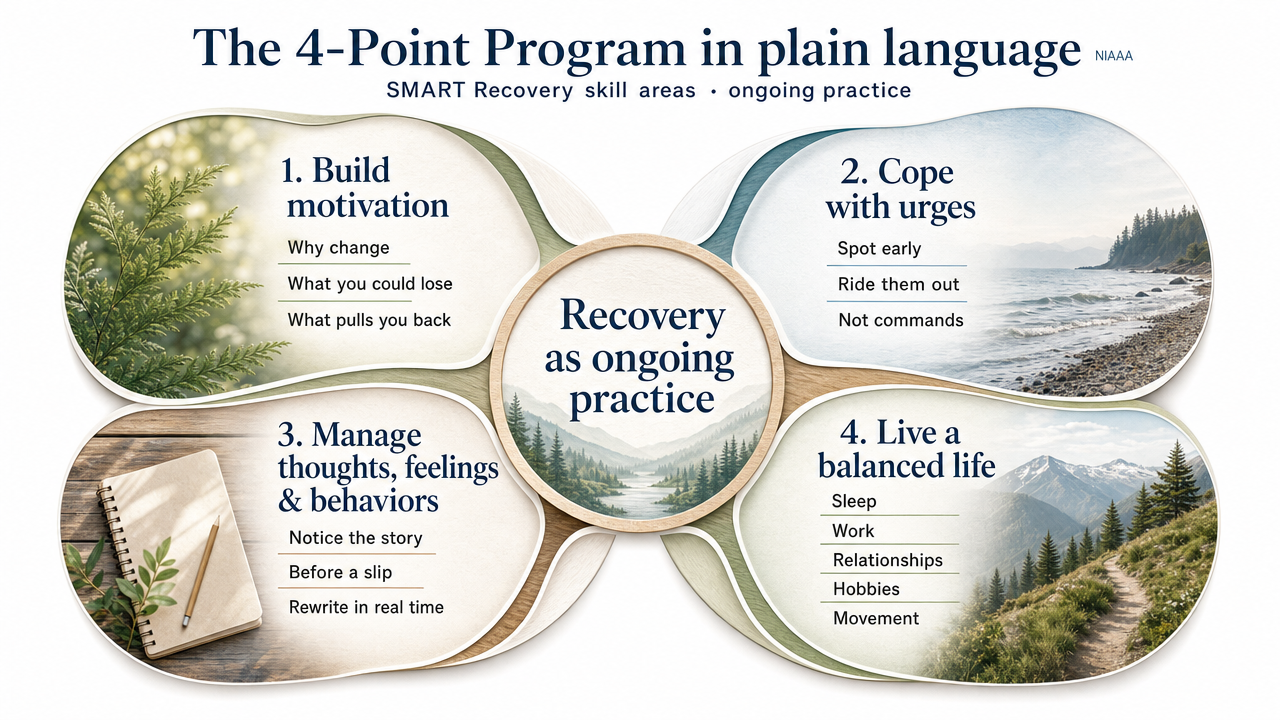
SMART Recovery organizes everything around four practical points. They're not steps you climb in order, and you don't graduate from one before starting the next. Think of them more like four muscle groups you keep training as long as recovery is part of your life.
- The first point is building and maintaining motivation. You get honest about why you want to change, what you stand to lose if you don't, and what's actually pulling you back toward use.
- The second is coping with urges. Cravings show up. You learn to spot them early, ride them out, and stop treating them like commands.
- The third is managing thoughts, feelings, and behaviors. This is the cognitive-behavioral core — noticing the story you tell yourself right before a slip and rewriting it in real time.
- The fourth is living a balanced life. Sleep, work, relationships, hobbies, movement — the ordinary stuff that makes staying sober feel worth it instead of like a life sentence.
The National Institute on Alcohol Abuse and Alcoholism describes this same skill set — motivation, urge coping, problem solving, and lifestyle balance — as what makes SMART a research-based support program.4Four points, four ongoing jobs. That's the whole frame.
The tools you'll actually use: ABC, CBA, DISARM, HOV
Every SMART meeting hands you homework. Not busywork — worksheets and mental tools you can pull out at 9 p.m. on a Tuesday when the craving hits and no one else is awake. Four of them come up again and again.
- ABC
- Stands for Activating event, Belief, Consequence. Something happens (your boss chews you out), you tell yourself something about it (I can't handle this sober), and you feel or do something as a result (you drive past the liquor store). ABC teaches you to slow that middle step down and challenge the belief before it drives the consequence. It comes straight from rational emotive behavioral therapy, one of SMART's core clinical roots.8
- CBA
- A Cost-Benefit Analysis. You write out — literally, on paper — the short-term and long-term costs and benefits of using versus not using. When you're ambivalent, and most people in recovery are ambivalent more often than they admit, seeing it in ink cuts through the fog.
- DISARM
- Stands for Destructive Images and Self-talk Awareness and Refusal Method. It's a way of naming the inner voice that romanticizes using — that little pitch from the part of your brain that swears just one won't hurt — and refusing to negotiate with it.
- HOV
- The Hierarchy of Values. You rank what matters most to you — your kids, your health, your work, your freedom — so that when a craving offers a shortcut, you already know what it would cost.
These are the tools you'll practice. They travel with you.
How SMART differs from a 12-step room
Walk into an AA meeting in Portland and you'll hear a shared vocabulary that has kept people sober for the better part of a century: powerlessness, surrender, higher power, sponsor, step work, one day at a time. Walk into a SMART meeting the same night and the room sounds different. Someone might be at a whiteboard mapping out an ABC worksheet. The facilitator is trained, not another peer working their own steps. The talk is less about turning your will over and more about what specific skill you're going to practice before Thursday.
The philosophical split is real. Twelve-step work rests on the idea that recovery starts with admitting you can't manage this alone and leaning into a fellowship and a power greater than yourself. SMART rests on the idea that you can build the self-management skills to change your behavior, and that motivation, urge coping, problem solving, and lifestyle balance are trainable. The National Institute on Alcohol Abuse and Alcoholism describes SMART in exactly those terms — a research-based support program organized around those four skill areas.4Neither frame is wrong. They're different starting assumptions about where change comes from.
Some other differences you'll notice quickly. SMART doesn't use sponsors; it uses facilitators who guide the meeting and coach the tools. There's no lifetime label — you're not asked to introduce yourself as an anything. Abstinence is the goal most participants land on, but the program leaves room for you to define your own goal at the outset, which lands differently than the abstinence-only frame of a traditional 12-step room. Meetings are usually 90 minutes and follow a loose agenda: check-ins, a tool of the week, and problem-solving on whatever real-life situation someone brought in.
None of this makes 12-step wrong or SMART right. It means if the language of the rooms hasn't fit you, there's a program that talks about your recovery in terms of skills you can practice — and a serious federal source that treats it as legitimate.4
What the evidence does and doesn't say
Roughly equivalent outcomes with honest caveats
Here's the headline you probably want first: in a prospective 12-month study of adults with alcohol use disorder, researchers followed people involved in 12-step groups and in three secular alternatives — Women for Sobriety, LifeRing, and SMART Recovery — and concluded the results "tentatively suggest equivalent efficacy" for the secular options compared with 12-step groups.3Not superior. Not inferior. Roughly the same, when you look at involvement and outcomes over a year.
That's a meaningful finding, and it's also a finding that comes with fine print. The study was observational, not randomized. People chose their group, which means the results reflect what happens when someone picks the path that fits them — not what would happen if you flipped a coin and assigned everyone to SMART. In fact, participants who named SMART as their primary group at baseline had lower odds of abstinence and no alcohol problems at follow-up than 12-step members, a difference the researchers attribute in part to self-selection and engagement patterns.3
So what does this actually tell you? If you engage with SMART — attend meetings, do the homework, stay involved — you can reasonably expect outcomes in the same neighborhood as someone who works a 12-step program with similar commitment. What you can't expect is that just showing your face makes the difference. Neither program works that way.
The dual-diagnosis trade-off
If you're carrying a co-occurring mental health diagnosis alongside a substance use disorder, the comparison gets more interesting. A randomized study of people with serious mental illness and substance use disorders in intensive outpatient and partial hospitalization settings found something worth sitting with: a 12-step–oriented approach was more effective at decreasing alcohol use and increasing social interactions, while a SMART Recovery–based cognitive-behavioral group was more effective at improving health and employment status.2
Read that again. It's not that one program won. It's that each program moved different needles. The 12-step arm looked stronger on drinking outcomes and connection. The SMART arm looked stronger on physical health and getting back to work. There's also a caveat that deserves airtime: marijuana use was greater among SMART participants in this study.2
What does that mean for your plan? If your primary target is reducing alcohol use and rebuilding a social world, a 12-step home group has real support. If your primary target is stabilizing your health and getting back to steady work — the kind of daily-life rebuilding an intensive outpatient program in Portland or Central Oregon is designed for — SMART's skill set carries genuine weight. You don't have to pick sides. You do have to name what you're optimizing for.
The evidence ceiling worth naming
You deserve the honest version. A comprehensive 2023 investigation of SMART Recovery found only one small randomized controlled trial in the published literature and called for more rigorous research before clinicians can confidently rank SMART against 12-step programs.8A separate systematic review protocol put it directly: while SMART's underlying principles like self-efficacy and its therapeutic tools like motivational interviewing and CBT are evidence-based,"further clarity regarding the direct evidence of its effectiveness as a mutual aid package is needed."11
Translated: the ingredients are well-studied. The recipe as a whole is still being tested.
SMART inside an intensive outpatient program
An intensive outpatient program lives or dies on what you do between sessions. You're not in a residential bed anymore. You're back at your kitchen table, back on the job, back in the same driveway where old patterns waited for you. The clinical hours matter, but the twenty other hours a day matter more. That's where SMART's toolkit earns its keep — it hands you homework you can actually run at home.
The mapping is almost too clean. IOPs in Portland and across the Pacific Northwest already lean on CBT, DBT, and motivational interviewing in group and individual work. SMART's ABC worksheets, cost-benefit analyses, and urge-coping drills are the same clinical family, translated into a mutual-help setting you can attend outside the treatment day. When you leave Tuesday's group and hit a Wednesday craving, you're not switching languages. The tool you practiced with your counselor is the same tool the SMART facilitator will walk you through that night.
A 2023 mixed-methods pilot that embedded SMART Recovery groups directly into three public outpatient addiction programs offers the strongest look at what happens when you make this integration formal. Among the 31 participants who completed the survey:
- 94% reported benefits related to their substance use
- 74% reported improvements in physical health
- 71% reported improvements in mental health and well-being
- 81% reported feeling better connected with others1
The authors are careful — those are self-reports from a modest sample without a control group, so treat the numbers as signal, not proof.1Still, the pattern lines up with what you'd hope for from a skills-based support running parallel to structured care: gains that show up not just in drinking or using, but in the ordinary architecture of a life — sleep, body, relationships.
Practically, that means asking your IOP whether SMART is already on the calendar or accessible nearby, and if it isn't, adding one or two meetings a week around your clinical schedule. Bring the worksheet you started in group. Finish it in the meeting. That's the loop that makes the program work.
Blending SMART with a 12-step home group
The choice isn't binary. A longitudinal analysis of mutual-help utilization tracked people into four pathways — SMART only, AA only, both SMART and AA, or neither — because many people in recovery already blend secular and 12-step supports rather than picking one lane.7If you're weighing whether you have to leave your Tuesday-night AA meeting to try SMART on Thursday, the honest answer is no. Plenty of people run both.
Here's how the pairing tends to work in practice. Your 12-step home group gives you the fellowship, the sponsor relationship, and the ritual of showing up in the same church basement week after week — the connection piece that runs deep in Portland's recovery community. SMART gives you the worksheet you fill out Wednesday morning after Tuesday's craving, the ABC you run when your sponsor isn't answering, the cost-benefit analysis you tape to the fridge. Fellowship on one night. Skills drill on another. They aren't competing for the same job.
Real Recovery Starts in Portland, Oregon
Call now or verify insurance to take the first step toward lasting recovery in Portland.
Online and digital SMART for rural and remote recovery
If you live an hour outside Bend, in a small town in eastern Oregon, or anywhere across Wyoming where the nearest in-person meeting is a two-hour drive, the geography of recovery has always been part of the problem. SMART Recovery moved a lot of its footprint online well before the pandemic forced everyone else to catch up, and that shift matters most for people who can't reliably get to a church basement on a Tuesday night.
The RCT worth knowing about here compared three conditions for people with problem drinking — a web-based SMART intervention called Overcoming Addictions, in-person SMART Recovery meetings, and both together. Across all three arms, the percentage of days abstinent climbed from 44% at baseline to 72% at three months, with no significant differences between the three conditions.10That's a large, clinically meaningful shift, and it landed just as strongly for the online-only group as for the in-person one. Digital SMART, in other words, isn't a watered-down version. It's a real dose of the same medicine.
An observational study of adults attending online SMART meetings found that the vast majority rated the experience favorably in terms of engagement and contribution to their recovery, though roughly one in five ran into technical difficulties along the way.5Translate that to your kitchen table in Prineville or Cheyenne: expect a working meeting most nights, and expect the occasional dropped connection or audio glitch you'll have to troubleshoot on your own.
Practical steps if you're building this into a Pacific Northwest or Wyoming aftercare plan:
- Pick two standing online meetings a week and put them on the calendar with the same weight you'd give a clinical appointment.
- Test your setup before the first one — headphones, a quiet room, a backup on your phone if the laptop drops.
- Keep a paper worksheet nearby, because clicking through a PDF while a facilitator is talking splits your attention.
- If the meeting doesn't fit, try another — online SMART runs at nearly every hour, and the room that clicks for you might be the 6 a.m. or the late-night one, not the after-dinner slot everyone else picks first.
SMART for court-involved and DUII-mandated readers
If you're reading this because a judge, a probation officer, or a DUII diversion program has handed you a treatment requirement, the calculus shifts. You're not just choosing what fits your beliefs — you're choosing something the court will accept and something that actually keeps you out of the next courtroom. The good news is that SMART has a track record in exactly this population that's worth knowing about.
A comprehensive investigation of SMART Recovery documented outcomes from Getting SMART, a program delivered in correctional settings:
- Participation in Getting SMART alone was associated with a 19% reduction in overall reconviction rates.
- Pairing Getting SMART with community SMART Recovery meetings pushed that to a 22% reduction.
- Violent reconviction dropped by 30% and 42%, respectively.8
Those are meaningful numbers for anyone whose next slip carries legal weight, not just personal weight.
Two practical notes before you build a plan around this:
- Verify with your probation officer or DUII case manager that SMART attendance meets your specific requirement — some Oregon programs accept it, some still ask for 12-step slips, and some accept either.
- Keep signed attendance records from every meeting. Facilitators can sign them; ask before the meeting starts, not after.
Building SMART into your relapse prevention plan
By this point you have enough to build something real. Not a wish list — a plan you can actually run for the next ninety days, when the risk of a return to use is highest and your energy for planning is lowest.
Start with your anchor. If you're in an intensive outpatient program in Portland or anywhere across the Pacific Northwest, that's your clinical spine. Around it, pick one or two standing SMART meetings a week — in person if you can get there, online if you can't — and treat them like appointments, not optional add-ons. If you already have a 12-step home group that grounds you, keep it. The four-pathway research is clear that blending SMART with AA is a legitimate route, not a compromise.7
Then pick your tools and put them somewhere physical. A cost-benefit analysis on the fridge. An ABC worksheet in the glovebox. A DISARM card in your wallet. When a craving lands at 9 p.m., you want the tool closer than your phone.
Name your slip plan before you need it. Who do you call first — your counselor, your sponsor, your SMART facilitator? What meeting do you get to within 24 hours? A slip is not the end of your recovery; it's a signal to tighten the plan you already built.
If you're finishing residential care and looking for a structured next step in Oregon addiction treatment, Oregon Trail Recovery is one place that can hold both the clinical work and the skills practice at the same time. Whatever you choose, choose something you'll actually show up to on a Tuesday in February. Consistency is the quiet work that makes the rest possible.
Frequently Asked Questions
Is SMART Recovery a replacement for AA or NA?
Not necessarily. It's an alternative if 12-step language doesn't fit you, and a complement if it does. Longitudinal research tracks people into four pathways — SMART only, AA only, both, or neither — because blending is common and legitimate.7Keep the Tuesday-night AA meeting that grounds you and add a SMART meeting for the skills work if that's what serves your recovery.
Does SMART Recovery require abstinence?
Most participants land on abstinence as their goal, and the program is built around getting there. What's different from a traditional 12-step room is that you define your goal at the outset rather than having it defined for you. That framing helps some people engage who otherwise wouldn't. If you're finishing residential care or entering an IOP, abstinence is almost always the clinically indicated target.
Is SMART Recovery evidence-based?
The National Institute on Alcohol Abuse and Alcoholism calls it a research-based support program.4Its components — CBT, REBT, motivational interviewing, self-efficacy work — are well-studied. The mutual-aid package as a whole has a smaller evidence base, with only one small RCT and a need for more rigorous studies.8, 11Solid foundation, growing research, honest limits.
What happens at a SMART Recovery meeting?
Meetings run about 90 minutes and follow a loose agenda. A trained facilitator opens with check-ins, walks the group through a tool of the week — often an ABC worksheet or cost-benefit analysis — and spends time problem-solving on whatever real-life situation a member brought in. No sponsors, no steps, no lifetime labels. You leave with a specific skill to practice before the next meeting.
Can I attend SMART Recovery online if I live in a rural area?
Yes, and the online option matters if you're an hour outside Bend or somewhere across Wyoming. An observational study of adults in online SMART meetings found the vast majority rated engagement and contribution to recovery favorably, though roughly one in five hit technical difficulties.5Meetings run at nearly every hour. Test your setup once before the first one and keep paper worksheets nearby.
Will a court accept SMART Recovery for a DUII requirement?
Sometimes yes, sometimes no — verify with your probation officer or DUII case manager before you commit. Some Oregon programs accept SMART attendance, some still require 12-step slips, and some accept either. Bring an attendance sheet to every meeting and ask the facilitator to sign it before the meeting starts. Getting SMART programs have been linked to meaningful reductions in reconviction rates.8
References
- Piloting the integration of SMART Recovery into outpatient alcohol and other drug treatment programs. https://pubmed.ncbi.nlm.nih.gov/37674227/
- Comparing treatments for dual diagnosis: twelve-step and self-management and recovery training. https://pubmed.ncbi.nlm.nih.gov/12765211/
- A Longitudinal Study of the Comparative Efficacy of Women for Sobriety, LifeRing, SMART Recovery, and 12-step Groups. https://pmc.ncbi.nlm.nih.gov/articles/PMC5884451/
- Long-Term Recovery Support | Alcohol Treatment Navigator. https://alcoholtreatment.niaaa.nih.gov/support-through-the-process/long-term-recovery-support
- Online SMART Recovery mutual support groups: Characteristics and experience of adults seeking treatment. https://pmc.ncbi.nlm.nih.gov/articles/PMC10087117/
- A Systematic Review of Smart Recovery, LifeRing, and Women for Sobriety Mutual Help Groups for Alcohol Use Disorders: Outcomes, Moderators, and Mechanisms of Change. https://minds.wisc.edu/items/eec4f7a4-4c15-4224-8d8a-4654682a4788
- Substituting, combining, or abstaining from SMART and Alcoholics Anonymous: Pathways of mutual-help group utilization. https://pmc.ncbi.nlm.nih.gov/articles/PMC11090757/
- An investigation of SMART Recovery. https://pmc.ncbi.nlm.nih.gov/articles/PMC9900056/
- Piloting the integration of SMART Recovery into outpatient settings. https://pmc.ncbi.nlm.nih.gov/articles/PMC10481580/
- Overcoming Addictions, a Web-Based Application, and SMART Recovery, an Online and In-Person Mutual Help Group for Problem Drinkers, Part 2: Six-Month Outcomes of a Randomized Controlled Trial and Qualitative Feedback From Participants. https://pubmed.ncbi.nlm.nih.gov/27701064/
- Protocol for a systematic review of evaluation research for adults attending SMART Recovery mutual aid groups. https://pmc.ncbi.nlm.nih.gov/articles/PMC4885378/
Relapse Doesn't Mean the End Of Your Journey
Reach out today to explore programs that support real, long-term sobriety.