




The Drug Addiction Test: A Guide for Concerned Families

Key Takeaways
- No single at-home quiz or urine strip can diagnose addiction; a real answer comes from a layered pathway of family observation, validated clinical screening, and full DSM-5 and ASAM-based evaluation.2,14
- Track patterns of change across physical, behavioral, cognitive, and social signs with specific dates, then bring those notes to a clinician who uses tools like TAPS, DAST-10, or AUDIT.1,18
- In Oregon, a DUII arrest triggers a structured route from ADSS screening to a designated provider's diagnostic assessment, with honesty at intake shaping whether DUII Education or Rehabilitation fits.17,4
- Ask any provider whether they screen for co-occurring anxiety, depression, or trauma, and plan to stay involved through family sessions, since sustained family engagement measurably improves young-adult outcomes.11,10
What You're Actually Looking For When You Search This
If you typed "drug addiction test" into a search bar tonight, you probably weren't looking for a quiz. You were looking for a way to know something you already half-know, without having to name it out loud yet.
Maybe you found a pipe in a jacket pocket. Maybe your adult child missed another Sunday dinner, or their voice sounded different on the phone, or a police officer called from somewhere off I-84. Whatever brought you here, you want three things at once: a way to confirm what your gut is telling you, a language that isn't cruel, and a next step that won't blow up the relationship.
Here is the honest answer up front. There is no single at-home test that will diagnose a substance use disorder in your adult child. What exists instead is a structured pathway: what you can observe as a parent, a set of validated screening questionnaires clinicians use, and a full evaluation that ties everything together and points toward care. This guide walks you through that pathway in the order it actually happens, including what changes if a DUII enters the picture in Oregon. You are not overreacting by reading this. You are doing the first useful thing.2,14
Why There Is No Single Drug Addiction Test
You might wish there were a strip you could dip in coffee or a ten-question quiz that gave you a yes or no. That wish is reasonable. Living inside uncertainty about someone you love is one of the harder places a parent can stand. But the reason no such single test exists is worth understanding, because it will change what you do next.
Addiction is a clinical diagnosis, not a lab value. A urine screen can tell a clinician whether a specific substance was used in a certain window. It cannot tell you whether your adult child meets criteria for a substance use disorder, how severe that disorder is, or what level of care would actually help. Those questions get answered through a layered process: a brief screen, then a fuller assessment, then a diagnostic conversation grounded in the DSM-5 and matched to a level of care using ASAM criteria.4
What clinicians rely on is a family of validated instruments, each built for a different job. NIDA maintains a chart of these tools organized by substance, age, and setting, including AUDIT, ASSIST, DAST-10, CRAFFT, TAPS, BSTAD, and S2BI. Brief screens like the NIDA Single Question or DAST-10 flag risk; positive results lead to fuller instruments, then to clinical evaluation. NIDA is explicit that these tools are designed for use by trained professionals with patients, not by families administering them across a kitchen table.1,2,14
So the honest reframe is this: the "test" you are looking for is a pathway, not a page. Your observations at home are the first tier of that pathway, and they matter. They just are not the whole answer, and they were never meant to be.
Three Lenses: What You Observe, What Clinicians Measure, What Happens Next
Lens One: The Warning Signs a Parent Can Actually See
You know your adult child. That's the strange comfort and the strange burden of being the person who noticed first. Long before any clinician sees them, you have been reading small shifts nobody else would catch.
SAMHSA groups the observable signs of substance misuse into four rough clusters, and it helps to think in those buckets rather than one long panicked list:18
- Physical signs include the smell of alcohol on the breath or cannabis on clothing, burned fingers, needle track marks, red or glassy eyes, weight changes, and unexplained shifts in coordination.
- Behavioral signs show up as missed obligations at work or school, secretive routines, disappearing for stretches, taking unnecessary risks, or acting recklessly in ways that used to be out of character.
- Cognitive signs look like slowed thinking, memory gaps, or wide mood swings that don't track with anything happening in their life.
- Social signs include a changing friend group, pulling away from family, or new financial pressure that never quite gets explained.
One caution before you build a case in a notebook. Any single sign has innocent explanations. A young adult can be exhausted, heartbroken, or burned out at their first real job. What matters is pattern and change. Three or four signs across two or three clusters, sustained over weeks, is a different picture than one bad Sunday.
Write down what you actually see, with dates. Not because you're building a courtroom file, but because human memory blurs stressful weeks together, and a clinician can work faster when you can say "three missed shifts in October, two unexplained overnights, a new smell in the car" instead of "something feels wrong." That's Lens One doing its job. It doesn't diagnose. It gives the next lens something to focus on.
Lens Two: The Validated Screening Tools Clinicians Use
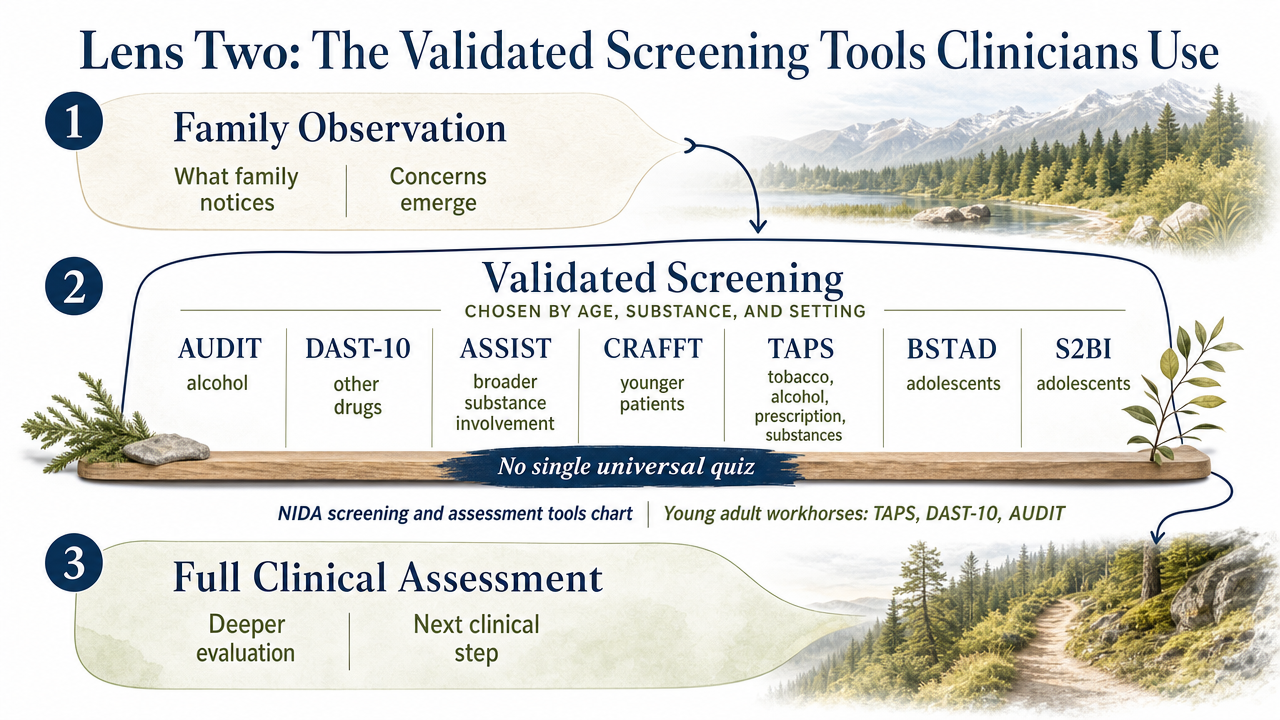
Here is where the phrase "drug addiction test" starts to have real meaning, though not the kind most search results promise. Clinicians don't reach for one universal quiz. They pull from a shelf of validated instruments, each designed for a different age, substance, or setting.
NIDA maintains the working shelf. Its Screening and Assessment Tools Chart organizes options by substance type, age group, and administration method, and it includes the names you'll see referenced most often in Oregon addiction treatment settings: AUDIT for alcohol, DAST-10 for other drugs, ASSIST for a broader picture of substance involvement, CRAFFT for younger patients, TAPS as a combined tobacco-alcohol-prescription-substance screen, and BSTAD and S2BI for adolescents. For a young adult child, TAPS and DAST-10 tend to be the workhorses, with AUDIT layered in when alcohol is part of the picture.1
These are meant to be used in stages, not administered all at once. A clinician typically starts with a brief screen. The NIDA Single Question, for example, asks:
"How many times in the past year have you used an illegal drug or used a prescription medication for non-medical reasons?"14
A non-zero answer opens the door to a fuller instrument like the DAST-10, a ten-item self-report covering drug use in the previous twelve months, or the ASSIST, an eight-question assessment of risky substance use across categories. Older NIDA materials referenced NMASSIST for this fuller pass; current practice has largely shifted to TAPS, which combines the brief and full screens into one flow.1,3,14
A fair question is why you shouldn't just print DAST-10 off the internet and hand it across the table. Two reasons. First, NIDA is explicit that these tools are designed to be used by trained professionals with patients, because scoring, interpretation, and next steps depend on clinical judgment as much as the answers. Second, self-administered at home under the pressure of a parent's worry, the same questionnaire measures something closer to trust in the room than actual substance use.2
From noticing to knowing: a three-tier pathway from family observation (SAMHSA warning signs) to validated screening (NIDA Quick Screen, DAST-10, TAPS, AUDIT, CRAFFT, ASSIST), to full clinical assessment (ASAM level of care, DSM-5 diagnosis, co-occurring evaluation).1,3,141,8
Your job in Lens Two is not to score your child. It's to know these tools exist so that when you call a provider, you can ask which ones they use and roughly what to expect.
Lens Three: What a Full Clinical Assessment Actually Includes
A full assessment is where a positive screen becomes a plan. It is also where most parents feel their shoulders drop for the first time in months, because someone qualified is finally holding the pen.
Expect a conversation, not a bubble sheet. A licensed clinician will spend somewhere between sixty and ninety minutes with your adult child in a structured interview that pulls in the screening results, a substance use history, medical history, family history, mental health history, and current functioning at work, school, and home. In Oregon, and in most states following the same clinical standard, two anchors do the heavy lifting. The first is a DSM-5 diagnostic review, which determines whether a substance use disorder is present and, if so, whether it is mild, moderate, or severe. The second is an ASAM level-of-care determination, which matches the person to the intensity of treatment they actually need, from outpatient counseling up through residential care.4
Biological testing usually plays a supporting role, not a starring one. A urinalysis or EtG panel can confirm recent use of specific substances and can be used to track progress once treatment begins, but it is not what makes the diagnosis.4
A good assessment also looks past substance use itself. CDC notes that substance use disorders travel closely with anxiety, depression, and elevated suicide risk, which is why comprehensive evaluations screen for co-occurring mental health conditions rather than treating substance use in isolation. If your adult child has ever mentioned a therapist, a diagnosis, a prescription, or a hard patch after a loss, bring that up. It shapes the plan.11
You will leave with something concrete: a diagnosis or the ruling out of one, a recommended level of care, and usually a referral. That is the destination the first two lenses were pointing toward all along.
Real Recovery Starts in Portland, Oregon
Call now or verify insurance to take the first step toward lasting recovery in Portland.
Moving From Suspicion to a Real Evaluation
The distance between "I think something is wrong" and "we have an appointment on Thursday" is where most families get stuck. Your adult child is legally their own person. You cannot compel a screening, and a badly timed confrontation can push them further away from the help they need. That's the terrain. It's real, and it's workable.
Start with the conversation, not the referral. Pick a sober hour, a private place, and lead with what you have seen rather than what you have concluded. "I noticed three missed shifts and you seemed different at Thanksgiving" lands differently than "I think you have a problem." You are not diagnosing; you are naming a pattern and asking them to talk to someone qualified. Bring the notes you kept from Lens One. Specifics de-escalate arguments faster than adjectives do.
Offer a concrete first step, not an ultimatum. That usually means a call to a primary care provider or a substance use clinician who can do a brief screen using a validated instrument like the TAPS or DAST-10, then move into a fuller assessment if the screen is positive. If your adult child agrees, offer to make the appointment while they're in the room. Momentum matters more than a perfect plan.1,14
If they refuse, you still have moves. Consult a clinician yourself about what you're observing, especially if overdose risk is on the table; CDC frames early identification and linkage to evidence-based treatment as core to overdose prevention. In Oregon, a formal intervention model (Arise, Johnson) run by a trained professional can bridge refusal and evaluation without the ambush dynamic that families dread. The goal is not to trick your adult child into a chair. It's to make the next honest step easier to take than avoiding it.12
When Legal Trouble Arrives: The Oregon DUII Pathway
If a DUII is what brought this whole conversation to your kitchen table, you are not alone, and the state has a defined process waiting for you. It is not gentle, but it is structured, and structure is useful when everything else feels chaotic.
Here is how it unfolds in Oregon:1,4,17
- After a DUII arrest, the court refers your adult child to an Alcohol and Other Drug Screening Specialist, known as an ADSS, who conducts an initial screening interview.
- That screening is not the final word. It routes the case to a designated DUII service provider, who performs a full diagnostic assessment: an ASAM-consistent level-of-care determination paired with a DSM-5 review to confirm or rule out a substance use disorder.
- From there, the provider assigns your adult child to either DUII Education, for cases without a diagnosed disorder or with lower severity, or DUII Rehabilitation, for cases where treatment is clinically indicated.
- Regular urinalysis and EtG testing continue throughout, on schedules and panels defined by Oregon Administrative Rules, to verify progress and hold the plan accountable.
The Oregon DUII pathway: arrest → ADSS screening interview → DUII service provider diagnostic assessment with ASAM level of care and DSM-5 confirmation → DUII Education or DUII Rehabilitation → ongoing UA/EtG monitoring aligned with Oregon Administrative Rules, set inside the state's broader impaired driving reduction strategy.4,5,17
A few things are worth knowing as a parent watching this move. The DUII assessment is not adversarial in the way the arrest was. The evaluator's job is to match your adult child to the right level of care, and Oregon has built its impaired driving strategy around linking enforcement to treatment rather than punishment alone. Honesty at the assessment helps; minimizing use tends to produce a plan that does not fit the actual problem, which then fails, which then compounds legal exposure.
You also do not have to be silent. Ask which provider was designated, ask what level of care was recommended, and ask what the testing schedule looks like. Your adult child still holds the pen on their own health information, but many providers welcome family involvement when the client consents, and Oregon's system was built with that door open. A DUII is a hard doorway. It is also, for many families in the Pacific Northwest, the first time a clinician has ever laid eyes on the pattern you have been watching for years.
Co-Occurring Mental Health: The Part Most Home Quizzes Skip
If your adult child has been quietly carrying anxiety, depression, or unresolved trauma alongside the substance use, you probably sensed that too. Most online "drug addiction tests" ignore this entirely, which is one of the reasons they fail families like yours.
Substance use disorders rarely travel alone. CDC notes that people with substance use disorders face elevated risk for anxiety, depression, and suicidality, which is why any credible clinical evaluation looks at both sides of the ledger rather than treating substance use as an isolated behavior. Early identification of that overlap is also part of how CDC frames overdose prevention, because untreated mental health conditions often drive the escalation families see.11,12
What this means in practical terms: when you call a provider, ask whether their assessment screens for co-occurring conditions and how they handle treatment when both are present. If your adult child has ever mentioned panic, insomnia, a past diagnosis, a prescription that got abandoned, or a stretch of grief that never lifted, say so. That single piece of information often reshapes the plan more than any lab result will.
What a Serious Response Actually Costs
One of the quieter reasons parents stall out on getting help is money. You are not shallow for thinking about it. You are running a household, and you have watched enough late-night ads for treatment centers to know that some of them cost more than a year of college. It helps to see what the research actually shows before you price anything.
The cheapest end of a serious response is not free, but it is closer to reasonable than most families expect. A 2024 CDC economic analysis of family-based interventions designed to prevent youth substance use found a median cost of $655 to $1,672 per family across the studies reviewed. That is the range for structured, evidence-based family programs, not a single therapy session or a wellness app. The same body of evidence found that societal benefits exceeded costs across every source examined, which is a rare thing to be able to say about any category of health spending.7,16
Once a substance use disorder is already present and treatment is clinically indicated, the numbers move. A peer-reviewed cost-effectiveness study of four adolescent SUD interventions reported total annual economic costs ranging from $9,471 per participant for a group-only condition to $25,743 per participant for a joint family-and-group condition. That is a real spread, and it reflects intensity, staffing, and how much family programming is layered in. The study is scoped to adolescents, so treat those figures as a directional benchmark for young-adult care rather than a quote.9
What a serious response actually costs: median family-based prevention runs $655–$1,672 per family , while active adolescent SUD treatment ranges from $9,471 per participant per year for a group-only model to $25,743 for a joint family-and-group model.7,9,16
Hold those numbers next to the free online quiz you almost took at midnight. The quiz costs nothing and tells you nothing. A structured evaluation and a plan cost real money and change the trajectory. In Oregon, insurance, Oregon Health Plan coverage, and DUII-related fee structures often absorb a meaningful share of assessment and treatment costs, so ask any provider you call to walk you through what your specific coverage handles before you assume the sticker price is what you'll pay.
Why Family Involvement Changes the Outcome
You may have been told, gently or otherwise, that your adult child's recovery is not your project. That is true in one sense and misleading in another. You cannot do the work for them. You can absolutely change the odds that the work happens at all.
The evidence on this is unusually consistent. A 2024 systematic review of family intervention models for young adults with substance use problems found that family-based approaches were associated with reductions in substance use and behavioral problems, along with measurable improvements in family functioning. The peer-reviewed literature on adolescents reaches a similar conclusion, describing family interventions as among the most effective prevention and treatment approaches for substance use and related developmental problems. The CDC-affiliated Community Preventive Services Task Force went further, formally recommending family-based interventions after finding reductions in initiation and use across alcohol, cannabis, tobacco, and misused prescription drugs.6,8,10,15
What this looks like in practice for a parent of an adult child is narrower than a full family therapy curriculum. It means showing up for the family sessions a treatment program offers, learning the difference between support and enabling, and being willing to change some of your own patterns when a clinician names them. It also means staying in the picture during the long tail after the acute phase ends, when relapse risk is highest and attention from everyone else has moved on.
Your involvement is not a substitute for treatment. It is what makes treatment stick.
Where This Leaves You Tonight
If it is still late and the house is quiet, here is what you actually have in your hands. You have a set of observations that matter. You have the names of the tools a clinician will use, so the intake call will not feel like a foreign language. You have a picture of what a real evaluation looks like, including the Oregon DUII pathway if that is where you find yourselves. And you have the research showing that your involvement, held steady over time, changes what happens next for your adult child.10
The next move is small. One call to a provider. One honest conversation. One appointment on the calendar. That is how families in Portland, Central Oregon, and across the Pacific Northwest start most recovery stories, including the ones that hold.
Frequently Asked Questions
Is there a single drug addiction test I can give my adult child at home?
No, and any product that promises otherwise is overselling what a single instrument can do. A substance use disorder is a clinical diagnosis that comes from a structured evaluation combining a screening tool, a clinical interview, and a DSM-5 review, not from a home quiz or a urine strip. What you can do at home is track patterns of change and bring those observations to a clinician.2,14
What screening tools do clinicians actually use to assess substance use?
For young adults, the workhorses are TAPS, DAST-10, and AUDIT, often preceded by a brief opener like the NIDA Single Question about past-year use of illegal drugs or non-medical prescriptions. NIDA's Screening and Assessment Tools Chart also lists ASSIST for broader substance involvement and CRAFFT, BSTAD, and S2BI for younger patients. Positive brief screens lead into fuller assessments, not straight to a diagnosis.1,3,13
How do I move from suspicion to getting my adult child a real evaluation?
Start with a specific, low-heat conversation grounded in what you have actually seen, then offer a concrete first step: a call to a primary care provider or substance use clinician who can run a brief screen and, if warranted, a full assessment. If your adult child refuses, consult a clinician about your own observations, especially where overdose risk is a factor, since early linkage to evidence-based treatment is central to prevention. A trained interventionist can also help bridge refusal without an ambush.12,14
What happens during a DUII assessment in Oregon?
After a DUII arrest, the court refers your adult child to an Alcohol and Other Drug Screening Specialist for an initial screening interview, then to a designated DUII service provider for a full diagnostic assessment. That assessment includes an ASAM-consistent level-of-care determination and a DSM-5 review to confirm or rule out a substance use disorder, along with ongoing urinalysis and EtG testing. From there, the provider assigns DUII Education or DUII Rehabilitation.4,17
Will a clinical assessment also look at mental health, not just substance use?
A good one will. CDC notes that substance use disorders travel closely with anxiety, depression, and elevated suicide risk, so credible evaluations screen for co-occurring conditions rather than treating substance use in isolation. Ask any provider you call whether their intake covers mental health, and mention any past diagnoses, prescriptions, or hard emotional stretches when you schedule. That context often reshapes the treatment plan.11
Does family involvement really make a difference for an adult child?
Yes, and the evidence extends beyond adolescents. A 2024 systematic review of family intervention models for young adults with substance use problems found reductions in substance use and behavioral problems along with improved family functioning. Peer-reviewed adolescent research reaches a similar conclusion, describing family-based approaches as among the most effective prevention and treatment models. Your steady presence, held over time, is what helps treatment stick.8,10
References
- Screening and Assessment Tools Chart. https://nida.nih.gov/nidamed-medical-health-professionals/screening-tools-resources/chart-screening-tools
- Screening Tools and Prevention. https://nida.nih.gov/nidamed-medical-health-professionals/screening-tools-prevention
- NIDAMED: Resources for Medical and Health Professionals. https://nida.nih.gov/sites/default/files/pdf/nidamed_one_page_flyer.pdf
- DUII Services Providers. https://www.oregon.gov/oha/BH/Providers/Pages/DSP.aspx
- Oregon Impaired Driving Strategic Plan. https://www.oregon.gov/odot/Safety/Documents/Impaired_Driving_Strategic_Plan_06-2024.pdf
- Substance Use: Family-based Interventions to Prevent Substance Use Among Youth. https://stacks.cdc.gov/view/cdc/168597
- Family-Based Interventions to Prevent Substance Use Among Youth: Cost–Benefit Analysis. https://stacks.cdc.gov/view/cdc/168597/cdc_168597_DS12.pdf
- Family-Based Interventions for the Prevention of Substance Use and Other Behavioral Disorders in Adolescence. https://pmc.ncbi.nlm.nih.gov/articles/PMC4392980/
- Cost-Effectiveness Analysis of Four Interventions for Adolescents with a Substance Use Disorder. https://pmc.ncbi.nlm.nih.gov/articles/PMC2323204/
- Family Intervention Models for Young Adults with Substance Abuse: A Systematic Review. https://pubmed.ncbi.nlm.nih.gov/39564277/
- Substance Use and Mental Health. https://www.cdc.gov/mentalhealth/substance-use/index.html
- Drug Overdose Prevention. https://www.cdc.gov/drugoverdose/prevention/index.html
- Adolescent Substance Use Screening Tools. https://nida.nih.gov/nidamed-medical-health-professionals/screening-tools-prevention/screening-tools-adolescent-substance-use/adolescent-substance-use-screening-tools
- Table 1 – Summary of Substance Use Screening Tools. https://pmc.ncbi.nlm.nih.gov/articles/PMC11410345/table/T1/
- Substance Use: Family-based Intervention to Prevent Substance Use among Youth. https://odphp.health.gov/healthypeople/tools-action/browse-evidence-based-resources/substance-use-family-based-intervention-prevent-substance-use-among-youth
- Family-Based Interventions to Prevent Substance Use Among Youth: Cost–Benefit Analysis. https://pubmed.ncbi.nlm.nih.gov/40252864/
- DUII Services – Oregon Health Authority. https://www.oregon.gov/oha/hsd/amh-duii/pages/services.aspx
- Substance Use and Suicide: A Nexus Requiring a Public Health Approach. https://library.samhsa.gov/sites/default/files/sma16-4935.pdf
- Alcohol Screening and Brief Intervention for Youth: A Practitioner’s Guide. https://www.niaaa.nih.gov/alcohols-effects-health/professional-education-materials/alcohol-screening-and-brief-intervention-youth-practitioners-guide
Relapse Doesn't Mean the End Of Your Journey
Reach out today to explore programs that support real, long-term sobriety.