


Co-Occurring Disorder Treatment Options in Oregon

Key Takeaways
- Oregon rebuilt its behavioral health system around integrated care because 69% of people in substance use treatment also have a co-occurring mental health condition 1.
- House Bill 2086 and the January 2023 Oregon Health Plan rule now fund co-occurring treatment as one service delivered by one team under one plan 3.
- Program quality varies sharply by geography, with only 42% of outpatient and 33% of residential substance use programs treating co-occurring conditions, and 32 of 36 counties short on mental health providers 1, 11.
- Before committing to an Oregon program, ask whether intake, treatment plan, therapies, and team coordination are truly integrated, and confirm validation under the state's co-occurring billing model 3.
Leaving Detox With Two Diagnoses and One Exhausted Nervous System
The hardest part of detox is often what comes right after it.
Your body has done something enormous. The substances are out. The acute crisis is over. And now you're sitting with a nervous system that feels raw, a mind that won't stop running, and a diagnosis (or two) that suddenly has nowhere to hide. Perhaps it's the anxiety you were quieting with alcohol, the depression that grew heavier every year, or trauma you haven't addressed directly in a long time.
If you're reading this from a hospital room, a detox bed at a partner facility like Pacific Crest Trail Detox, or a couch in Portland at 2 a.m., take a breath. You are exactly where many Oregonians have stood before you.
This article will guide you through what integrated co-occurring disorder treatment actually looks like in Oregon, why the state rebuilt its system around treating both conditions together, and how to determine if a program can truly address both aspects of your health. Not two providers passing notes, but one comprehensive plan and one unified team.
You've already taken the hardest first step. The next one is choosing the right kind of care, and you have more options in Oregon than you did even three years ago.
Why Integrated Care Became the Standard in Oregon
The Prevalence of Co-Occurring Conditions in Oregon
If you've ever felt like you were the only person leaving detox with two diagnoses instead of one, please understand: you are in the majority, not the exception.
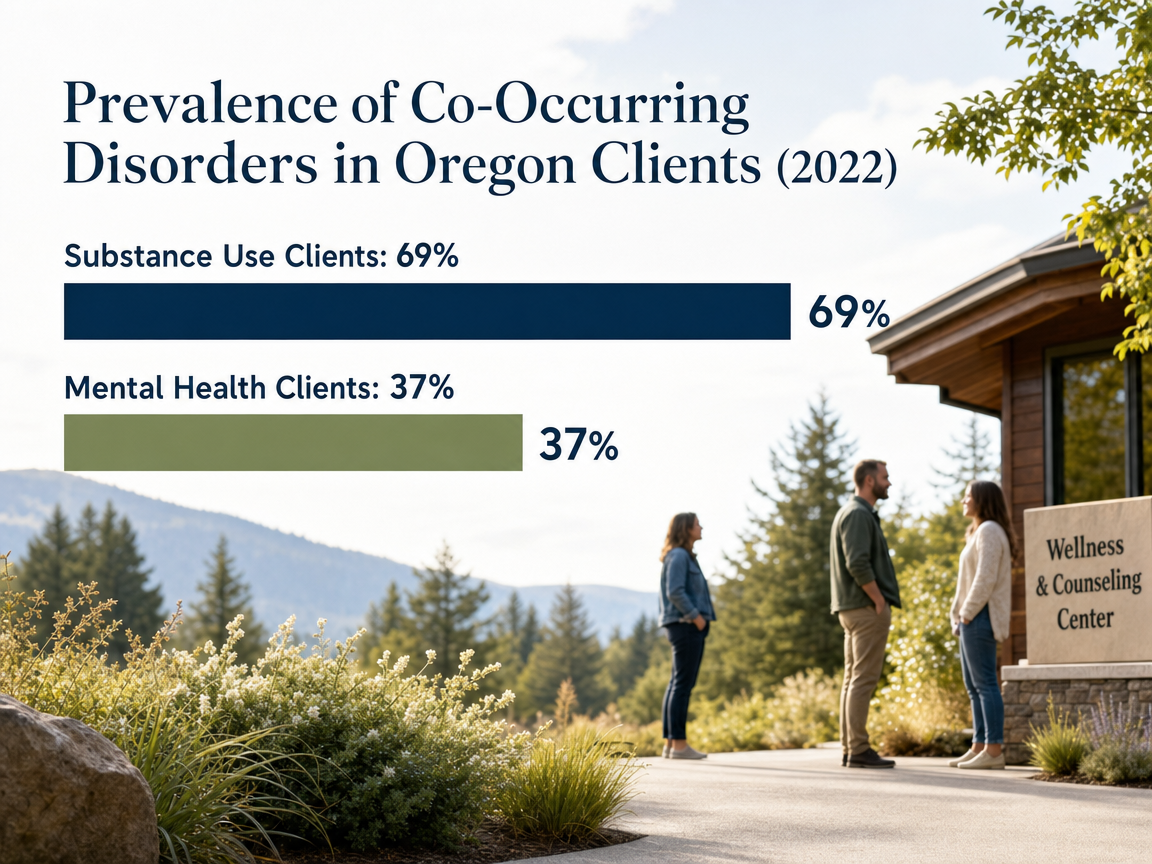
In 2022, the Oregon Health Authority examined treatment trends across the state. They found that 69% of people in Oregon substance use treatment also had a co-occurring mental health condition. Conversely, 37% of mental health clients also had a substance use disorder 1. This significant overlap indicates that for most individuals seeking care, both conditions are present.
Consider these numbers in the context of your own experience. The anxiety that made a drink feel like the only off-switch, the depression that intensified with every attempt to quit, or the trauma that never found resolution—these are not secondary issues. For most Oregonians in treatment, they are central to their story.
Historically, the system treated these as separate problems, managed by different professionals in different settings. You might finish detox, receive a referral to a therapist with a six-week waiting list, and struggle to cope in the interim. If this has been your experience, it wasn't a failure on your part; the system itself was flawed.
Oregon has been working to change this for several years, largely driven by these statistics. When the majority of people seeking care require simultaneous treatment for both conditions, separating them becomes a barrier to effective care, rather than a clinical choice.
You deserve care that addresses your complete needs.
The Policy Shift: HB 2086 and the 2023 Integrated Billing Rule
Here's a crucial detail most people don't know, but it directly impacts you.
Oregon lawmakers passed House Bill 2086 to rectify a specific issue. Previously, a provider treating both your substance use and anxiety in the same session could only bill for one. This created a financial incentive for programs to specialize: treat addiction and refer out mental health, or vice versa. HB 2086 mandated that the Oregon Health Authority reimburse co-occurring disorder treatment at an enhanced rate and establish a single payment model for integrated care 2.
Effective January 1, 2023, this model was implemented. The Oregon Health Plan now covers integrated treatment of co-occurring disorders as a single service, delivered by one qualified provider team, under one comprehensive plan of care 3. In simpler terms: the state stopped incentivizing programs to keep the two halves of your recovery separate.
Why is this significant for you, right now?
It means that when you contact an Oregon program equipped for integrated co-occurring care, you're not asking for a special favor or for your mental health to be an afterthought in an addiction program. You are requesting the precise service the state established a payment model to support. Your anxiety, depression, or trauma is not an add-on; it is an integral part of the treatment plan from day one.
Policy has finally aligned with what individuals leaving detox have expressed for years. This represents genuine progress, and it is designed to support your recovery.
One Plan vs. Two Providers: The Choice That Changes Recovery
Imagine two different scenarios for your next six months.
In the first, you complete detox and receive a list of phone numbers. One for an outpatient substance use program meeting Tuesdays and Thursdays. Another for a therapist with an opening in five weeks. A third for a psychiatrist who might see you in July for a medication review. Three intake forms, three different inquiries about your history, and three professionals who don't communicate with each other. When your anxiety escalates on a Sunday night, none of them are the person you call, so you call no one.
In the second scenario, you enter one program. A single clinical team conducts the intake, discussing both your substance use and mental health in the same conversation. Your treatment plan addresses both conditions on the same page. If your CBT therapist observes your sleep deteriorating, they communicate with the person managing your medication support that same week. When you share about a panic attack in group, no one makes you feel out of place.
This second version exemplifies integrated care. It's not just a philosophy; it's a practical reality.
This choice is central to your next decision, and it aligns with SAMHSA's long-standing guidance for co-occurring care: one team, one plan, coordinated response 13. When substance use and mental health are treated as interconnected, relapse triggers are identified sooner, medication adjustments are made with a holistic view, and you are no longer solely responsible for managing your own care during challenging times.
The two-provider path isn't a reflection of your lack of effort. It's what happens when the system expects you to manage everything yourself.
You don't have to.
What Good Co-Occurring Care Actually Includes
Integrated Screening, Assessment, and a Single Treatment Plan
Effective co-occurring care begins before you even start therapy. It starts at the initial point of contact.
When you first engage with an Oregon program that treats both conditions, the intake conversation should cover your substance use history and your mental health history concurrently, with the same clinician, using the same forms. This means one comprehensive conversation that treats your anxiety, depression, or trauma symptoms as clinically equal to your substance use, rather than separate assessments or a tacked-on mental health check.
SAMHSA's guidance is clear: screening and assessment for co-occurring disorders should be integrated, not sequential, to ensure the treatment plan addresses both conditions from the outset 12. TIP 42 further advocates for a single, unified plan of care that identifies each diagnosis, sets goals for both, and outlines how symptoms interact 13.
In practice, this means your plan should detail your medication support needs, the therapy modalities to be used, how relapse triggers relate to mental health symptoms, and who on the team is responsible for each aspect of your care. One document, one weekly team meeting about your progress. This is the standard to expect from any Oregon program.
Key Therapies for Co-Occurring Conditions
You don't need an exhaustive list of therapy acronyms. You need the specific approaches that effectively address both conditions simultaneously.
Cognitive Behavioral Therapy (CBT) helps you identify and interrupt thought patterns that fuel both cravings and anxious spirals. Learning to challenge thoughts like "I can't handle this feeling" addresses both substance use and anxiety concurrently.
Dialectical Behavior Therapy (DBT) provides practical skills for challenging moments in recovery: distress tolerance for panic attacks, emotion regulation for depressive lows, and interpersonal skills for difficult family conversations.
Seeking Safety is a trauma-informed therapy designed for individuals managing PTSD and substance use simultaneously, without requiring you to prioritize one over the other.
Motivational Interviewing engages with your ambivalence about change without judgment.
These four therapies are supported by federal integrated-treatment guidelines that Oregon programs are expected to follow 13. When you contact a program, inquire which of these they utilize and how frequently. A specific answer is a good sign; a vague one suggests you should continue your search.
How to Vet an Oregon Program in Ten Minutes
You don't need a clinical background to determine if a program can effectively treat both aspects of your health. You need five targeted questions and the patience to listen for specific responses.
Here are five questions to ask during any intake call:
"Do you assess for mental health conditions and substance use in the same intake, with the same clinician?" A reputable program will answer yes without hesitation.
"Will I have one treatment plan that addresses both conditions, or two separate plans?" The answer should be one unified plan.
"Which therapies do you use for co-occurring care?" Listen for specific mentions of CBT, DBT, Seeking Safety, or motivational interviewing.
"How does your team coordinate when my symptoms change?" You want to hear about weekly team meetings and shared patient records, not "we'll refer you out."
"Are you a validated integrated co-occurring disorders provider under the Oregon Health Plan model?" A yes here confirms the program meets the state's integrated billing standard 3.
If a program struggles with more than one of these questions, continue your search. You are not being overly particular; you are being precise about what your recovery truly requires.
Real Recovery Starts in Portland, Oregon
Call now or verify insurance to take the first step toward lasting recovery in Portland.
Access, Geography, and the Continuum From Detox Forward
Treatment Access Across Oregon
Your location in Oregon influences what's within driving distance, but it should not dictate the quality of care you receive.
The Portland metro area offers the widest selection of integrated co-occurring programs, licensed outpatient providers, and residential beds. However, access becomes more challenging outside the I-5 corridor. Oregon's 2025 workforce assessment revealed that 32 of the state's 36 counties lack even one mental health provider per 1,000 residents 11. If you reside in Bend, Coos Bay, Klamath Falls, Pendleton, or other rural areas, finding a therapist and a substance use provider who collaborate can be difficult.
This is precisely where integrated care is most vital. When one team manages both aspects of your plan, you make one journey, not three. Many Portland-based programs, including Oregon Trail Recovery, support individuals who relocate for residential or intensive outpatient care and then transition to a level of care suitable for their home community.
If you live in a rural area, consider coming to Portland for the initial phase of treatment. The distance is a factor, but the benefits of a coordinated team are significant.
The Pacific Crest Trail Detox to Oregon Trail Recovery Handoff
Detox and subsequent care are distinct licensed services in Oregon, and understanding this helps you plan your next 30 days realistically.
Under Oregon's licensing structure, withdrawal management and residential treatment are separate categories overseen by the Behavioral Health Division 4. This is why most people do not receive medical detox and long-term recovery care under the same roof. It's a licensing reality, not a deficiency in your provider's commitment.
Here's how the transition works in practice. Pacific Crest Trail Detox provides medically supervised withdrawal, ensuring your safety during physical stabilization. Oregon Trail Recovery then continues your care with gender-specific residential programs, intensive outpatient programming, sober living, and co-occurring mental health treatment integrated with your substance use plan. This partnership involves two licenses but offers a continuous arc of care.
What should differentiate this from a cold referral is the coordination. Your intake at Oregon Trail Recovery should acknowledge your detox experience, not start from scratch. Your medications, symptoms, and initial insights into underlying anxiety or depression should all be carried forward.
One warm handoff, not a stack of phone numbers and a wish of good luck.
The First 30 Days After Detox: Integrated Treatment in Action
No one tells you that the first week after detox can feel more challenging than the week before.
Your sleep may be erratic, your appetite unpredictable. The anxiety you once suppressed now weighs on you at 4 a.m., and the depression previously masked by substance use emerges in daylight. This is not a sign that treatment is failing; it's a sign that your nervous system is beginning to heal and process emotions more openly.
Here's what the first 30 days can look like in an integrated Oregon program.
Week one focuses on establishing anchors. Small, consistent routines. A morning check-in with your group. A walk outdoors before noon. A meeting with your therapist to develop a shared plan that addresses both substance use and mental health. In gender-specific residential care, this might be as simple as sitting at the same breakfast table with the same individuals for seven consecutive days. This repetition provides stability.
By week two, therapy begins to resonate. CBT provides language for recurring thought patterns. If trauma is part of your experience, Seeking Safety introduces coping skills before delving into difficult memories. Medication support, if part of your plan, is adjusted based on real-time observations from your team, not assumptions made weeks prior in a different setting.
Week three often brings honesty. Cravings may emerge, as do the deeper feelings beneath them. In an integrated program, when a craving intensifies on a Wednesday afternoon, the same team familiar with your depression history is there to support you. No one is starting from zero.
By week four, you establish a rhythm. Not a cure, but a sustainable pattern. You learn which skills to employ when panic arises. You know who to contact when depression tries to convince you that you are a burden. You develop a relapse prevention plan that considers your mental health symptoms as triggers requiring careful planning, precisely as SAMHSA's guidance for integrated care recommends 13.
Thirty days in, you are not "fixed." You are supported. That is the crucial difference.
Progress Is Real: Overdose Trends and What They Signal
Recovery is a personal journey, but you are not undertaking it in isolation. Current trends across Oregon are relevant to your story.
For years, overdose numbers in this state consistently increased. That trend has begun to reverse. Oregon reported 1,833 overdose deaths in 2023, which dropped to 1,544 in 2024. Preliminary data for 2025 indicates a further reduction to approximately 1,100 10. While these numbers still represent significant loss, the sustained decline is the first in a long time.
Why is this relevant to co-occurring care? Because the policy shifts that enabled integrated treatment in 2023, the increasing residential capacity, and the expansion of naloxone, outreach, and warm handoffs from detox to recovery are all contributing factors to fewer Oregonians dying. Integrated co-occurring care is one component of a system that is slowly, imperfectly, but effectively improving.
The fact that you are reading this means people are choosing treatment that addresses the whole person. You would be joining a movement, not walking alone.
Hold onto that hope.
A Warm Handoff: Calling Oregon Trail Recovery
If you've read this far, you already know what you're seeking: one team, one plan, and a program that treats your anxiety, depression, or trauma alongside your substance use as part of the same narrative, not separate issues.
Oregon Trail Recovery in Portland offers this continuum of care for individuals transitioning from detox at Pacific Crest Trail Detox or other Oregon facilities. We provide gender-specific residential care, intensive outpatient programming that accommodates work or school schedules, sober living options, and co-occurring mental health treatment integrated into your substance use plan through therapies like CBT, DBT, Seeking Safety, and motivational interviewing.
Making the call is the next small step. Not the entire journey, just the next one.
When you call, use the questions from earlier in this article. Listen for specific answers. If it feels like a good fit, proceed. If not, you now know what to look for elsewhere in Oregon.
You've already accomplished the hardest part. The next call can be a supportive one.
Frequently Asked Questions
What are co-occurring disorders, and how do I know if I have one?
Co-occurring disorders mean you are experiencing both a substance use disorder and a mental health condition simultaneously, most commonly anxiety, depression, or trauma-related symptoms. You don't need a formal diagnosis to explore this. If your drinking or drug use has been intertwined with your emotional state, an integrated intake assessment can clarify this in one conversation 12.
Does Oregon Health Plan cover integrated co-occurring disorder treatment?
Yes. Since January 1, 2023, the Oregon Health Plan has covered integrated treatment of co-occurring disorders as a single service, delivered by one qualified provider team under one plan of care 3. When you request integrated care, you are not asking for a favor; you are requesting a service the state has established a payment model to support, ensuring both conditions are treated together.
What's the difference between going to one program versus seeing separate providers for mental health and substance use?
One integrated program means a single intake, one comprehensive treatment plan, and a unified team that coordinates your therapy, medication support, and crisis response. Separate providers typically involve multiple intakes, different schedules, and a lack of a complete picture when challenges arise. Federal guidance supports the integrated model because the symptoms of both conditions interact, and treating them together allows for early intervention 13.
Do I need to complete detox before starting co-occurring disorder treatment in Oregon?
For many substances, medically supervised withdrawal is a necessary first step to stabilize your body before therapy can be effective. In Oregon, withdrawal management is a separately licensed service 4, which is why Oregon Trail Recovery partners with Pacific Crest Trail Detox for this phase. Once you are medically stable, co-occurring care seamlessly continues your journey without requiring you to restart your story from the beginning.
What should I ask an Oregon program to confirm they actually treat both conditions together?
Ask these five questions: Do you assess mental health and substance use in the same intake? Will I have one treatment plan that names both conditions? Which co-occurring therapies do you use (listen for CBT, DBT, Seeking Safety, motivational interviewing)? How does your team coordinate week to week? Are you a validated integrated co-occurring disorders provider under the Oregon Health Plan model 3?
Can I get co-occurring care if I live outside the Portland metro area?
Yes, though it may require additional planning. Oregon's 2025 workforce assessment found that 32 of the state's 36 counties lack adequate mental health provider access 11, meaning rural options are more limited. Many individuals from Central Oregon, the coast, and eastern counties travel to Portland for residential or intensive outpatient care, then transition to a local level of support once a solid plan is established.
References
- Oregon inventory of services for co-occurring substance use and mental health disorders, 2022. https://www.oregon.gov/oha/HSD/AMH/DataReports/COD-Service-Inventory-2022.pdf
- Oregon Health Authority : Integrated Co-occurring Disorders. https://www.oregon.gov/oha/hsd/amh/pages/co-occurring.aspx
- Integrated Co-Occurring Disorders Billing Guide. https://www.oregon.gov/oha/HSD/AMH/docs/ICD-Billing-Guide.pdf
- Oregon Health Authority : Licensing and Certification : Providers. https://www.oregon.gov/oha/BH/Providers/Pages/Licensing-Certification.aspx
- Substance Use Disorder Integration Report. https://www.oregon.gov/oha/HSD/AMH/DataReports/SUD-Integration-Report.pdf
- Oregon Behavioral Health Residential+ Facility Study. https://www.oregon.gov/oha/HSD/AMH/DataReports/Behavioral-Health-Residential-Facility-Study-June-2024.pdf
- 2025 Regular Session – Behavioral Health. https://www.oregonlegislature.gov/lpro/Publications/Behavioral_Health_Session_Brief_2025.pdf
- House Bill 2059. https://olis.oregonlegislature.gov/liz/2025r1/Downloads/MeasureDocument/HB2059/A-Engrossed
- 2025 - Opioids and the Ongoing Drug Overdose Crisis in Oregon. https://www.oregon.gov/oha/PH/PREVENTIONWELLNESS/SUBSTANCEUSE/OPIOIDS/SiteAssets/Lists/feature/EditForm/2025%20Oregon%20Opioid%20Overdose%20Report.pdf
- Oregon overdose deaths declined in 2024, 2025. https://www.oregon.gov/oha/erd/pages/oregon-overdose-deaths-declined-in-2024-2025-05.13.2026.aspx
- Oregon Behavioral Health Talent Assessment. https://www.oregon.gov/workforceboard/data-and-reports/Documents/2025-Oregon-Behavioral-Health-Talent-Assessment-Report-final.pdf
- Advisory: Substance Use Disorder Treatment for ... - SAMHSA. https://www.samhsa.gov/resource/ebp/advisory-substance-use-disorder-treatment-people-co-occurring-disorders-based-tip-42
- TIP 42: Substance Use Treatment for Persons With Co-Occurring Disorders. https://library.samhsa.gov/product/tip-42-substance-use-treatment-persons-co-occurring-disorders/pep20-02-01-004
Relapse Doesn't Mean the End Of Your Journey
Reach out today to explore programs that support real, long-term sobriety.