


Your Guide to Out-of-State Rehab for Idaho Residents

Key Takeaways
- Idaho's publicly funded substance use care runs through a single contracted private network, and roughly three of four Idahoans who need treatment go without it in a given year 2.
- Statewide treatment capacity has actually shrunk, with single-day enrollment dropping from 6,287 in 2015 to 5,634 in 2019, even as need continued to grow 6.
- Amphetamines lead Idaho's primary-substance admissions at 35.6% 3, so a Portland program should be vetted specifically on how it treats stimulant use disorder and polysubstance patterns.
- Portland sits about seven hours west on I-84, Oregon law allows out-of-state admission 10, and an Oregon DUII requires an ADSS referral and residency documentation before enrollment 7.
Why the Next Step After Detox Often Points West
If you're reading this from Boise, Coeur d'Alene, Nampa, Twin Falls, or somewhere quieter along the Panhandle, you've probably already run into the same wall. You called around for a bed. You waited on a call back that took days. You were told the IOP slot opens next month, maybe. And you're standing at the end of detox, or watching someone you love standing there, knowing that early sobriety is not a moment to wait through.
Here's the honest part: Idaho's treatment system is small, and it was built small on purpose. Substance use disorder services in the state are delivered through a single contracted private network overseen by a managed services organization 5. That structure has real strengths, but it also means capacity is finite, and a lot of Idahoans who need care simply do not receive it in-state.
So people look west. Portland sits at the far end of I-84, roughly seven hours from the Treasure Valley, and it holds one of the densest clusters of Pacific Northwest addiction treatment programs within reach of an Idaho driver's license. That drive isn't nothing. But if you've just finished medical detox and the next thirty days will decide a lot, a structured post-detox environment across the state line can be a practical, clinical answer, not a dramatic one.
This guide walks through what you're actually choosing between, and what to expect if you point the car west.
The Idaho Treatment Gap Isn't Your Imagination
How Many Idahoans Actually Get Care
If you've been feeling like the system is stacked against you, it's not just a feeling. The numbers back you up.
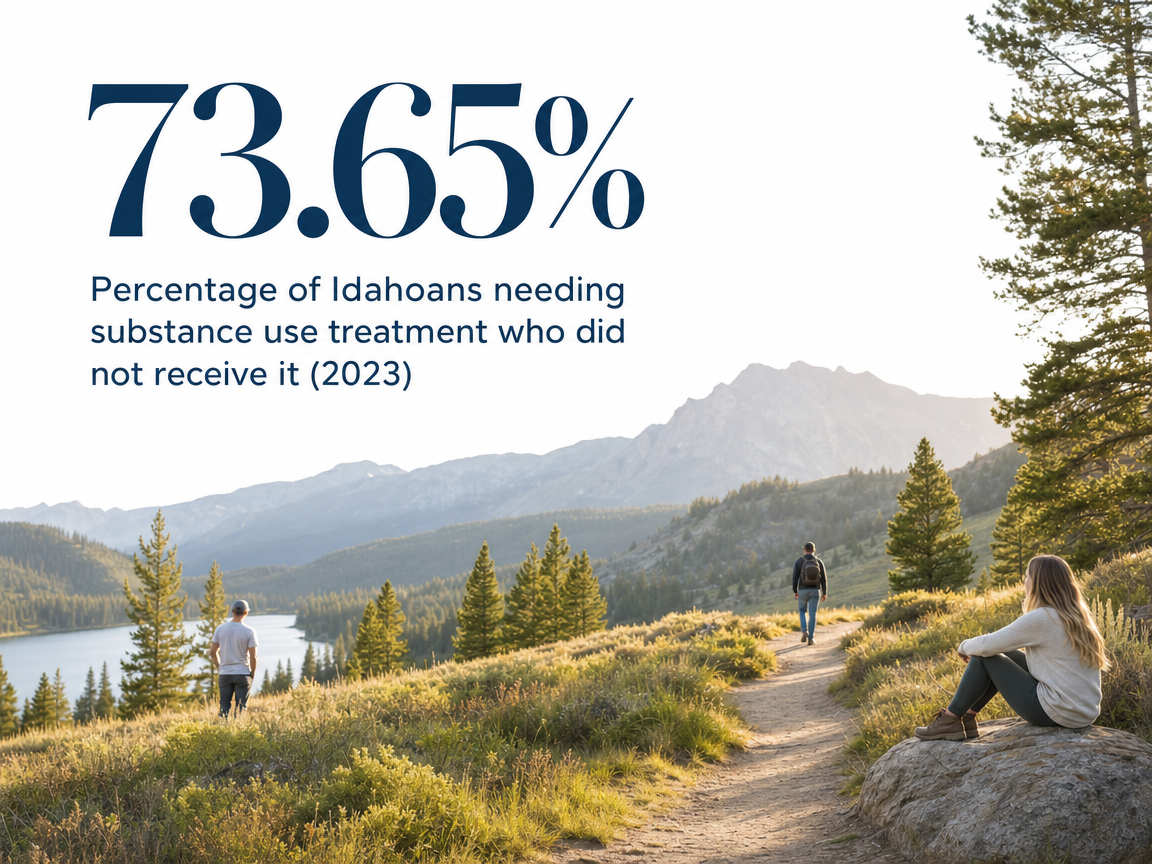
For the 2022–2023 period, an estimated 330,000 Idahoans aged 12 and older were classified as needing substance use treatment. Of those, about 73.65% did not receive care 2. That's not a rounding error. That's roughly three out of every four people who could benefit from treatment going without it in a given year.
Zoom in on a single year and the picture stays the same. In 2022, 319,000 Idaho residents aged 12+ were classified as needing substance use treatment, and only 89,000 received any. The other 238,000 did not 1. Those aren't strangers in some abstract dataset. They're neighbors in Nampa, ranch hands outside Twin Falls, college students in Moscow, retirees in Coeur d'Alene, and parents in Boise trying to hold jobs together while something quieter is falling apart at home.
So when you called around and kept hitting voicemail, or when the intake coordinator said the next opening is weeks out, you weren't running into your own bad luck. You were running into a math problem the state has not solved. And if you're the family member doing the calling for someone you love, the frustration you're carrying is legitimate. You are one of many people trying to move a person from need to care through a very narrow door.
Understanding that gap is the first step to making a clear-eyed decision about what to do next.
One Private Network, One State
Here's a piece most people never hear until they've already spent a week making calls: Idaho's publicly funded substance use disorder services aren't delivered by a big statewide agency the way you might picture. They're delivered by a private network contracted through the Division of Behavioral Health, with a managed services organization handling eligibility, service authorization, and payment 5.
That's not a scandal. It's a design choice. And it has real strengths, like a single point of coordination and clearer contract oversight. But it also means the front door to care in Idaho is narrower than it looks from the outside. If a provider in that network is full, the next in-network option may be hours away. If you live in a frontier or rural county along the Panhandle or in the eastern part of the state, the geography compounds the problem.
None of this is your fault. You did not build this system, and you shouldn't have to be an expert in state contracting to get your husband, your daughter, or yourself into a bed. But knowing how the network is structured helps explain why waitlists feel long, why phone tag can drag on, and why the same three or four names keep coming up when you search for Idaho drug rehab. It's a small pool by design, and it's already carrying a lot of weight.
Capacity Is Shrinking Even as MAT Grows
Here's the part that surprises even people who work in this field. Idaho's total treatment enrollment has been sliding downward, not up.
In a single-day count in March 2015, 6,287 Idahoans were enrolled in substance use treatment. By March 2019, that number had dropped to 5,634 6. That's a roughly 10% decline in a state where the population, and the need, were both moving the other direction. Over the same period, the number of Idahoans receiving buprenorphine as part of their treatment rose from 353 to 559 6. So medication-assisted treatment for opioid use disorder was expanding, which is real progress, while overall enrolled capacity was quietly contracting underneath it.
Both things can be true at the same time. MAT growth is a win, and if you or your loved one is dealing with opioid use, the fact that more Idaho providers now prescribe buprenorphine matters. But if the total number of people enrolled in any substance use treatment on a given day has fallen, that means the ceiling on how many Idahoans the state can actively hold in care has come down. Fewer beds. Fewer active outpatient slots. Fewer weekly group chairs.
You can see now why the drive west isn't a dramatic escape. It's a way to add capacity that Idaho, at this moment, simply does not have to give you.
What Idaho Residents Are Actually Being Treated For
If you were guessing what most Idahoans walk into treatment for, you might say alcohol, or maybe opioids, because that's the national headline. In Idaho, the picture on the ground looks different.
In 2022, Idaho recorded 284 treatment admissions among people aged 12 and older in the federal TEDS-A data. Of those, 35.6% listed amphetamines as the primary substance, and 18.3% listed marijuana. Male residents accounted for 67.3% of admissions 3. That's a stimulant-heavy clinical profile, and it matters more than it might sound.
Stimulant use disorder, especially methamphetamine, does not respond to the same clinical playbook as alcohol or opioids. There's no FDA-approved medication that acts on meth the way buprenorphine acts on opioids. Recovery leans harder on behavioral therapies, structured environments, sleep and nutrition rebuilding, and the slow return of dopamine function, which can take weeks after you stop using. A program that mostly runs an opioid track will not meet you where you are if meth is your primary substance.
The male majority in Idaho's admissions data also shapes what a good next step looks like. Gender-specific residential settings, where men are in group with other men working through similar patterns, can lower the noise and speed up the honest conversations.
The Boise-to-Portland Drive, Honestly
I-84 and What Seven Hours Really Means
Let's be straight with each other. From Boise, Portland is about a seven-hour drive west on I-84. From Coeur d'Alene, you're looking at closer to eight, and you'll likely route down through Spokane before catching the interstate. Nampa shaves twenty minutes off the Boise number. Twin Falls adds an hour and change. That's the honest math. It's not a quick trip, and pretending otherwise doesn't help anyone.
But here's what seven hours actually is. It's a familiar drive for a lot of Idahoans. You've probably already made it, maybe for a game, a wedding, a doctor's appointment in a bigger city. I-84 is the same highway that runs right through the Treasure Valley. You pick it up, you stay on it, and it ends in Portland. There's no complicated routing. No connecting flights. No lost luggage.
Most people don't drive themselves the day they leave detox. A family member drives, or a sober friend, or a paid transport. You sleep part of the way. You stop for food in Ontario or La Grande. By evening, you're checking in. It's a long day. It's not an impossible one.
How Families Visit Without Burning Out
The question you're probably really asking is whether your family can still be part of this. They can. It just takes a plan you can both live with.
Most families who send someone to Portland from Idaho settle into a rhythm. Weekly phone calls or video sessions during the week, when the program allows them. One in-person visit built around a weekend, timed to a family therapy session so the drive earns its keep clinically. A spouse or parent leaves Friday after work, arrives late, sees you Saturday, drives back Sunday. It's tiring. It's also doable, and it means the visits count for something.
Some families rotate. Your mom comes one month, your brother the next, your partner the one after. That protects everyone from the exhaustion of being the only person making the trip. If flying is more realistic than driving for a particular visit, Boise to Portland is a short flight, often under two hours in the air.
What matters most is honesty on both sides about what's sustainable. A visit you can't afford or can't recover from doesn't help your recovery. A steady presence, even a distant one, does.
If You Have an Oregon DUII Charge
This one comes up more than you'd think. You live in Idaho, but the charge is Oregon's, maybe from a work trip through the Gorge, a wedding in Bend, or a weekend that got away from you on the way home. Now you have court dates in one state and a life in another, and you're trying to figure out how treatment even works across a state line.
Here's what you need to know. Oregon expects providers to document your out-of-state residency and to have a copy of your referral from an Alcohol and Drug Safety School, or ADSS, before they enroll you in DUII-related services 7. That paperwork isn't a hurdle a good program will hide from you. It's a normal part of intake, and a Portland provider that works with out-of-state clients will walk you through what to bring: proof of Idaho residency, your ADSS referral, and the court paperwork tied to your case.
The rule also addresses a question Idaho residents ask a lot. Even if your home state wouldn't require DUII treatment for an equivalent conviction, Oregon still expects you to complete a program at the level the Oregon charge calls for 7. In plain terms, you don't get out of the requirement by being from somewhere else.
Get an ADSS referral, keep your court dates, and pick a Portland program that has done this before. It's manageable.
What Oregon Law Actually Allows
You might be wondering whether an Oregon program can even take you if your driver's license says Idaho. The short answer is yes.
Oregon's core behavioral health statute, ORS 430, gives the Oregon Health Authority the responsibility to arrange substance use disorder care directly or through licensed contractors, and it frames addiction as a health issue rather than a criminal one 10. Licensed Oregon programs are set up to serve people who need care, and residency in another state does not disqualify you from enrollment in outpatient, residential, or IOP services.
What that means in practice is simple. A Portland provider can lawfully admit you, run your assessment, place you at the right level of care, and coordinate with your family back home. You do not need to establish Oregon residency to be treated. You do not need a special waiver. You need an intake call, honest answers about your history, and the willingness to show up.
Real Recovery Starts in Portland, Oregon
Call now or verify insurance to take the first step toward lasting recovery in Portland.
What a Post-Detox Program in Portland Looks Like
The Handoff From Medical Detox to Structured Care
Detox is the beginning, not the finish line. Your body is stable. The withdrawal has passed or is passing. What comes next is the part that actually decides whether the sobriety holds, and it's the part Idaho's system most often can't hand you cleanly.
In Portland, that handoff can look like this. Oregon Trail Recovery partners with Pacific Crest Trail Detox for the medical piece, so when you're cleared, you don't go home to an empty apartment and a phone full of the same contacts. You move into a structured residential setting or step into an intensive outpatient program with sober living attached. The clinical team already has your history. The transition is one conversation, not four intake calls.
That continuity matters more than any single therapy on the schedule. The first thirty to ninety days after detox are when the brain is still rebalancing, sleep is still weird, and cravings arrive without warning. A program that catches you in that window, with structure during the day and accountability at night, gives you a floor to stand on while the harder work of therapy, life skills, and relapse prevention starts to take root.
Why Polysubstance Care Matters for Idaho Clients
Most Idahoans walking into treatment today aren't using one thing. The CDC has tracked substantial increases in overdose deaths involving fentanyl and stimulants used together, and that pattern complicates both prevention and clinical care 8. Given that amphetamines lead Idaho's primary-substance admissions 3, meth plus fentanyl exposure is a real risk profile, not a hypothetical one.
A Portland program built for post-detox transition should assume polysubstance use until you tell them otherwise. That means naloxone access and training as a baseline, honest conversations about stimulant cravings that don't respond to opioid medications, and a therapy schedule that addresses the specific patterns of each substance rather than lumping everything into a single track.
For you, this shows up in practical ways. Your assessment should ask about every substance you've used in the past year, not just the one on your chart. Your relapse prevention plan should name the situations tied to each. If you're on buprenorphine for opioid use, your program should still take stimulant cravings seriously, because staying on your medication doesn't automatically protect you from a meth relapse. Ask about this on the intake call. The answer tells you a lot.
Younger Adults and Family-Supported Transitions
If you're a parent calling on behalf of a son or daughter in their early twenties, the numbers explain why this feels so urgent. In 2021, 29.05% of Idahoans aged 18 to 25 met criteria for a past-year substance use disorder 9. Nearly one in three young adults in the state. That's your kid's college roommate, their coworkers, the friends they grew up with in Meridian or Idaho Falls.
Young adults often need a different kind of container after detox. They're still building the life skills that older clients rebuild: managing money, holding a job or class schedule, cooking a meal, sitting with boredom without reaching for something. A Portland program that pairs residential structure with employment and education assistance meets that need directly, rather than treating early sobriety as the only project.
Family support looks different for this age group too. Parents want to help without hovering. A good program will pull you into family therapy sessions on a schedule, coach you on what boundaries actually sound like out loud, and give your young adult room to own the work. You're not being pushed out. You're being asked to change shape so the recovery has room to grow.
Making the Call: What to Ask and What to Pack
When you're ready to pick up the phone, a few good questions will tell you most of what you need to know about a Portland program. Ask how they handle the handoff from medical detox, and whether they coordinate directly with Pacific Crest Trail Detox or a similar partner. Ask what their post-detox residential and IOP schedule actually looks like on a Tuesday. Ask how they treat stimulant use disorder specifically, given how many Idaho residents come in with meth as their primary substance 3. Ask about gender-specific residential options, family therapy scheduling, and whether they've admitted Idaho residents before. If you have an Oregon DUII, ask if they've handled out-of-state ADSS referrals and residency documentation 7.
For the bag, keep it simple. Comfortable clothes for a week, layers for Portland's damp cool, sturdy shoes for walking. Your ID, insurance card, and any court paperwork. A current medication list and prescription bottles. A notebook. Phone numbers written on paper in case your phone gets locked up during early days. Photos of the people you're doing this for.
When you're ready, call Oregon Trail Recovery. One conversation is where this starts.
Frequently Asked Questions
Is it legal for an Idaho resident to go to rehab in Oregon?
Yes. Oregon's core behavioral health statute gives the Oregon Health Authority the responsibility to arrange substance use disorder care through licensed providers, and residency in another state does not disqualify you from enrollment 10. You don't need to become an Oregon resident. You need an intake call, honest answers, and your ID.
How long is the drive from Boise to Portland for treatment?
Roughly seven hours west on I-84, straight through. Nampa is about twenty minutes shorter. Twin Falls adds an hour or so. Coeur d'Alene runs closer to eight hours, usually routed through Spokane. Most people don't drive themselves right out of detox. A family member, sober friend, or paid transport handles it, with a food stop in Ontario or La Grande.
What happens if I have an Oregon DUII but live in Idaho?
Oregon expects providers to document your out-of-state residency and to have a copy of your referral from an Alcohol and Drug Safety School before enrolling you in DUII-related services 7. Even if Idaho wouldn't require treatment for an equivalent conviction, Oregon still expects you to complete a program at the level your Oregon charge calls for 7. Get the ADSS referral first, then call a Portland program that has handled out-of-state clients.
Do I need to finish detox before going to Portland?
For most substances, yes. Medical detox stabilizes your body so structured treatment can actually do its work. Oregon Trail Recovery is a post-detox transition, residential, and IOP provider, and partners with Pacific Crest Trail Detox for the medical piece. If you haven't started detox yet, call anyway. The intake team can help you sequence it so the handoff is clean.
Can my family visit me during treatment in Portland?
Yes, and most families settle into a rhythm that works. Weekly phone or video sessions during the week. One in-person weekend visit built around a family therapy session, so the drive earns its keep clinically. Some families rotate who makes the trip to protect everyone from burnout. Boise to Portland is also a short flight when driving isn't realistic.
Why can't I find a treatment bed inside Idaho?
It's not your search skills. Idaho's publicly funded substance use disorder services are delivered through a private network contracted by the Division of Behavioral Health, with a single managed services organization handling authorization 5. That structure keeps capacity finite. Single-day treatment enrollment in Idaho actually fell from 6,287 in 2015 to 5,634 in 2019, even as need grew 6. Fewer beds. Longer waits. A real math problem.
References
- IDAHO – 2022 National Survey on Drug Use and Health, Small Area Estimates State Tables. https://www.samhsa.gov/data/sites/default/files/reports/rpt44486/2022-nsduh-sae-state-tables/NSDUHsaeIdaho2022.pdf
- IDAHO – 2023 National Survey on Drug Use and Health, State Tabs. https://www.samhsa.gov/data/sites/default/files/reports/rpt56188/2023-nsduh-sae-state-tables_0/2023-nsduh-sae-state-tabs-idaho.pdf
- 2022 Treatment Episode Data Set: Admissions (TEDS-A), Idaho. https://www.samhsa.gov/data/node/51008
- 2022 National Survey on Drug Use and Health (NSDUH) – National Releases. https://www.samhsa.gov/data/data-we-collect/nsduh-national-survey-drug-use-and-health/national-releases/2022
- Idaho 2022 State Report – Underage Drinking Prevention and Related Issues. https://library.samhsa.gov/sites/default/files/idaho-iccpud-state-report-2022.pdf
- Behavioral Health Barometer: Idaho, Volume 6. https://www.samhsa.gov/data/sites/default/files/reports/rpt32829/Idaho-BH-Barometer_Volume6.pdf
- PERMANENT ADMINISTRATIVE ORDER – Oregon Health Authority (309-019, 2023). https://www.oregon.gov/oha/HSD/HSDRules/Perm309-019.04072023.pdf
- Drug Overdose Deaths Involving Fentanyl, Methamphetamine, and Cocaine — United States, 2011–2024. https://www.cdc.gov/mmwr/volumes/73/wr/pdfs/mm7307a3-H.pdf
- 2021 National Survey on Drug Use and Health: Idaho Tables. https://www.samhsa.gov/data/sites/default/files/reports/rpt39467/2021NSDUHsaeSpecificStatesTabs122022_0/NSDUHsaeIdaho2021.pdf
- Oregon Revised Statutes Chapter 430 – Mental and Behavioral Health Treatment; Developmental Disabilities. https://www.oregonlegislature.gov/bills_laws/ors/ors430.html
Relapse Doesn't Mean the End Of Your Journey
Reach out today to explore programs that support real, long-term sobriety.