




Treatment Groups in Portland, OR

Key Takeaways
- Portland's group-heavy treatment network reflects a statewide service shortfall and high substance use prevalence, so a group seat is often the first real opening you'll find.1,2
- Match the group format to your recovery stage: step-down groups after detox, evening IOP cohorts for working professionals and students, and ongoing aftercare for year-two pattern work.
- Compare clinical versus peer-led rooms, DUII or culturally specific tracks, and whether the program handles co-occurring mental health before committing to a schedule.
- Weigh logistics honestly—transit access, evening availability, insurance coverage, and waitlist length—and call several programs in parallel, using BHRN-funded peer groups to hold steady in the gap.5,9
Finding a Group That Fits Your Job, Your Schedule, and Your Recovery Stage
You already know recovery is hard work. What you may not know yet is how many shapes group treatment takes in Portland—and how much that variety matters when you're trying to keep a job, finish a semester, or hold a family together while you do this.
Some groups meet at 6 a.m. before shift. Some run three evenings a week as part of an intensive outpatient cohort. Some are clinically facilitated process groups led by a licensed counselor. Others are peer fellowships in a church basement off MAX, free and open to anyone who walks in. A few are specifically for women, for men, for Native communities, or for people working through a DUII requirement.
The honest truth is that picking the right group depends less on which one sounds best and more on where you are in your recovery right now. Fresh out of detox is different from twelve months out. Post-residential is different from never-been-treated. This guide maps Portland's group options to those stages, so you can find something that holds you accountable without quietly costing you the rest of your life.
How Portland's Treatment Landscape Shapes Your Group Options
The Access Gap Behind Why Groups Carry So Much Weight Here
Before you start comparing meeting times or program brochures, it helps to understand why group treatment is so prominent in Portland in the first place. The short version: there are not enough one-on-one slots to go around, and groups are how the system stretches to meet you.
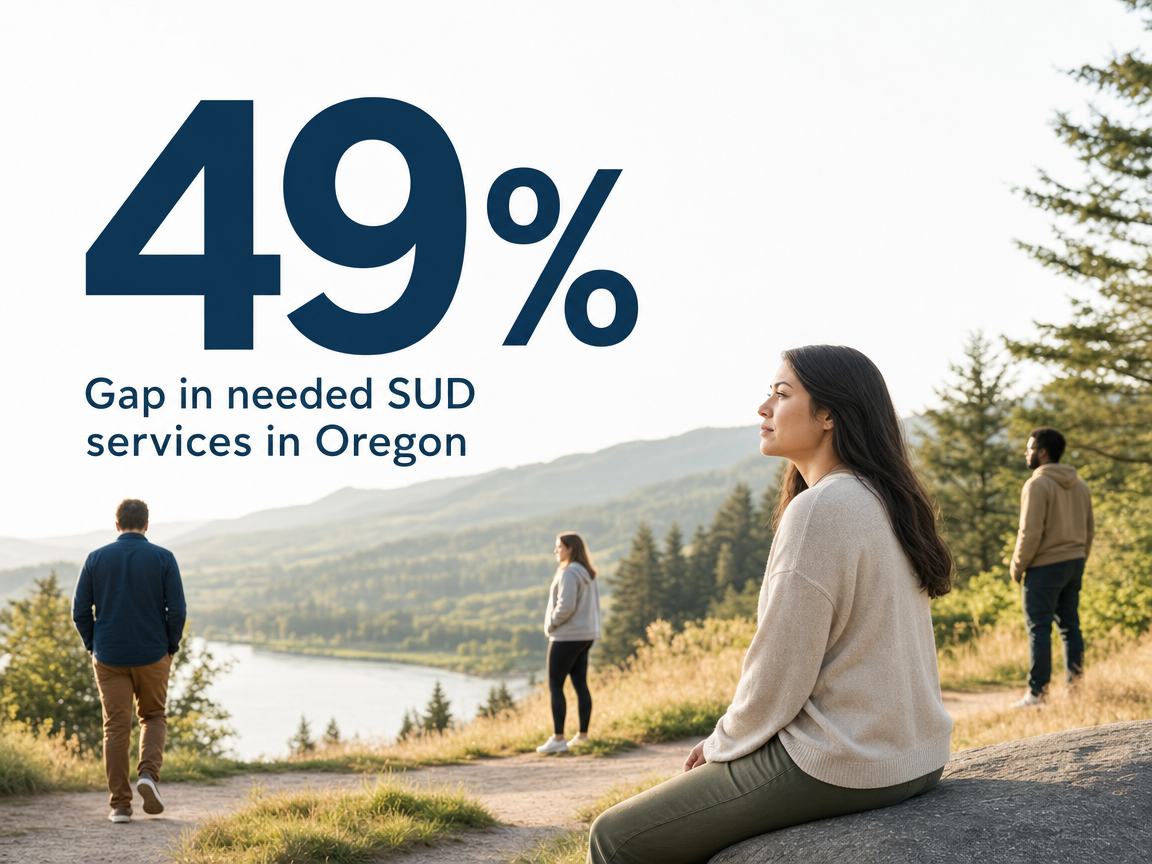
Oregon's Health Authority gap analysis estimated a 49% shortfall between the substance use disorder services Oregonians actually need and what providers can deliver, with over half of SUD providers reporting they could not meet demand for services. That figure is a statewide estimate, not a Portland-specific count, and it covers the full continuum from outpatient through residential care. Still, it explains a lot about what you're walking into. When individual counselor caseloads are full, groups are how programs serve more people without turning anyone away at the door.1
This matters for you in practical terms. A clinically facilitated group of eight to twelve people lets one licensed counselor work with that whole room in a single evening. That is not a compromise on quality—group work has its own clinical strengths, especially around accountability and shared experience—but it is the reason your first real opening in a Portland program is more likely to be a group seat than a weekly solo therapy hour.

Oregon's National Ranking and What It Means for Portland Demand
The access gap is not just a supply problem. It sits on top of unusually high need. A 2019 legislative analysis of Oregon's publicly funded substance use treatment system reported that in 2017, Oregon ranked fourth in the country for both alcohol use disorders and substance use disorders, while lagging well behind on treatment access. High prevalence, low access. That combination is what built the group-heavy network you're now trying to enter.2
Portland feels this acutely because it functions as a regional hub. People come into the metro for work, for school, for healthcare, and for treatment itself. The SAMHSA Portland–Vancouver–Hillsboro metro data, drawn from a combined 2005–2010 sample, documented substantial local need for SUD services alongside co-occurring mental health concerns like major depressive episodes and binge alcohol use. The sample is older than you'd like, but the pattern it describes has not reversed.3
What this means for your search: the density of groups in Portland is not a marketing accident. Evening intensive outpatient cohorts, morning recovery meetings near transit lines, weekend process groups in inner Southeast—they exist because the demand has been there for a long time, and groups are how the metro absorbs it.
Measure 110, BHRNs, and Low-Barrier Entry Points
There is one more piece of the Portland landscape worth understanding before you pick a group: how you might actually get in the door. Since Measure 110 passed, Oregon has funded Behavioral Health Resource Networks in every county, and the Oregon Health Authority requires each BHRN to offer screenings, assessments, peer support, harm reduction, low-barrier substance use treatment, and trauma-informed, culturally specific services. Many of those services are delivered as groups—peer recovery circles, drop-in support meetings, and culturally specific gatherings that do not require insurance verification before you sit down.5
That matters when you're early in the process and not sure where to start. You do not have to call a clinical intake line first. A BHRN-funded peer group can be your on-ramp, and the peers in that room can help you move toward an assessment and a higher level of care when you're ready. Academic and policy reviews of Measure 110 describe these networks as a deliberate shift toward treating substance use as a public health issue, with cannabis tax revenue funding the community-based programs that often run the groups you'll encounter. Uptake has been uneven and debated, but the doorway is real.6,7
Group Formats Mapped to Your Stage of Recovery
Right After Detox or Residential: Step-Down Groups and Stabilization
The first ninety days after detox or residential are not the time to figure things out alone. Your brain chemistry is still settling, your sleep is uneven, and the structure you had inside a treatment center is suddenly gone. Step-down groups exist to bridge that gap.
These are typically clinically facilitated, meet several times a week, and focus on stabilization—sleep, nutrition, trigger mapping, medication adherence if you're on any, and rebuilding a daily rhythm. Expect a counselor to lead, expect homework, and expect to be asked direct questions about cravings and contact with people from your using life.
Portland leans hard on this level of care partly because residential beds are limited. The Oregon Health Authority's behavioral health capacity dashboard tracks bed availability through March 1, 2024, and the picture it paints is one of constrained inpatient capacity statewide. That constraint pushes more of the early-recovery workload into structured outpatient groups. If you left residential last week, a step-down group is not a downgrade. It is the next correct step, and starting within seven to ten days of discharge protects the work you already did.8
Intensive Outpatient Cohorts for Working Professionals and Students
Intensive outpatient programs—IOP—are where most working professionals and students in Portland land for the bulk of their treatment. A typical IOP meets three evenings a week for about three hours per session, often somewhere between 5:30 and 8:30 p.m., which is built specifically so you can keep showing up at your job or your classes.
The cohort model matters here. You start with the same group of eight to twelve people and move through the program together over roughly eight to twelve weeks. That continuity is doing real clinical work. By week three, the person across from you knows when you're minimizing, and you know when they are. A counselor leads the room, but the accountability gets distributed. Sessions blend psychoeducation, process work, and skills practice drawn from CBT, DBT, REBT, and relapse prevention frameworks.
For students at PSU, PCC, or OHSU, evening IOP usually layers under a full course load without forcing a withdrawal. For professionals, it means you can keep your job and your insurance while doing serious treatment. You will have to protect those three evenings. That is the trade. Move the dentist, decline the after-work drinks invite, tell the friend you'll call Saturday. The cohort only works if you actually sit in it.
Ongoing Outpatient and Aftercare Groups
After IOP, the work is not done—it just changes shape. Ongoing outpatient groups meet once or twice a week, usually for ninety minutes, and they're where you practice being a person in recovery while also being a person with a job, a partner, a kid, a thesis.
The clinical focus shifts. Less crisis management, more pattern work: the second-year relationship strain, the promotion that triggers old coping habits, the holiday that always wrecks you. Many Portland programs run these as open-ended process groups, meaning members rotate in and out as readiness changes. You might stay six months, you might stay two years.
This is the stage where people quietly fade if no one notices. Aftercare groups are the noticing. When you skip a week, someone texts. When you show up flat, someone asks. That low-grade, consistent attention is what carries a lot of people through year two and year three, which the research and clinical community treat as a genuinely vulnerable window even when the outside world assumes you're fine.
Peer Mutual-Aid Meetings That Stack With Clinical Care
Clinical groups and peer mutual-aid meetings are not competitors. They do different jobs, and the strongest recovery plans usually run both at once.
Peer meetings—AA, NA, Refuge Recovery, SMART Recovery, Wellbriety circles, women-only and men-only fellowships—are free, frequent, and walk-in. Portland's meeting density is genuinely useful here. You can find a 6:30 a.m. meeting near a MAX stop on your way into work, a noon meeting downtown, a 9 p.m. meeting in Southeast on a night you can't sleep. No insurance check, no intake paperwork, no clinical assessment. Just a seat.
What peer meetings offer that clinical groups cannot is volume and continuity. You can attend daily if you need to. You build relationships with people who are five, ten, twenty years into recovery and who will pick up the phone at midnight. What clinical groups offer that peer meetings cannot is structured assessment, treatment planning, and a licensed counselor watching for the warning signs you might not catch in yourself.5
Stack them. A common pattern for someone in IOP is three clinical evenings plus two or three peer meetings a week. After IOP steps down, the peer meetings often increase. That is not redundancy—that is how the support load redistributes as the clinical scaffolding comes down.
Real Recovery Starts in Portland, Oregon
Call now or verify insurance to take the first step toward lasting recovery in Portland.
Clinically Facilitated Groups vs. Peer-Led Groups: What Actually Happens in the Room
You've probably noticed by now that two very different things get called "groups" in Portland recovery conversations. Knowing which one you're walking into matters, because the room runs differently, the expectations are different, and the role you play is different.
A clinically facilitated group has a licensed counselor in the room. Sessions follow a treatment plan tied to your diagnosis, your goals, and a documented modality—CBT, DBT, Seeking Safety, relapse prevention, motivational interviewing. The counselor steers the work, assigns skills practice, tracks your progress in a chart, and bills your insurance. Confidentiality is governed by HIPAA. You sign in, you do focused work, and the clinical record follows you if you step up or step down in care.
A peer-led group is run by people in recovery, not clinicians. There's no chart, no billing, no treatment plan. The structure comes from a shared format—readings, shares, sponsorship, traditions—and the authority in the room is lived experience. You're not a client there. You're a member.
Both rooms are doing legitimate work. Clinical groups give you assessment, structured skill-building, and a counselor watching for early warning signs. Peer rooms give you frequency, longevity, and people who have walked the same ground for decades. The Behavioral Health Resource Network framework explicitly funds both kinds of services—peer counseling and support alongside low-barrier clinical treatment—because Oregon recognized that one without the other leaves gaps. Your job is not to pick a side. It is to know which room you're in on any given evening, so you can show up as the right version of yourself: a client doing clinical work, or a member doing fellowship.
Specialized Groups: DUII-Mandated, Gender-Specific, and Culturally Specific Options
Not every group is built for every person. Portland has a layer of specialized groups designed around legal requirements, gender, and culture, and choosing inside that layer can make the difference between sitting through hours you resent and doing work that actually lands.
If you're working through a DUII, you're looking at a specific lane. Court-mandated treatment typically requires an alcohol and drug evaluation followed by a defined course of education and treatment groups, with attendance documented and reported back to the court or your diversion program. Many Portland providers run DUII-specific groups separately from their general outpatient track so the curriculum stays aligned with state requirements. Bring your court paperwork to the first call. The intake coordinator can tell you whether their groups meet your specific mandate before you commit to a schedule.
Gender-specific groups exist because the conversations people need to have about trauma, relationships, parenting, sexuality, and shame often go deeper when the room is set up for them. A women's group can hold a different kind of honesty than a mixed room. A men's group can too. Neither is better in the abstract—what matters is whether you'll actually say the hard thing out loud, and where.
Culturally specific groups are funded directly through the Behavioral Health Resource Network requirement that each county provide trauma-informed, culturally specific, and linguistically responsive services. In Portland that includes Wellbriety circles drawing on Native American recovery traditions, Spanish-language groups, and programs built for Black, Indigenous, and other communities of color. If a generic group has ever felt like it was asking you to translate your own experience before you could share it, a culturally specific group may be where the translation stops.5
Co-Occurring Mental Health and Why Group Selection Matters More Here
If you live with depression, anxiety, PTSD, bipolar disorder, or ADHD alongside a substance use disorder, the group you pick is doing double duty. It has to hold your recovery work without ignoring the mental health condition that is often driving the cravings in the first place.
The Portland metro carries a real load here. SAMHSA's combined 2005–2010 estimates for the Portland–Vancouver–Hillsboro area documented substantial co-occurring concerns alongside SUD, including major depressive episodes and heavy alcohol use patterns. The data window is dated, but clinicians in the metro have not stopped seeing the same overlap.3
What this means practically: ask before you enroll whether the group is built for co-occurring work. Modalities like Seeking Safety, DBT, and trauma-informed CBT are designed for exactly this overlap. A general relapse-prevention group can miss the trauma piece entirely and leave you wondering why the skills are not sticking.
One honest caveat. Most SUD-focused programs in Portland offer co-occurring mental health support as part of treatment, not standalone psychiatric care. If your mental health condition is acute, you will likely need a psychiatric provider working alongside your group, not instead of it.
Practical Logistics: Schedule, Cost, and Getting Off the Waitlist
Fitting a Group Around Work, Class, and Family
The logistics question is usually the one that decides whether you actually start. You can find the right modality, the right counselor, the right cohort, and still lose the whole thing to a Tuesday calendar conflict.
Start by mapping a real week, not an idealized one. Block your fixed obligations first: work hours, commute, class times, kid pickups, anything non-negotiable. What's left is the space a group has to fit into. For most working professionals in Portland, that means evening IOP between roughly 5:30 and 8:30 p.m., with mutual-aid meetings tucked into early mornings or weekends.
Be honest about transit. A group near a MAX line or a frequent-service bus route is one you'll actually attend in February rain. A group requiring a 25-minute drive each way after a long shift is one you'll start skipping by week four.
Tell the people who need to know. A partner, a manager if you choose to disclose, a study group. You don't owe anyone the clinical details, but you do need the calendar protected. Three evenings a week is not a soft commitment.
Affordability, Insurance, and Portland's Income Reality
Cost is the second logistics question, and it's more navigable than most people fear. Portland's median household income sits at $90,919 in the 2020–2024 reporting window, which means many working professionals carry employer-sponsored insurance that covers IOP and outpatient group therapy as in-network behavioral health benefits. Call the number on your insurance card and ask specifically about IOP, group therapy CPT codes, and your out-of-pocket maximum.10
If you don't have private insurance, the Oregon Health Plan covers a broad range of SUD services. BHRN-funded programs add another layer: peer support, screenings, and low-barrier group services delivered without traditional insurance gatekeeping.5
One thing worth saying plainly. Treatment groups are usually cheaper per session than individual therapy, and many programs offer sliding-scale fees. Don't assume cost rules you out before you've asked. The intake coordinator's job includes walking you through what your specific coverage looks like.
Waitlists, Workforce Constraints, and How to Move Faster
Waitlists are real, and pretending otherwise doesn't help you. Oregon's behavioral health workforce report documented ongoing capacity constraints among SUD counselors, with reimbursement and retention pressures that limit how quickly programs can add new cohorts. In practical terms, a Portland IOP might have an opening this week or might be three weeks out.9
You can move faster if you call several programs in parallel rather than waiting on one. Ask each intake coordinator three questions:
- when does the next cohort start,
- what does your assessment process look like, and
- is there a peer support group or drop-in meeting I can attend while I wait.
That third question matters. A BHRN-funded peer group can hold you steady through a waitlist gap, and the peers in that room often know which programs are actually opening seats soon.5
The window between deciding to start and actually starting is when people lose momentum. Fill it with something—a meeting, a phone assessment, a conversation with a peer recovery specialist. Movement counts.
Choosing Your First Group and What Honest Attendance Looks Like
Here is the part no brochure will tell you straight: the best group is the one you'll actually sit in next Tuesday, and then the Tuesday after that. Fit beats prestige. A program with a slightly less impressive website that meets near your bus line at a time your shift allows will outperform the gold-standard cohort you can't realistically reach.
When you make your shortlist, ask three questions on the first call. What's the format and modality? What does the cohort look like right now—who else is in the room? And what happens when I miss a session? That third answer tells you a lot. Programs that treat attendance as paperwork will let you drift. Programs that treat it as clinical data will call you when you're not there.
Honest attendance is not perfection. It's showing up when you don't feel like it, sharing the thing you'd rather keep quiet, and telling the counselor before you skip rather than after. If you slip, you come back the next session, not the next month. That is the work.
If you're stepping out of detox or residential and need a long-term outpatient program built around your job or school, Oregon Trail Recovery's intensive outpatient program is one option in the Portland area worth a call.
For whole-person detox and recovery support built by those who've walked the path themselves, connect with Oregon Trail Recovery today. We'll hold you accountable to a healthier, happier future.
Frequently Asked Questions
What's the difference between a clinically facilitated group and a peer mutual-aid meeting?
A clinically facilitated group is led by a licensed counselor, follows a treatment plan, and bills your insurance under HIPAA. A peer mutual-aid meeting is run by people in recovery, has no chart or clinician, and runs on shared format and lived experience. Both do real work. Most strong recovery plans run both, because the clinical room and the peer room solve different problems.
Can I attend a treatment group in Portland while keeping a full-time job?
Yes. Most intensive outpatient programs in the Portland metro run evening cohorts roughly between 5:30 and 8:30 p.m., three nights a week, specifically so working professionals can keep their jobs and insurance. You will need to protect those evenings as fixed appointments, not flexible ones. Many peer mutual-aid meetings also run before work, at lunch, or late evening near MAX and frequent-service bus lines.
Will a Portland treatment group satisfy DUII or court-mandated requirements?
Only if the program is set up for it. DUII-mandated treatment requires a specific alcohol and drug evaluation followed by a defined course of education and treatment that gets documented back to the court or diversion program. Bring your court paperwork to the first intake call and ask directly whether their groups meet your specific mandate before you enroll. Not every general outpatient group qualifies.
How soon can I get into a group after detox or residential treatment?
Aim for seven to ten days after discharge. That window protects the work you already did. Waitlists are real because of statewide behavioral health workforce constraints, so call several programs in parallel rather than waiting on one. While you wait, a Behavioral Health Resource Network-funded peer group can hold you steady and connect you to clinical openings as they come up.5,9
What if I also have a mental health condition alongside substance use?
Ask before you enroll whether the group is built for co-occurring work. Modalities like Seeking Safety, DBT, and trauma-informed CBT are designed for that overlap. Most SUD-focused programs in Portland offer co-occurring mental health support inside treatment, not standalone psychiatric care. If your mental health condition is acute, you will likely need a psychiatric provider working alongside your group rather than the group working alone.
How do I know when it's time to step down from IOP to an ongoing aftercare group?
Your counselor will track this with you, but the markers are practical. Stable sleep, consistent attendance, honest sharing, a working relapse-prevention plan, and reduced crisis moments over several weeks. Stepping down does not mean stepping out. Most people move from three IOP evenings to one weekly aftercare group plus two or three peer meetings. If you start skipping, that is information, not failure. Tell someone.
References
- Oregon Substance Use Disorder Services Inventory and Gap Analysis. https://www.oregon.gov/oha/HSD/AMH/DataReports/SUD-Gap-Analysis-Inventory-Report.pdf
- Analysis of Oregon's Publicly Funded Substance Abuse Treatment System. https://www.oregonlegislature.gov/citizen_engagement/Reports/2019-OCJC-SB1041-Report.pdf
- Portland-Vancouver-Hillsboro, OR-WA | CBHSQ Data. https://www.samhsa.gov/data/report/portland-vancouver-hillsboro-or-wa
- Behavioral Health and Health Care. https://www.oregonlegislature.gov/lpro/Publications/SOL%20Behavioral%20Health%20and%20Health%20Care_FINAL.pdf
- Behavioral Health Resource Network (BHRN) Program. https://www.oregon.gov/oha/hsd/amh/pages/measure110.aspx
- The Life of OR Measure 110: Evolution, Implementation, and Impact. https://pdxscholar.library.pdx.edu/cgi/viewcontent.cgi?article=1217&context=anthos
- The Oregon Drug Battle: Is Measure 110 Making a Difference?. https://larc.cardozo.yu.edu/ersj-blog/72/
- Behavioral Health Housing and Licensed Capacity Investments Dashboard. https://www.oregon.gov/oha/hsd/amh/pages/housing-dashboard.aspx
- Behavioral Health Workforce Report to the Oregon Health Authority and the Legislature. https://www.ohsu.edu/sites/default/files/2022-02/PRP_113_Behavioral_Reimbursement_Report_02.01.22_V2.pdf
- QuickFacts: Portland city, Oregon. https://www.census.gov/quickfacts/fact/table/portlandcityoregon/PST045225
- 2020 State of Housing in Portland: Part 1 – Portland Demographics & Housing Stock. https://www.portland.gov/phb/documents/2020-state-housing-part-1-portland-demographics-housing-stock/download
Relapse Doesn't Mean the End Of Your Journey
Reach out today to explore programs that support real, long-term sobriety.