




The Substance Abuse Facts Every Family Should Know

Key Takeaways
- Substance use disorder is a diagnosable medical condition with severity levels, not a character flaw, and the language a program uses signals whether its clinical approach matches current evidence.
- National and Oregon overdose deaths have declined for multiple years, but a fentanyl-contaminated supply means individual risk still warrants naloxone at home and prompt clinical assessment 3, 10, 11.
- Evidence-based care for opioid use disorder includes methadone, buprenorphine, or naltrexone alongside counseling, and integrated co-occurring mental health treatment outperforms addressing conditions separately 4, 5, 6.
- Focus next on asking programs four specific questions: medication policies, co-occurring care scope, structured family involvement, and how handoffs between detox, residential, IOP, and sober living are managed 6, 12, 13.
What Substance Use Disorder Actually Means (And Why the Word Matters)
If you're reading this, you've probably already said the word "addiction" out loud at a kitchen table or in a car at midnight. You've likely also heard harder words—ones that sting and strip your adult child of their full self. Before anything else, swap those out. The clinical name is substance use disorder, or SUD, and the shift from slang to diagnosis matters more than it sounds.
Substance use disorder is a diagnosable health condition, not a character flaw or a willpower problem. Clinicians define it by patterns of impairment: using more than intended, trying to cut back without success, cravings that crowd out other goals, continued use despite real harm to work, relationships, or health. The diagnosis also comes with a severity range—mild, moderate, or severe—based on how many of these patterns are present. That matters because "my child has a substance problem" and "my child meets criteria for severe alcohol use disorder" lead to very different next steps.
Language shapes how your adult child sees themselves, and how a clinician treats them. Calling someone "an addict" collapses a whole human being into a single behavior. Saying "a person with opioid use disorder" keeps the person in view and names something treatable. You're not softening reality by using person-first language—you're matching the language that evidence-based care uses, including the clinical guidance that identifies methadone, buprenorphine, and naltrexone as standard treatment for opioid use disorder.4
Here's the practical takeaway. SUD is a condition, not an identity. It has severity levels, which means it can be assessed and matched to a level of care. And the words you choose at your kitchen table are the same words you'll want from any program you trust with your child's recovery. If a provider still talks about "addicts" and "clean time," that tells you something about whether their clinical model has kept up with the evidence.
The Current Overdose Landscape: Progress, Fentanyl, and Why Individual Risk Still Matters
The National Picture in 2024
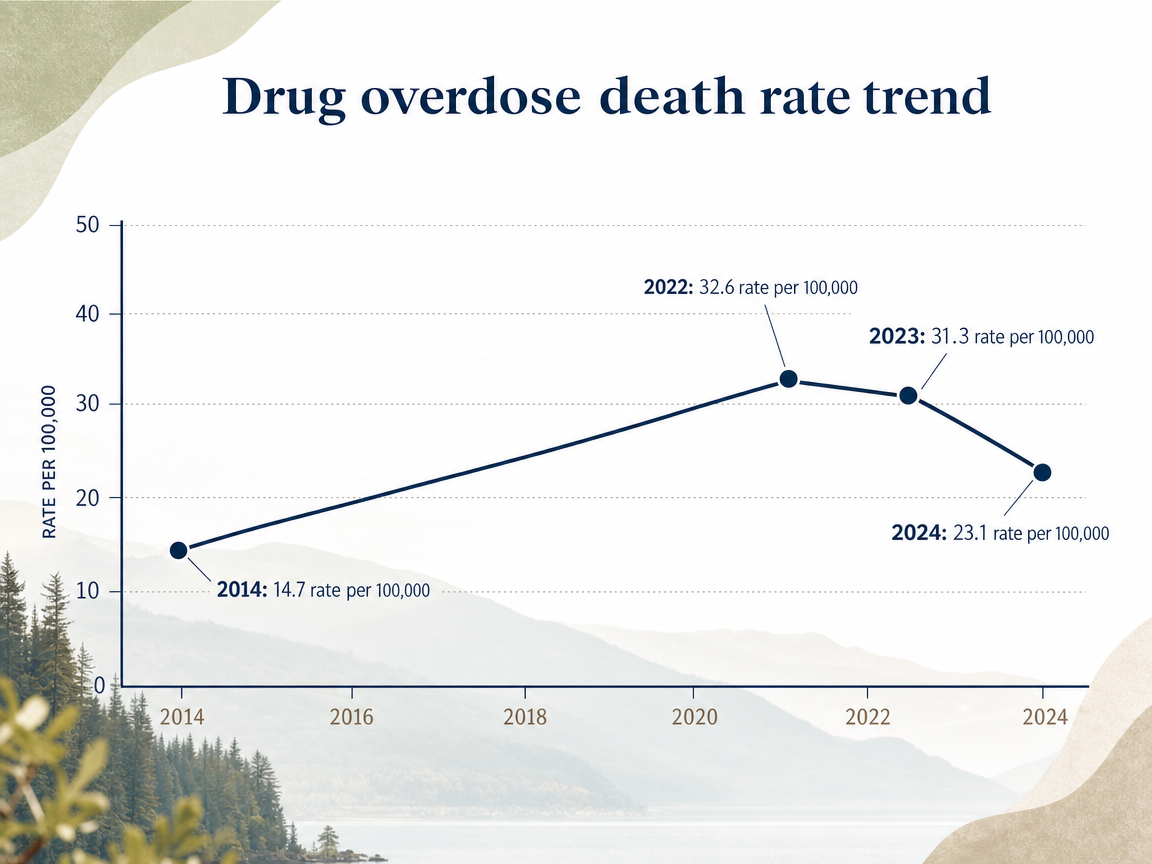
Here's something you probably haven't heard on the news: the national overdose numbers are moving in the right direction. For the first time in years, there is genuine, measurable improvement. In 2024, the United States recorded 79,384 drug-overdose deaths, which works out to an age-adjusted rate of 23.1 deaths per 100,000 people—a 26.2% drop from 2023.10For context, the age-adjusted rate was 14.7 in 2014, climbed to 32.6 in 2022, slipped to 31.3 in 2023, and then fell sharply to 23.1 in 2024.10That decline has now extended through 2025, marking the third consecutive year of improvement at the national level.1
Take a breath. This matters. Thousands of families got to keep someone this year who, under the 2022 trend, might not have made it home.
But hold two things at once. A declining national rate is not the same as safety for your adult child. National averages smooth over what's happening on your street, in your zip code, with the specific substances in your region. A rate per 100,000 is a demographer's tool, not a prediction about one person. If your child is using opioids, stimulants, or combinations of substances right now, the only number that applies to them is their own risk—shaped by what they use, how often, who they use with, whether naloxone is nearby, and whether they've been assessed by a clinician.
Progress is real. It is also not a reason to wait.
What the Pacific Northwest Looks Like Right Now
If you live in Portland, Bend, or anywhere else in the Pacific Northwest, you want local numbers, not a national average. Oregon recorded 1,544 drug-overdose deaths in 2024, a 16% decline from 2023.11The Oregon Health Authority has confirmed that overdose deaths declined in both 2024 and 2025, which puts the state on the same downward curve the country is seeing.2
One figure inside that Oregon report deserves your attention as a parent. Among people who died from overdose in 2024, 34% had been administered naloxone before they died—compared with just 10% in 2020.11Read that twice. More than three times as many people had someone try to reverse their overdose with naloxone in 2024 as in 2020. Some of those attempts came too late, which is why those people are counted in the death data. But that shift tells you something important: naloxone is in more hands, more families and friends know how to use it, and more people are trying. If you don't already have naloxone in your home and your car, that is a concrete step you can take this week.
Here is the honest caveat. Oregon's statewide decline doesn't mean every county, every community, or every substance follows the same curve. A state audit of Measure 110-funded services found that overdose rates cannot be attributed to any single grantee or program, because they're shaped by complex environmental and systemic factors.14Translation: no one gets to take a victory lap, and no family should assume the local service system is uniformly strong. Capacity for Oregon addiction treatment, residential beds, and intensive outpatient programming still varies by county and by week.
Why the Supply Itself Changes the Math
The reason overdose risk is so unpredictable right now has less to do with how much your adult child uses and more to do with what's actually in the substance they're using. CDC surveillance from 2021 through 2024 shows that illegally manufactured fentanyls and carfentanil continue to turn up in overdose deaths, even as overall numbers decline.3A counterfeit pill that looks like a prescription painkiller, a bag of powder that looks like what someone used last week—neither one is reliable anymore. The dose can shift from one batch to the next.
The Substances Families Ask About Most
Alcohol: The Risk Hidden in Plain Sight
Alcohol doesn't come with a stigma shadow around it the way other substances do, which is exactly why it slips past so many families. Your adult child can be in genuine trouble with alcohol without ever touching a pill or a powder. The National Institute on Alcohol Abuse and Alcoholism defines binge drinking as a pattern that pushes blood alcohol concentration to 0.08% or higher—roughly four drinks for women or five for men in about two hours.8That's not a Saturday-night anomaly for a lot of people. It's a Wednesday.
Risk sits on a continuum, not on a single line between "fine" and "problem." Pregnancy, medications, liver conditions, mental health, and age all shift where real harm starts for one person versus another.8A drink count alone won't tell you what you need to know. A clinical assessment will. If you've been quietly tracking empty bottles and talking yourself out of your own concern, trust the pattern you're seeing—and ask for an evaluation.
Prescription Medications That Can Be Misused
When families picture a substance problem, they often picture something bought on a street corner. The pharmacy bottle on the kitchen counter rarely enters the mental image. It should. The National Institute on Drug Abuse identifies three categories of prescription drugs that are commonly misused:
- Opioid pain medications
- Central nervous system depressants like benzodiazepines and some sleep aids
- Stimulants prescribed for ADHD
Any of these can start as a legitimate prescription and drift into a pattern no one meant to create.7
A few distinctions matter here, because they get mashed together in everyday conversation. Physical dependence—your body adjusting to a medication so that stopping suddenly causes withdrawal—is not the same as a substance use disorder. Tolerance is not the same as misuse. Misuse is not automatically a diagnosis. These are clinical judgments, not kitchen-table ones.7If your adult child is taking more than prescribed, running out early, combining prescriptions with alcohol, or using someone else's medication, that's worth a clinician's eyes—not a lecture.
Opioids and the Fentanyl-Era Reality
Opioid use today isn't the opioid use of ten years ago, and that gap is where a lot of parents get stuck. The illicit supply has changed. CDC surveillance from 2021 through 2024 continues to find illegally manufactured fentanyls and carfentanil showing up in overdose deaths, even in substances people believed were something else entirely.3Counterfeit pills pressed to look like prescription painkillers or benzodiazepines are part of this story. So is powder that varies in strength from one batch to the next.
Here's what that means for your family. Opioid use disorder is treatable, and the clinical standard of care includes medications—methadone, buprenorphine, and naltrexone—alongside counseling and support.4Waiting for your adult child to "hit bottom" assumes they'll get another chance. In a fentanyl supply, that assumption is thinner than it used to be. Naloxone in the house and a prompt assessment are not overreactions. They're the floor.
Real Recovery Starts in Portland, Oregon
Call now or verify insurance to take the first step toward lasting recovery in Portland.
What Evidence-Based Treatment Actually Involves
Medications Are Treatment, Not a Replacement Substance
This is the sentence that trips up more families than any other: "I don't want them trading one drug for another." You've probably said some version of it, or heard it from a relative who means well. Set it down for a minute. The clinical evidence on this question is settled, and it's worth knowing where it actually lands.
For opioid use disorder, the standard of care includes three medications: methadone, buprenorphine, and naltrexone.4These are not substitutes for recovery work. They're the floor that keeps recovery work possible. A National Academies review concluded that medications for opioid use disorder save lives and should be more widely available—language that doesn't appear in reports about treatments that merely swap dependencies.6What these medications do is stabilize brain chemistry that opioid use has disrupted, cut cravings down to something a person can actually work around, and dramatically lower overdose risk during the vulnerable early weeks and months.
Co-Occurring Mental Health Conditions Need Integrated Care
You've probably noticed the two threads tangled together already. The depression that showed up before the drinking got worse. The anxiety that spiked when the pills ran out. The trauma no one talked about for years. Substance use disorder and mental health conditions travel together more often than not, and the research on how to treat them is clear: integrated care, where both conditions are addressed in a coordinated plan, works better than treating them separately or sequentially.5
Integrated doesn't mean every addiction program is also a psychiatric hospital. This distinction matters when you're calling around. A program that offers co-occurring mental health treatment alongside SUD care can screen for depression, anxiety, PTSD, and similar conditions, build them into the treatment plan, and coordinate with outside prescribers or therapists. That is a different thing from primary mental healthcare, which includes comprehensive psychiatric management, acute stabilization, and long-term treatment of serious mental illness.5
Ask directly:
- "Do you provide co-occurring treatment, or primary psychiatric care?"
- "Who prescribes psychiatric medications, and how often does my child see them?"
- "If my child is in a mental health crisis mid-program, what happens?"
A program that answers these questions clearly and tells you where its scope ends is more trustworthy than one that implies it does everything.
The Continuum of Care: Detox, Residential, IOP, Sober Living
"Rehab" is one word in English and at least four different things clinically. Treating them as interchangeable is one of the most expensive mistakes a family can make, because the handoff between levels is where a lot of people fall out of care. Here's the honest sketch of what each one actually does.
- Medical detox
- The first stop when a person is physically dependent on alcohol, opioids, or benzodiazepines. It is a medically supervised process—often 3 to 10 days—designed to manage withdrawal safely. Detox is not treatment for the underlying substance use disorder. It stabilizes the body so treatment can begin. Many Oregon addiction treatment organizations partner with a dedicated detox provider rather than running detox in-house, because the medical supervision requirements are specific.
- Residential treatment
- 24-hour care in a structured, substance-free environment, typically for people who need that level of containment to interrupt a pattern or stabilize after detox. Length varies with clinical need, often somewhere in a one-to-six-month window depending on the person.
- Intensive outpatient programs (IOPs)
- Structured clinical hours—usually 9 or more per week across several days—while the person lives at home or in sober housing and often continues working or going to school. A peer-reviewed review rated the evidence for IOP effectiveness as high, with studies reporting meaningful reductions in alcohol and drug use and outcomes comparable to inpatient or residential care for appropriate clients.12That last phrase matters. IOP is not a watered-down version of residential; for the right person at the right point, it's the clinically indicated level of care.
- Sober living
- Substance-free housing with peer accountability and structure, usually layered alongside IOP or after residential. It extends the recovery environment past the clinical hours of the day.
Most recovery journeys move through more than one of these levels. The question isn't which one is best; it's which one fits where your adult child is right now, and whether the program can hand them off cleanly to the next.
Family Involvement: What the Evidence Shows and Where It Stops
You're not powerless, and you're also not in charge. Both of those things are true, and holding them at the same time is one of the hardest parts of being the parent of an adult child with a substance use disorder.
Here's what the research actually says about your role. A 2026 systematic review of randomized controlled trials of family-based interventions for SUD screened 3,864 records and included 15 trials; 11 of them reported significant positive effects, including reduced substance use and improved family functioning.13An umbrella review of family intervention models for young adults, pulling together 41 studies, found similar patterns: family interventions were associated with reductions in substance use and behavioral problems, along with better family functioning.15Translation for your kitchen table: when families participate in structured ways—family therapy sessions, coached communication, clear agreements—outcomes measurably improve. You are a therapeutic resource, not a bystander.
Now the harder half. Your adult child is an adult. Consent, privacy, and autonomy don't pause because you're frightened. The same umbrella review notes that intervention models vary considerably, and evidence that works for one age group or family structure may not apply to every adult context.15A good program will ask your adult child what they want you to know and what they don't, and will hold that line even when you push. That boundary is not the program shutting you out—it's the thing that makes your child willing to stay.
What you can do: show up when invited, learn the family-therapy skills a clinician teaches you, keep naloxone accessible, and stop financing the pieces of the status quo you don't want to keep paying for. What you can't do: force an adult child into willingness. Pressure can open a door. It cannot walk them through it.
Questions to Ask Before You Trust a Program
Phone calls to treatment programs can feel like a stilted job interview where you don't know the industry. You do, actually—you just need a short list of questions that cut past the marketing script. Here are the ones that separate programs that have kept up with the evidence from programs that haven't.
"What's your policy on medications for opioid use disorder?" A credible answer references clinical reasoning—who prescribes, how buprenorphine or naltrexone is coordinated, and when methadone referrals are made.6A blanket ban is a flag, not a philosophy.
"Do you provide co-occurring mental health treatment, or primary psychiatric care?" You want them to answer this precisely, including who handles a mental health crisis mid-program and how they coordinate with outside prescribers.5Programs that overstate their scope often underdeliver when something hard happens at week three.
"How do you involve families, and what are the limits?" Look for structured family sessions and coached communication, grounded in the kind of evidence that shows family interventions improve outcomes.13Also listen for how they protect your adult child's consent and privacy.
"What does the handoff to the next level of care look like?" Detox to residential to intensive outpatient to sober living—each transition is where people fall out of care. Ask who owns the warm handoff and how continuity is tracked.
When Legal Involvement Is Part of the Picture
For a lot of families, treatment isn't a decision made in a quiet room. It's a condition set by a judge, a probation officer, or a DUII assessment after a weekend that went sideways. If that's where you are, you're not alone, and the court order is not a verdict on your child as a person—it's a structure you can work inside.
Here's what matters clinically. Treatment continuity and evidence-based care are especially important when someone moves between the justice system and community services, because interruptions in that handoff raise both health and relapse risks.9Ask the program how they coordinate with probation, how they handle medication access if your adult child is on buprenorphine or methadone, and what happens if a court date and a treatment session collide. Legal pressure can open the door. The quality of the care behind it is what makes staying worthwhile.
Frequently Asked Questions
Is substance use disorder a choice or a medical condition?
It's a diagnosable health condition, not a willpower failure. Clinicians diagnose substance use disorder using a specific set of impairment patterns and assign a severity level (mild, moderate, or severe). That's why opioid use disorder has standard medical treatments—methadone, buprenorphine, and naltrexone—recognized as evidence-based care.4Early choices may be involved; the disorder that follows is a treatable medical condition.
My adult child refuses treatment. Can I force them into a program?
No, not in most situations, and pressure alone rarely produces lasting change. Your adult child retains consent and privacy. What does help: structured family involvement. A systematic review of 15 randomized trials found 11 showed significant positive effects on substance use and family functioning when families engaged in evidence-based intervention models.13Learn those skills. Pressure can open a door; it can't walk them through.
Are medications like buprenorphine or methadone just replacing one drug with another?
No. These medications stabilize brain chemistry disrupted by opioid use, cut cravings, and sharply lower overdose risk. A National Academies review concluded that medications for opioid use disorder save lives and should be more widely available—language reserved for treatments that work, not substitutes.6If a program bans them outright, ask what clinical reasoning supports that policy for your specific adult child.
How do I know if my child needs residential treatment or if an intensive outpatient program is enough?
A clinical assessment decides this, not a parent's guess. A peer-reviewed review rated IOP evidence as high, with outcomes comparable to inpatient or residential care for appropriate clients.12Residential care tends to fit people who need 24-hour containment, recent detox, or an unsafe home environment. IOP fits people who can live at home or in sober housing while completing structured clinical hours.
What should I ask a treatment program before trusting them with my child's care?
Four questions cut through the marketing. What's your policy on medications for opioid use disorder?6Do you provide co-occurring mental health treatment or primary psychiatric care, and who handles a crisis?5How do you involve families while protecting my adult child's consent?13What does the handoff to the next level of care look like? Clear, specific answers signal a program that's kept up.
If my child also has depression or anxiety, will a substance use program treat that too?
Sometimes—but there's a real distinction worth asking about. Integrated care for co-occurring mental health and substance use conditions is the recommended standard, with services coordinated rather than siloed.5That's different from primary psychiatric care, which handles acute stabilization and serious mental illness. Ask directly: "Do you provide co-occurring treatment or primary mental healthcare?" A program that names its scope honestly is more trustworthy.
References
- U.S. Overdose Deaths Decrease for Third Consecutive Year in 2025. https://www.cdc.gov/nchs/pressroom/releases/20260513.html
- Oregon overdose deaths declined in 2024, 2025. https://www.oregon.gov/oha/erd/pages/oregon-overdose-deaths-declined-in-2024-2025-05.13.2026.aspx
- Detection of Illegally Manufactured Fentanyls and Carfentanil in Drug Overdose Deaths—United States, 2021–2024. https://www.cdc.gov/mmwr/volumes/73/wr/pdfs/mm7348a2-H.pdf
- Treatment of Opioid Use Disorder | Overdose Prevention. https://www.cdc.gov/overdose-prevention/treatment/opioid-use-disorder.html
- Substance Use Disorder Treatment for People With Co-Occurring Disorders. https://www.ncbi.nlm.nih.gov/books/NBK64164/
- Medications for Opioid Use Disorder Save Lives. https://www.ncbi.nlm.nih.gov/books/NBK424859/
- What classes of prescription drugs are commonly misused?. https://nida.nih.gov/publications/research-reports/misuse-prescription-drugs/what-classes-prescription-drugs-are-commonly-misused
- Alcohol’s Effects on Health. https://www.niaaa.nih.gov/alcohols-effects-health/alcohol-drinking-patterns
- Substance Use Disorder Treatment for Adults in the Criminal Justice System. https://www.ncbi.nlm.nih.gov/books/NBK559115/
- Drug Overdose Deaths in the United States, 2023–2024. https://www.cdc.gov/nchs/products/databriefs/db549.htm
- 2025 - Opioids and the Ongoing Drug Overdose Crisis in Oregon. https://www.oregon.gov/oha/PH/PREVENTIONWELLNESS/SUBSTANCEUSE/OPIOIDS/SiteAssets/Lists/feature/EditForm/2025%20Oregon%20Opioid%20Overdose%20Report.pdf
- Substance abuse intensive outpatient programs: assessing the evidence. https://pubmed.ncbi.nlm.nih.gov/24445620/
- Efficacy of Family-based Interventions in Addressing Substance Use Disorders: A Systematic Review on Randomized Controlled Trials. https://pubmed.ncbi.nlm.nih.gov/41970367/
- Measure 110 Lacks Stability, Coordination, and Clear Results. https://sos.oregon.gov/audits/Documents/2025-29.pdf
- Family Intervention Models for Young Adults with Substance Use Problems: An Umbrella Review. https://pubmed.ncbi.nlm.nih.gov/39564277/
Relapse Doesn't Mean the End Of Your Journey
Reach out today to explore programs that support real, long-term sobriety.