


Cocaine Addiction Treatment in Portland, OR

Key Takeaways
- Cocaine recovery has no FDA-approved medication, so Portland treatment leans on behavioral care, structured days, and skill-building through the long tail of cravings that runs weeks two through ten 1.
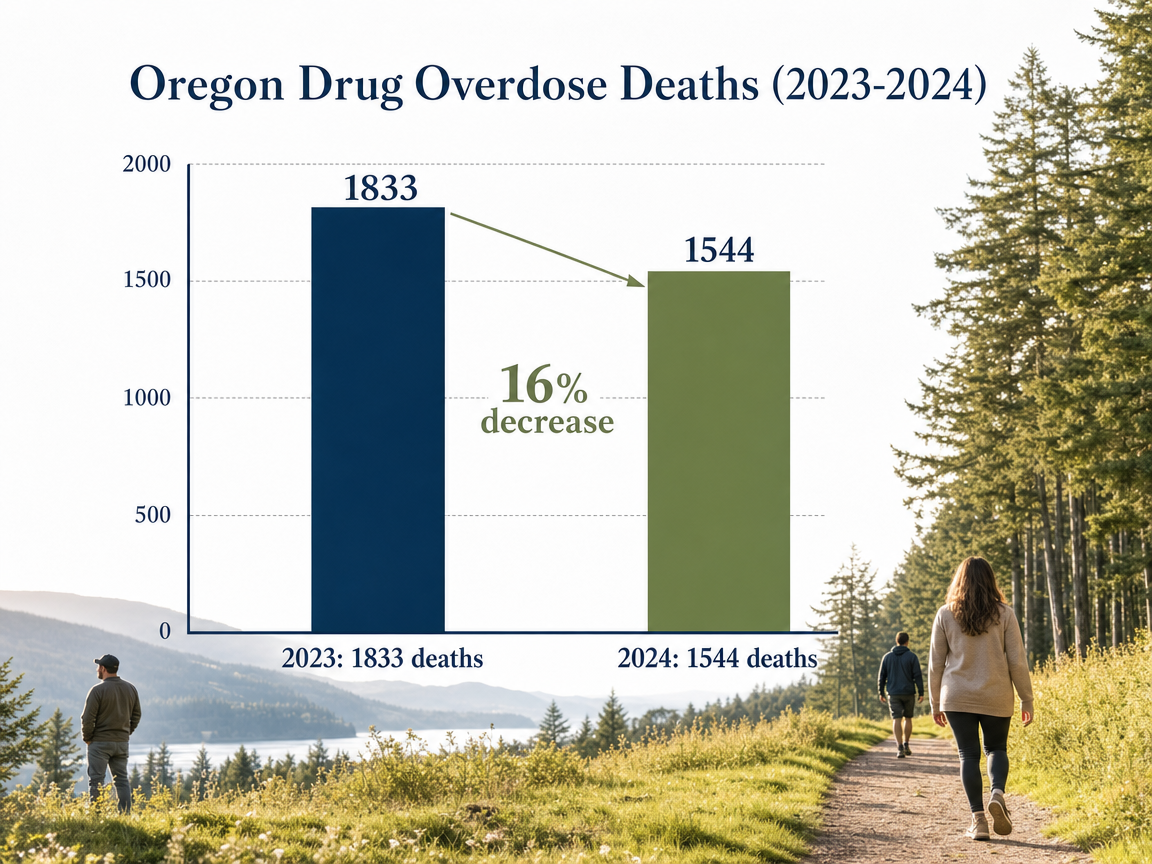
- Oregon's overall overdose deaths fell 16% in 2024, but cocaine-related harms rose and young adult use sits at 5.7%, more than double the national rate 5, 6.
- Contingency management paired with CBT carries the strongest evidence for stimulant use disorder, reinforcing negative screens with tangible rewards while building trigger-response skills 9, 11.
- Before choosing care in Portland, compare the detox handoff (Oregon Trail Recovery partners with Pacific Crest Trail Detox), the level of care fit—residential, IOP, or sober living—and OHP or insurance coverage 16.
Why Stimulant Recovery Needs Its Own Playbook
If you're reading this after a cocaine crash, or on behalf of someone you love who just finished detox, you already know something that opioid-focused rehab pages tend to miss: this doesn't feel the same. There's no Suboxone equivalent waiting at the pharmacy. No daily dose that quiets the pull. The National Institute on Drug Abuse is direct about it—no medication is currently FDA-approved to treat cocaine use disorder, which means the heavy lifting in recovery happens in behavioral treatment, structure, and skill-building 1.
That's not bad news. It's a different map.
Stimulant recovery runs on its own clock. The crash hits hard and fast, cravings come in waves for weeks, and the work of staying off cocaine looks less like managing a medication and more like rebuilding your days—sleep, people, triggers, the Tuesday night that used to belong to using. In Portland, where roughly four in five Oregonians who needed substance use treatment in 2024 didn't get it 6, finding a program that actually understands stimulants matters.
Oregon Trail Recovery is built for that exact gap: the stretch between detox stabilization and a life you can hold onto. This page walks through what cocaine withdrawal looks like, what the evidence says works, and how the handoff from detox into structured care actually happens in Portland.
What Cocaine Withdrawal Actually Feels Like
The Crash, Early Withdrawal, and the Long Tail of Cravings
Cocaine withdrawal doesn't look like what most people picture when they hear the word "detox." There's no shaking fever, no vomiting curled on a bathroom floor. The pain is quieter and, in some ways, harder to name.
The first phase is the crash. In the hours right after your last use, often stretching across the first three days, your body collapses into exhaustion. You sleep, or you try to. Appetite swings. Mood drops hard. The high-energy state your brain had been running on is gone, and what's left feels gray and heavy 1. Agitation and anxiety can show up in the same breath as flat-out fatigue 12.
Then comes early withdrawal, roughly days three through ten. The crash loosens its grip, but sleep stays uncooperative, concentration is thin, and irritability sits close to the surface. You might feel okay for an hour and then not. That's normal for stimulant recovery, even though it rarely gets talked about.
The long tail is where cocaine really distinguishes itself from opioids. From week two through week ten, cravings come in waves—triggered by a song, a street corner, a Friday night, a familiar face. Mood can stay flat. Pleasure in ordinary things takes a while to come back 1, 12. This is the stretch where behavioral treatment and structure do their heaviest work, because there's no medication to blunt the pull. You've already done the hardest physical part. What's next is the part where consistency, support, and skill-building carry you.
Why There Is No Pill for This
If you've watched a loved one stabilize on buprenorphine or methadone for opioid use, the absence of a parallel option for cocaine can feel confusing, even unfair. Here's the honest answer: no medication is currently FDA-approved to treat cocaine use disorder 1, 12. Researchers have studied bupropion, topiramate, psychostimulants, and antipsychotics, and some have shown narrow signals worth continued study, but none have crossed the bar for routine prescribing as a cocaine treatment 8.
That changes what recovery looks like. The weight shifts to behavioral treatment, structured days, relapse-prevention skills, and the kind of accountability that catches you before a craving becomes a decision. It's not a lesser path. For stimulants, it's the path with the strongest evidence behind it, and it's the one Oregon Trail Recovery is built around.
Cocaine in Oregon Right Now
A Rising Local Trend Hidden Inside Falling Overdose Numbers
Here's a number that made a lot of Oregon headlines: 1,544 people died of a drug overdose in Oregon in 2024, down from 1,833 in 2023—a 16% drop driven mostly by fewer fentanyl-related deaths 5. That's real progress, and it reflects a lot of hard work by families, outreach teams, and clinicians across the state.
If you're trying to understand why cocaine-focused care matters in Portland right now, that gap is the whole story. The overall overdose curve is bending, which is good. The stimulant curve is not bending, which is why a program built around cocaine recovery—not just repackaged opioid treatment—is more important, not less.
For you or someone you love who's working through a cocaine problem, this isn't a reason to panic. It's a reason to take the next step seriously. The resources are here. The research is clearer than it used to be. And the window right after detox is when structured care does its most important work.
Young Adults and the Oregon Gap
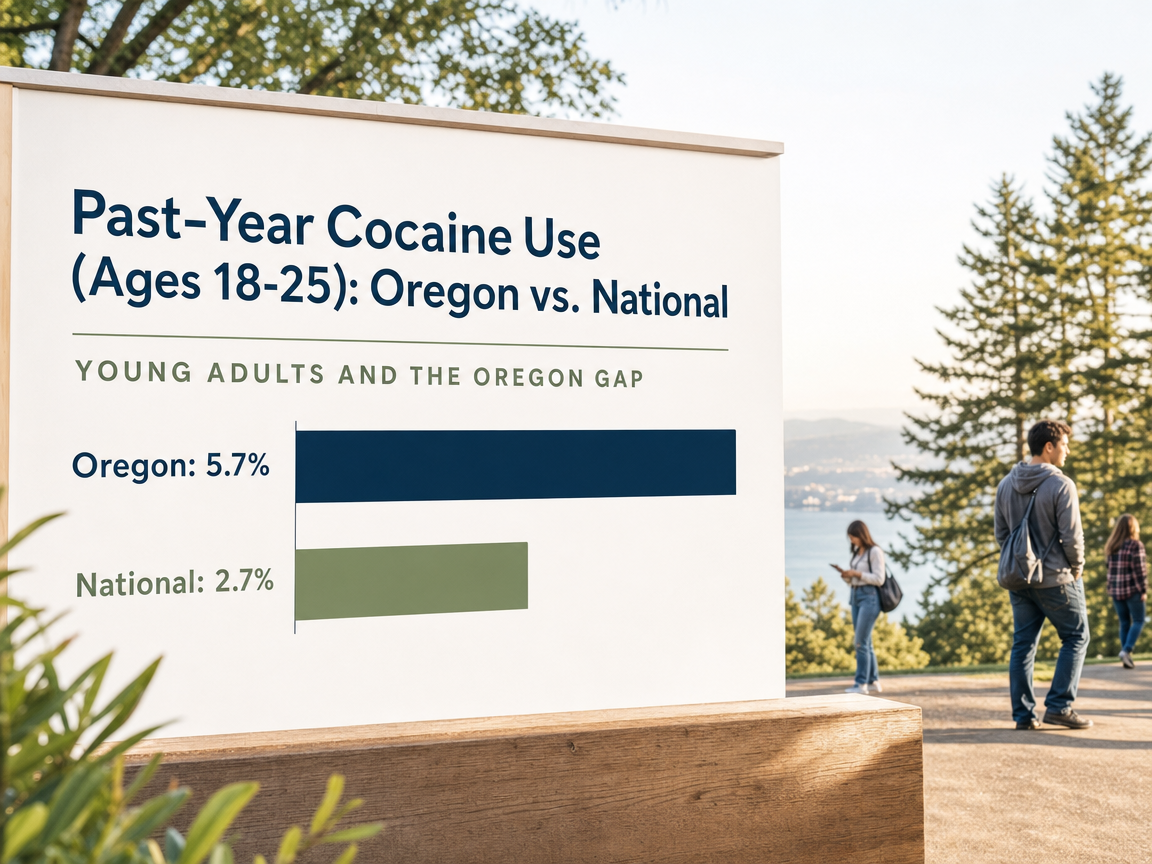
If you're a parent, a partner, or a sibling of someone in their twenties, this part may land close to home. Past-year cocaine use among Oregon adults aged 18 to 25 sits at 5.7%, compared with 2.7% nationally 6. That's more than double the national rate for the same age group.
There's no single clean reason for the gap, and the Oregon report itself cautions that federal survey changes make precise state rankings less reliable than they used to be 6. What the number does tell you is that cocaine use among young adults in Oregon isn't a fringe concern. It's a pattern big enough to shape how a Portland treatment program should think about who's walking through the door.
It also means you're not alone in this, even if it feels that way. The friend group that's hard to leave, the party house that's hard to stop driving past, the weekend that still has a shape built around using—those are shared experiences across a lot of young adults in this state right now.
Oregon Trail Recovery sees that reader. The intensive outpatient structure is designed to hold onto work or school while giving you a serious container for the recovery work itself. Call when you're ready to talk through what fits.
The First 30 to 90 Days After a Cocaine Crash
Sleep Repair, Mood Stabilization, and Structured Days
The first month after a cocaine crash is quieter than you might expect, and that quiet is part of what makes it hard. The acute physical crisis has passed. What's left is a body trying to remember how to sleep, a mood that keeps dipping without warning, and a calendar that used to have cocaine built into it in ways you may not have fully seen until now.
Sleep is often the first thing to rebuild. After the crash, your sleep architecture is scrambled—too much some nights, too little others, vivid dreams that leave you more tired than when you lay down 1. A regular wake time matters more than a regular bedtime in these early weeks. Light in the morning. Caffeine capped early. A room that signals rest instead of scrolling.
Mood tends to run flat before it runs steady. Pleasure in ordinary things—coffee, a walk along the Willamette, a conversation that used to feel easy—can take weeks to come back online 1, 12. That's the brain recalibrating, not a sign that recovery isn't working.
Structured days are the scaffolding that holds all of this up. An intensive outpatient schedule at Oregon Trail Recovery gives your week a shape: group in the morning or evening, individual sessions, time blocked for sleep and meals and movement. You're not building a perfect life yet. You're building a container that keeps the next 30 days predictable enough for the harder work to happen inside it.
Cravings Work: What to Do When the Wave Hits
Cocaine cravings don't usually arrive as a steady background hum. They come in waves, often triggered by something small—a text from someone you used with, a song on shuffle, the particular quality of a Friday afternoon in Portland when work winds down and the city starts to loosen. The wave builds, peaks, and passes. Most peaks last ten to thirty minutes if you don't act on them.
That's the central skill of early stimulant recovery: letting the wave move through you without reaching for the thing that would end it fastest. In cognitive-behavioral terms, you learn to notice the trigger, name what's happening in your body, and have a short list of practiced responses ready 11:
- Call someone from group.
- Walk a specific loop you've already mapped.
- Put a glass of cold water in your hand.
- Get to the next session on your calendar.
At Oregon Trail Recovery, cravings work is practiced out loud, not just explained. You rehearse the response before you need it. And when a wave hits between sessions, you have numbers to call and a schedule that pulls you forward. When you're ready to put that structure in place, Oregon Trail Recovery picks up.
Real Recovery Starts in Portland, Oregon
Call now or verify insurance to take the first step toward lasting recovery in Portland.
The Behavioral Spine: Contingency Management and CBT
Contingency Management, Explained Without Jargon
Contingency management is the clinical name for a simple idea: when you do the recovery behavior, something tangible and immediate happens to reinforce it. In cocaine treatment, that usually means a negative urine screen earns a small reward—a voucher, a prize draw, a modest incentive that stacks over time if you keep showing up with cocaine-negative results.
It can sound almost too plain to be clinical. But the evidence is the strongest of any behavioral approach studied for stimulants. A systematic review of 26 reviews on stimulant use disorder found contingency management had the deepest evidence base of any psychosocial intervention, with community reinforcement plus contingency management increasing abstinence both during treatment and at follow-up 9. A 2025 systematic review focused specifically on single-substance interventions found moderate-to-large effects for contingency management, and the cocaine-targeted interventions actually exceeded their predicted effect sizes 10.
What that means on a Tuesday morning: your brain, which has been running on the fast reward loop cocaine built, gets a different fast reward loop built underneath it—one tied to showing up, giving a screen, staying engaged. It's not willpower. It's wiring. And it's one of the few things the research is clear about for cocaine recovery.
CBT for Cocaine Use Disorder, and Why the Two Work Together
Cognitive-behavioral therapy does the thinking work that contingency management reinforces. In CBT, you map your triggers out loud—the people, the places, the internal states that led to using. You learn to catch the chain of thoughts between a trigger and a decision, and you practice interrupting it before it closes.
A 2024 systematic review of cocaine use disorder outcomes identified CBT and contingency management as especially appropriate approaches, and noted evidence that adding contingency management to CBT may improve and maintain abstinence at six months 11. That's the pairing that matters. CBT gives you the skills. Contingency management gives you a reason to use them this week, not someday.
At Oregon Trail Recovery, that pairing shows up in how a week is built: group work where you practice the CBT skills out loud with people doing the same work, individual sessions where you refine them for your specific triggers, and measurable goals that reinforce the behaviors as they happen.
What New Research Is Adding
The newest cocaine-treatment research is starting to ask bigger questions than abstinence alone. A 2025 randomized controlled trial tested contingency management against physiological and cardiovascular biomarkers in people with cocaine use disorder, randomizing participants to high-value reinforcers, low-value reinforcers, or a noncontingent control over a 12-week trial using urine benzoylecgonine to measure abstinence 19.
It's one study, and it doesn't settle every question. What it signals is that the field is moving from "does this reduce use" to "does reducing use heal the body you're trying to get back." That's a hopeful direction, and it's the direction cocaine-focused care in Oregon is heading too.
Co-Occurring Mental Health Care Alongside SUD Treatment
Cocaine use rarely travels alone. Depression that sat quietly before cocaine entered the picture can get louder in early recovery. Anxiety that cocaine briefly muted comes back with interest. And cocaine itself can produce psychiatric symptoms during use and withdrawal—agitation, paranoia, hallucinations, mood swings, and in some cases suicidal thinking—that need to be taken seriously and screened for carefully 13. Co-occurring psychiatric disorders are common in people with cocaine use disorder, which is why thoughtful screening belongs in the first weeks of treatment, not an afterthought 13.
Here's an honest line to hold onto: Oregon Trail Recovery is not a primary mental healthcare provider. What the program does offer is co-occurring mental health treatment alongside substance use disorder care—so when depression, anxiety, trauma responses, or sleep disruption show up during your cocaine recovery, they're treated as part of the same picture, not sent down a separate hallway. If a condition needs a higher level of psychiatric care than co-occurring treatment can offer, you'll be helped to connect with the right Oregon addiction treatment and mental health partners. That coordination is part of the work.
Fentanyl in the Cocaine Supply: What Families Should Know
Here's the hard reality worth saying plainly: the illicit cocaine supply in the U.S. isn't what it used to be. Fentanyl contamination—sometimes from cross-contaminated equipment, sometimes deliberate—has turned stimulant use into an overdose risk even for someone who has never knowingly touched an opioid. CDC data shows cocaine was involved in roughly one in five U.S. overdose deaths in 2020, and overdose deaths involving cocaine rose 22% from 2019 to 2020 2. Many of those deaths involved opioids the person didn't know were there.
From Detox to Oregon Trail Recovery: How the Handoff Works
The Pacific Crest Trail Detox Partnership
Oregon Trail Recovery does not run a medical detox under its own roof. For the first stabilization window after heavy cocaine use—when sleep is scrambled, mood is bottoming out, and medical screening needs to happen under supervision—the program partners with Pacific Crest Trail Detox.
That partnership matters because the handoff is where a lot of people fall through. You finish detox feeling fragile and still raw, and if there's no next appointment waiting, the first week home can quietly become the first week back. The Pacific Crest to Oregon Trail Recovery pathway is built to close that gap: your intake conversation, your schedule, and your first group can be lined up before you walk out of detox, so the structure meets you instead of the other way around.
If you or someone you love is still in the detox stage, a call to Oregon Trail Recovery is how that bridge gets built in advance.
Residential, IOP, and Sober Living in Portland
After detox, the right next level depends on what your life looks like right now—not on a template.
Gender-specific residential treatment gives you a full-time container when going home would mean going back to the people, places, and routines that were part of using. Days have shape. Sleep gets protected. Group and individual sessions, CBT-aligned skills work, and the measurable reinforcement patterns the cocaine research supports 11get built into the week, not squeezed around it.
Intensive outpatient programming is the fit when you need to hold onto a job, a class schedule, or a parenting load while still getting serious treatment hours. You come in several times a week, do the cravings work and the group work, and go home to practice what you learned under real conditions.
Sober living extends the scaffolding further out—a stable, substance-free home environment with accountability built in, usually alongside IOP or after residential. For post-detox cocaine recovery in Portland, that layered continuum is often what makes the difference between a strong first month and a durable first year.
Access, OHP, and Insurance in Portland
Paying for cocaine addiction treatment in Portland is less complicated than it often feels when you're trying to figure it out at 11pm on a phone. The Oregon Health Plan covers substance use disorder care, including outpatient services, residential treatment, and medically supervised withdrawal management under Oregon's Medicaid SUD framework 16. What that looks like for any specific person depends on plan rules, authorization, provider network status, and the level of care being requested 15, so a quick benefits check is worth doing before the first appointment rather than after.
If you're not sure where to start, the Oregon Health Authority maintains an Alcohol and Drug Help Line and provider directories that identify programs accepting OHP and other coverage 14. Oregon Trail Recovery can also walk you through what your plan covers for IOP, residential, and the Pacific Crest Trail Detox handoff on a single call. You don't have to have the insurance piece figured out before you reach out—figuring it out together is part of what intake is for.
When You're Ready, Here's Who Picks Up
You've done the hard part. The crash is behind you, or someone you love is on the other side of it, and the question now is what the next week looks like—not the next year.
Oregon Trail Recovery is a Portland phone call. The team can talk through what level of care fits, line up the handoff from Pacific Crest Trail Detox if that's where you're coming from, and start a benefits check against your Oregon Health Plan or private coverage on the same call. You don't need a plan already written. You need the next appointment on the calendar.
When you're ready, reach out. Someone picks up.
Frequently Asked Questions
Is there a medication that treats cocaine addiction the way Suboxone treats opioid use?
No. There's currently no FDA-approved medication for cocaine use disorder 1, 12. Some medications have shown narrow research signals worth continued study, but none are standard-of-care prescribing for cocaine 8. Recovery leans on behavioral treatment, structure, and skill-building instead—which is where Oregon Trail Recovery focuses.
How long does cocaine withdrawal last after the last use?
The acute crash usually spans the first 1 to 3 days, with heavy fatigue, flat mood, and scrambled sleep. Early withdrawal continues through roughly day 10. Cravings and mood flatness often come in waves through weeks 2 to 10, which is why ongoing behavioral treatment matters most during that longer stretch 1, 12.
Does Oregon Trail Recovery provide medical detox for cocaine?
No. Oregon Trail Recovery partners with Pacific Crest Trail Detox for medical detox and inpatient-level stabilization. Once you've been medically stabilized, the handoff into Oregon Trail Recovery's residential treatment, intensive outpatient programming, or sober living can be lined up before you walk out of detox—so your next appointment is already waiting.
Will the Oregon Health Plan (OHP) cover cocaine addiction treatment in Portland?
OHP covers substance use disorder care under Oregon's Medicaid SUD framework, including outpatient services, residential treatment, and medically supervised withdrawal management 16. What's covered for any specific person depends on plan rules, authorization, provider network status, and the level of care requested 15. A quick benefits check at intake clarifies your coverage.
What is contingency management, and how is it used in cocaine recovery?
Contingency management reinforces recovery behaviors—like showing up and giving a cocaine-negative urine screen—with small, tangible rewards that stack over time. It has the strongest evidence base of any behavioral intervention for stimulants 9, and a 2025 review found cocaine-targeted contingency management exceeded predicted effect sizes 10. It pairs especially well with CBT 11.
What should families know about fentanyl showing up in the cocaine supply?
Illicit cocaine is sometimes contaminated with fentanyl, which has pushed stimulant-involved overdose deaths up—overdose deaths involving cocaine rose 22% from 2019 to 2020, and roughly one in five U.S. overdose deaths in 2020 involved cocaine 2. Keep naloxone (Narcan) accessible at home and in bags, and learn how to use it.
References
- Cocaine - National Institute on Drug Abuse (NIDA) - NIH. https://nida.nih.gov/research-topics/cocaine
- Stimulant Guide. https://www.cdc.gov/drugoverdose/featured-topics/stimulant-guide.html
- Stimulants | Overdose Prevention. https://www.cdc.gov/overdose-prevention/about/stimulant-overdose.html
- SUDORS Dashboard: Fatal Drug Overdose Data. https://www.cdc.gov/overdose-prevention/data-research/facts-stats/sudors-dashboard-fatal-overdose-data.html
- 2025 - Opioids and the Ongoing Drug Overdose Crisis in Oregon. https://www.oregon.gov/oha/PH/PREVENTIONWELLNESS/SUBSTANCEUSE/OPIOIDS/SiteAssets/Lists/feature/EditForm/2025%20Oregon%20Opioid%20Overdose%20Report.pdf
- Programmatic and Fiscal Inventory of Primary. https://www.oregon.gov/adpc/Documents/HB3321%20Report%2009.15_FULL%20REPORT%20WITH%20APPENDICES.pdf
- National Institute on Drug Abuse: Cocaine. https://nida.nih.gov/sites/default/files/1141-cocaine.pdf
- Pharmacotherapy for Cocaine Use Disorder-a Systematic Review and Meta-analysis. https://pubmed.ncbi.nlm.nih.gov/31183685/
- Treatment of stimulant use disorder: A systematic review of reviews. https://pmc.ncbi.nlm.nih.gov/articles/PMC7302911/
- Contingency management for monosubstance use disorders: Systematic review and assessment of predicted versus obtained effects. https://pubmed.ncbi.nlm.nih.gov/39545650/
- Predictors of cocaine use disorder treatment outcomes. https://pmc.ncbi.nlm.nih.gov/articles/PMC11077740/
- Cocaine Use Disorder (CUD): Current Clinical Perspectives. https://pubmed.ncbi.nlm.nih.gov/36093428/
- Cocaine and Psychiatric Symptoms. https://pmc.ncbi.nlm.nih.gov/articles/PMC181074/
- Oregon Health Authority: Addiction Services. https://www.oregon.gov/oha/BH/Adults/Pages/Substance-Use.aspx
- Oregon Health Authority: Behavioral Health Services Rules. https://www.oregon.gov/oha/HSD/OHP/Pages/Policy-BHS.aspx
- Section 1115 SUD Monitoring Report Template (Version 3.0). https://www.oregon.gov/oha/HSD/Medicaid-Policy/SUDWaiver/or-health-plan-sud-quart-rpt-part-b-jul-sep-2024.pdf
- 95 Neighborhood Profiles Showcase Economic And Livability Issues. https://www.portland.gov/civic/news/2023/2/3/95-neighborhood-profiles-showcase-economic-and-livability-issues
- State of Housing in Portland 2024 - Executive Summary. https://www.portland.gov/phb/documents/state-housing-portland-2024-executive-summary/download
- A single-blind, randomized, controlled contingency management trial on physiological indices and biomarkers of cardiovascular health in people with cocaine use disorder. https://pubmed.ncbi.nlm.nih.gov/40088641/
Relapse Doesn't Mean the End Of Your Journey
Reach out today to explore programs that support real, long-term sobriety.