



The Right Addiction Center for Long-Term Sobriety

Key Takeaways
- Choosing a program starts with matching the level of care to withdrawal risk, acuity, readiness, and home environment, not picking a 30-day facility by brand or brochure.
- Intensive outpatient care can produce outcomes comparable to residential for appropriate candidates 7, while medications for opioid and alcohol use disorder belong in routine clinical practice 2, 6.
- Verify Oregon certification under ASAM Level 2.1 for IOP and Division 18 for residential 15, 16, then use the ten-question admissions script to test for clinical substance.
Why the 30-day rehab question is the wrong starting point
If you've landed here, you've probably already asked some version of the question: "What's the best 30-day rehab for my adult child?" It's a reasonable place to start. It's also, respectfully, the wrong one.
The honest truth is this: a month-long stay, by itself, rarely produces lasting sobriety. The National Institute on Alcohol Abuse and Alcoholism (NIAAA) is direct about it: detox is not treatment, and a course of care for alcohol use disorder is likely measured in months, not days or weeks, with continued care often needed to sustain recovery 5, 6. Opioid use disorder follows the same pattern, with medications and ongoing support working together over time rather than inside a single admission window 2.
So the better question isn't "Which facility is best?" It's "Which level of care fits this moment, and what comes after it?" Recovery is a chain of connected steps: possibly withdrawal management, maybe residential, often intensive outpatient, usually recovery housing, and continuing care that stretches well past discharge day.
You're tired. You may have watched a prior episode end badly. That exhaustion is real, and it isn't a failure of love or research. It's a signal that the old frame hasn't been serving your family. The rest of this guide gives you a new one.
The continuum of care, translated for parents
What each level of care actually does
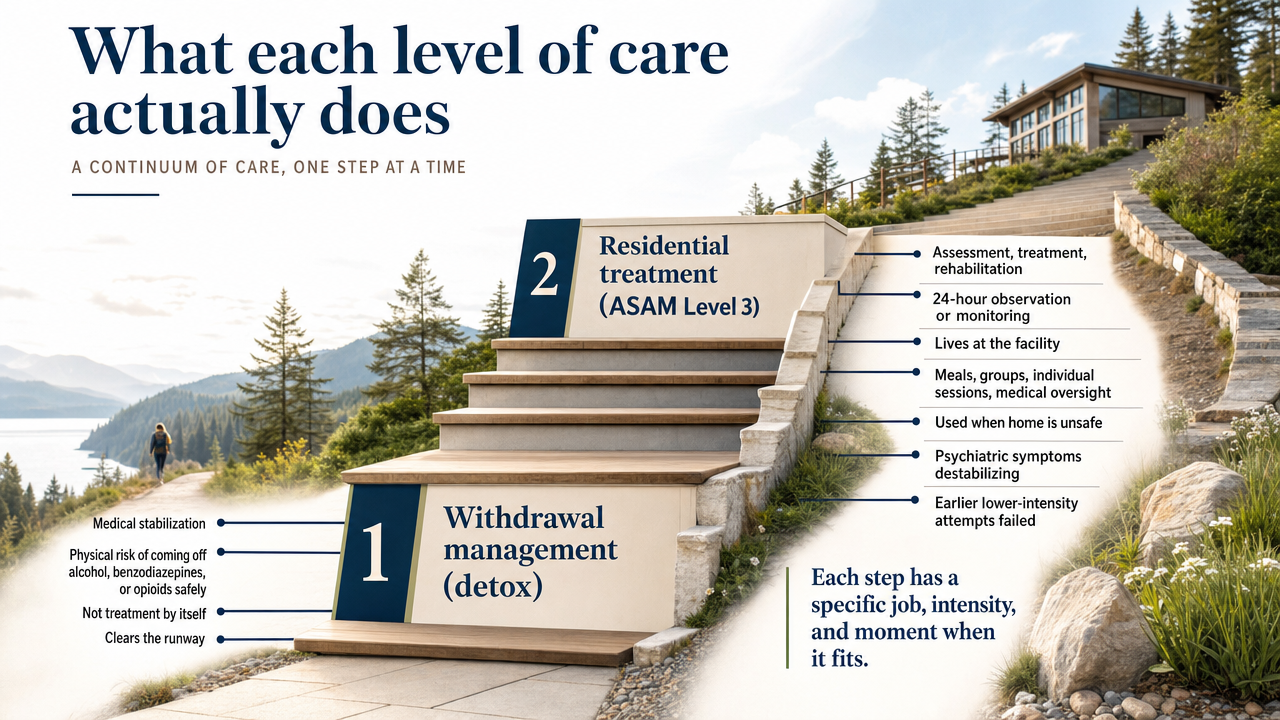
Think of addiction treatment less as a single building and more as a staircase. Each step has a specific job, a specific intensity, and a specific moment when it fits.
Withdrawal management (detox). This is the medical stabilization phase. It handles the physical risk of coming off alcohol, benzodiazepines, or opioids safely. NIAAA is clear that detox, by itself, is not treatment 5. It clears the runway. It doesn't build the plane.
Residential treatment (ASAM Level 3). Oregon's rules define this as assessment, treatment, and rehabilitation with 24-hour observation or monitoring 16. Your adult child lives at the facility. Meals, groups, individual sessions, and medical oversight all happen under one roof. It's the right call when the home environment is unsafe, when psychiatric symptoms are destabilizing, or when earlier attempts at lower intensity haven't held.
Intensive outpatient (ASAM Level 2.1, or IOP). Oregon defines IOP as structured, nonresidential care for people who need more therapeutic contact than traditional outpatient services provide 14. The Substance Abuse and Mental Health Services Administration (SAMHSA) describes adult IOP as generally delivering at least nine hours of clinical services per week, often across three or four sessions 1. Your adult child sleeps at home or in sober housing, works or attends school around sessions, and practices recovery skills in real life between groups.
Traditional outpatient. One to a few hours of counseling per week. Appropriate for people who are stable and need continuing support, not acute structure.
Recovery housing (sober living). A substance-free residence paired with peer accountability. The NIAAA review of recovery from alcohol use disorder reports that recovery-home stays of at least six months are associated with better long-term outcomes 9.
The staircase isn't always climbed in order. Many people step down from residential into IOP, then into weekly outpatient while living in a recovery home. Others start at IOP and never need residential at all. The right question isn't "which step is best?" It's "which step fits where my adult child is standing today?"
Matching the moment: withdrawal risk, acuity, and environment
A credible addiction center won't let you shop by brochure. They'll run an assessment first, because the appropriate level of care depends on the clinical picture in front of them, not on which bed happens to be open.
SAMHSA's guidance on co-occurring disorders is specific about this: placement should match functional challenges, symptom severity, and the recovery environment, with continuity of care planned across settings 4. Translated for you as a parent, a thoughtful intake asks about four things.
- First, withdrawal risk. Is your adult child drinking daily, using benzodiazepines, or using opioids in a way that makes stopping medically dangerous? If yes, withdrawal management comes before anything else.
- Second, medical and psychiatric acuity. Are there untreated health conditions, suicidal thoughts, or psychiatric symptoms that need 24-hour monitoring? Higher acuity pushes toward residential. Stable acuity opens the door to IOP.
- Third, readiness and engagement. Has your adult child tried outpatient care before and disengaged? Are they ambivalent about change? Lower readiness often benefits from the structure and separation residential provides, at least to start.
- Fourth, the recovery environment. This is where many parents in the Portland metro and Central Oregon get stuck. If home means a partner who still drinks heavily, a neighborhood where substances are a text message away, or isolation that drives relapse, outpatient care alone can be set up to fail. Recovery housing paired with IOP often solves what residential alone cannot sustain.
A program that assesses all four and then recommends a level, honestly, even if it's not the level they sell, has already shown you something important about how they practice.
Why IOP is the workhorse most parents underestimate
Here's the piece most families don't hear on the first phone call: for the right person, intensive outpatient care can produce outcomes comparable to residential treatment.
A peer-reviewed evidence review of substance abuse intensive outpatient programs rated the IOP research base as high and found generally comparable outcomes between IOP and inpatient or residential services across multiple studies, with substantial reductions in substance-use problems in both settings 7. That's a meaningful counter-narrative to the common assumption that longer, higher-cost residential care is always the stronger choice.
The caveat matters, so hold it alongside the finding. IOP programs vary significantly in staffing, weekly hours, services offered, and how they measure results 7. The label alone tells you very little. Two programs can both call themselves IOP and deliver wildly different experiences.
What IOP does well, when it's well-run, is bridge the gap between a controlled environment and the actual life your adult child has to rebuild. Groups on a Tuesday evening teach a coping skill. Wednesday morning at work, that skill gets tested. Thursday's individual session unpacks what happened. The feedback loop is tight, and the learning happens where it has to stick.
IOP is also where family involvement, employment support, and continuing care tend to get stitched together 1. For an adult child stepping down from residential or detox, it's often the connective tissue between a protected 30 days and a durable year.
Real Recovery Starts in Portland, Oregon
Call now or verify insurance to take the first step toward lasting recovery in Portland.
What evidence-based treatment looks like inside the building
Therapies that have earned their place
Walk into a credible addiction center and you shouldn't hear about a single "signature method" that fixes everything. You should hear about a small toolbox used thoughtfully: cognitive behavioral therapy, dialectical behavior therapy, motivational interviewing, relapse-prevention skills, trauma-informed approaches like Seeking Safety, and structured family work.
Why the mix? A recent umbrella review of 30 systematic reviews of psychosocial interventions for adults with substance use disorder and co-occurring mental-health conditions found widespread improvement across therapies, but substantial heterogeneity in populations and outcomes, making it hard to crown any single approach as universally superior 12. The research supports a matched toolbox, not a magic one.
What you can ask a program directly: Which therapies do your clinicians deliver, how often, and in what format—individual, group, or family? Who leads each group, and what's their training? Programs that answer in specifics (a Monday CBT group of eight, a weekly individual DBT session, a family psychoeducation night twice a month) are telling you something real. Programs that answer in adjectives—holistic, cutting-edge, personalized—are telling you something, too.
Medications for opioid and alcohol use disorder
If your adult child is struggling with opioids or alcohol, ask early whether the program offers or coordinates medication treatment. This is not optional background information. It's one of the clearest signals of clinical seriousness.
SAMHSA's Treatment Improvement Protocol identifies methadone, buprenorphine, and naltrexone as FDA-approved medications for opioid use disorder, and describes effective care as combining medication with counseling, monitoring, and recovery supports 2. For alcohol use disorder, NIAAA recommends evidence-based treatment that may include medications alongside counseling, delivered in residential, outpatient, or combined settings 6.
Programs differ. Some prescribe directly. Some coordinate with an outside prescriber. Some, unfortunately, still discourage medication on philosophical grounds, which runs against current clinical guidance.
Fair questions on the admissions call: Do you offer medications for opioid use disorder on-site, or do you refer? Will my adult child be able to start or continue buprenorphine or naltrexone during the program? How is medication duration decided, and by whom? A program that treats medication as a routine clinical option, not a last resort, is operating in step with the evidence.
Co-occurring mental health support vs. primary psychiatric care
This distinction trips up a lot of families, and it matters. Many addiction centers, including the strong ones in the Portland metro and across the Pacific Northwest, offer co-occurring mental health support—screening for and treating depression, anxiety, PTSD, and similar conditions alongside substance use. That's different from being a primary psychiatric hospital or standalone mental health clinic.
SAMHSA's guidance on co-occurring disorders recommends screening for mental health conditions at intake, coordinating care across providers, using staged treatment, and offering individual, group, family, and peer formats within an integrated plan 4. A 2023 systematic review of co-located mental health and substance use treatment found provisional evidence of reduced substance use, lower mental-health symptom severity, fewer emergency visits and hospital admissions, and lower health-system expenditure, while noting that many studies had meaningful risk of bias 11.
What to ask: Do you screen for co-occurring conditions at admission? Who on staff can address them, and how? If my adult child needs more intensive psychiatric care than you provide—an acute episode, medication management beyond your scope, or inpatient psychiatric stabilization—who do you partner with, and how fast does that handoff happen? A program that knows its lane, and knows exactly who to call when a case crosses it, is a program you can trust.
The admissions call: ten questions that separate clinical substance from marketing
Pick a quiet Thursday afternoon. Have a notepad ready. The first ten minutes of an admissions call will tell you more than a dozen testimonials ever will, if you ask the right questions and listen for specifics instead of adjectives.
Here's the script.
- 1. What ASAM level of care are you certified to provide, and under which Oregon rule? For intensive outpatient, you want to hear ASAM Level 2.1 certification; for residential, licensing under Oregon's Division 18 residential rules 15, 16. A program that can name its own certification without hesitation is a program that has read its own paperwork.
- 2. How many clinical hours per week does your IOP deliver, and across how many sessions? SAMHSA guidance describes adult IOP as generally providing at least nine hours per week 1. If the answer is vague or well below that, keep asking.
- 3. Do you screen every admission for co-occurring mental health conditions, and who does the screening? SAMHSA's co-occurring guidance expects screening at intake and coordinated care across providers 4. "We handle it as it comes up" isn't an answer.
- 4. Do you offer or coordinate medications for opioid use disorder—buprenorphine, naltrexone, or methadone? SAMHSA's TIP 63 treats these as FDA-approved standards of care, combined with counseling and recovery support 2. Philosophical objections to medication are a flag.
- 5. How is family therapy structured, and how often does it happen? SAMHSA's family therapy advisory connects positive family involvement to long-term abstinence and conflict-driven dynamics to higher relapse risk 3. Ask for the format: psychoeducation night, multi-family group, scheduled sessions with the primary clinician.
- 6. What does continuing care look like after discharge, and who schedules it? A warm handoff beats a phone number on a discharge sheet.
- 7. Do you have recovery housing partnerships, and how do referrals work?
- 8. How do you measure outcomes—retention past 90 days, abstinent days, return to work or school—and will you share them?
- 9. How do you handle my adult child's consent and my involvement if they sign a release, and what happens if they don't?
- 10. Walk me through a realistic discharge plan at week one, not week four. The answer tells you whether the program is thinking in months or in billable days.
Verifying programs against Oregon and Pacific Northwest standards
Marketing copy is cheap. Certification isn't. Before you commit to a program in the Portland metro, Central Oregon, or anywhere in the Pacific Northwest, spend fifteen minutes verifying what the state actually says about it.
For intensive outpatient care, Oregon's rules require ASAM Level 2.1 programs to be certified by the state's behavioral health division to provide outpatient SUD treatment and recovery services 15. The administrative definition is specific: IOP is structured, nonresidential care for people who need more therapeutic contact than traditional outpatient services provide 14. Ask the admissions team for their certification status and the program's listed level of care. A credible team answers in seconds.
For residential treatment, Oregon's Division 18 rules require licensure to deliver 24-hour assessment, treatment, rehabilitation, and monitoring consistent with ASAM Level 3 16. If a program in the region offers residential beds, it should be licensed under that framework. If detox is part of the plan, that's a separate medical level typically delivered through partner facilities, which is common across the Pacific Northwest.
One honest caveat: certification confirms a program meets regulatory minimums. It does not, by itself, tell you anything about staffing stability, family experience, or whether your adult child will still be engaged at day 90. Pair the paperwork check with the admissions-call script, and you'll have both the floor and the ceiling in view.
Family involvement without overriding an adult child
What positive support actually looks like
Your love is not the problem. The question is where to point it.
SAMHSA's family therapy advisory is clear that positive family support is associated with long-term abstinence and recovery, while conflict or social pressure to use is associated with higher relapse risk 3. That cuts both directions. The same parent who shows up to a Thursday family night can also, without meaning to, raise relapse risk by criticizing, policing, or rescuing.
Positive support tends to look like steady, boring reliability. You attend the family psychoeducation nights the program offers. You learn the language your adult child is learning—triggers, cravings, relapse-prevention skills—so the vocabulary is shared. You celebrate the small wins out loud: a completed week of IOP groups, an honest conversation, a sponsor call made at 11 p.m. instead of a drink poured.
What it isn't: paying every bill, driving every ride, speaking for your adult child in sessions, or treating one hard day as a verdict on the whole year. Hold the line between support and control. Your adult child's recovery has to belong to them.
Consent, confidentiality, and the release of information
Here's where many parents hit a wall. Your adult child is over 18. Federal and state confidentiality rules protect their treatment information, and a credible program won't share clinical details with you unless your adult child signs a release of information naming you specifically.
That can feel like being shut out. It isn't. It's the frame that makes real trust possible.
Ask the program how they handle consent from the first intake call. A thoughtful team will invite your adult child to decide what you get to know—progress updates only, participation in family sessions, inclusion in discharge planning, or nothing at all—and will document it. SAMHSA's co-occurring guidance treats individual, group, family, and peer formats as part of integrated care, with the person in treatment at the center of those choices 4.
If your adult child declines a release today, that door isn't locked forever. Trust rebuilds in small installments. Keep showing up the way you'd want to be shown up for, and let consent arrive on its own schedule.
Continuing care, recovery housing, and the first 90 days after discharge
The weeks after a residential stay or an IOP completion are where recovery is most often won or lost. The structure drops. The groups end. Monday morning arrives without a schedule, and the old cues (the drive past a familiar bar, the group text from the person who still uses, the Sunday night loneliness) are waiting right where they always were.
Two things stack the odds in your adult child's favor during this window.
The first is active continuing care. NIAAA's review of recovery from alcohol use disorder reports that longer continuing care paired with active engagement efforts (not just a phone number handed over at discharge) tends to produce more consistently positive results 9. Ask the program who schedules the first follow-up appointment, who calls if your adult child misses it, and how long the continuing-care relationship lasts. A warm handoff beats a brochure every time.
The second is recovery housing. A 2025 systematic review of recovery housing for substance use disorder found moderate evidence that recovery housing outperformed usual continuing care on abstinence, employment, and income outcomes 10. NIAAA's review adds that recovery-home stays of at least six months are associated with better long-term outcomes 9. Six months, not six weeks. That timeline is worth saying out loud at the family table before discharge day, so no one is surprised when the plan isn't "come home next weekend."
Access, telehealth, and when geography complicates care
If your adult child lives in Bend, La Grande, or a smaller Pacific Northwest town, geography is part of the clinical picture. A program that looks great on paper means little if the drive to Tuesday evening group is ninety minutes each way.
Telehealth has become a real option for some families, though it's smaller than the marketing suggests. SAMHSA's 2024 national survey found that 5.4% of people aged 12 or older with a past-year substance use disorder received substance-use treatment through telehealth 13. Useful for continuing-care sessions, family involvement across distance, or Wyoming residents without local IOP access. Not a replacement for the in-person groups that carry most of the clinical weight.
Ask admissions directly: what parts of the program can happen remotely, and what has to be in the room?
Where to go from here
Close the laptop for a minute. You already know more than you did an hour ago, and that's enough for tonight.
This week, pick three programs in the Portland metro, Central Oregon, or wherever your adult child is willing to go. Verify each one's Oregon certification 15, 16. Call admissions with the ten-question script in hand. Listen for specifics, not adjectives.
Then have one honest conversation with your adult child about what level of care fits right now, and who they'd allow on a release of information. Oregon Trail Recovery is one option in that search, among others worth calling.
Recovery is measured in months, sometimes years 6. You don't have to get the whole plan right today. You just have to make the next good call.
Frequently Asked Questions
How do I know if my adult child needs residential treatment or an intensive outpatient program?
A clinical assessment should drive that call, not a brochure. SAMHSA guidance says placement depends on functional challenges, symptom severity, and the recovery environment 4. Higher withdrawal risk, acute psychiatric symptoms, or an unsafe home usually point to residential. Stable medical status and a workable living situation often fit intensive outpatient, where outcomes can be comparable for appropriate candidates 7.
What should I look for to verify an Oregon addiction center is properly licensed?
For intensive outpatient care in Oregon, ASAM Level 2.1 programs must be certified by the state's behavioral health division 15. For residential care, programs must be licensed under Oregon's Division 18 rules to provide 24-hour assessment, treatment, and monitoring consistent with ASAM Level 3 16. Ask admissions to name their certification and level of care out loud.
Can I participate in my adult child's treatment without violating their confidentiality?
Yes, but only with their consent. A credible program will ask your adult child what you may know and document it on a release of information. Within those boundaries, you can attend family psychoeducation nights, join scheduled family sessions, and support discharge planning. SAMHSA notes positive family involvement supports recovery, while conflict raises relapse risk 3.
Why isn't a 30-day program enough for long-term sobriety?
Because recovery timelines don't match billing cycles. NIAAA states a course of alcohol use disorder treatment is likely measured in months rather than days or weeks, with continued care often needed to sustain abstinence 6. Detox alone is not treatment 5. A 30-day stay can be a strong beginning, but the next six to twelve months carry most of the clinical weight.
Should the program offer medications for opioid or alcohol use disorder?
If opioids or alcohol are part of the picture, yes. SAMHSA's TIP 63 identifies methadone, buprenorphine, and naltrexone as FDA-approved medications for opioid use disorder, delivered alongside counseling and recovery support 2. NIAAA recommends evidence-based treatment for alcohol use disorder that may include medications 6. A program that discourages medication on principle is out of step with current guidance.
What questions should I ask on the admissions call?
Ask about ASAM certification level, weekly clinical hours (SAMHSA describes adult IOP as at least nine hours per week 1), co-occurring screening at intake 4, medication policy, family therapy structure, continuing care scheduling, recovery housing partnerships, outcome measurement, how consent and releases are handled, and a realistic discharge plan sketched at week one. Listen for specifics, not adjectives.
References
- CLINICAL ISSUES IN INTENSIVE OUTPATIENT TREATMENT FOR SUBSTANCE USE DISORDERS. https://library.samhsa.gov/sites/default/files/pep20-02-01-021.pdf
- TIP 63 - Medications for Opioid Use Disorder. https://library.samhsa.gov/sites/default/files/SAMHSA_Digital_Download/PEP20-02-01-005_0.pdf
- THE IMPORTANCE OF FAMILY THERAPY. https://library.samhsa.gov/sites/default/files/pep20-02-02-016.pdf
- Substance Use Disorder Treatment for People With Co-Occurring Disorders. https://library.samhsa.gov/sites/default/files/pep20-06-04-006.pdf
- Alcohol Use Disorder: From Risk to Diagnosis to Recovery. https://www.niaaa.nih.gov/health-professionals-communities/core-resource-on-alcohol/alcohol-use-disorder-risk-diagnosis-recovery
- Recommend Evidence-Based Treatment. https://www.niaaa.nih.gov/health-professionals-communities/core-resource-on-alcohol/recommend-evidence-based-treatment-know-options
- Substance Abuse Intensive Outpatient Programs: Assessing the Evidence. https://pmc.ncbi.nlm.nih.gov/articles/PMC4152944/
- Substance abuse intensive outpatient programs: assessing the evidence. https://pubmed.ncbi.nlm.nih.gov/24445620/
- Recovery From Alcohol Use Disorder. https://arcr.niaaa.nih.gov/media/1561/download
- Recovery housing for substance use disorder: a systematic review. https://pubmed.ncbi.nlm.nih.gov/40115346/
- Health outcomes and service use patterns associated with co-located mental health and alcohol and other drug treatment: a systematic review. https://pubmed.ncbi.nlm.nih.gov/37015828/
- Effectiveness of psychosocial interventions for adults with substance use disorder that have a co-occurring common mental health disorder: an umbrella review. https://pubmed.ncbi.nlm.nih.gov/42381425/
- Results from the 2024 National Survey on Drug Use and Health. https://www.samhsa.gov/data/sites/default/files/reports/rpt56287/2024-nsduh-annual-national/2024-nsduh-annual-national-html-071425-edited/2024-nsduh-annual-national.htm
- Health Systems Division: Behavioral Health Services - Chapter 309. https://www.oregon.gov/oha/HSD/RAC/309-019.pdf
- Behavioral Health Services - Chapter 309. https://www.oregon.gov/oha/HSD/Medicaid-Policy/SUDWaiver/309-019-Highlighted-040723.pdf
- DIVISION 18 RESIDENTIAL SUBSTANCE USE DISORDERS AND RECOVERY SERVICES. https://www.oregon.gov/oha/HSD/Medicaid-Policy/SUDWaiver/309-018-Highlighted-040723.pdf
Relapse Doesn't Mean the End Of Your Journey
Reach out today to explore programs that support real, long-term sobriety.