




When to Choose Residential Treatment Centers for Adults

Key Takeaways
- Residential treatment at ASAM Level 3 is a 24-hour clinically managed setting designed for people whose home environment, mental health, or relapse history makes outpatient recovery unrealistic after detox 7.
- Use the ASAM six-dimension framework to decide: withdrawal load, medical needs, emotional stability, readiness, relapse pattern, and recovery environment together determine whether Level 3 fits better than IOP or sober living.
- Short-cycle relapses after prior outpatient attempts, active substance use in the home, severe co-occurring symptoms, or persistent cravings two weeks post-detox are strong signals pointing toward residential care 1.
- Compliant Oregon programs identify their licensed ASAM sublevel, assess placement against the six dimensions, and build a step-down plan early, since outcomes depend heavily on continuing care after discharge 9, 10.
The decision that comes after detox
Deciding what comes after detox is one of the harder calls in early recovery. You've completed the physically demanding part, and your body is stabilizing. Now, you face a choice: return home with an outpatient schedule, move into a sober living house, or enter a 24-hour residential program. This decision is more impactful than many realize.
In 2021, only 6.8% of individuals needing substance use treatment received it at a specialty facility, according to NIDA's summary of national survey data 2. If you're at the post-detox decision point, you're already navigating a system where many do not even reach this stage.
This article provides a clear understanding of when residential treatment is the appropriate next step, when it is not, and what a compliant Oregon program should offer. It uses the framework clinicians employ to help you make an informed decision.
What residential treatment actually is at Level 3
The 24-hour structured setting, defined
Residential treatment at ASAM Level 3 is distinguished by one key factor: you live there. The environment is staffed around the clock, clinically managed, and structured to provide support you might not be able to generate independently 7. This structure is crucial when early recovery is fragile, as the environment helps stabilize your nervous system.
Within a Level 3 program, your day is organized with group therapy, individual sessions, medication management if needed, meals, chores, and sleep. The CMS/Medicaid ASAM guide describes these programs as offering "a safe, stable environment that is critical to individuals as they begin their recovery" 7. This safety extends beyond the physical, removing environmental cues, people, and access points associated with past substance use.
This setting provides a supportive container where clinical care can be effectively delivered.
Residential rehabilitation is not residential detox
If you've recently completed a stay at a detox facility, you've experienced a 24-hour setting, but residential detox differs from residential rehabilitation. SAMHSA's TIP 45 quick guide describes clinically managed residential detox (Level III.2-D) as care for individuals whose withdrawal "is sufficient to warrant 24-hour support" but who do not require full medical monitoring 3. Its primary goal is safe withdrawal management.
Residential rehabilitation begins after your body has stabilized. The focus shifts from managing acute physical symptoms to rebuilding psychological, behavioral, and social support for your recovery. While both are residential, their clinical missions are distinct.
It's important not to confuse the two. Completing detox is a significant step, but the subsequent decision about rehabilitation is separate.
Where Level 3 sits on the ASAM continuum
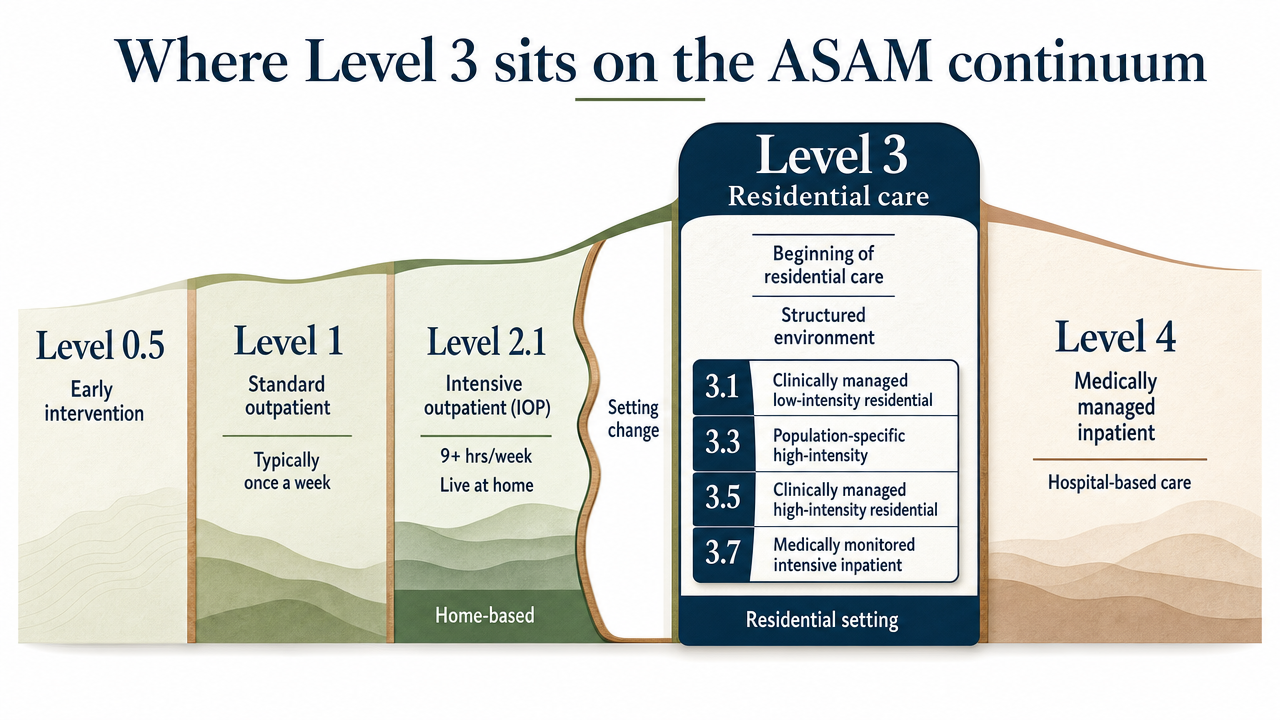
The ASAM Criteria categorize substance use care along a continuum:
- Level 0.5 is early intervention, and Level 1 is standard outpatient care, typically once a week.
- Level 2.1 is intensive outpatient (IOP), involving nine or more hours of clinical programming weekly while living at home.
- Level 3 marks the beginning of residential care, with sublevels: 3.1 (clinically managed low-intensity residential), 3.3 (population-specific high-intensity), 3.5 (clinically managed high-intensity residential), and 3.7 (medically monitored intensive inpatient).
- Level 4 is medically managed inpatient, which is hospital-based care 7.
The transition from Level 2.1 to Level 3 involves more than just increased hours; it's a change in setting. IOP assumes you can maintain recovery at home, while Level 3 provides a structured environment when that's not yet feasible. The shift from Level 3 to Level 3.7 or Level 4 indicates a need for medical monitoring by nurses and physicians due to medical or psychiatric acuity 7.
All Level 3 programs share the characteristic of being "provided in a structured, residential setting that is staffed 24 hours daily and are clinically managed" 7. Variations among sublevels relate to intensity, population, and staffing, but the core commitment to 24-hour structure remains. Understanding this continuum helps in selecting the appropriate level of care.
The ASAM six-dimension read on your own situation
Dimension 1 and 2: withdrawal risk and biomedical load
The first two ASAM dimensions assess your physical health. Dimension 1 addresses acute intoxication and withdrawal potential, while Dimension 2 examines biomedical conditions and complications 7. These dimensions collectively determine if your physical state is stable enough to support recovery in an outpatient setting.
If you've completed detox, acute withdrawal is likely over. However, post-acute withdrawal symptoms, such as sleep disturbances, intense cravings, and autonomic instability, can persist for weeks. Substances like alcohol, benzodiazepines, and opioids have prolonged post-acute symptoms. If these symptoms significantly impact your daily life, a 24-hour setting can alleviate the burden of managing them alone 3.
Dimension 2 considers other medical factors: uncontrolled diabetes, chronic pain, hepatitis, pregnancy, recent injuries, and medications requiring daily supervision. When your medical needs are substantial, a clinically managed residential setting provides monitoring without requiring hospitalization 7.
Dimension 3: emotional, behavioral, and cognitive conditions
Dimension 3 often guides post-detox decisions, focusing on your current mental health, emotional regulation, and cognitive function, independent of your pre-substance use state 7.
Consider your current emotional state: are you experiencing suicidal thoughts, debilitating panic attacks, severe depression that makes daily tasks difficult, or trauma symptoms that intensify when you try to relax? Conditions like PTSD, bipolar disorder, and major depression frequently co-occur with substance use, and detox can reveal symptoms previously masked by substance use 1.
A residential setting can provide the necessary support. Staff are available overnight for crises, medication adjustments can be closely monitored, and structured group and individual therapy sessions are provided. If your emotional challenges outweigh your current coping skills, Level 3 care is a strong consideration.
Dimension 4 and 5: readiness to change and relapse pattern
Dimension 4 assesses your readiness to change, and Dimension 5 evaluates your relapse history and potential for continued substance use 7. These dimensions often require honest self-reflection.
Readiness isn't about motivation on your best day, but rather your actions on your worst. If you feel significant ambivalence or are contemplating future substance use, a structured environment can reduce the immediate pressure of making difficult decisions.
For Dimension 5, examine your past patterns. How often have you relapsed within 30 days of outpatient treatment? Do cravings intensify rapidly when you're alone? Does a single instance of substance use consistently lead to a full relapse? A history of short-cycle relapses, particularly after previous outpatient attempts, strongly indicates that Level 3 is the appropriate next step 1. This suggests that outpatient care may no longer be sufficient for your current needs.
Dimension 6: the recovery environment you're returning to
Dimension 6 is particularly crucial for individuals post-detox, as it evaluates your recovery environment: your home, its occupants, your neighborhood, job, and daily triggers 7.
Honestly assess your environment. Is there active substance use in your home? Does a partner drink nightly, or a roommate deal substances? Is your living space associated with past substance use? Do you encounter triggers on your commute or have contacts who facilitate substance use?
Signals that point clearly toward residential care
Certain post-detox situations clearly indicate the need for a 24-hour structured setting. When multiple factors align, residential care becomes the most appropriate choice.
- If you have relapsed multiple times within days or weeks of leaving prior outpatient treatment, residential care is particularly suitable for individuals with severe substance use disorders and co-occurring issues, especially after unsuccessful treatment attempts 1. A pattern of short-cycle relapses provides important data for this decision.
- Your home environment may not be conducive to recovery. Active substance use in the household, unstable housing, or homelessness strongly suggest the need for Level 3 care. Oregon's admission standard for adult residential SUD treatment specifies this for individuals "unable to live independently in the community" who "cannot maintain even a short period of abstinence" without 24-hour supervision 9.
- If co-occurring mental health symptoms like depression, PTSD flashbacks, panic, or suicidal thoughts are severe post-detox and cannot be managed with weekly therapy, a setting with overnight staff and daily clinical contact is essential 1. Oregon programs integrate SUD care with co-occurring mental health support.
- If you are using opioids, high-dose benzodiazepines, or alcohol at a level where cravings still dominate your day two weeks after detox, the combination of post-acute symptoms, environmental cues, and living alone often makes outpatient care insufficient.
The presence of two or more of these signals strongly indicates that residential care is the appropriate next step.
Real Recovery Starts in Portland, Oregon
Call now or verify insurance to take the first step toward lasting recovery in Portland.
When residential is not the right next step
Residential treatment is not universally appropriate for everyone leaving detox. Research indicates that these settings yield the best outcomes for individuals with high problem severity, social disorganization, or co-occurring issues, and are most effective when integrated into a continuum of care 10. If your situation doesn't fit this profile, a lower level of care might be more effective and less disruptive to your life.
Consider intensive outpatient or sober living if:
- Your housing is stable and substance-free, and those you live with are supportive and either sober or willing to keep substances out of shared spaces.
- You can return to work or school without triggering unmanageable cravings, your withdrawal symptoms have fully resolved, and post-acute symptoms are manageable.
- You have strong recovery capital, including a sponsor, a home group, a therapist, transportation, and a supportive network.
Your prior treatment history is also relevant. If this is your first serious attempt at recovery and outpatient options haven't been explored, starting at Level 2.1 is a reasonable approach. Oregon's system allows for reassessment and escalation to a higher level of care if IOP proves insufficient, using the same ASAM criteria 9.
Choosing a lower level of care when it genuinely fits your needs is a strategic decision, not a compromise.
What Oregon licensing actually requires of a residential program
OAR Chapter 309 and the ASAM placement standard
Any residential SUD program in Oregon must comply with Oregon Administrative Rules Chapter 309. These rules outline the obligations of a licensed program.
A core requirement is that an approved residential SUD program must demonstrate compliance with one or more ASAM Level 3 residential substance use disorder services as part of its licensure 5. This means a program must specify which Level 3 sublevel it provides and staff accordingly.
Placement decisions are also regulated. Oregon mandates the use of ASAM Patient Placement Criteria to determine the appropriate level of SUD care 9. If a program admits you without a multidimensional assessment, it's a red flag. The admission discussion should align with the six-dimension assessment framework, rather than a sales pitch.
You should ask any Oregon program to identify the ASAM sublevel they are licensed for and how their admission assessment aligns with placement criteria. A compliant program will readily provide this information.
Division 35 updates and what a current program looks like
Oregon's rules are dynamic. Division 35, which governs residential treatment facilities for adults with mental health disorders, was updated by permanent administrative order effective April 15, 2024 6. A program that hasn't kept pace with current regulations may indicate operational issues.
A current, compliant program features:
- 24-hour staffing appropriate for its licensed ASAM sublevel
- A person-centered service plan developed with your input
- Coordination with community resources for co-occurring mental health support
- A clear step-down plan established early in your stay
Reassessment and transition to less restrictive care upon stabilization are expected, not optional 8.
It is appropriate to inquire about the last review date of the program's rules and policies. A team that can readily answer this demonstrates careful management.
Outcomes are real, but they depend on what comes next
Residential treatment can yield significant positive outcomes. A longitudinal study of emerging adults with substance use disorder who completed residential treatment found that 29% of the opioid-dependent subgroup achieved complete abstinence at 12-month follow-up, with all groups showing meaningful improvements in psychiatric symptoms and abstinence self-efficacy 4. This demonstrates that a well-managed Level 3 stay can positively alter recovery trajectories.
However, the study also highlighted that the positive effects diminish without ongoing engagement. Residential care is most effective when integrated into a continuum of care, rather than viewed as a final solution 10. What you do in the 90 days following discharge is as important as your time in the program.
Therefore, your program should begin developing your step-down plan from the first week. This plan might include sober living placement, an IOP schedule at Level 2.1, a therapist for co-occurring mental health support, a sponsor, a home group, and strategies for managing challenging situations. Oregon's regulations anticipate this transition, expecting reassessment and movement to less restrictive care once you stabilize 8.
Residential treatment serves as a foundation, not the ultimate destination. Inquire about the subsequent steps and ensure a clear plan is in place.
Gender-specific and environmental considerations
Gender-specific residential settings are a clinical consideration under ASAM's recovery-environment dimension, not merely a marketing feature 7. If your history of substance use is intertwined with dynamics that feel unsafe or distracting in mixed-gender environments, a single-gender living situation can significantly reduce triggers and enhance focus on recovery.
For men, a same-gender house can foster an environment where certain performance pressures are reduced, allowing for deeper conversations in group therapy. For women, safety, particularly concerning trauma history, often takes precedence over specific therapy modalities. Neither setup is universally superior; the crucial factor is whether the environment allows you to engage fully in the therapeutic process.
Other environmental factors in the Pacific Northwest also influence suitability, such as proximity to family, distance from previous substance acquisition locations in Portland or Central Oregon, and access to culturally specific supports, including Wellbriety programming for Native communities. It's important to understand the actual living environment beyond what is presented in promotional materials.
Questions to ask before you say yes to a program
Before committing to a program, conduct a brief interview. A well-run, compliant facility will answer these questions readily and transparently.
Inquire about the specific ASAM sublevel the program is licensed to provide and how their admission assessment aligns with placement criteria. Since Oregon programs are required to use ASAM Patient Placement Criteria, this should be a straightforward answer 9.
Ask about the step-down plan from the first week and who is responsible for coordinating the transition to IOP, sober living, or a therapist for co-occurring mental health support. Residential care is most effective as part of a continuum, so aftercare planning should begin during intake 10.
Additionally, ask how the program coordinates with community resources across the Pacific Northwest, including Central Oregon, and if applicable, how they connect with Wyoming drug rehab or Wyoming mental health resources if you plan to return there. Understand what a typical day looks like inside the house, and when their rules and policies were last reviewed.
Frequently Asked Questions
How long does residential treatment usually last for adults?
Length of stay is determined by your ASAM assessment, not a fixed schedule. Programs commonly range from 30, 60, or 90 days, with some longer therapeutic community models. Oregon's regulations expect reassessment and transition to a less restrictive level of care once you've stabilized, meaning the duration is based on your progress across the six dimensions, rather than a predetermined package 8.
Do I have to complete detox before entering a residential program?
If you are still experiencing acute withdrawal, most Level 3 rehabilitation programs will require you to be medically stabilized first. Detox and residential rehabilitation are distinct services with different clinical objectives 3. In the Pacific Northwest, this often involves a transition from a detox partner to a residential program once withdrawal is managed. Some programs facilitate this transition directly.
Will insurance cover residential treatment in Oregon?
Most commercial plans and the Oregon Health Plan cover residential SUD care when medical necessity is documented using ASAM Patient Placement Criteria, which Oregon mandates programs to use 9. Specifics of coverage, prior authorization requirements, and length-of-stay limitations vary by plan. Always ask any program to verify your benefits before admission and to explain how they document ongoing medical necessity to ensure continuous authorization.
What is the difference between residential treatment and intensive outpatient (IOP)?
Residential (ASAM Level 3) is a 24-hour structured setting where you reside on-site with clinically managed care 7. IOP (Level 2.1) involves nine or more hours of clinical programming per week while you live at home. The key distinction is whether your home environment can support your recovery overnight. If it can, IOP may be suitable. If not, Level 3 provides the necessary protective structure.
Can I get residential treatment if I have a co-occurring mental health condition?
Yes. Residential settings are often appropriate when conditions like depression, PTSD, or anxiety are significantly impacting you after detox 1. Oregon programs integrate SUD care with co-occurring mental health support, eliminating the need to navigate separate systems. It's important to note that most SUD residential programs address mental health alongside substance use, rather than providing primary psychiatric care. Inquire about how psychiatric medication management and therapy are structured on-site.
What happens after I complete residential treatment?
Discharge should be a seamless transition, not an abrupt end. A robust step-down plan typically includes sober living, an IOP schedule, a therapist for co-occurring support, a sponsor, and a home group. Residential care is most effective when embedded within a continuum, as its benefits can diminish without ongoing engagement 10. Your program should develop this plan from the initial weeks, rather than hastily assembling it just before your departure.
References
- Residential Treatment for Substance Use Disorder. https://www.ncbi.nlm.nih.gov/books/NBK541232/
- Addiction Treatment | National Institute on Drug Abuse (NIDA) - NIH. https://nida.nih.gov/nidamed-medical-health-professionals/treatment/addiction-treatment
- Quick Guide For Clinicians Based on TIP 45—Detoxification and Substance Abuse Treatment. https://nida.nih.gov/sites/default/files/samhsa_detoxification_and_substance_abuse_treatment.pdf
- Is residential treatment effective for opioid use disorders? A longitudinal comparison of treatment outcomes among opioid dependent, opioid misusing, and non-opioid using emerging adults with substance use disorder. https://www.ncbi.nlm.nih.gov/pmc/articles/PMC4253677/
- Health Systems Division: Behavioral Health Services – Chapter 309 (Residential Substance Use Disorders Treatment Services). https://www.oregon.gov/oha/HSD/RAC/309-018.pdf
- PERMANENT ADMINISTRATIVE ORDER: 309-035 (Residential Treatment Facilities and Homes for Adults with Mental Health Disorders). https://www.oregon.gov/oha/HSD/HSDRules/PERM-309-035-04152024.pdf
- Overview of Substance Use Disorder (SUD) Care: Clinical Guidelines for ASAM Levels of Care. https://www.medicaid.gov/state-resource-center/innovation-accelerator-program/iap-downloads/reducing-substance-use-disorders/asam-resource-guide.pdf
- Oregon Summary – State Residential Treatment for Behavioral Health Conditions. https://www.hud.gov/sites/dfiles/Housing/documents/Oregon_2022.pdf
- State Residential Treatment for Behavioral Health Conditions – Oregon. https://aspe.hhs.gov/sites/default/files/2021-08/StateBHCond-Oregon.pdf
- A review of research on residential programs for people with substance use disorders. https://pubmed.ncbi.nlm.nih.gov/15763752/
Relapse Doesn't Mean the End Of Your Journey
Reach out today to explore programs that support real, long-term sobriety.