





Choosing Meth Withdrawal Treatment for Your Mental Health

Key Takeaways
- Frame meth withdrawal as a mental health routing decision, since no pharmacotherapy is proven effective and setting, monitoring, and screening are the actual clinical work.1,9
- Expect depressive and psychotic symptoms to largely resolve within a week of abstinence while craving persists at least five weeks, which shifts relapse risk into the extended window.4
- Skip locking in a primary psychiatric diagnosis during the first days after last use; rescreen around two weeks of abstinence to separate substance-induced symptoms from persistent co-occurring disorders.4,7
- Treat any medication use during withdrawal as off-label, symptom-targeted, and time-limited, since a 2023 review of nine RCTs found insufficient evidence for any withdrawal drug.1,2
- Match level of care to psychiatric and social safety signals — suicidality, psychosis, medical instability, unsafe housing — rather than the autonomic markers used for alcohol or opioid withdrawal.6,12,15
- Screen every client for both mental health and substance use at intake and again at two weeks, following the no wrong door principle so risk isn't missed during the depressive dip.10,11
- Build the detox-to-continuing-care hand-off before discharge, with named providers, a first appointment inside 48 hours, and screening data that travels with the client.6,7,10
- Route contingency management and any conditional methylphenidate conversation into continuing care after the acute window, since craving and use-disorder treatment extend well past week two.13,14
Why This Is a Mental Health Decision, Not Just a Detox Decision
When a client walks in with active methamphetamine use and a mental health presentation that won't quiet down, you already know the setup. Depression that looks like a major episode. Paranoia that could be primary or induced. Sleep so wrecked the person can't tell you their last coherent thought. The question you're being asked to answer isn't really "how do we detox them?" It's "where do we route this person so the psychiatric picture gets managed alongside the stimulant piece, safely, starting today?"
That reframe matters because the pharmacology story is thin. A 2023 systematic review of medications for methamphetamine withdrawal concluded there is insufficient evidence that any medication is effective, and the earlier literature says the same thing going back more than a decade. You're not choosing a drug protocol. You're choosing a setting, a monitoring intensity, and a screening plan.1,2
SAMHSA's guidance is direct about this: someone with a mental health condition and a substance use disorder needs both treated, together, from the first contact. For meth withdrawal specifically, that means the level-of-care decision, the safety plan, and the hand-off to continuing care are the actual clinical work. The rest of this piece walks through how to make those calls.9
What Methamphetamine Withdrawal Actually Looks Like in the First Six Weeks
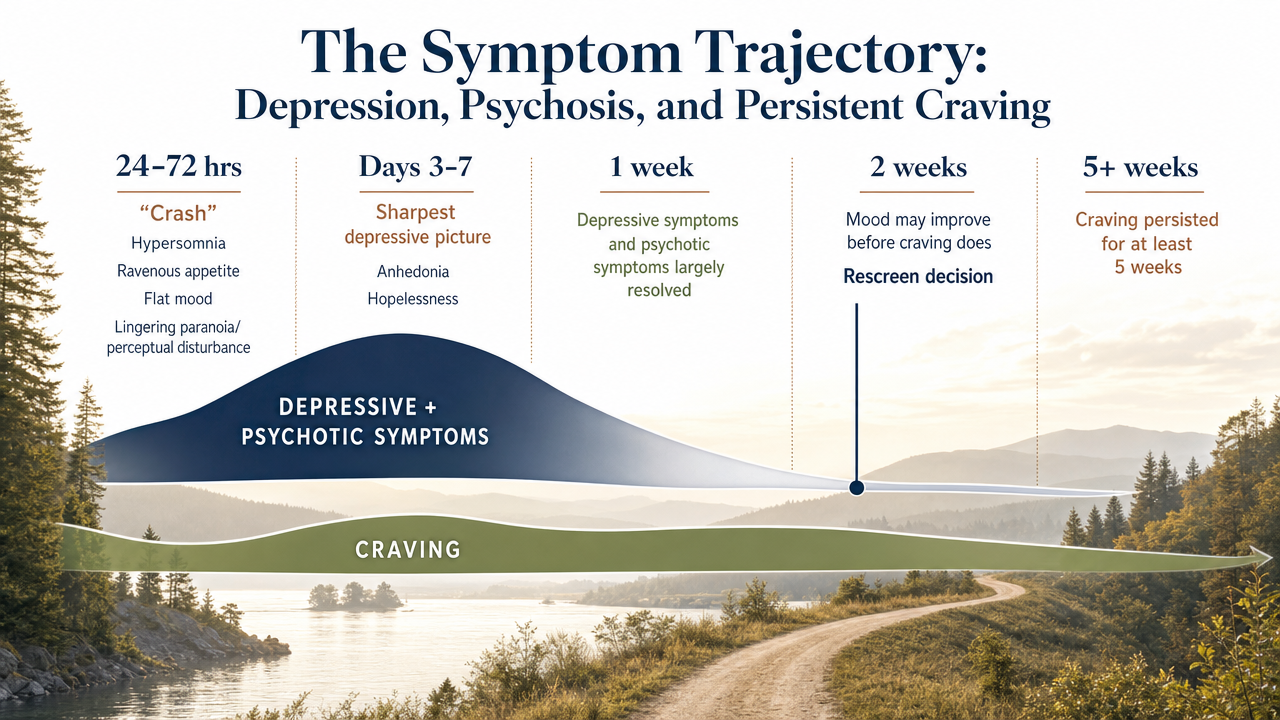
The Symptom Trajectory: Depression, Psychosis, and Persistent Craving
Before you can pick a setting, you need a working map of what's about to happen in the client's body and mind. The most useful map we have comes from a study tracking abstinent methamphetamine-dependent adults through early recovery, and its finding is worth memorizing: depressive symptoms and psychotic symptoms largely resolved within one week of abstinence, while craving persisted for at least five weeks. That gap between mood and craving is the single most important clinical fact in this section.4
What that looks like on the ground: the first 24 to 72 hours are typically dominated by the crash — hypersomnia, ravenous appetite, flat mood, sometimes lingering paranoia or perceptual disturbance from the run itself. Days three through seven are where you often see the sharpest depressive picture. Anhedonia, hopelessness, tearfulness, sometimes passive suicidal ideation. It feels, to the person going through it and often to the clinician watching, like a major depressive episode arriving all at once. Anxiety runs alongside it, though the direct evidence base for anxiety-specific treatment during meth withdrawal is thin — one review found only seven studies, most of them small pharmacotherapy trials.3
By the end of week one, most of that mood and psychotic weight lifts noticeably for a majority of clients. What does not lift is the craving. Five weeks in, sometimes longer, the pull toward use is still active. That's the window where relapse risk peaks and where the mental health picture becomes about sustaining, not stabilizing.
Substance-Induced vs. Primary Psychiatric Disorder: Using the Time Course to Decide
Here's where that one-week versus five-week gap becomes a decision tool. When a client presents with acute depressive symptoms or psychotic features in the first several days after last use, resist the pull to lock in a primary diagnosis. The base rate says most of that will attenuate substantially with sustained abstinence and supportive care. Treating it as major depressive disorder or a primary psychotic illness on day two, and starting long-term medication accordingly, risks anchoring a diagnosis that the time course itself would have resolved.4
What you can do instead: document symptoms carefully, keep the person safe, and re-evaluate at roughly two weeks of confirmed abstinence. If depression, psychosis, or severe anxiety are still present at that point — not just craving, which is expected — you're looking at something that behaves more like a primary or persistent co-occurring disorder, and integrated psychiatric treatment moves to the front of the plan. SAMHSA's TIP guidance acknowledges this exact difficulty and frames it as one of the core clinical judgments in co-occurring care.7
Two caveats keep this from being a clean rule. First, active suicidality, command hallucinations, or dangerous agitation don't wait for a two-week window — those get treated now, in a setting that can hold the person safely. Second, prior psychiatric history matters. A client with a documented mood or psychotic disorder that predates methamphetamine use is not a diagnostic puzzle; they need integrated care from day one.
The Pharmacotherapy Reality: No Proven First-Line Medication
What the 2023 Evidence Review Actually Says
If you're waiting for the meth withdrawal equivalent of buprenorphine, it isn't here yet. A 2023 systematic review and meta-analysis identified nine randomized controlled trials covering six different medications, with 242 participants total across all trials and 186 participants in the six studies that could be pooled for meta-analysis. The authors' conclusion was straightforward: there is insufficient evidence that any medication is effective for methamphetamine withdrawal.1,8
That's a small evidence base by any standard. Six medications, fewer than 250 people combined, and heterogeneous outcome measures. Nothing in that pool crossed the threshold to become a recommended withdrawal pharmacotherapy. And this isn't a new gap that better trials will close next quarter — the same conclusion appeared in a systematic review more than a decade earlier, which described a lack of well-conducted research targeted toward the management of methamphetamine withdrawal.2
What that means for your treatment planning is concrete. You are not selecting a withdrawal medication regimen the way you would for alcohol or opioids. You're building a supportive care plan, choosing a setting that matches the safety picture, and screening aggressively for the mental health conditions that will drive the next phase of care. Any medication used during this window is off-label, symptom-targeted, and time-limited — not a protocol.
Symptom-Targeted Supportive Care: What Peers Can Actually Offer
Without a first-line withdrawal drug, the work becomes clinical craftsmanship. You're treating the symptoms in front of you, one at a time, with the least aggressive option that keeps the person safe and functional.
Sleep is usually the first battleground. After the initial crash resolves, insomnia often runs hard for one to three weeks. Non-benzodiazepine options — trazodone, mirtazapine at low doses, melatonin, sleep hygiene work — carry less risk than benzodiazepines, which SAMHSA cautions can create serious adverse effects when combined with other substances in this population. If a benzodiazepine is used at all, it should be short-course and closely supervised.5
For anxiety, the direct evidence is thin. A review of anxiety outcomes in methamphetamine dependence and withdrawal treatment found only seven studies — five pharmacotherapy, one psychosocial, one exercise — a base too small to generate confident medication guidance. That absence pushes you toward psychosocial supports, structured routine, physical activity where tolerated, and monitoring rather than reaching for an anxiolytic on day two.3
For depressive symptoms in the first week, remember the time-course data. Most of that lifts with abstinence and supportive care alone. Starting an SSRI on day three risks locking in a treatment the person may not need at day fourteen. If active suicidality is present, that changes the calculus immediately — safety planning, higher level of care, and psychiatric consultation move to the front, regardless of whether the mood picture is substance-induced or primary.6
Psychotic symptoms follow the same logic. Short-course antipsychotic use for acute agitation or perceptual disturbance is defensible; long-term antipsychotic maintenance based on a day-two presentation is not.
Scoping the 2024 ASAM/AAAP Methylphenidate Recommendation Correctly
One point worth naming clearly, because it gets conflated in referral conversations: the 2024 ASAM and AAAP guideline includes a conditional recommendation for long-acting methylphenidate for amphetamine-type stimulant use disorder, including methamphetamine use disorder. That is a recommendation about treating the use disorder over time, not about managing acute withdrawal.14
The distinction matters. A client three days out from last use, in the thick of the crash, is not the population that recommendation addresses. A client six weeks past acute withdrawal, engaged in outpatient treatment, still fighting cravings and struggling to sustain abstinence — that's closer to the population where a conditional methylphenidate trial might enter the conversation, in consultation with a physician comfortable with stimulant agonist approaches.
If you're routing someone through withdrawal now, keep methylphenidate off the withdrawal plan. Note it as a potential downstream option for the continuing-care team to evaluate once the person is stable, screened, and clear of the acute window. Framing it that way protects both the client and the referral relationship.
Real Recovery Starts in Portland, Oregon
Call now or verify insurance to take the first step toward lasting recovery in Portland.
Matching Level of Care to Safety Signals
A Decision Matrix: Severity Signal to Recommended Setting
Once you've ruled out the pharmacology shortcut, the level-of-care call becomes the highest-value decision you make for this client. It's also where referring peers most often get stuck, because the classic ASAM criteria were built around alcohol and opioid withdrawal, where autonomic instability drives the setting choice. With methamphetamine, the safety signals sit almost entirely in the psychiatric and social domains — active suicidality, acute psychosis, medical instability from prolonged runs, and unsafe housing that guarantees relapse within hours of discharge.
A working matrix looks like this:6,7,12,15
- Outpatient integrated co-occurring care is defensible for mild-to-moderate depressive symptoms without suicidal intent, no psychotic features, stable housing, engaged support system, and a client who can attend daily contact — often with a short observation period at a detox partner during the crash.
- Residential co-occurring treatment fits moderate-to-severe depression with passive ideation, subacute psychotic symptoms, tenuous housing, or a history of leaving outpatient care against advice — it gives you the containment and daily psychiatric contact the outpatient setting can't.
- Hospital-level inpatient care, with a structured methamphetamine protocol where available, addresses active suicidality with plan or intent, florid psychosis with dangerousness, medical instability from dehydration or cardiac symptoms, or severe agitation requiring pharmacologic control.
The matrix isn't a checklist you run once at intake. It's a live assessment. A client who looks like a clean outpatient candidate on day one can shift into residential territory on day four when the depressive picture deepens, and the referral path needs to be built with that mobility in mind. SAMHSA's integrated-care framework assumes exactly this — that severity is a moving target and the system has to move with it.6

Outpatient Integrated Co-Occurring Care: When It Fits
Outpatient is the right call more often than the field's reflexes suggest — but only when specific conditions are actually met, not assumed. You want a client who can maintain daily or near-daily therapeutic contact for the first two weeks, has somewhere to sleep that isn't a use environment, has at least one sober support person reachable by phone, and shows no active suicidal intent or psychotic dangerousness on assessment.
The clinical work inside that setting is dense. Daily or every-other-day check-ins during the first week to catch the depressive dip that typically peaks around day three to seven. A screening pass for depression, anxiety, PTSD, and psychosis at intake and again at the two-week mark, when substance-induced symptoms should be attenuating and any persistent picture starts to look like a primary co-occurring disorder. Sleep support, structured routine, and psychoeducation about what craving at week four is going to feel like, so the client isn't blindsided.7,10
Intensive outpatient programming carries this well when it's built for co-occurring populations — several hours of programming multiple days a week, individual therapy, group work, and psychiatric consultation available on site or through a tight referral loop. Across the Portland metro and Central Oregon, IOP with an integrated co-occurring lens is often the sustainable path once the acute crash has been observed. It gives the client daily accountability without pulling them out of housing, work, or family attachments that will anchor recovery long past week six.6
Residential and Hospital-Level Care: Suicidality, Psychosis, Medical Instability
Some signals move the decision out of outpatient territory before the conversation even finishes. Active suicidal ideation with plan, means, or recent attempt is the clearest one. SAMHSA's advisory is explicit that people with co-occurring disorders carry elevated self-harm risk, and the acute meth withdrawal window — with its abrupt depressive drop in the first week — is exactly the period where that risk expresses itself. If the client can't credibly contract for safety and doesn't have continuous supervision at home, outpatient isn't a defensible plan.6
Acute psychosis is the second hard signal. Perceptual disturbance during the immediate post-run period often resolves within days, but persistent paranoid delusions, command hallucinations, or disorganization that impairs the client's ability to follow a safety plan need a setting with 24-hour psychiatric monitoring. Residential co-occurring care handles the subacute end of that spectrum; hospital-level inpatient handles the acute end, especially when pharmacologic intervention for agitation or dangerousness is required.12
Medical instability is the third. Prolonged use runs often leave clients dehydrated, malnourished, cardiovascularly compromised, or with untreated wounds and infections. General detoxification guidance is clear that setting selection has to account for medical monitoring capacity, not just psychiatric acuity. A client with resting tachycardia, chest pain history, or a use pattern that included IV route with active injection-site infection belongs in a medically supervised setting for the first several days, regardless of how the mental health picture reads.15
Unsafe housing is the fourth signal, and it's the one most likely to get underweighted in a rushed assessment. Discharging a client into an active-use household or street-level instability during peak-craving weeks is a setup, not a plan. Residential bridges that gap while continuing-care arrangements are built.
Integrated Screening and the No Wrong Door Principle in Practice
Whichever door the client walks through — a Portland ED after a psychiatric hold, a Central Oregon primary care clinic flagging a positive urine screen, an IOP intake for depression that turns out to include a three-day run — the screening obligation runs both ways. SAMHSA's guidance is unambiguous: every person presenting for substance use treatment should be screened for mental disorders, and every person presenting for mental health treatment should be screened for substance use. That's the no wrong door principle, and in meth withdrawal it's the difference between catching a suicide risk on day three and missing it.10
What that looks like in a working intake: a validated depression measure, a suicide risk screen, a trauma screen, a psychosis screen, and a substance use history taken in the same session, by staff trained to hold both frames at once. When same-site integrated care isn't available — which is the reality in a lot of the Pacific Northwest, especially outside the Portland metro — SAMHSA's TIP guidance says treatment should be closely coordinated across providers, not sequential. Sequential care, where the client detoxes first and then gets referred to mental health weeks later, is where people fall out of the system.7
Rescreen at two weeks. That's when substance-induced symptoms should be attenuating and any persistent picture starts to declare itself as a co-occurring disorder that needs its own treatment plan.11
Building the Detox-to-Continuing-Care Hand-Off in the Pacific Northwest
The hand-off is where good clinical decisions go to die. A client gets stabilized through the acute crash at a detox partner, walks out on day five with a piece of paper listing three phone numbers, and never makes the first call. That's not a client problem. That's a routing problem, and it's the one piece of this pathway you actually control.
What works across Portland, Central Oregon, and the broader Pacific Northwest referral map is a warm hand-off built before the client leaves detox, not after. Pacific Crest Trail Detox operates as the medically supervised entry point for the acute window, with the monitoring capacity that outpatient settings can't match during the first several days. The clinical work during that stay isn't just symptom management — it's building the bridge. That means the continuing-care team is named, contacted, and scheduled while the client is still inpatient, with the first outpatient appointment set inside 48 hours of discharge.6,7
Two operational details make or break this. First, the screening data travels with the client. Depression, suicide risk, trauma, and psychosis screens completed at detox should land on the continuing-care clinician's desk before intake, not get repeated cold. Second, someone owns the gap. Whether that's a case manager at the detox facility or an intake coordinator at the outpatient program, one named person is responsible for the client between discharge and the first appointment. In Oregon addiction treatment settings that run integrated co-occurring IOP — Oregon Trail Recovery among them — that bridge role is where week-four craving stops becoming a relapse statistic.10,11
What Comes After Withdrawal: Contingency Management and Emerging Options
The acute window closes around week two for most clients, but the treatment decision doesn't. Craving is still active at week five and beyond, and the continuing-care plan you build during withdrawal is what carries the person through it. Two pieces of the current evidence base are worth naming here.4
Contingency management is the strongest behavioral intervention for methamphetamine use disorder. A recent scoping review of the MUD intervention landscape identifies it as especially effective, with combination pharmacotherapy and repetitive transcranial magnetic stimulation flagged as promising but still emerging. If your continuing-care partner offers contingency management inside an integrated co-occurring frame, that's the strongest evidence-based option in the current landscape. It also pairs well with the CBT, DBT, and motivational interviewing that most Pacific Northwest IOPs already deliver.13
The 2024 ASAM/AAAP conditional recommendation on long-acting methylphenidate lives here, not in the withdrawal plan. Once a client is stable, screened, and past the acute window, that's a physician-led conversation about the use disorder itself. Frame it that way in the referral, and the continuing-care team can evaluate it on its own timeline.14
Frequently Asked Questions
How long does methamphetamine withdrawal typically last?
The acute window runs roughly one to two weeks, but that's not the whole picture. Depressive and psychotic symptoms largely resolve within about a week of abstinence for most clients, while craving persists for at least five weeks and often longer. Plan the acute care around the first two weeks and the continuing care around the extended craving window.4
Is there a medication that treats meth withdrawal?
No medication has proven first-line efficacy for methamphetamine withdrawal. A 2023 systematic review of nine RCTs covering six medications in 242 participants concluded there is insufficient evidence that any medication is effective, and the same conclusion held more than a decade earlier. Symptom-targeted supportive care — sleep, hydration, psychosocial support, safety monitoring — remains the standard.1,2
How do you tell the difference between meth withdrawal symptoms and a primary mental health condition?
Use the time course. Substance-induced depressive and psychotic symptoms typically attenuate substantially within the first week of abstinence. Rescreen at two weeks: if depression, psychosis, or severe anxiety persist past that point, the picture behaves more like a primary or persistent co-occurring disorder and warrants integrated psychiatric treatment. Prior documented psychiatric history changes that timeline immediately.4,7
When does a client need residential or hospital-level care instead of outpatient withdrawal support?
Active suicidality with plan or intent, florid psychosis with dangerousness, medical instability, or severe agitation requiring pharmacologic control push the decision to hospital-level care, ideally with a structured methamphetamine inpatient protocol. Moderate symptoms with tenuous housing, subacute psychosis, or a history of leaving outpatient against advice fit residential co-occurring care. Stable housing plus daily contact capacity supports outpatient.6,15
What does integrated co-occurring care actually look like after detox?
Same-site or closely coordinated treatment that addresses substance use and mental health simultaneously, not sequentially. Practically: intensive outpatient programming several days a week, individual and group therapy, psychiatric consultation on site or through a tight referral loop, and evidence-based modalities including contingency management, which the current scoping literature identifies as especially effective for methamphetamine use disorder. Screening data travels between providers.7,13
Does the 2024 ASAM/AAAP methylphenidate recommendation apply to meth withdrawal?
No. The 2024 ASAM and AAAP conditional recommendation for long-acting methylphenidate addresses amphetamine-type stimulant use disorder over time, not acute withdrawal management. Keep it off the withdrawal plan. Once a client is past the acute window, stable, and engaged in continuing care, a physician comfortable with stimulant agonist approaches can evaluate whether a methylphenidate trial fits the ongoing use-disorder picture.14
References
- Pharmacological treatment for methamphetamine withdrawal. https://pmc.ncbi.nlm.nih.gov/articles/PMC10083934/
- the poor evidence base for treating methamphetamine withdrawal. https://pubmed.ncbi.nlm.nih.gov/21355922/
- A Review of Methamphetamine Dependence and Withdrawal Treatment: A Focus on Anxiety Outcomes. https://pubmed.ncbi.nlm.nih.gov/27776672/
- Withdrawal symptoms in abstinent methamphetamine-dependent subjects. https://pubmed.ncbi.nlm.nih.gov/20840201/
- Co-Occurring Disorders and Other Health Conditions. https://www.samhsa.gov/substance-use/treatment/co-occurring-disorders
- Substance Use Disorder Treatment for People with Co-Occurring Disorders. https://library.samhsa.gov/sites/default/files/pep20-06-04-006.pdf
- Chapter 12. Treatment of Co-Occurring Disorders. https://www.ncbi.nlm.nih.gov/books/NBK64163/
- Pharmacological treatment for methamphetamine withdrawal. https://pubmed.ncbi.nlm.nih.gov/35862266/
- What are Co-Occurring Disorders?. https://www.samhsa.gov/mental-health/what-is-mental-health/conditions/co-occurring-disorders
- Managing Life with Co-Occurring Disorders. https://www.samhsa.gov/mental-health/serious-mental-illness/co-occurring-disorders
- Advisory: Substance Use Disorder Treatment for People with Co-Occurring Disorders. https://library.samhsa.gov/product/advisory-substance-use-disorder-treatment-people-co-occurring-disorders-based-tip-42/pep20
- An Inpatient Protocol for the Treatment of Methamphetamine .... https://pubmed.ncbi.nlm.nih.gov/38227855/
- Mapping the Intervention Landscape for Methamphetamine Use Disorder: A Scoping Review of Integrated Pharmacological, Behavioral, and Neuromodulation Approaches. https://pubmed.ncbi.nlm.nih.gov/42411348/?fc=20220523101529&ff=20260707110700&v=2.20.0
- An Equitable Behavioral Engagement Framework for Stimulant Medication Treatment in Methamphetamine Use Disorder. https://pubmed.ncbi.nlm.nih.gov/42283199/
- Management of Acute Withdrawal and Detoxification for Adults With Substance Use Disorders. https://www.ncbi.nlm.nih.gov/books/NBK545066/
Relapse Doesn't Mean the End Of Your Journey
Reach out today to explore programs that support real, long-term sobriety.