




What Are the Key Drug Rehabilitation Facts to Know?

Key Takeaways
- Substance use disorder behaves like a chronic condition, so recovery depends on matching level of care to ASAM criteria and staying engaged across a 12 to 24 month continuum rather than betting on a single 30-day stay.
- For opioid use disorder, medications like buprenorphine and methadone are standard of care and were linked to roughly a 55% reduction in overdose risk in one cohort; for stimulants, verified contingency management is the intervention with real evidence behind it.9,7
- There is no standardized national success rate—federal tracking measures housing, employment, retention, and abstinence together, and reputable programs can name what they measure at 6 and 12 months and treat co-occurring mental health conditions on-site.1
- Focus next on the two levers families actually control: time-in-treatment across step-downs, and informed family involvement—then use ASAM assessment, medication access, and outcome metrics as the questions that separate serious programs from polished pitches.
What the research actually says about recovery
If you're reading this, you've probably already made a few calls, scrolled through more admissions pages than you can count, and heard a lot of confident promises. Take a breath. The facts that actually predict whether your adult child recovers are more specific—and more hopeful—than most marketing pages let on.
Here's the honest starting point: substance use disorder is a chronic health condition, and structured, evidence-based treatment consistently outperforms no treatment or informal support for reducing substance use and improving day-to-day functioning. That's the floor. The ceiling is higher when the level of care matches severity, medications are used where indicated, co-occurring mental health needs get addressed, and your family stays engaged over time.12
The scale of the need in this region is real. In Oregon alone, an estimated 664,607 people needed but did not receive specialty substance use treatment in the past year—roughly a 49% service gap. You are not overreacting by moving quickly. You're also not too late. What follows is a working framework, grounded in SAMHSA, ASAM, and peer-reviewed research, so you can read any program with sharper questions.4
Rehab is a chronic-disease process, not a single event
One of the hardest reframes for families is this: a 30-day program is not a cure. Substance use disorder behaves more like diabetes or hypertension than a broken bone. It responds to treatment, it can relapse, and it usually asks for ongoing management—not a single heroic intervention followed by a discharge date.
That framing changes what you're looking for. Instead of asking "how long is the program?" you start asking "what does the next 12 to 24 months look like?" National outcome tracking already assumes this longer view. The federal Treatment Episode Data Set measures stability in housing, employment, criminal justice involvement, social support, retention in treatment, and abstinence—not a pass/fail grade at discharge. Recovery is scored across life, not just at the door.1
Practically, that means a reputable program should be able to describe a continuum: withdrawal management or detox if needed, then residential or intensive outpatient, stepping down into outpatient care, and connecting to sober living, peer support, or medication maintenance as clinically indicated. The point of each step isn't to graduate. It's to keep your adult child engaged long enough for the brain, the body, and the daily routines to actually shift. Time-in-treatment is one of the few levers with real leverage—and it's a marathon your family runs together, not a sprint you drop them off at.
Level of care: how ASAM decides where your adult child starts
The ASAM continuum in plain language
When an admissions clinician talks about "level of care," they're usually working from the American Society of Addiction Medicine (ASAM) criteria. It's a matching system, not a menu. The goal is to place your adult child in the least restrictive setting that can safely and effectively support them, and to step up or down as their needs change.
In plain terms, the continuum runs like this. Medically managed withdrawal (detox) handles the acute risk of coming off substances like alcohol, benzodiazepines, or opioids under clinical supervision. Residential or inpatient care provides 24-hour structure for people whose home environment, medical status, or relapse risk makes outpatient care unsafe. Partial hospitalization programs (PHP) and intensive outpatient programs (IOP) offer several hours of clinical programming a day or a week while your adult child sleeps at home or in sober housing. Standard outpatient care and recovery support—peer services, medication maintenance, therapy—carry the long tail.
A good assessment looks at six dimensions:
- withdrawal risk
- medical conditions
- mental health
- motivation
- relapse potential
- living environment
If a program tells you within five minutes that your adult child "needs 90 days residential" without doing that assessment, that's a signal about the program, not about your child.
Residential vs. outpatient: what the evidence actually shows
This is where families get pulled in two directions, and the research honestly pulls the same way. Both things can be true at once, and knowing that will save you a lot of second-guessing.
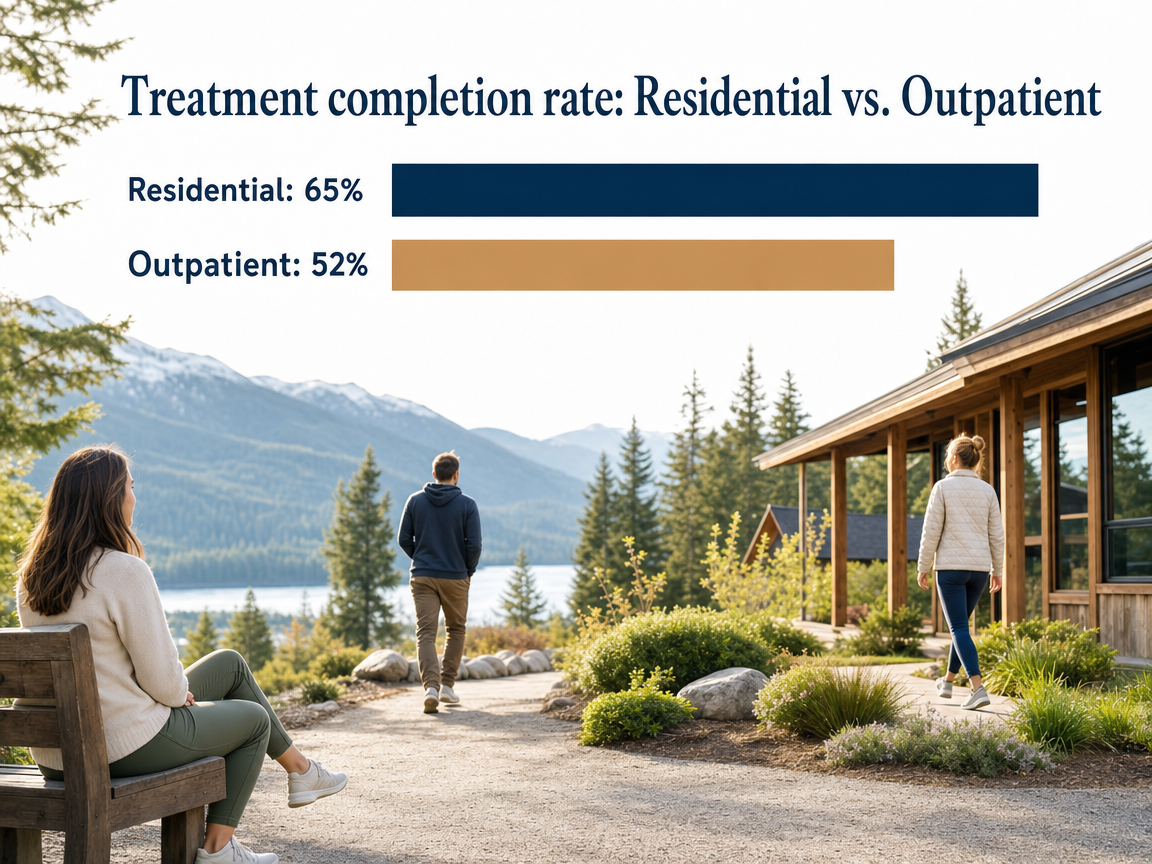
On one hand, residential programs do post higher completion rates. A study comparing the two settings found a 65% completion rate for residential programs versus 52% for outpatient, with clients in residential treatment nearly three times as likely to complete the program they started. If your adult child has been unable to string together sober days at home, or the living environment is unstable, that structure matters. Completion isn't a small thing—leaving treatment early is one of the most common precursors to relapse.8
On the other hand, completion isn't the same as long-term recovery. In a cohort study of individuals with opioid use disorder specifically, residential treatment was not associated with better outcomes—overdose, emergency department visits, hospitalizations—than outpatient care once medication was in the picture. Residential care did increase six-month retention by a factor of 1.71 in that same opioid use disorder population, but the medication itself was doing much of the heavy lifting on the outcomes families care most about.7
The practical read for you: don't assume residential is automatically "more serious" or "better," and don't assume outpatient is a discount version. Ask the program to justify the level of care against ASAM's six dimensions. For opioid use disorder in particular, ask whether medication for opioid use disorder is available at whichever level they're recommending—because a residential bed without medication is not the same product as a residential bed with it. For a young adult in Portland with stable housing and a job, an intensive outpatient program with strong medication support and family therapy may protect recovery better than uprooting their life. For someone leaving detox with nowhere safe to land, residential or sober living may be exactly the right first step.
You're not choosing between good and bad. You're choosing between fits, and the fit can change in six weeks. That's normal.
Medication matters, and the substance changes the answer
Opioid use disorder: why MOUD should be on the table
If your adult child is using opioids—prescription pills, heroin, or fentanyl—this is the single most important paragraph you will read on any admissions call. Medications for opioid use disorder (MOUD), which include buprenorphine, methadone, and extended-release naltrexone, are not a nice-to-have. The American Society of Addiction Medicine's national practice guideline is direct about it: medications should be offered to every person with opioid use disorder, paired with counseling and recovery supports, across every level of care where they can be delivered.10
Here's why that language is so firm. In a cohort study of individuals with opioid use disorder, MOUD use was associated with roughly a 55% reduction in overdose risk compared with no medication (adjusted hazard ratio 0.45). That finding comes from a population already diagnosed with opioid use disorder, so treat it as guidance for opioid cases specifically—not as a universal number for every substance. But within that population, this is the closest thing rehab has to a life-saving intervention.7
You will still hear programs describe medication as "trading one addiction for another," or offer a residential stay that quietly excludes MOUD. That framing is out of step with current evidence and current federal guidance. When you call, ask plainly: Is buprenorphine or methadone available here? Will my adult child be able to start it, continue it, or transition onto it? If the answer is no, or if the answer comes with a long explanation about willpower, keep calling. A residential bed without medication is a different product than a residential bed with it—and for opioid use disorder, the medication is doing much of the protective work your family is paying for.
Stimulant use disorder: contingency management as first-line
Methamphetamine and cocaine are a different clinical problem, and Oregon families know it. There is no FDA-approved medication for stimulant use disorder. What the evidence points to instead is a behavioral approach called contingency management (CM)—structured, verifiable rewards for meeting treatment goals like negative drug tests or session attendance. A recent review calls contingency management an efficacious treatment for stimulant use disorders and specifically warns that watered-down versions are unlikely to move outcomes.9
The details matter. Real CM uses escalating incentives of meaningful value, delivered quickly and consistently, tied to objective evidence (usually a urine screen). If a program mentions "positive reinforcement" or hands out small tokens on an irregular schedule, that's not the same intervention as the one the research supports. Ask directly: Do you use contingency management for stimulant use disorder? What are the incentives, how often are they delivered, and how are you verifying abstinence?
Pair that with cognitive behavioral therapy, motivational interviewing, and, when depression or trauma is in the picture, co-occurring mental health care. For stimulants especially, the point is not to find one perfect intervention. It's to stack several that work, and to keep your adult child in the door long enough for those stacks to hold.
Alcohol and polysubstance: what to ask about
Alcohol use disorder has its own set of FDA-approved medications—naltrexone, acamprosate, and disulfiram—that are underused in routine rehab. If alcohol is your adult child's primary substance, ask whether the program prescribes and monitors these, or whether it treats alcohol purely as a talk-therapy problem. Both matter, but medication should be on the table.
Polysubstance use is now closer to the rule than the exception, especially with fentanyl contaminating stimulant supplies. That changes the intake conversation. A program serving your adult child well should assess every substance separately, plan withdrawal management for the ones that require it (alcohol and benzodiazepines can be medically dangerous to stop cold), and match evidence-based approaches to each: MOUD for opioids, contingency management for stimulants, medication plus counseling for alcohol. If the answer to "how do you handle polysubstance use?" is a single generic protocol, you've learned something useful about the program.9,10,12
Co-occurring mental health care is not an add-on
Roughly half of people with a substance use disorder also live with a mental health condition—depression, anxiety, PTSD, bipolar disorder, ADHD. Treating one without the other is one of the most common reasons a program looks successful at discharge and then falls apart six weeks later. If your adult child has been self-medicating trauma or an untreated mood disorder, the substance was doing a job. Take the substance away without addressing the job, and something else fills the gap.
Integrated care means both conditions are treated in the same place, by a team that talks to itself, at the same time. It doesn't mean a substance use program that refers out to a separate therapist your adult child may or may not call. When you're on an admissions call, ask specifically: Do you screen for co-occurring conditions at intake? Who prescribes and manages psychiatric medication? How does the therapy schedule handle trauma and mood work alongside substance use counseling?
A note on scope: many addiction treatment centers, including reputable ones in the Pacific Northwest, offer co-occurring mental health treatment alongside substance use care rather than primary psychiatric care. That's appropriate for most cases. If your adult child needs acute psychiatric stabilization, ask the program directly how they coordinate that step.12
Real Recovery Starts in Portland, Oregon
Call now or verify insurance to take the first step toward lasting recovery in Portland.
What 'success' actually means in the outcome literature
Somewhere along the way, someone will quote you a success rate. A clean-sounding percentage that promises this program works X% of the time. Set that number aside. There is no standardized national success rate for rehab, and any program that leads with one is telling you more about its marketing than its clinical work.
What federal data actually measures is broader and more useful. The Treatment Episode Data Set tracks recovery across several National Outcome Measures: stability in housing, employment status, criminal justice involvement, social support, retention in treatment, and abstinence. Notice what's on that list. A person can hold a job, sleep somewhere safe, stay out of the emergency room, and rebuild a relationship with you—and every one of those counts as an outcome the system cares about. Recovery is scored across a life, not against a single lab result.1
Oregon's own public system underscores why you should ask harder questions here. A state analysis of publicly funded substance abuse treatment found no reliable outcomes data in core administrative systems and called for better evaluation. Translation: even large, funded programs often don't measure what happens to people six or twelve months out. So when you're on an admissions call, ask the program directly. How do you define success? What do you measure at 6 and 12 months? Housing, employment, retention, return to use—if they can name the metric and show you the number, that's a serious program.6
Oregon and the Pacific Northwest: the access picture your family is walking into
Where you live shapes what treatment looks like in practice, and Oregon's picture has been shifting. The 2019 state survey counted 234 substance use treatment facilities serving more than 20,000 clients on a single day, with methadone and opioid treatment programs carrying a meaningful share of that census. That's a real system—but it's not evenly distributed, and demand outruns supply. Roughly 664,607 Oregonians needed but did not receive specialty substance use treatment in the past year, a service gap of about 49%. If you've been calling and hearing "we can put your adult child on a list," that's what you're bumping into. It isn't a sign you're doing this wrong.2,3,4
The good news is that access has started to move, especially outside the Portland metro. Certified Community Behavioral Health Clinics (CCBHCs) have driven a 4.9% overall increase in access to treatment in Oregon, with a 30.6% increase in rural areas and a 14.5% increase in remote areas. If your family is in Central Oregon, along the coast, or east of the Cascades, that gain matters. The nearest program a year ago may not be the nearest program today, and CCBHCs are built to integrate substance use care with mental health services—useful when your adult child needs both.5
Two practical moves come out of this. First, don't assume the closest facility is your only option; the Pacific Northwest treatment map is broader than a Google search suggests, and SAMHSA's free, confidential National Helpline (1-800-662-HELP) offers 24/7 treatment referral if you want a second set of eyes on what's available. Second, ask any Oregon program directly how they coordinate with prescribers, sober housing, and outpatient providers in your adult child's actual zip code. Access on paper isn't access in practice until the handoffs are real.11
Family involvement and time-in-treatment: the two levers you can pull
You have less control than you want, and more than you think. Two things you can actually influence—how long your adult child stays engaged in care, and how the family shows up around them—shape outcomes as much as which brand name is over the door.
Start with time. Federal outcome tracking treats retention in treatment as a National Outcome Measure in its own right, right alongside housing, employment, and abstinence. That's not academic. Every additional week your adult child stays in structured care is another week of new coping skills getting rehearsed, another week of medication doing its work if it's been prescribed, and another week the old routines lose their grip. For opioid use disorder in particular, residential care roughly increased six-month retention (aOR 1.71) in one U.S. cohort study—but the takeaway isn't "pick residential." It's that staying in care matters, whichever level of care fits. Ask any program how they handle the step-downs: from residential to intensive outpatient, from IOP to standard outpatient, from outpatient to peer and medication maintenance. The handoffs are where people fall out.1,7
Now the family piece. Your job is not to run the treatment plan or police your adult child's sobriety. It's to be a steady, informed presence: showing up to family therapy sessions the program offers, learning what enabling looks like versus what support looks like, and holding boundaries that make recovery easier to choose than to abandon. Encouraging and accountable—not one or the other. When you ask an admissions team "how do you involve families?" listen for specifics: scheduled family sessions, education groups, communication with you between phases of care. Vague answers usually mean vague practice.
Questions that separate a reputable program from a sales pitch
By the time you're on your third or fourth admissions call, the pitches start to blur. Everyone says they're evidence-based. Everyone mentions dual diagnosis. Here's a short list of questions that tend to sort serious programs from polished ones—and what a good answer sounds like.
How do you decide the level of care? A reputable program will name the ASAM criteria and describe an assessment across withdrawal risk, medical status, mental health, motivation, relapse potential, and living environment. A sales pitch will recommend a specific length of stay before doing the assessment.
If my adult child has opioid use disorder, is buprenorphine or methadone available here? The answer should be yes, with a clear description of how medication is prescribed, monitored, and continued after discharge. "We prefer an abstinence-based approach" for opioid use disorder is a red flag, not a philosophy.10
For stimulant use disorder, do you use contingency management? Listen for specifics: verified drug tests, escalating incentives of meaningful value, consistent delivery. Vague talk about "positive reinforcement" is not the same intervention.9
How do you handle co-occurring mental health conditions? Screening at intake, on-site prescribers or a tight coordination arrangement, and therapy that treats both conditions together—not a separate referral list.
What do you measure at 6 and 12 months? Retention, return to use, housing, employment—the outcomes the federal system already tracks. If a program can't name its metrics, it likely doesn't have them.1,6
How do you involve families? Scheduled family sessions, education, and communication between phases of care. "We'll keep you posted" is not a plan.
Where to go from here
You don't need to have this perfectly figured out before you make the next call. You need a shorter list of the right questions and the willingness to keep asking until an admissions team gives you real answers.
Write down the substance, the living situation, and any mental health history. Ask about ASAM assessment, medication where it's indicated, contingency management for stimulants, co-occurring care, and how the program measures outcomes at 6 and 12 months. If a program stumbles, call another one. SAMHSA's National Helpline (1-800-662-HELP) is free, confidential, and available 24/7 for treatment referrals across Oregon and the wider Pacific Northwest.11
Your adult child is not a lost cause, and you are not powerless. Programs like Oregon Trail Recovery exist for exactly this conversation—when you're ready, so are they.
Frequently Asked Questions
Is residential rehab always better than outpatient for my adult child?
No. Residential care shows higher completion rates, but for opioid use disorder specifically, one cohort study found no outcome advantage over outpatient care once medication was in the picture. The right answer depends on your adult child's living environment, medical needs, and whether medication is available at either level. Ask any program to justify its recommendation against the ASAM assessment.7
Should my adult child be on medication for opioid use disorder, or is that just swapping one drug for another?
Medications for opioid use disorder—buprenorphine, methadone, extended-release naltrexone—are considered standard of care, not substitution. The ASAM national practice guideline states these medications should be offered to every person with opioid use disorder alongside counseling and recovery supports. If a program frames MOUD as trading addictions or excludes it from residential care, that's a signal to keep calling.10
How long does drug rehabilitation actually need to last to work?
Longer than a single 30-day stay. Substance use disorder is a chronic condition, and retention in treatment is tracked federally as a National Outcome Measure alongside housing, employment, and abstinence. Think in terms of 12 to 24 months across a continuum—detox if needed, then residential or intensive outpatient, stepping down into outpatient care, medication maintenance, and peer support.1
What does 'success' really mean when a program talks about outcomes?
There is no standardized national success rate. Federal outcome tracking measures recovery across stability in housing, employment, criminal justice involvement, social support, retention, and abstinence. Oregon's own analysis of publicly funded treatment found many programs don't reliably track long-term outcomes at all. Ask any program what it measures at 6 and 12 months—and whether it can share the numbers.1,6
What questions should I ask an admissions team to tell a reputable program from a sales pitch?
Ask how they use ASAM criteria to set level of care, whether MOUD is available for opioid use disorder, whether they use verified contingency management for stimulant use disorder, how they treat co-occurring mental health conditions on-site, what outcomes they measure at 6 and 12 months, and how they involve families. Vague answers usually mean vague practice.9,10
If we live outside the Portland metro, are our treatment options really limited?
Less than they used to be. Certified Community Behavioral Health Clinics have driven a 30.6% increase in access in rural Oregon and 14.5% in remote areas. The Pacific Northwest treatment map has broadened, and SAMHSA's National Helpline (1-800-662-HELP) offers free, confidential 24/7 referrals to help you find programs beyond the closest facility. Ask about telehealth options too.5,11
References
- Treatment Episode Data Set (TEDS) 2023: Admissions to and Discharges from Substance Use Treatment Services. https://www.samhsa.gov/data/report/2023-teds-annual-report
- Oregon: National Survey of Substance Abuse Treatment Services (N-SSATS), 2019. https://www.samhsa.gov/data/sites/default/files/quick_statistics/state_profiles/NSSATS-OR19.pdf
- Behavioral Health Barometer: Oregon, Volume 4. https://www.samhsa.gov/data/sites/default/files/Oregon_BHBarometer_Volume_4.pdf
- Oregon Substance Use Disorder Services Inventory and Gap Analysis Report. https://www.oregon.gov/oha/HSD/AMH/DataReports/SUD-Gap-Analysis-Inventory-Report.pdf
- Overview of Behavioral Health in Oregon. https://olis.oregonlegislature.gov/liz/2025I1/Downloads/CommitteeMeetingDocument/310296
- Analysis of Oregon's Publicly Funded Substance Abuse Treatment System. https://www.oregonlegislature.gov/citizen_engagement/Reports/2019-OCJC-SB1041-Report.pdf
- Association Between Treatment Setting and Outcomes Among Individuals With Opioid Use Disorder. https://pmc.ncbi.nlm.nih.gov/articles/PMC9389731/
- Residential and Outpatient Treatment Completion for Substance Use Disorders. https://pubmed.ncbi.nlm.nih.gov/26925821/
- Contingency Management for Stimulant Use Disorder. https://pubmed.ncbi.nlm.nih.gov/36745163/
- ASAM National Practice Guideline for the Treatment of Opioid Use Disorder. https://www.samhsa.gov/resource/ebp/asam-national-practice-guideline-treatment-opioid-use-disorder
- National Helpline for Mental Health, Drug, Alcohol Issues. https://www.samhsa.gov/find-help/helplines/national-helpline
- Effective Treatment for Substance Use Disorders (Appendix G: Evidence Table). https://www.ncbi.nlm.nih.gov/sites/books/NBK402356/bin/appg-et1.docx
Relapse Doesn't Mean the End Of Your Journey
Reach out today to explore programs that support real, long-term sobriety.