




Getting Started with the AA 12 Steps of Recovery

Key Takeaways
- The 12 Steps work as a sequenced practice across three phases—acceptance, action, and maintenance—not as a belief test, with each phase depending on the honest work of the one before it.
- Getting a sponsor early is the single highest-leverage move, associated with an odds ratio of 3.67 for abstinence even after controlling for meeting attendance 8.
- Online meetings help as a floor but not a ceiling; exclusive online attendance is linked to lower involvement, while combining online and in-person matches in-person-only outcomes 10.
- Treat AA and clinical care as complementary tracks—Steps handle fellowship and accountability, while outpatient treatment addresses co-occurring depression, anxiety, or trauma the Steps were never built to treat 4.
What the First Meeting Doesn't Tell You About Step Work
Your first meeting probably handed you a coffee, a phone list, and a copy of the Steps printed on a laminated card. What it didn't hand you was a manual. Nobody sat you down and explained that the 12 Steps are a sequenced practice—not a creed, not a personality test, and not something you either believe in or don't.
Here's what tends to get lost between the readings and the applause for chips: the Steps ask you to do things, in order, with another person. The research bears this out. Manualized 12-Step Facilitation is competitive with cognitive behavioral therapy for continuous abstinence, and it saves on healthcare costs when people actually engage 1, 2. The keyword is engage—not attend, not observe, not white-knuckle through the Serenity Prayer.
You don't have to feel ready. You do have to show up, get honest with someone who has done this before, and start moving through the Steps as written. The rest of this guide walks you through what that looks like in your first weeks—Portland, Central Oregon, or anywhere in the Pacific Northwest you happen to be sitting right now.
The 12 Steps as a Sequenced Practice, Not a Belief Test
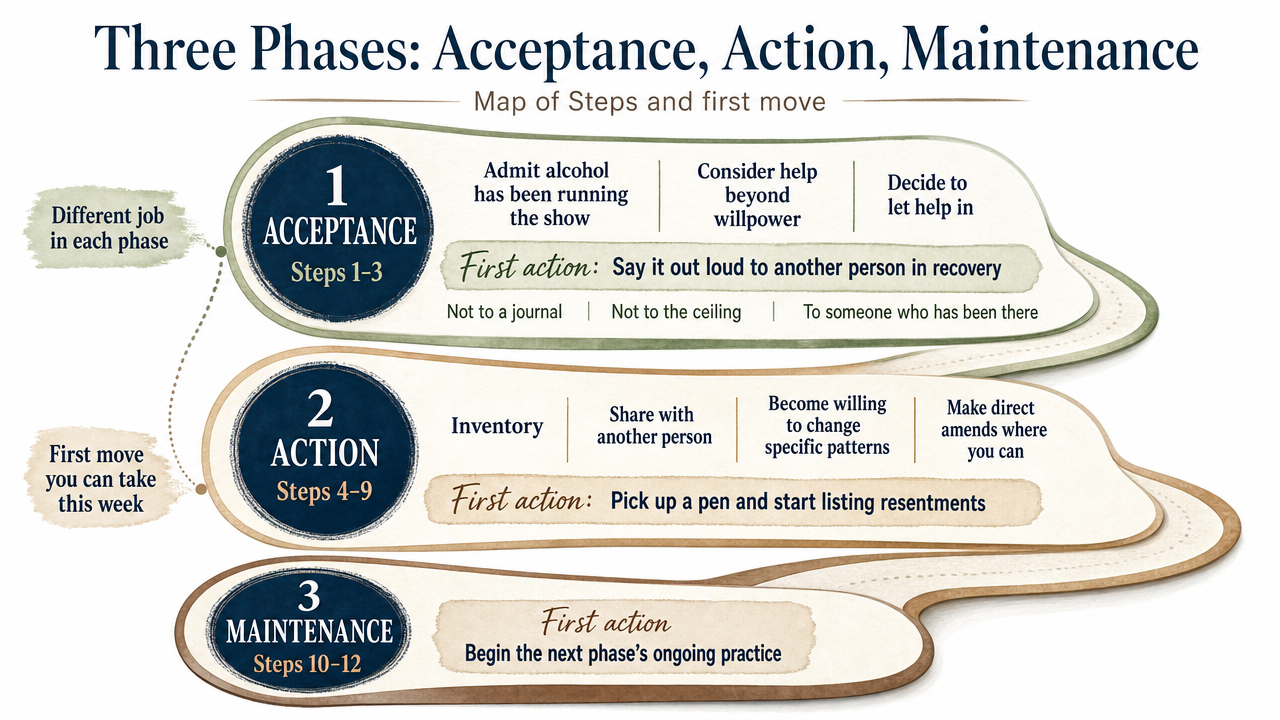
Three Phases: Acceptance, Action, Maintenance
If you group the Steps the way the Project MATCH Twelve-Step Facilitation manual does, three phases show up clearly 11. Each phase has a different job, and each one has a first move you can actually take this week.
Acceptance (Steps 1–3). This is where you stop arguing with reality. Step 1 asks you to admit that alcohol has been running the show. Step 2 asks you to consider that something outside your own willpower might help. Step 3 asks you to decide to let that help in. First action: say it out loud to another person in recovery. Not to a journal. Not to the ceiling. To someone who has been there.
Action (Steps 4–9). This is the middle stretch—inventory, sharing that inventory with another person, becoming willing to change specific patterns, and making direct amends where you can. First action: pick up a pen and start listing resentments, one column at a time, with a sponsor guiding you.
Maintenance (Steps 10–12). Daily inventory, prayer or meditation on your own terms, and helping the next person coming in. First action: end each day with a two-minute check-in—what went well, what didn't, who you owe an amends to tomorrow.
The sequence isn't decorative. Each phase depends on the one before it.
What the Evidence Actually Supports
You deserve a straight answer about what the research says, because you've probably heard the extremes—AA saves everyone, AA saves no one. Neither is true.
The 2020 Cochrane review, distilled by federal and clinical summaries, found that manualized AA and Twelve-Step Facilitation are at least as effective as other established treatments like CBT on most drinking outcomes, and superior for continuous abstinence and remission 1, 2. That's a real finding. It's also a specific one: it applies to structured, manual-guided engagement with AA, not passively sitting in the back row of a meeting once a month.
The honest complication: when researchers apply strict causation criteria to AA specifically, the experimental evidence is mixed—some positive studies, some null, one negative 12. People who stick with AA are often already motivated to stick with recovery.
Here's what that means for you: the Steps are not a guaranteed outcome, and they are not snake oil either. They are a well-supported pathway that works better the more actively you engage—sponsor, home group, step work, service. What you put in shapes what you get back.
Working Steps 1–3 in Your First Week
Step 1: Admitting What's Already True
Step 1 is not a public confession. It's a private one, said out loud to at least one other person who understands what you're saying.
The sentence itself is short: you admit you're powerless over alcohol and that your life has become unmanageable. What makes it hard is that most people in early recovery have already suspected this for months, sometimes years, and have been arguing with the suspicion the whole time. Step 1 asks you to stop arguing.
Try this in your first week: write down three specific moments in the last year when you told yourself you'd stop or slow down and didn't. Not a list of every drink—three moments where the gap between your intention and your behavior was undeniable. Read them to a sponsor, a counselor in your outpatient program, or a person at a home group who has time. That's it. You've worked Step 1. The point isn't shame; it's naming what's already true so you can stop spending energy defending it 11.
Steps 2 and 3: A Higher Power You Can Actually Use
If the word "God" makes you flinch, you are not alone, and you are not disqualified. The research on this is clearer than the culture sometimes suggests: spirituality, not formal religiosity, is what tracks with AA participation and better outcomes 16. A separate longitudinal study found that changes in spiritual practices among 12-Step affiliates predicted increased abstinence, independent of how often people attended meetings 6. Something is happening in that internal shift—but it does not require a specific theology.
Step 2 asks you to consider that a power greater than your own willpower could restore you to sanity. Step 3 asks you to decide to let that power in. For some people, that power is God as they understood God growing up. For others, it's the group itself—the collective wisdom of people who've stayed sober longer than you have. For others still, it's honesty, or nature, or the practice of showing up when you don't feel like it. Your sponsor won't audit your definition.
First-week action: pick something outside your own head that you're willing to trust more than the voice that told you one more drink would be fine. Write down what it is. You can revise it later. What matters now is that you've named a counterweight to the pattern that got you here.
Finding a Sponsor: The Single Highest-Leverage Move
If you do one thing this month beyond staying sober today, make it this: get a sponsor. Not the perfect sponsor. Not someone whose sobriety story matches yours down to the year. Someone who has worked the Steps, is currently working them, and is willing to walk you through them starting now.
The research on early AA affiliation is striking here. In a peer-reviewed study of people affiliating with AA, having a sponsor was associated with an odds ratio of 3.67 for abstinence—after controlling for how often people attended meetings and other factors 8. The effect is not just about being in the room. It's about having a specific person you're accountable to when you leave the room. Attendance without sponsorship is a weaker version of the same medicine.
Here's how to actually do it. Go to the same meeting three or four times so faces start to repeat. Listen for someone whose share sounds honest rather than polished. After the meeting, walk up and say, Would you be willing to sponsor me, or could you point me to someone who might be?
That sentence is enough. Most sponsors were asked exactly that way.
A few things to know going in. Your first sponsor may not be your last, and that's normal. If the fit is wrong—values, availability, how they work Steps—you can respectfully find someone else. What matters is that you don't stay unsponsored while you shop. Pick someone temporarily if you have to. In Portland and across the Pacific Northwest, most home groups keep a list of members open to sponsoring newcomers; ask the secretary before or after the meeting.
The call itself doesn't have to be long. A daily check-in of five minutes, a weekly step-work meeting of an hour, and permission to text when things get loud in your head. That's the shape of it. You are not asking for a therapist or a friend. You are asking someone to hand you the tools they were handed.
Steps 4–9: The Middle Work Nobody Wants to Start
Inventory and Confession (Steps 4–5)
Step 4 asks you to make a searching and fearless moral inventory of yourself. Step 5 asks you to admit to God, to yourself, and to another human being the exact nature of your wrongs. Together, they are the part of the program most people delay the longest—and the part that tends to break the log jam once it's done.
The mechanics are simpler than the dread suggests. Most sponsors will hand you a four-column format: the person, institution, or principle you resent; what they did; how it affected you (self-esteem, security, relationships, finances, ambitions); and your part in it. You are not writing a memoir. You are writing a list. Fears go on a separate page. So does a sexual conduct inventory, when you're ready.
Then you read it aloud to another person. That is Step 5. Not a therapist, unless your sponsor is also a therapist; typically your sponsor, at their kitchen table or in a quiet corner of a church basement. This part matters. The Twelve-Step Facilitation clinical logic treats the disclosure itself as therapeutic—the isolation of secrecy is part of what keeps the pattern in place 11. You will likely feel lighter walking out than you did walking in. That is not imagination.
Willingness, Amends, and What to Do When You Can't (Steps 6–9)
Step 6 is being entirely ready to have your character defects removed. Step 7 is humbly asking that they be. On paper, they sound like a pause between the inventory of Step 5 and the amends of Steps 8 and 9. In practice, they are where you sit with what you saw about yourself and decide you actually want it to change—not just the drinking, but the patterns underneath. Resentment. Dishonesty. Fear that runs your decisions.
Step 8 is a list of everyone you have harmed and a willingness to make amends. Step 9 is the follow-through—direct amends wherever possible, except when doing so would injure them or others.
Financial amends—money you owe, property you damaged—usually come with a payment plan, not a lump sum you don't have. What matters is the pattern of showing up. Your sponsor will help you sequence which amends to make first. Start with the easier ones. The hardest ones tend to take months to become approachable, and that is normal.
Steps 10–12: Why Helping Others Changes the Odds
Steps 10, 11, and 12 are where the program stops being something you do and starts being something you live. Step 10 is a daily inventory—short, honest, ongoing. Step 11 is prayer or meditation as you understand it, aimed at staying connected to whatever you named as a counterweight back in Step 3. Step 12 is carrying the message to other people with alcohol use disorder and practicing these principles in the rest of your life.
Step 12 is the one that surprises people. It sounds like a graduation requirement—help someone else once you've got yours together. The research suggests it works the other way around. In a study of people leaving treatment, those who engaged in helping other alcoholics were significantly less likely to relapse in the following year: 40% of helpers avoided a drink for 12 months, compared with 22% of non-helpers 7. The gap is not small, and it holds up in a population that was already in treatment—meaning the effect is not just about who volunteers.
You don't have to sponsor anyone yet to start doing service. Make coffee. Set up chairs. Give the newcomer your phone number. Chair a meeting when someone asks. In Portland home groups, service commitments turn over every six months, and most secretaries will hand a job to anyone with 30 days who raises their hand.
Step 11 fits alongside this without ceremony. Two minutes in the morning of quiet, two minutes at night of inventory—what did you do well, where did you fall short, who do you owe an amends to tomorrow 11. The spiritual practice piece is not decorative either; longitudinal work shows that shifts in spiritual practices among 12-Step affiliates track with abstinence independent of meeting count 6. It is doing the practice, not endorsing a doctrine, that seems to matter.
The pattern across Steps 10–12 is simple: keep showing up, keep getting honest, keep giving away what was given to you. That is the maintenance phase, and it doesn't have an end date.
Real Recovery Starts in Portland, Oregon
Call now or verify insurance to take the first step toward lasting recovery in Portland.
Meetings in a Hybrid Era: Online, In-Person, or Both
Since 2020, the meeting landscape has changed for good. You can join a Zoom meeting from your kitchen at 6:30 a.m. before an outpatient session, and you can walk into a church basement in Southeast Portland that same night. Both count. But they don't count the same way, and the research is starting to tell us why.
A 2024 study comparing modes of mutual-help attendance found that online-only attendees actually went to more meetings than their in-person counterparts—but reported lower involvement. When researchers checked back, people who dropped out entirely at follow-up were doing more heavy drinking than those who had stuck with in-person attendance 9. A 2025 follow-up study reinforced the pattern: exclusive online attendance was linked to diminished benefits, likely because involvement—getting a service commitment, staying after to talk, exchanging phone numbers—is harder to sustain through a screen. The good news buried in that same study: combining online and in-person attendance produced outcomes comparable to in-person-only 10.
What that means for your week: online meetings are a real asset, especially for early mornings, travel, illness, rural stretches of Central Oregon, or the days you would otherwise not go at all. Treat them as a floor, not a ceiling. If you can only do one in-person meeting a week right now, make it the same meeting every week so people recognize you. Recognition is how involvement starts.
When AA Isn't Enough on Its Own
Co-Occurring Depression and Anxiety
If you are working the Steps and still can't get out of bed some mornings, that is not a failure of the program. It is a signal that something else is happening alongside the alcohol use, and it deserves its own attention.
There is real evidence that AA participation can help with mood. One NIH-indexed study found that AA attendance was associated with reductions in depression symptoms, which in turn predicted better drinking outcomes 14. That is one documented pathway—not the whole picture. The Steps are not designed to treat clinical depression or an anxiety disorder, and asking them to do that job on their own puts weight on the fellowship it was never built to carry.
How Outpatient Care Fits Alongside the Fellowship
NIAAA guidance places mutual-support groups alongside behavioral therapy and medication as complementary options, not competing ones 3, 4. Twelve-Step Facilitation was in fact designed to run next to professional treatment, with meetings, sponsorship, and step work happening while a clinician handles the therapy hour 11.
An intensive outpatient program in Portland or elsewhere in the Pacific Northwest typically meets three to five days a week, three hours at a time, and leaves your evenings open for meetings and your weekends open for step work with a sponsor. The two schedules were built to coexist. Cognitive behavioral therapy, DBT skills, and relapse prevention work in group don't replace what happens at a home group—they give you language for what you are already noticing there.
If you're post-detox or newly out of residential care, treat outpatient and AA as one plan with two tracks, not two competing loyalties.
A First-90-Days Plan for the Pacific Northwest
Ninety days is long enough to build a rhythm and short enough to keep in your head. Here is what the first three months can look like when the parts actually fit together.
Days 1–30. Pick one in-person home group in your neighborhood—Southeast Portland, Beaverton, Bend, wherever you are—and attend the same meeting every week. Add two or three additional meetings, online or in-person, to hit four or five weekly. Ask someone to sponsor you by day 14. Read Steps 1–3 with them and say your Step 1 out loud to one other person. If you are in intensive outpatient care, tell your counselor you are working the Steps in parallel; the two schedules were built to coexist 11.
Days 31–60. Start Step 4 with your sponsor's format. Take a small service commitment at your home group—coffee, greeter, chairs. If depression or anxiety hasn't lifted by day 60, tell your sponsor and a clinician the same week 14.
Days 61–90. Finish and share your Step 5. Begin Steps 6–9 with your sponsor's pacing. Keep the meeting count steady. You are no longer new. You are in it.
Frequently Asked Questions
Do I have to believe in God to work the 12 Steps?
No. The research points to spiritual practice, not formal religiosity, as what tracks with better outcomes among 12-Step affiliates 16. Your Higher Power can be the group, honesty, nature, or something you're still figuring out. What matters is naming a counterweight to your own willpower and being willing to lean on it. Your sponsor is not going to audit your theology.
How quickly should I get a sponsor after starting meetings?
Within your first two to four weeks, ideally. Go to the same meeting a few times, listen for someone whose share sounds honest, and ask. A temporary sponsor is better than no sponsor while you look for a longer-term fit. The point is not perfection—it's having a specific person you're accountable to when the meeting ends and the noise in your head starts up again.
Can I just attend online meetings, or do I need to show up in person?
Online meetings count and they help, especially early mornings, travel, illness, or rural stretches of Central Oregon. But exclusive online attendance has been linked to lower involvement and diminished benefits, while combining online and in-person produced outcomes comparable to in-person-only 10. Aim for at least one steady in-person meeting a week. Recognition from the same faces is how real involvement starts.
Is AA enough on its own, or do I also need outpatient treatment?
It depends on what you're carrying. NIAAA guidance treats mutual-support groups and professional treatment as complementary, not competing 4. If you have co-occurring depression, anxiety, trauma, or you're post-detox, an intensive outpatient program running alongside your meetings tends to work better than either track alone. The Steps handle the fellowship piece. A clinician handles what the Steps weren't built to treat.
What if I disagree with parts of AA culture or don't click with my first sponsor?
Both are common and neither disqualifies you. You can respectfully find a different sponsor if values, availability, or step-work style don't match—just don't stay unsponsored while you shop. On the culture piece, take what helps and set aside what doesn't. Secular AA meetings, agnostic groups, and alternatives like SMART Recovery exist across the Pacific Northwest. Working the program does not require endorsing every opinion in the room.
How long does it take to work through all 12 Steps?
Most people move through Steps 1 through 9 with a sponsor over roughly six to twelve months, though pacing varies. Steps 10, 11, and 12 are not a finish line—they're a daily practice you keep for as long as you're in recovery. Don't rush the middle work. Inventory and amends do their job when you actually sit with them, not when you sprint past them to get a chip.
References
- Alcoholics Anonymous and Other 12-Step Programmes for Alcohol Dependence. https://odphp.health.gov/healthypeople/tools-action/browse-evidence-based-resources/alcoholics-anonymous-and-other-12-step-programmes-alcohol-dependence
- A Distillation of a 2020 Cochrane Review for Clinicians and Policy Makers. https://pubmed.ncbi.nlm.nih.gov/32628263/
- Treatment for Alcohol Problems: Finding and Getting Help. https://www.niaaa.nih.gov/publications/brochures-and-fact-sheets/treatment-alcohol-problems-finding-and-getting-help
- Recommend Evidence-Based Treatment: Know the Options. https://www.niaaa.nih.gov/health-professionals-communities/core-resource-on-alcohol/recommend-evidence-based-treatment-know-options
- Project MATCH Volume 2: Motivational Enhancement Therapy Manual. https://www.niaaa.nih.gov/sites/default/files/match02.pdf
- Spirituality as a Change Mechanism in 12-Step Programs. https://pmc.ncbi.nlm.nih.gov/articles/PMC4768745/
- Helping Other Alcoholics in Alcoholics Anonymous and ... - PMC. https://pmc.ncbi.nlm.nih.gov/articles/PMC3008319/
- Is it Beneficial to Have an Alcoholics Anonymous Sponsor?. https://pmc.ncbi.nlm.nih.gov/articles/PMC5512698/
- Mode of mutual-help group attendance: Predictors and outcomes in .... https://pubmed.ncbi.nlm.nih.gov/38740188/
- Effectiveness of online mutual-help group attendance for adults with .... https://pubmed.ncbi.nlm.nih.gov/41167988/
- Twelve Step Facilitation Therapy Manual. https://www.niaaa.nih.gov/sites/default/files/match01.pdf
- Alcoholics Anonymous Effectiveness: Faith Meets Science. https://pmc.ncbi.nlm.nih.gov/articles/PMC2746426/
- Are Alcoholics Anonymous and Other 12-step Programs Effective for Alcohol Use Disorder?. https://www.bu.edu/aodhealth/2020/04/21/are-alcoholics-anonymous-and-other-12-step-programs-effective-for-alcohol-use-disorder/
- Mechanisms of behavior change in Alcoholics Anonymous: Does Alcoholics Anonymous lead to better alcohol use outcomes by reducing depression symptoms?. https://pmc.ncbi.nlm.nih.gov/articles/PMC3860468/
- Helping Others in Alcoholics Anonymous: Correlates and Outcomes. https://pmc.ncbi.nlm.nih.gov/articles/PMC2951669/
- Religiosity, spirituality, and Alcoholics Anonymous participation. https://pmc.ncbi.nlm.nih.gov/articles/PMC2797092/
Relapse Doesn't Mean the End Of Your Journey
Reach out today to explore programs that support real, long-term sobriety.