


How to Find the Right Treatment for Drug Addiction Near Me

Key Takeaways
- After detox, choose the next step deliberately rather than impulsively, building on early momentum with structured outpatient care, sober living, or a thoughtful combination.
- Use vetted federal and state locators like FindTreatment.gov, the SAMHSA Helpline, and 988 to filter licensed providers instead of relying on general search results 10, 2, 4.
- Match the level of care (PHP, IOP, outpatient, sober living) to your work, family, and legal obligations so treatment fits your real life 8.
- Verify state licensing and certification before touring or sharing insurance details, since brochures alone cannot confirm a program's legitimacy 10, 3.
- Treat the intake call as a mutual interview, asking about therapies, medication, individualized plans, and step-down duration to gauge program quality 8, 9.
- Ask directly about medication for opioid or alcohol use disorder, integrated mental health care, and family involvement, since evidence supports addressing these together 9, 8.
- Clarify insurance, Medicaid, and state-funded options early, because coverage structures and behavioral health redesigns shape which programs you can actually access 7, 1.
- Close the search this week by shortlisting three licensed programs, scheduling two intake calls, and saving 988 in case things get harder before they improve 10, 4.
You just finished detox. Now what?
The first few days after detox can feel disorienting. While your body begins to heal, the structured routine of a program is gone, leaving you to navigate the next steps. It's common to feel overwhelmed by the sheer volume of information when searching for "treatment for drug addiction near me."
Take a breath. You don't have to figure this out alone, nor do you need to have all the answers today. What's important is to identify a next step that builds on the momentum detox started. For many individuals leaving stabilization in Portland, Central Oregon, or anywhere across the Pacific Northwest, this often involves a structured outpatient program, sober living, or a combination of both, chosen thoughtfully rather than impulsively.
This guide will help you find that crucial next step by outlining official tools for vetting programs, matching levels of care to your life, and providing key questions to ask before committing to a program 10, 8.
Start with federal and state locators that vet programs
FindTreatment.gov, the SAMHSA Helpline, and 988: understanding their roles
Before diving into general online searches for "treatment for drug addiction near me," utilize tools specifically designed to help. Each serves a distinct purpose, and knowing which one to use can save significant time.
- FindTreatment.gov
- SAMHSA's official locator. By entering your ZIP code, it provides a list of state-licensed providers specializing in substance use and mental health care 10. The term "licensed" is critical here, as general search results often mix legitimate programs with unregulated referral services. If a program isn't listed, it's important to inquire why.
- The SAMHSA National Helpline, 1-800-662-HELP (4357)
- Offers free, confidential, 24/7 support. Staff can help you discuss options and connect you to local services 1, 2. This is ideal when online listings feel overwhelming and you need human assistance. You can also text your ZIP code to 435748 (HELP4U) if calling is too difficult 2.
- 988
- The crisis and suicide lifeline, intended for immediate support if you are struggling with dangerous cravings, rapidly declining mental health, or any emotional distress 4. Use FindTreatment.gov for planning, the SAMHSA Helpline for decision-making, and 988 for urgent situations.
Layer state directories for a comprehensive view
While federal locators are a strong starting point, state health departments often provide more detailed information. Most states maintain their own certified provider lists, indicating programs that have met state licensing requirements in addition to federal recognition.
If you're searching in Oregon or the Pacific Northwest, consult the Oregon Health Authority's behavioral health directories alongside FindTreatment.gov. State pages frequently include contact numbers, Medicaid acceptance, and whether programs accept court-mandated referrals, details rarely found in national tools. Wyoming, for instance, offers an online certified substance use disorder services provider search, separate lists for residential treatment centers, and a directory of division-contracted community providers 3, 5. Wyoming also directs residents back to SAMHSA's locator for broader options 6.
For those near state lines, or considering programs a few hours away in locations like Bend, Boise, or Cheyenne, reviewing both states' directories is beneficial. A residential program in Wyoming that transitions you to outpatient care back home in Portland is a viable option, especially if covered by insurance. Explore cross-border options on paper before traveling.
Opioid Treatment Program and buprenorphine locators
If opioid use is part of your history, additional specialized tools are available. The HHS maintains a state-by-state Opioid Treatment Program directory and a separate buprenorphine provider locator, both accessible through federal treatment pages 1. These are valuable even if you've already used FindTreatment.gov.
The OTP directory lists programs certified to dispense methadone, which is highly regulated and only available at approved sites. The buprenorphine locator identifies clinicians who can prescribe medications like Suboxone in an office setting, which can integrate more easily into a work or school schedule. HHS allows anonymous and secure searches by address, city, or ZIP code 1.
Utilize this information during intake calls. Asking a program if they coordinate with a nearby OTP or prescribe buprenorphine on-site is a quick way to assess if their care aligns with current evidence-based practices.
Match the level of care to your actual post-detox life
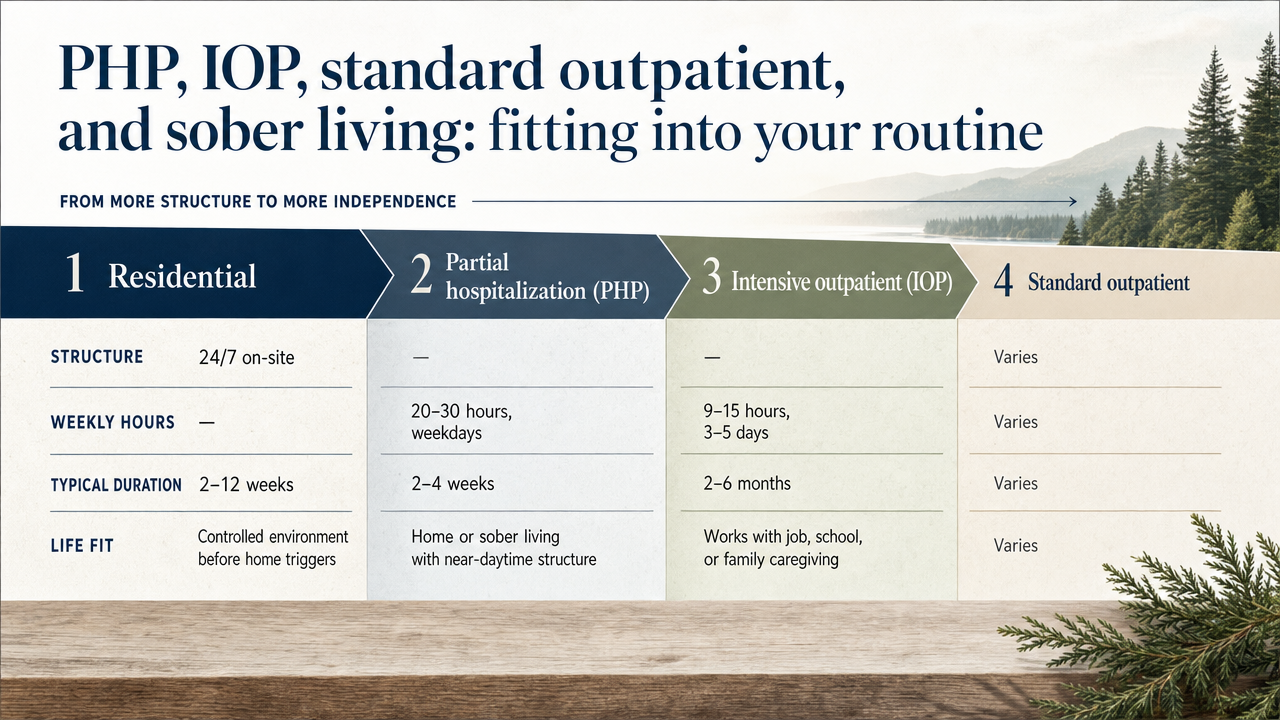
PHP, IOP, standard outpatient, and sober living: fitting into your routine
Detox stabilizes your body, but the next phase of care must align with your daily life. This is why carefully choosing a level of care is essential: NIDA's principles emphasize that effective treatment is individualized and must match the person's circumstances, not just their diagnosis 8.
Here's a breakdown of common post-detox care levels, from most to least structured:
| Level of care | Typical weekly clinical hours | Typical duration | Post-detox life it supports |
|---|---|---|---|
| Residential | 24/7 on-site | 2–12 weeks | You need a controlled environment before returning to home triggers. |
| Partial hospitalization (PHP) | 20–30 hours, weekdays | 2–4 weeks | You live at home or in sober living but need near-daytime structure. |
| Intensive outpatient (IOP) | 9–15 hours, 3–5 days | 2–6 months | You are holding a job, school schedule, or family caregiving. |
| Standard outpatient | 1–3 hours, 1–2 days | Ongoing | You have solid stability and want continued therapy. |
| Sober living | Housing, not clinical | 3–12+ months | You need a safer place to sleep while attending PHP, IOP, or outpatient. |
How long is long enough? Evidence-based duration
The duration of effective treatment is often longer than anticipated, and frequently exceeds initial insurance pre-authorizations. NIDA's research-based guidelines clearly state that remaining in treatment for an adequate period is critical, and shorter stays often yield weaker results 8. Detox alone, without subsequent care, is merely the beginning of the recovery process.
For most individuals leaving detox, this means planning for months of structured care, not just weeks. A typical progression might involve two to four weeks of PHP, followed by two to six months of IOP, and then standard outpatient or ongoing therapy for another year. Sober living can be integrated throughout this entire process.
You don't need to commit to the entire arc on day one. The key is that the initial program you choose can describe the step-down process. During your intake call, ask: "What does month three look like here? Month six?" Vague answers are a red flag. Programs genuinely committed to long-term recovery plan in terms of months, not just individual sessions 8.
Navigating court dates, custody, or employment during recovery
Life doesn't pause for recovery, and effective programs understand this. If you are involved in a DUII case, a custody hearing, or have probation requirements, disclose this during your first call. A reputable outpatient program in the Portland metro area will have established procedures for court documentation, including progress letters, attendance verification, and treatment plans that meet judicial timelines.
If you need to maintain employment, inquire about IOP schedules designed for early mornings or evenings, allowing you to balance work and recovery. Ask if the program offers employment or education support alongside clinical hours. If you have children, ask about family therapy integration into the weekly schedule and whether childcare coordination is available.
The ideal level of care allows you to preserve important aspects of your life while addressing your substance use disorder effectively 8.
Verify credentials before you tour
State certification and licensing checks
A program's brochure or website won't confirm its legitimacy. State certification does. Before scheduling a tour or providing insurance details, take a few minutes to confirm the program is licensed to provide the services it advertises.
Begin with FindTreatment.gov, which exclusively lists state-licensed providers specializing in substance use and mental health 10. If a Portland-area program isn't listed, it's not an automatic disqualification, but it warrants an explanation. Next, directly check your state's behavioral health directory. Oregon publishes its own certified provider lists through the Oregon Health Authority. Wyoming offers a similar model, with the Department of Health maintaining publicly searchable directories for certified substance use disorder services, residential treatment centers, and division-contracted community providers 3, 5.
Ask the program directly for their state license number and the name of their accrediting body. A legitimate outpatient or residential program in the Pacific Northwest will readily provide this information.
Red flags in marketing and intake practices
Certain warning signs can appear even before you visit a facility. Pay attention to them.
Be wary of any program that promises a "cure," guarantees sobriety, or cites success rates without clarifying what was measured. NIDA emphasizes that no single treatment works for everyone, and ethical programs focus on progress and individualized planning, not guarantees 8. Exercise caution with programs that don't specify their therapeutic approaches, can't explain their stance on medication for opioid or alcohol use disorder, or dismiss these medications entirely. SAMHSA considers medication combined with counseling the evidence-based standard for opioid use disorder, so a refusal to discuss it indicates a program's outdated approach 9.
Real Recovery Starts in Portland, Oregon
Call now or verify insurance to take the first step toward lasting recovery in Portland.
What a good intake call sounds like
The first call is a mutual interview. While the program learns about you, you're also evaluating them. The questions they ask, and the clarity of their answers, will reveal much about their approach before you ever visit.
Keep this checklist handy. Any program in the Portland area or Pacific Northwest that is worth your time should be able to answer these questions clearly:
- Are you state-licensed, and can you provide your license number? Cross-reference this with FindTreatment.gov, which only lists state-licensed substance use and mental health providers 10.
- Which evidence-based therapies do you offer? Look for specific names like CBT, DBT, motivational interviewing, or contingency management. Vague references to "holistic care" are not sufficient 8.
- Do you prescribe or coordinate medication for opioid or alcohol use disorder? SAMHSA considers medication combined with counseling the benchmark for opioid use disorder, so a program should explain their approach 9.
- How do you address co-occurring mental health conditions? Integrated care within the same facility is preferable to external referrals.
- How do you develop and review individualized treatment plans? NIDA stresses that treatment must be tailored to the individual and adjusted over time 8.
- What does the step-down process look like from PHP to IOP to outpatient, and what is the typical duration of stay? Look for plans that span months, not just weeks 8.
- How do you involve family, and what does aftercare planning entail?
Pay attention to their responses. A good intake specialist will inquire about your detox experience, living situation, work or court obligations, and mental health history before discussing costs. If every question is met with a price, it's likely best to move on to the next option.
Inquire about medications, co-occurring care, and family involvement
Medication for opioid and alcohol use disorder
If opioids or alcohol were factors leading to detox, discussing medication is crucial. It's a clear indicator of a program's adherence to current medical practices. SAMHSA describes medication for opioid use disorder as clinically driven, individualized, and combined with counseling and behavioral therapies, not used in isolation 9. This combination is what the evidence supports.
Ask a Portland-area program three specific questions:
- Do you prescribe buprenorphine or naltrexone on-site, or coordinate with a nearby provider?
- Do you collaborate with a certified opioid treatment program if methadone is appropriate for my history?
- For alcohol use, do you offer naltrexone, acamprosate, or disulfiram alongside counseling?
Some programs still view these medications as a crutch, which contradicts evidence-based care endorsed by SAMHSA and NIDA 9, 8. You're not looking for an argument, but rather to gauge if the program recognizes medication as a legitimate tool. If not, consider other options.
Co-occurring mental health support
Many individuals leaving detox also manage co-occurring mental health conditions such as depression, anxiety, PTSD, or trauma. These issues don't wait for substance use treatment to conclude. NIDA explicitly states that effective treatment addresses multiple needs, not solely drug use 8. Therefore, mental health support must be an integral part of the treatment plan from the outset.
Inquire about how the program handles co-occurring care. The ideal response involves integrated services: therapists trained in both substance use and mental health, treatment plans that address both concurrently, and clinicians who can adjust psychiatric medication as needed. A referral to a separate, external provider is a less effective model, especially during the vulnerable initial months post-detox.
If a program states they only treat the addiction and suggest you "deal with anxiety later," this is a significant concern. "Later" is often when relapse occurs. Integrated care within one facility ensures a holistic approach.
Family involvement and aftercare planning
Recovery is not an isolated journey. The people in your life—partners, parents, adult children, close friends—can either support healing or contribute to stress. A strong outpatient program in the Pacific Northwest will incorporate both aspects.
Ask if family therapy is offered, its frequency, and whether sessions can be conducted in the evenings or via video for family members outside Portland. Inquire about family education, particularly regarding boundaries, communication, and responding to setbacks without eroding trust.
Then, ask about aftercare. What happens when you complete IOP? Do they assist in developing a step-down plan into standard outpatient, sober living, alumni groups, or a Wellbriety circle? A program that views discharge as the end of the relationship may inadvertently set you up for relapse. One that sees it as the beginning of the next phase is invested in your sustained well-being 8.
Coverage, cost, and state funding access
Cost is often a sensitive topic, yet it frequently determines which program you ultimately choose. Start by asking three direct questions:
- Do you accept my insurance?
- Do you accept Medicaid?
- If I have neither, what sliding scale or state-funded slots are available?
A program's offerings are influenced by more than just its price list; state funding structures dictate what providers can bill for, and these structures evolve. Wyoming provides a relevant example: as of July 1, 2024, the state's Behavioral Health Redesign allows the Department of Health to contract directly with Behavioral Health Centers for outpatient and residential mental health and substance use disorder treatment, altering access to covered care 7. Oregon has its own Medicaid pathways through the Oregon Health Plan, and coordinated care organizations in the Portland metro often determine in-network programs.
Ask each program if they assist with paperwork. Effective outpatient teams typically have staff who verify benefits, file pre-authorizations, and know which state-funded slots are open. If cost is a barrier, contact the SAMHSA National Helpline at 1-800-662-HELP (4357) and specifically ask about low-cost and state-funded options in your area 1, 2. Financial obstacles are often surmountable.
A short checklist to close the search this week
You don't need a perfect plan by Friday, but a shortlist and two intake calls scheduled are achievable. Here's how to do it:
- Identify three programs from FindTreatment.gov using your ZIP code. This resource exclusively lists state-licensed providers, quickly narrowing your options 10.
- Cross-reference each program with your state's certified provider directory. Both Oregon and Wyoming publish their own lists, a quick and essential verification step 3.
- Call the SAMHSA National Helpline at 1-800-662-HELP (4357) if the list remains overwhelming or if cost is a concern. It's free, confidential, and available 24/7 1, 2.
- Schedule two intake calls, not just one. This allows for comparison rather than settling for the first option.
- Bring your list of questions: licensing, evidence-based therapies, medication for opioid or alcohol use disorder, integrated co-occurring care, family involvement, and what the long-term plan looks like 8, 9.
- Save 988 in your phone immediately, in case the week becomes more challenging before it improves 4.
You successfully completed detox. Choosing the next step requires similar dedication, one honest phone call at a time. If a program in the Portland area or across the Pacific Northwest meets these criteria and treats you with respect for your journey, that's a promising lead. Oregon Trail Recovery is one place to begin that conversation, as is any licensed program that answers your questions transparently.
Frequently Asked Questions
What's the difference between PHP, IOP, and standard outpatient care?
PHP (partial hospitalization) is the most structured, typically involving 20–30 hours per week during the day. IOP (intensive outpatient) usually consists of 9–15 hours over 3–5 days, designed to accommodate work or school schedules. Standard outpatient is generally 1–3 hours per week for ongoing therapy. Many individuals progress from PHP to IOP to outpatient over several months 8.
How do I verify that a treatment program near me is licensed and legitimate?
Search for the program on FindTreatment.gov, which exclusively lists state-licensed substance use and mental health providers 10. Additionally, check your state's behavioral health directory. Oregon publishes its own certified provider lists, and states like Wyoming maintain public searches for certified SUD services and residential centers 3. Always ask the program directly for its state license number; a legitimate program will provide it.
Should I ask a program about medication for opioid or alcohol use disorder?
Yes. If opioids or alcohol were part of your detox experience, inquiring about medication is essential. SAMHSA describes these medications as clinically driven, tailored to each patient, and combined with counseling and behavioral therapies, not used in isolation 9. Ask if the program prescribes buprenorphine or naltrexone on-site, coordinates with an opioid treatment program, or if they dismiss medication as a treatment option.
What if I have a mental health condition alongside my substance use?
Seek integrated co-occurring care, meaning both conditions are addressed within the same program by clinicians trained in both areas. NIDA emphasizes that effective treatment attends to multiple needs, not solely drug use 8. A referral to a separate mental health provider elsewhere is a less effective model, particularly during the vulnerable period after detox when symptoms of depression, anxiety, or trauma often intensify.
How long should treatment last after detox?
Effective treatment typically lasts longer than most people anticipate. NIDA clearly states that remaining in treatment for an adequate period is critical, and shorter stays often lead to less favorable outcomes 8. A common post-detox trajectory involves 2–4 weeks of PHP, followed by 2–6 months of IOP, and then standard outpatient or therapy for a year, sometimes with sober living integrated throughout. Plan in terms of months, not just individual sessions.
What do I do if I'm in crisis or can't wait for an intake appointment?
Immediately call or text 988. It's a free, confidential, 24/7 lifeline for anyone experiencing emotional distress, concerns about alcohol or drugs, or needing someone to talk to 4. For non-crisis assistance in finding treatment quickly, call the SAMHSA National Helpline at 1-800-662-HELP (4357), or text your ZIP code to 435748 (HELP4U) 1, 2. Save both numbers now.
References
- How to Find Opioid Treatment Programs? | HHS.gov. https://www.hhs.gov/opioids/treatment/index.html
- Find Services and Treatment. https://www.cdc.gov/howrightnow/find-services/index.html
- Provider Certification - Wyoming Department of Health. https://health.wyo.gov/behavioralhealth/mhsa/certification/
- Mental Health and Substance Use Treatment Services. https://health.wyo.gov/behavioralhealth/mhsa/
- Drug and Alcohol Treatment Centers (Residential). https://health.wyo.gov/behavioralhealth/mhsa/treatment/rsac/
- Find Mental Health or Substance Use Treatment. https://health.wyo.gov/behavioralhealth/mhsa/treatment/
- BHC Benefit Plans. https://health.wyo.gov/behavioralhealth/mhsa/treatment/bhc-benefit-plans/
- Principles of Drug Addiction Treatment: A Research-Based Guide (Third Edition). https://www.drugabuse.gov/publications/principles-drug-addiction-treatment-research-based-guide-third-edition
- Medication-Assisted Treatment (MAT). https://www.samhsa.gov/medication-assisted-treatment
- Find Substance Use Disorder Treatment. https://www.samhsa.gov/substance-use/treatment/find-treatment
Relapse Doesn't Mean the End Of Your Journey
Reach out today to explore programs that support real, long-term sobriety.