


Senior Addiction Treatment: Options for Older Adults

Key Takeaways
- Substance use in older adults often hides behind what looks like aging, grief, or medication side effects, so screening and a full medication review matter more than labels 2.
- Age-specific care works: the GRACE project found older adults in an interprofessional addiction program had better adherence, fewer relapses, and improved depression, anxiety, and chronic disease control 3.
- Medicare meaningfully covers treatment, including intensive outpatient at nine or more therapeutic hours per week and methadone, buprenorphine, and naltrexone for opioid use disorder 7, 8.
- Move one piece this week: call the Oregon Alcohol and Drug Help Line, book a primary care screening with a medication review, or have one specific, non-shaming conversation.
When a Parent's Drinking or Pills Stop Looking Like Aging
You've been telling yourself it's just how your dad unwinds now. Two glasses of wine became a bottle. The pill bottles on the counter grew from two to seven. He's quieter, more unsteady, maybe a little harder to reach on the phone at night. You keep hoping it's the knee, or the grief, or just getting older.
If you're reading this at 11 p.m. after a hard call with your mom, or at your kitchen table with a sibling text thread open, you're not overreacting. Substance use disorder in older adults often gets missed because the signs look like aging, depression, medication side effects, or chronic illness 2. That overlap is exactly why so many families wait until a fall, a hospital stay, or a near-miss overdose forces the conversation.
Here's the honest part: treatment for an older adult works, but only when the program is built around how a 68-year-old or 82-year-old body, medication list, and life actually look. This guide walks you through what age-appropriate addiction treatment looks like, how Medicare fits in, what to ask any program in the Portland area or across Oregon, and what you can do this week.
Why Aging Changes Addiction Treatment
The Age-Specific Risk Factors a Standard Program Misses
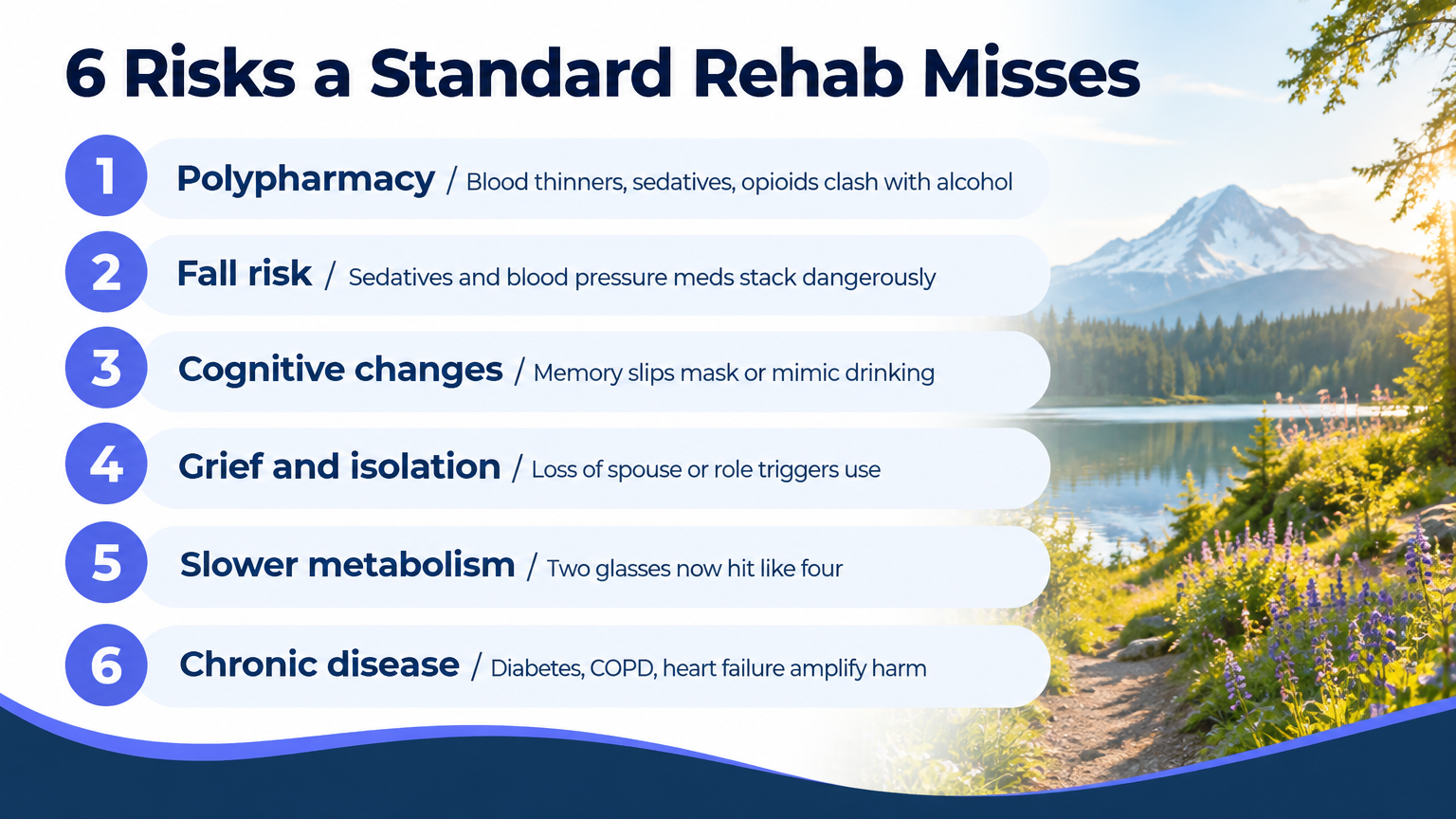
A rehab designed for a 25-year-old doesn't fit a 72-year-old, and not just because of the group chairs. Six things change once a body has been living, working, grieving, and taking prescriptions for six or seven decades, and a standard program often misses all of them.
Start with polypharmacy. Your dad may be taking a blood thinner, a statin, a benzodiazepine for sleep, something for his prostate, and an opioid left over from a knee replacement. Add alcohol, and you have interactions that didn't exist when he was 40. Falls are the next hidden risk. Sedatives, alcohol, and new blood pressure medications stack together and send older adults to the ER. Cognitive changes come next. Memory slips can hide drinking patterns, and drinking can look like memory slips. Grief and isolation after a spouse's death or retirement often become the trigger no one is naming. Slower alcohol metabolism means the two glasses of wine that were fine at 55 now register like four. And chronic disease, from diabetes to COPD to heart failure, interacts with every substance on the list.
SAMHSA's clinical guidance is blunt about this overlap: older-adult substance use often gets overlooked because the symptoms resemble normal aging, cognitive impairment, depression, medication effects, or chronic illness 1, 2. A program that doesn't screen for all six at intake isn't really treating an older adult.
What the Research Says About Age-Specific Care
You don't have to take the clinical argument on faith. The Gaining Recovery in Addiction for Community Elders (GRACE) project compared an age-specific, interprofessional addiction program with treatment as usual among 78 older adults in a single clinic. Participants in the age-specific program had better treatment adherence, fewer relapses, longer engagement, and larger improvements in depression and anxiety. Their hypertension and diabetes control improved, and they had fewer avoidable emergency visits and hospitalizations than the comparison group 3.
Two honest caveats belong in the same breath. The study was quasi-experimental, not a randomized trial, and 78 people is a small sample. So read GRACE as a strong signal, not a guarantee: when you build the clinical team around how older adults actually present, the medical side of recovery gets better alongside the addiction side.
The federal clinical guidance points the same direction. SAMHSA recommends an individualized continuum for older adults — screening and brief intervention, education, structured counseling, formal treatment programs, relapse prevention, and pharmacotherapy where indicated — rather than a single setting for everyone 1. In plain terms: ask any program you're considering how they adapt pacing, group composition, medication review, and medical coordination for someone your parent's age.
Spotting a Substance Use Problem in an Older Adult
Alcohol After Retirement, Grief, or a Medical Event
Three moments reliably change an older adult's relationship with alcohol: the week after retirement, the first year after losing a spouse, and the recovery period after a serious medical event. If your mom started drinking a little more after your dad died, that's not just sadness. It's one of the most common on-ramps to an alcohol use disorder in people over 65.
Watch for the quiet shifts, not the dramatic ones. The wine refill that used to happen at dinner now happens at 3 p.m. The recycling bin has more bottles than it used to, or fewer because she's switched to vodka. She's napping harder, bruising easier, forgetting conversations you had the day before. Her blood pressure medication isn't working as well as it was. She's canceled lunch with friends twice this month.
SAMHSA's clinical guidance names this exact pattern: late-life drinking often hides behind what looks like grief, sleep problems, or medication side effects, which is why it gets missed for years 1, 2. The question isn't whether she's "an alcoholic." The question is whether the drinking is doing more damage than it did at 50 — and at 72, the answer is almost always yes.
Prescription and Opioid Misuse You Can Actually See
Prescription misuse in an older adult rarely looks like a stereotype. It looks like a nightstand with four amber bottles, a pharmacy printout you can't read, and a dad who swears he's taking "just what the doctor said" while refilling his oxycodone two weeks early. It looks like a mom who takes her anxiety pill, then forgets and takes another, then has a glass of wine on top of it.
Specific signs you can actually see:- pill bottles from more than one prescriber or pharmacy
- running out of medication before the refill date
- hoarding leftover pills from old surgeries
- confusion about which pill is which
- new falls
- slurred speech by late afternoon
- or a sudden push to get a particular prescription renewed

How to Talk About It Without Shaming Them
You are not going to confront your 74-year-old father the way an intervention looks on TV. That approach almost always backfires with older adults, who have decades of pride, independence, and privacy to protect. What works better is quieter and more specific.
Pick a calm moment, not a holiday and not right after an incident. Lead with what you've noticed, not with a label. Try:"Dad, I've seen you refill the oxycodone early twice this month, and you fell last Tuesday. I'm worried, and I love you. Can we talk to your doctor together?"Name one concrete thing, name your feeling, and offer to go with him. Don't argue about whether he has a problem with the label itself — labels shut the conversation down and they aren't the language we use anyway.
If he gets defensive, don't push harder in that moment. Leave the door open and come back in a few days. One honest conversation rarely fixes anything, but three or four of them, spaced out, often do.
Levels of Care, Translated for an Older Body
Screening, Brief Intervention, and Outpatient Counseling
Not every older adult needs rehab. For some, the right starting point is a careful screening, a short structured conversation, and weekly outpatient counseling — the lightest end of what SAMHSA calls the continuum of care for older adults 1.
Screening is a short set of questions, usually at a primary care visit, that asks about how much and how often your mom drinks or how she uses her prescriptions. Brief intervention is the honest 10- to 20-minute conversation that follows: her doctor names what the screening showed, explains the specific risks at her age and with her medications, and sets a goal with her. For a lot of older adults whose drinking has crept up after retirement, that conversation alone moves the needle.
Outpatient counseling adds weekly individual or group therapy, often using cognitive behavioral therapy (CBT) to work on the thoughts and routines around drinking or pill use. If your parent is still driving, still socially connected, and not in medical danger, this is often where you start.
Intensive Outpatient (IOP) and When It Fits Older Adults
An intensive outpatient program sits between weekly counseling and residential care. You go home at night and sleep in your own bed, but during the week you're in structured group and individual therapy for several hours at a time. For many older adults with stable housing and a supportive family, IOP is the sweet spot — enough structure to actually change the pattern, without uprooting a 70-year-old from her garden, her dog, and her routines.
Medicare Part B may cover IOP services when the treatment plan requires at least nine therapeutic hours per week, delivered in settings like hospital outpatient departments, community mental health centers, federally qualified health centers, rural health clinics, and opioid treatment programs. Covered services can include group and individual therapy, education, and medication management 7.
IOP fits older adults who've completed a detox or short residential stay and need help building the new routines that replace drinking. We often see parents and spouses do well here because the program uses CBT, DBT, and the Seeking Safety curriculum for co-occurring trauma, while still letting them live at home.
Residential Care and Medically Supervised Withdrawal
Sometimes outpatient isn't safe as a starting point. If your dad has been drinking a bottle of vodka a day, or if he's taking a benzodiazepine like alprazolam around the clock, stopping on his own can trigger seizures, dangerous blood pressure spikes, or delirium. Alcohol and benzodiazepine withdrawal in older adults is a medical event, not a willpower problem, and it's one of the places where age genuinely raises the stakes.
Medically supervised withdrawal — often called detox — is a short stay where doctors and nurses manage withdrawal with medications, monitor vital signs, and watch for the heart, kidney, and cognitive issues that are more common at 70 than at 30. Oregon Trail Recovery partners with Pacific Crest Trail Detox for this step; we don't provide medical detox directly.
Residential care, the next step up from IOP, means living at the treatment program for several weeks. It's the right call when your parent's home environment is unsafe, when co-occurring conditions need daily eyes on them, or when a prior outpatient attempt didn't hold.
Medications for Alcohol and Opioid Use Disorder
Medications can make recovery stick, and they're underused in older adults. SAMHSA's clinical guidance for this age group explicitly includes pharmacotherapy as part of effective care 1.
For alcohol use disorder, pharmacotherapy is one tool a prescriber may consider as part of a broader plan. Any medication choice has to be matched to your mom's liver function, kidney function, and other medications, which is why a prescriber who knows her full medication list has to make that call.
For opioid use disorder, Medicare covers methadone, buprenorphine, and naltrexone across inpatient, outpatient, physician, and opioid treatment program settings, along with counseling, assessments, toxicology testing, and coordinated care 8. That's a big deal for an older adult on fixed income who's been told methadone or buprenorphine is "only for younger people" — it isn't, and the research doesn't support that framing.
Medication-assisted treatment (MAT) isn't trading one addiction for another. It's using a prescription, under a doctor's care, to steady the brain while therapy does the longer work.
Medicare, Costs, and the Treatment Gap
What Medicare Actually Covers for IOP and OUD
Cost is almost always the second question families ask, right after "will it actually help?" The good news: for most adults over 65, Medicare does meaningful work here, and you can self-screen before you call anyone.
For intensive outpatient care, Medicare Part B may cover IOP when the treatment plan requires at least nine therapeutic hours per week. Covered services can include group and individual therapy, education, and medication management, delivered through hospital outpatient departments, community mental health centers, federally qualified health centers, rural health clinics, and opioid treatment programs 7. If a program is quoting your mom a schedule that doesn't hit that nine-hour threshold, it may not qualify as IOP for Medicare purposes — ask directly.
For opioid use disorder, Medicare covers methadone, buprenorphine, and naltrexone across inpatient, outpatient, physician, and opioid treatment program settings, plus counseling, assessments, toxicology testing, and coordinated care 8. That matters because the treatment gap is real. In 2024, 12.2% of adults aged 50 or older with a past-year substance use disorder received treatment, compared with 8.5% of young adults aged 18–25 4. Older adults aren't getting more help than younger adults — most aren't getting any.
Telehealth, Transportation, and Mobility-Friendly Access
If your dad can't drive anymore, or your mom's hip makes a weekly car ride painful, access is the real barrier — not motivation. Telehealth has quietly become a serious option for older adults, especially in rural parts of Oregon and Washington where the nearest counselor is 40 minutes away. Across the general population in 2024, 5.4% of people aged 12 or older with a past-year SUD received substance-use treatment through telehealth, roughly 2.6 million people — a figure that spans all ages, not just older adults 11.
Ask any program three practical questions:
- Do you offer video sessions, and will you help my parent set up the technology?
- Do you coordinate transportation for in-person days?
- And can you time appointments around dialysis, physical therapy, or a caregiver's schedule?
A program that can't answer those isn't really built for someone over 70.
Co-Occurring Conditions: Trauma, Grief, and Depression
Almost no older adult drinks or misuses pills in a vacuum. Underneath the bottle or the prescription, there's usually a layer of grief after losing a spouse, depression that crept in after retirement, chronic pain that nobody has really treated, or trauma from decades back that got buried instead of healed. SAMHSA's clinical guidance is explicit that these conditions tangle together in older adults, and that pulling them apart matters for both diagnosis and treatment 1, 2.
Here's the honest part for families: addiction treatment isn't primary mental healthcare, and a good program will say so out loud. What we do is trauma-informed addiction treatment, using approaches like cognitive behavioral therapy, dialectical behavior therapy, and the Seeking Safety curriculum — an evidence-based model for people living with both post-traumatic stress and substance use. When a psychiatric diagnosis needs active treatment, we coordinate with a psychiatrist or primary care provider rather than pretending we can do it all.
If grief, depression, or thoughts of giving up are part of your parent's story, call or text 988 for the Suicide & Crisis Lifeline. Then ask any addiction program how they handle co-occurring care, and who they refer out to when psychiatric treatment is needed.
Finding Help in Oregon and the Pacific Northwest
Oregon Addiction Treatment Resources You Can Call Today
If you want a phone number before you close this tab, start here. The Oregon Alcohol and Drug Help Line at 1-800-923-4357 is free, confidential, and staffed around the clock. The Oregon Hopeline at 1-833-975-0505 is another statewide access point. Every county and Tribal area in Oregon has at least one Behavioral Health Resource Network that can connect your parent to local services, including culturally specific programs 9.
For a national option, SAMHSA's helpline is free, confidential, and available every day for mental-health, drug, and alcohol treatment referrals, and FindTreatment.gov is a searchable provider directory 10. If grief, depression, or thoughts of suicide are part of what's happening, call or text 988.
Keep in mind what these numbers can and can't do. They're the fastest way to find openings, insurance-matched programs, and age-specific options in the Portland area and across the Pacific Northwest. They can't diagnose withdrawal risk or clear a medical plan — that still takes an in-person assessment with your parent's doctor or an intake clinician.
Questions to Ask Any Program Before You Admit a Parent
A good program will welcome these questions. A program that gets impatient with them is telling you something.
Ask how they adapt treatment for someone your parent's age. Specifically: Who reviews her full medication list for interactions, and how often? How do you pace group therapy so a 76-year-old isn't lost in a room of 24-year-olds? What's your protocol if she has a fall, a cardiac event, or sudden confusion during treatment?
Ask about coordination. Will you talk to her primary care doctor, her cardiologist, and her pharmacist? If medical detox is needed first, who do you partner with? (We work with Pacific Crest Trail Detox because we don't provide medical withdrawal directly.) How do you handle co-occurring depression or trauma, and who do you refer out to for psychiatric care?
Ask the practical questions last. Do you accept Medicare, and does your IOP schedule hit the nine-hour weekly threshold? Can she do video sessions on hard-mobility days? What does family involvement actually look like — are you going to call me, or am I going to be left guessing at 10 p.m.?
A Realistic Next Step This Week
You don't have to solve this by Sunday. You do have to move one piece.
Pick one of three things.
- Call the Oregon Alcohol and Drug Help Line at 1-800-923-4357, or search FindTreatment.gov for age-specific programs in the Portland area and across the Pacific Northwest 9, 10.
- Book a visit with your parent's primary care doctor and ask for a substance-use screening and a full medication review.
- Or have the quieter conversation we talked about earlier — one specific thing you've seen, one feeling, one offer to go with them.
Waiting until a fall, a hospital bed, or an overdose forces the issue is the most common path, and it's the hardest one on everyone. Age-appropriate addiction treatment works, and your parent is not too old to start. If grief or thoughts of giving up are in the picture, call or text 988. Then take the one step this week.
Frequently Asked Questions
Is my parent too old for addiction treatment to work?
No. Age-specific addiction care has been shown to improve adherence, reduce relapse, and improve depression, anxiety, and chronic disease control in older adults, based on a 78-person quasi-experimental study of an interprofessional clinic 3. Your parent isn't too old. The program just has to fit how they actually live.
Does Medicare cover addiction treatment for older adults?
Yes, meaningfully. Medicare Part B may cover intensive outpatient care when the plan requires at least nine therapeutic hours per week 7. Medicare also covers methadone, buprenorphine, and naltrexone for opioid use disorder across inpatient, outpatient, physician, and opioid treatment program settings, along with counseling and coordinated care 8. Confirm specifics with each program.
How do I know if it's alcohol misuse or just normal aging?
You often can't tell from the outside, which is exactly the problem. SAMHSA's clinical guidance says late-life substance use often hides behind what looks like aging, cognitive change, depression, or medication side effects 2. The honest answer is a screening at your parent's next primary care visit, paired with a full medication review by their doctor.
What if my parent needs medical detox before rehab?
That's common with daily heavy drinking or long-term benzodiazepine use, where stopping cold can trigger seizures. Medical detox is a short, supervised stay where doctors manage withdrawal safely. We don't provide medical detox directly at Oregon Trail Recovery; we partner with Pacific Crest Trail Detox and then transition people into outpatient care afterward.
Can an older adult do outpatient treatment instead of residential?
Often, yes. If your parent has stable housing, isn't in acute withdrawal, and has family support, intensive outpatient is frequently a better fit than uprooting them. Medicare's IOP benefit requires at least nine therapeutic hours per week 7. Residential makes more sense when the home environment isn't safe or outpatient has already been tried.
How do I start the conversation without pushing my parent away?
Pick a quiet moment, not a holiday. Name one specific thing you've seen, name your worry, and offer to go with them to their doctor. Try: "Dad, you fell last week and the oxycodone ran out early. I love you, and I want to go to Dr. Chen with you." If they shut down, come back in a few days.
References
- TIP 26 Treating Substance Use Disorder in Older Adults Updated 2020. https://library.samhsa.gov/sites/default/files/SAMHSA_Digital_Download/PEP20-02-01-011%20PDF%20508c.pdf
- Treating Substance Use Disorder in Older Adults. https://www.ncbi.nlm.nih.gov/books/NBK571029/
- Gaining Recovery in Addiction for Community Elders (GRACE) Project: The Impact of Age-Specific Care on Clinical Outcomes and Health Care Resource Utilization in Older Adults With Substance Use Disorder in an Interprofessional Addiction Clinic. https://pubmed.ncbi.nlm.nih.gov/39049443/
- Population Statistics Reports: Substance Use Treatment among People with Substance Use Disorder: 2022-2024. https://www.samhsa.gov/data/sites/default/files/reports/rpt56617/2024-nsduh-psr4-sutx-among-sud.pdf
- Alcohol Treatment in the United States. https://www.niaaa.nih.gov/alcohols-effects-health/alcohol-topics-z/alcohol-facts-and-statistics/alcohol-treatment-united-states
- Drug Overdose Deaths in the United States, 2023–2024. https://www.cdc.gov/nchs/products/databriefs/db549.htm
- Mental health care (outpatient): Intensive outpatient program services. https://www.medicare.gov/coverage/mental-health-care-outpatient-intensive-outpatient-program-services
- Opioid Use Disorder treatment services. https://www.medicare.gov/coverage/opioid-use-disorder-treatment-services
- Substance Use Disorder Services. https://www.oregon.gov/oha/BH/Adults/Pages/Substance-Use.aspx
- Mental Health, Drug and Alcohol: Support for Older Adults | SAMHSA. https://www.samhsa.gov/find-support/how-to-cope/older-adults
- Results from the 2024 National Survey on Drug Use and Health. https://www.samhsa.gov/data/sites/default/files/reports/rpt56287/2024-nsduh-annual-national/2024-nsduh-annual-national-html-071425-edited/2024-nsduh-annual-national.htm
Real Recovery Starts in Portland, Oregon
Call now or verify insurance to take the first step toward lasting recovery in Portland.
Relapse Doesn't Mean the End Of Your Journey
Reach out today to explore programs that support real, long-term sobriety.