




Portland, OR Rehab with Immediate OHP Openings

Key Takeaways
- An 'immediate OHP opening' in Portland means a program contracted with your CCO can schedule intake within days and start treatment the same week, not the same hour.
- Your CCO—typically Health Share of Oregon, CareOregon, or Trillium—determines which Portland programs can bill for your care, and no PCP referral is required to call admissions directly.
- Match the level of care to your actual week before dialing: detox, residential, IOP, outpatient, sober living, or MAT each fit different situations, with IOP being the most common OHP pathway.
- Before committing, compare programs on three points: whether they're contracted with your CCO, when the next intake assessment is scheduled, and how quickly you can start groups after that assessment.
What 'immediate opening' actually means under OHP in Portland
You searched "rehab Portland" because waiting isn't a plan. Fair. But before you dial the first number on a Google results page, it helps to know what "immediate opening" really means when you're using Oregon Health Plan coverage.
Here's the honest version: a program with immediate OHP openings is one that (a) contracts with your Coordinated Care Organization, (b) has a licensed clinician available to do an intake assessment within the next few business days, and (c) can seat you in a group or start a treatment plan the same week that assessment happens. That's it. It doesn't mean you walk in at 2 p.m. and start group at 3. It means you're not stuck on a four-week waitlist while your motivation drains away.
The good news is that OHP is built to support this pace. Behavioral health benefits cover substance use treatment, co-occurring mental health support, medication-assisted treatment, and residential care—and you do not need a referral from your primary care provider to start. You can call a program directly.1
Where people get stuck is the mismatch between the program with an opening and the CCO on their OHP card. A great intensive outpatient program in East Portland might have three seats open Monday and still not work for you if it's not contracted with your CCO's network. That's a fixable problem, not a dead end.2
The rest of this guide walks you through how to fix it in days, not weeks.
Why same-week access matters right now in the Portland metro
You already know why you're calling this week. You don't need a lecture. But if part of you is wondering whether it's okay to wait until things "calm down"—until after the holiday, until payday, until the next appointment—here's the piece of the picture that changes the math.
Oregon lost 1,833 people to drug overdoses in 2023, and more than 3,000 Oregonians died from alcohol-related causes in 2022. Those aren't abstract numbers. They're neighbors, coworkers, people who had every intention of starting treatment soon. "Soon" is the word that quietly does the most damage in substance use disorders. The gap between deciding to get help and sitting in a first group is where a lot of people lose ground.10
The Portland-Vancouver-Beaverton metro carries elevated rates of certain substance use indicators compared with national averages, which means the pressure on local programs is real. It also means the system here has been building capacity specifically to meet you where you are—outpatient, residential, medication-assisted treatment, co-occurring mental health support—rather than pushing everyone into one long line.1,7
Same-week access isn't about panic. It's about protecting the window you're in right now. Motivation to change is not a permanent state. Neither is the crisis that got you searching "rehab portland" tonight. If you can get from decision to intake inside seven days, you skip the stretch where second-guessing usually wins.
You are not asking for too much by wanting to start this week. You're asking for exactly what OHP was designed to deliver. The rest of this guide shows you how to hold the system to that promise.
How OHP behavioral health benefits flow through your CCO
Your OHP card is not just an insurance card. It's a routing document. And once you understand how the routing works, the whole system stops feeling like a maze.
Here's the flow. When you enrolled in the Oregon Health Plan, you were assigned to a Coordinated Care Organization, or CCO. In the Portland metro, that's most often Health Share of Oregon, CareOregon, or Trillium. Washington County residents may also see Trillium on their card. Your CCO is the local group that manages your medical, dental, and behavioral health benefits through its own network of contracted providers. So when you call a rehab program and they ask, "Which CCO are you with?" they're asking whether they're in your network and can bill for your care.2,8
Oregon designed it this way on purpose. CCOs are required to integrate financing and delivery for mental health, addiction, and physical care under one local umbrella. In practice, that means your substance use treatment, your co-occurring mental health support, and your primary care are supposed to talk to each other instead of living in three separate silos.4
The piece that trips most people up: you do not need a referral from your primary care doctor to start substance use treatment. You can pick up the phone yourself. The CCO doesn't gatekeep the first call—it just determines which programs can bill for the services once you're admitted.1
Look at your OHP card right now. The CCO name is printed on the front. If you don't have your card handy, call OHP Client Services at 800-273-0557 and they'll tell you which plan you're on. Same number if you want to change CCOs because your current network doesn't include the program you want. That change usually takes effect the following month, so if you need care this week, it's often faster to find an in-network program than to switch plans.3
One card. One CCO. One network of Portland programs that can see you without a referral. That's the whole map.
Matching the level of care to your life this week
Before you start dialing, get honest about what your week actually looks like. Are you still using and physically dependent? Do you have a safe place to sleep tonight? Can you take three hours a day off work, or none? The answers point you to a level of care, and the level of care points you to which Portland programs are worth calling first.
OHP covers the full spectrum, from medically supervised detoxification to residential treatment to outpatient counseling and medication-assisted treatment. That's not filler—it means you don't have to jam your situation into whatever program picks up the phone. Match the level to your life this week, then find the opening.1
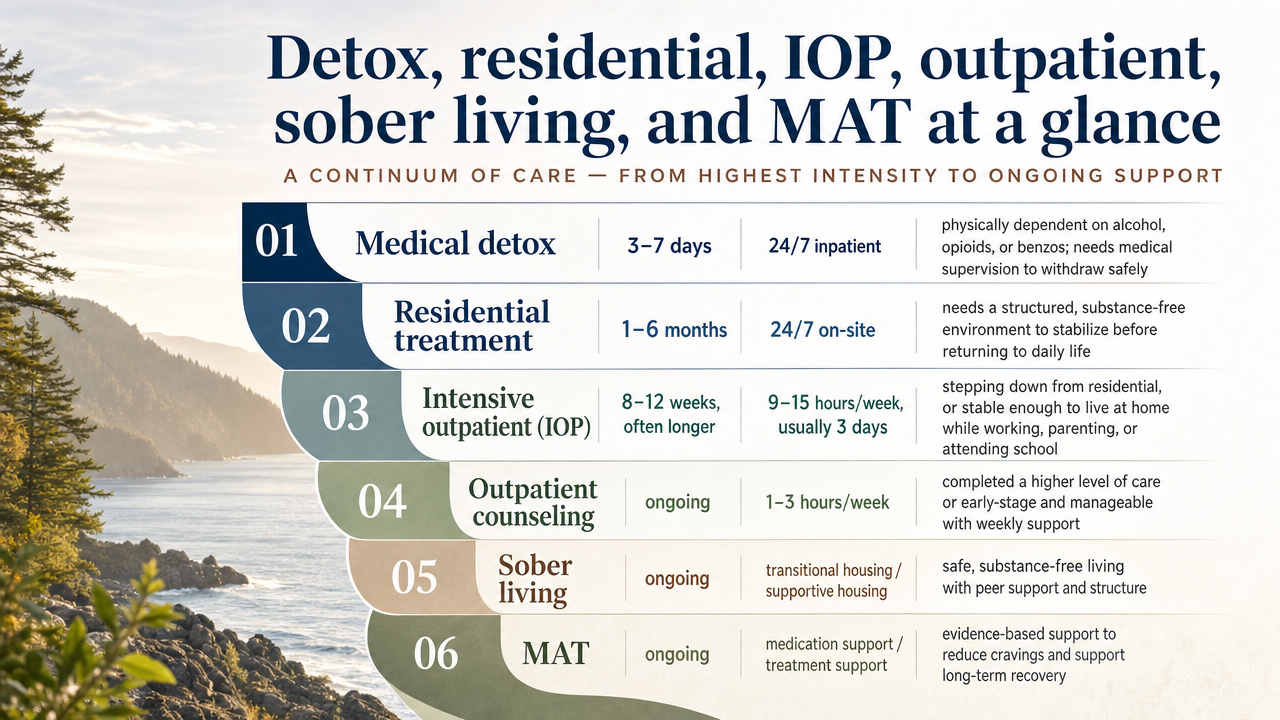
Detox, residential, IOP, outpatient, sober living, and MAT at a glance
Here's the plain-English version of what OHP will pay for and who each level tends to fit best.1
A few things worth naming. Detox is not treatment on its own—it's the medical bridge that gets you safely to treatment. Sober living isn't a clinical service, so OHP doesn't pay for the housing itself, but it pairs with the IOP or outpatient care OHP does cover. And MAT is not a separate track from the rest; it runs alongside counseling and groups, whichever level you're in.1
If you're not sure where you land, an intake assessment at any Portland program will place you. That's what the first phone call is for.
Why IOP is the workhorse level for most OHP members
If you're picturing rehab as a month locked away from your life, that image is doing you a disservice. For most OHP members in Portland, intensive outpatient is where the real work happens.
IOP runs about three days a week, often mornings or evenings, so you can keep your job, keep your kids in school, and keep your housing. You get group therapy, individual counseling, relapse prevention, and co-occurring mental health support that addresses depression, anxiety, or trauma showing up alongside the substance use. If you're leaving detox or residential, IOP is the step-down that keeps momentum from evaporating the moment you're back in your own kitchen.1
It's also the level that tends to have the most openings across Portland's OHP-contracted providers, because programs run multiple cohorts a week. That's not a lesser option. That's a program built to fit the life you're trying to protect.
Real Recovery Starts in Portland, Oregon
Call now or verify insurance to take the first step toward lasting recovery in Portland.
The same-week access map: four calls that move you forward
You've probably already made a few phone calls that went nowhere. Voicemail. "We'll call you back." A form to fill out online. That pattern is why people give up before intake, and it's not your fault—it's what happens when you dial without a map.
Here's a different pattern. Four short calls, in a specific order, each with a specific job. You can do all of them in a single afternoon. Every step below is grounded in how OHP behavioral health benefits actually work: no PCP referral required, CCO determines network, program handles intake. Follow the sequence and you skip most of the phone tag.1
Confirm your CCO before you dial a program
Call one: the shortest call of the day. Pull out your OHP card and look at the plan name printed on the front. That's your Coordinated Care Organization—most likely Health Share of Oregon, CareOregon, or Trillium if you're in the Portland metro. Write it down. That name is the first thing every program will ask for.2
Can't find your card? Call OHP Client Services at 800-273-0557 and they'll tell you which CCO you're enrolled with. Two minutes, one answer. Do this before you call any rehab program, because starting with the CCO question saves you from getting halfway through an intake with a program that can't bill for your care.3
Call the program directly—no referral needed
Call two: the program itself. You do not need your primary care doctor to send a referral first. That's the single biggest myth that keeps people stuck. Pick up the phone and call the rehab's admissions or intake line yourself.1
Ask for admissions, not the front desk. Say plainly: "I have OHP through [your CCO], and I'm looking for an opening this week." That one sentence tells the intake coordinator exactly what they need to know to route you—coverage, network, timeline. If they can't help, they'll usually name a Portland program that can.
The three access questions that cut phone tag
Call three is really the same call, extended. Before you hang up with any program, get answers to these three questions:
- Are you contracted with my CCO? If no, ask which programs in your CCO's network they'd recommend.
- When is your next intake assessment? Push for a specific day and time this week, not "we'll be in touch."
- Once I'm assessed, when can I start group or begin treatment? A same-week program should answer in days, not weeks.
Write the answers down. If any of the three is vague, call the next program.
What to bring to intake so nothing stalls
Call four is the confirmation call the day before intake. Ask what to bring. The short list is almost always: your OHP card, a photo ID, a list of current medications, and any recent hospital or detox discharge paperwork if you have it. If you're court-mandated, bring your referral letter or DUII paperwork. Show up fifteen minutes early. That's it—that's the whole doorway.
What to expect clinically once you're admitted
The first week of treatment is rarely what people picture. There's less confrontation than TV suggests, more paperwork than anyone warns you about, and a slower, steadier rhythm than the crisis that got you here. That shift is intentional. The clinical goal in the first days isn't to fix everything—it's to steady you enough that the real work becomes possible.
Once you're admitted to an OHP-covered program in Portland, expect an intake assessment that maps your substance use history, medical conditions, mental health, housing, work, and legal situation. From that, a clinician builds a treatment plan you actually see and sign. OHP-covered services include individual counseling, group therapy, medication-assisted treatment, and coordination with primary care when co-occurring conditions are in the picture. If you're stepping down from detox or residential, your plan should already include a step-down pathway before you finish your first week of groups.1
Two things surprise most people. First, how much of recovery is skill-building rather than storytelling—learning how to sit with a craving, how to sleep without a substance, how to have a hard conversation with a family member without disappearing. Second, how quickly the work turns practical: rides, childcare, a paystub, a probation officer's email. Portland programs that serve OHP members tend to keep those threads in view because the population they serve lives with those threads every day.
IOP structure, groups, and co-occurring mental health support
A typical Portland intensive outpatient program runs three days a week, three hours per session, for eight to twelve weeks—sometimes longer if your plan calls for it. You'll rotate through process groups, psychoeducation groups on topics like relapse prevention and emotion regulation, and individual sessions with your primary counselor. Medication-assisted treatment, if it's part of your plan, is coordinated alongside groups rather than replacing them.1
The co-occurring piece matters. Depression, anxiety, PTSD, and grief show up in almost every IOP room in Portland, and OHP covers treatment for those conditions when they're tangled with substance use. That doesn't mean your IOP becomes your only mental health provider—it means the groups and individual sessions address the whole picture instead of pretending the substance use lives in isolation. If you need a psychiatric medication evaluation, your program can coordinate that through your CCO's network.1,2
Sober living, employment support, and the step-down plan
Housing is where a lot of good treatment plans break down. If you're leaving detox or residential and going back to a place that isn't safe, sober living gives you a substance-free environment while you attend IOP or outpatient. OHP doesn't pay for the housing itself, but the clinical care you attend from that house is covered. Ask your intake counselor which sober living homes Portland programs work with regularly.1
Employment and education support belong in the same conversation. Many Portland IOPs help with resume work, job search structure, or re-enrollment in classes, because a paycheck and a purpose protect recovery. Before you finish IOP, your counselor should build a written step-down plan: outpatient counseling, MAT continuation, a peer support connection, and a specific relapse-response protocol. That plan is your bridge out—don't leave without it.
When your CCO network feels like a dead end
Sometimes you do everything right and still hit a wall. Every program your CCO covers is full. The intake coordinator says "three weeks out" and means it. You're sitting with the phone in your lap wondering if you should just give up for now. Don't. There are three more moves.
First, ask the last program you called to name every other in-network provider they know of, not just the ones they typically refer to. Health Share of Oregon and CareOregon contract with more Portland-area programs than most intake coordinators list from memory If you're on Trillium in the Washington County side of the metro, the same principle applies—their network is broader than a single referral suggests. Ask for the full list and work down it.2,8
Second, consider OHSU as an access pathway. As a major Portland OHP participant, OHSU coordinates behavioral health screening and can connect you with substance use providers inside its network. That's a different door into the same system.9
Third, if your CCO's network is genuinely thin for what you need, you can change plans. Call OHP Client Services at 800-273-0557 and ask about switching. The change typically takes effect the following month, which is why this is a third move, not a first one—but if you're planning for longer-term care, it's worth the call.3
SAMHSA's national treatment locator and opioid treatment program directory are backup tools when local options feel exhausted. They won't replace a Portland intake coordinator, but they can surface programs you haven't tried. A dead end usually isn't. It's just the third program that said no.11,12
The national treatment gap—and why Portland access is a personal decision
Zoom out for a second. In 2024, 80% of people in the United States who needed treatment for a substance use disorder did not get it. That's a national number, not a Portland one—but it explains why the phone tag you've been playing feels less like a personal failing and more like a system-wide problem. Four out of five people who needed care last year stayed on the sidelines.6
Read that number two ways. First, as evidence that the barriers you're hitting are real. The exhaustion, the voicemails, the "we'll call you back"—that pattern didn't start with you. Second, as the reason your call this week matters more than it feels like it does. Every person who moves from the 80% into the 20% who actually get care changes their own trajectory, and often their family's too.
Portland's OHP infrastructure exists specifically to shrink that gap locally. Coverage without a referral, a network of contracted programs, IOP slots that turn over weekly. The tools are here. What the national data can't do is make the call for you. That part is yours—and it's a smaller step than the number makes it sound.1
Your next call
You've read this far, which means the part of you that wants to be done with this is still driving. Trust that part for ten more minutes.
Pick up your OHP card. Read the CCO name off the front. If it isn't there, dial 800-273-0557 and ask. Then call one Portland program's admissions line and say the sentence: "I have OHP through [your CCO], and I'm looking for an opening this week." Ask the three questions. Write down the answers. If the first program can't help, call the second.3
You don't have to feel ready. You don't have to have the right words. You just have to make the call while the card is still in your hand. That's the whole next step—and Oregon Trail Recovery, along with other OHP-contracted programs across the Portland metro, is on the other end of that line when you're ready to dial.
Frequently Asked Questions
Do I need a referral from my primary care doctor to start rehab under OHP?
No. Oregon Health Plan behavioral health benefits do not require a referral from your primary care provider to start substance use treatment. You can call a Portland rehab program's admissions line directly, tell them your CCO, and ask for an intake assessment this week.1
Which CCOs cover OHP members in the Portland metro?
Most Portland-area OHP members are enrolled in Health Share of Oregon or CareOregon, with Trillium also serving parts of the metro, especially in Washington County. Your CCO name is printed on the front of your OHP card. If you can't find it, call OHP Client Services at 800-273-0557.2,3,8
What levels of substance use care does OHP actually pay for?
OHP covers medically supervised detoxification, residential treatment, intensive outpatient, standard outpatient counseling, medication-assisted treatment with medications like buprenorphine or methadone, individual and group therapy, and in-home supports. Co-occurring mental health care is covered when it's tied to substance use treatment. Sober living housing itself isn't covered, but the clinical care you attend while there is.1
What should I say when I call a Portland program to ask about openings this week?
Ask for admissions, then say: "I have OHP through [your CCO name], and I'm looking for an opening this week." Then ask three questions: Are you contracted with my CCO? When is your next intake assessment? Once I'm assessed, when can I start? If any answer is vague or pushes past two weeks, call the next program on your list.1
What if my CCO's in-network programs are all full or waitlisted?
Ask each program you call for the full list of other in-network providers they know—Health Share of Oregon and CareOregon contract with more Portland-area programs than any single intake coordinator names from memory. OHSU is another OHP access pathway. You can also call 800-273-0557 to change CCOs, though the switch takes effect the following month. SAMHSA's national locators are a backup.2,3,9,11,
Can I get help for both a substance use disorder and a mental health condition at the same time?
Yes. OHP covers co-occurring mental health treatment alongside substance use care, so depression, anxiety, PTSD, or grief can be addressed inside the same treatment plan. Portland CCOs are required to integrate mental health, addiction, and physical care through one local network, which makes coordinating those services more straightforward.4
References
- Oregon Health Plan (OHP) Behavioral Health Coverage. https://www.oregon.gov/oha/hsd/ohp/pages/behavioral-health.aspx
- Coordinated Care Organizations (CCO). https://www.oregon.gov/oha/hsd/ohp/pages/coordinated-care-organizations.aspx
- Coordinated Care Organization (CCO) Plans. https://www.oregon.gov/oha/hsd/ohp/pages/cco-plans.aspx
- Oregon's Medicaid Coordinated Care Organizations. https://pmc.ncbi.nlm.nih.gov/articles/PMC4939819/
- SAMHSA Releases Annual National Survey on Drug Use and Health. https://www.samhsa.gov/newsroom/press-announcements/20250728/samhsa-releases-annual-national-survey-on-drug-use-and-health
- Release of the 2024 National Survey on Drug Use and Health. https://www.samhsa.gov/blog/release-2024-nsduh-leveraging-latest-substance-use-mental-health-data-make-america-healthy-again
- Substance Use and Mental Disorders in the Portland-Vancouver-Beaverton Metropolitan Statistical Area. https://www.samhsa.gov/data/sites/default/files/NSDUHMetroBriefReports/NSDUHMetroBriefReports/NSDUH-Metro-Portland.pdf
- Local CCOs | Washington County, OR. https://www.washingtoncountyor.gov/behavioral-health/local-ccos
- Oregon Health Plan Members | OHSU. https://www.ohsu.edu/health-services/oregon-health-plan-members
- The 2026-2030 Comprehensive Plan. https://www.oregon.gov/adpc/pages/plan.aspx
- Treatment Locators: Mental Health, Drug, Alcohol Issues. https://www.samhsa.gov/find-help/locators
- Opioid Treatment Program Directory. https://www.samhsa.gov/find-help/locators/opioid-treatment-program-directory
Relapse Doesn't Mean the End Of Your Journey
Reach out today to explore programs that support real, long-term sobriety.