


Rehab Options for Montana Residents

Key Takeaways
- Montana has expanded its treatment continuum through the HEART 1115 Medicaid waiver, but 72% of residents with a substance use disorder still aren't receiving care 1.
- Rural geography, thin workforce, and small-town privacy concerns often make in-state care harder to access than the benefit book suggests, especially in frontier counties 7.
- Leaving Montana after detox can create protective distance from triggers and people tied to substance use, without cutting off Medicaid coverage, family contact, or job protections 12.
- Verify options through DPHHS approved provider lists and SAMHSA locators, ask programs direct questions about ASAM level, billing, and discharge planning back to Montana 5, 7.
When Staying Close to Home Stops Working
You already know what the drive home from detox feels like. The same exit off the interstate. The same gas station. The same friend who'll text within a week asking if you want to grab a drink and "just catch up." If you're reading this, some part of you is asking whether staying close to home is going to be enough this time.
That question is not weakness. It's information.
Montana has real treatment options, and we'll walk through them honestly in a minute. The state has expanded Medicaid coverage across the full continuum of care, funded new residential beds through the HEART initiative, and built out drug courts that actually work for a lot of people 2. If in-state care is the right fit for you, that path is more open than it was five years ago.
But for some people, especially after detox, the most protective next step is putting some miles between yourself and the places where the substance use lived. That's not running. That's strategy.
This piece is going to do two things. It's going to show you what rehab for Montana residents actually looks like right now, in plain language. And it's going to give you permission to consider leaving the state for a stretch of time if that's what your recovery needs. Both can be true. Let's take it one section at a time.
What Montana's Treatment System Actually Looks Like Right Now
The Gap Between Need and Available Care
Here's the piece nobody in a Montana clinic waiting room wants to say out loud: the system is doing more than it used to, and it's still stretched thin.
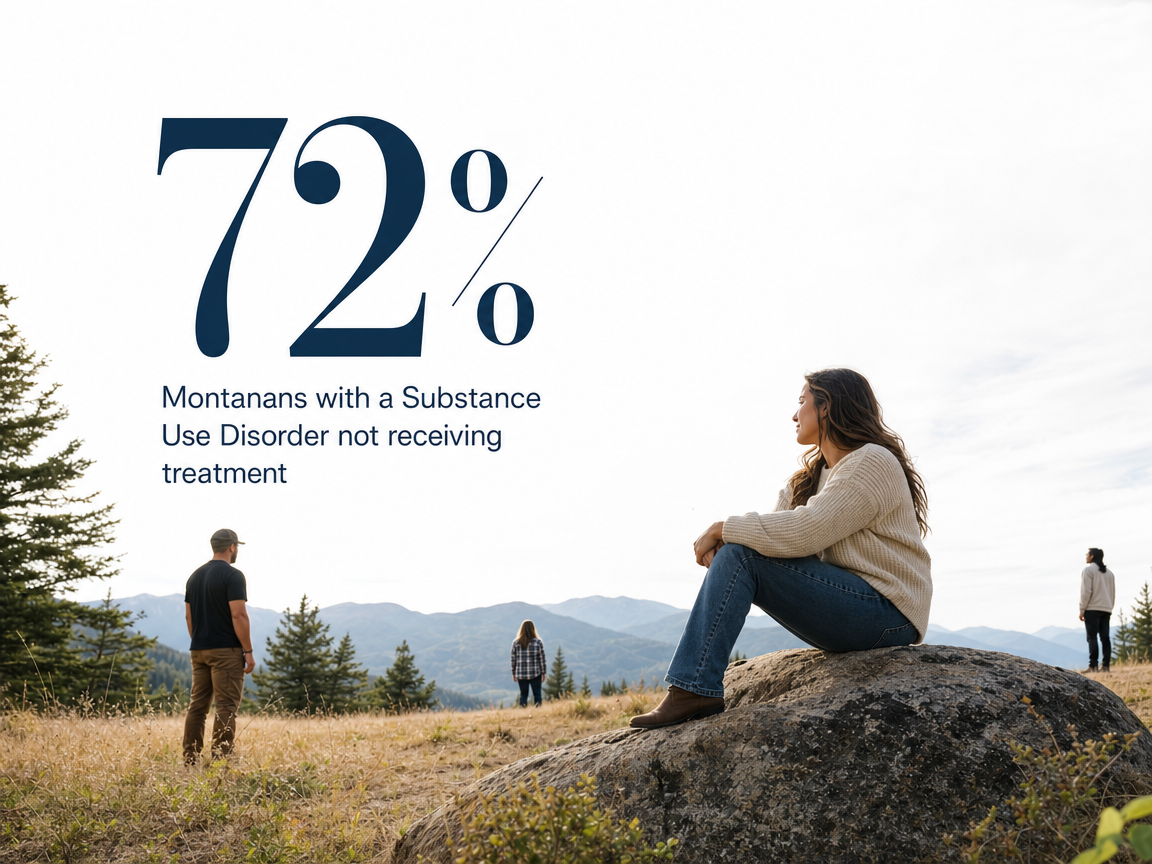
The Montana Substance Use Disorder Task Force reports that 72% of Montanans with a substance use disorder are not receiving treatment 1. That's not a number to weaponize. It's a number that explains why the intake counselor you called last Tuesday said the next assessment slot was three weeks out, and why your cousin in Glendive was told the nearest residential bed was in Billings or Missoula.
Geography does a lot of the damage here. Montana has 56 counties, and many of them are frontier counties where the closest state-approved outpatient program might be a ninety-minute drive one way 7. If you live in a small town on the Hi-Line or east of the Divide, "local treatment" often isn't local at all. It's already a road trip.
The workforce is thin too. Counselors leave. Programs pause admissions. Recovery residence beds fill up. None of that is a moral failure on Montana's part. Rural states across the West are working through the same shortage.
Why does this matter for you, specifically? Because if you've been feeling like you're pushing against a door that keeps sticking, it isn't you. The door is heavy. That doesn't mean you stop pushing. It means you get honest about whether the door you're pushing on is the only one, or the best one, for what you actually need next.
How HEART and Medicaid Expanded What's Covered
Now the better news, because there's real news here.
In 2022, Montana got federal approval for the HEART 1115 Medicaid demonstration waiver. In plain language, that let Medicaid start paying for levels of care it couldn't fully cover before, including high-intensity residential treatment (ASAM 3.3 and 3.5) and residential withdrawal management 4. The 2026 Montana Medicaid Member Guide spells out what's on the benefit list today:
- screening and assessment
- medication-assisted treatment (MAT)
- peer support
- clinically managed low-intensity residential care
- medically monitored non-hospital inpatient treatment
- partial hospitalization
- intensive outpatient
- outpatient therapy
- recovery support 12
That is a real continuum. Five years ago, a lot of that wasn't reimbursable.
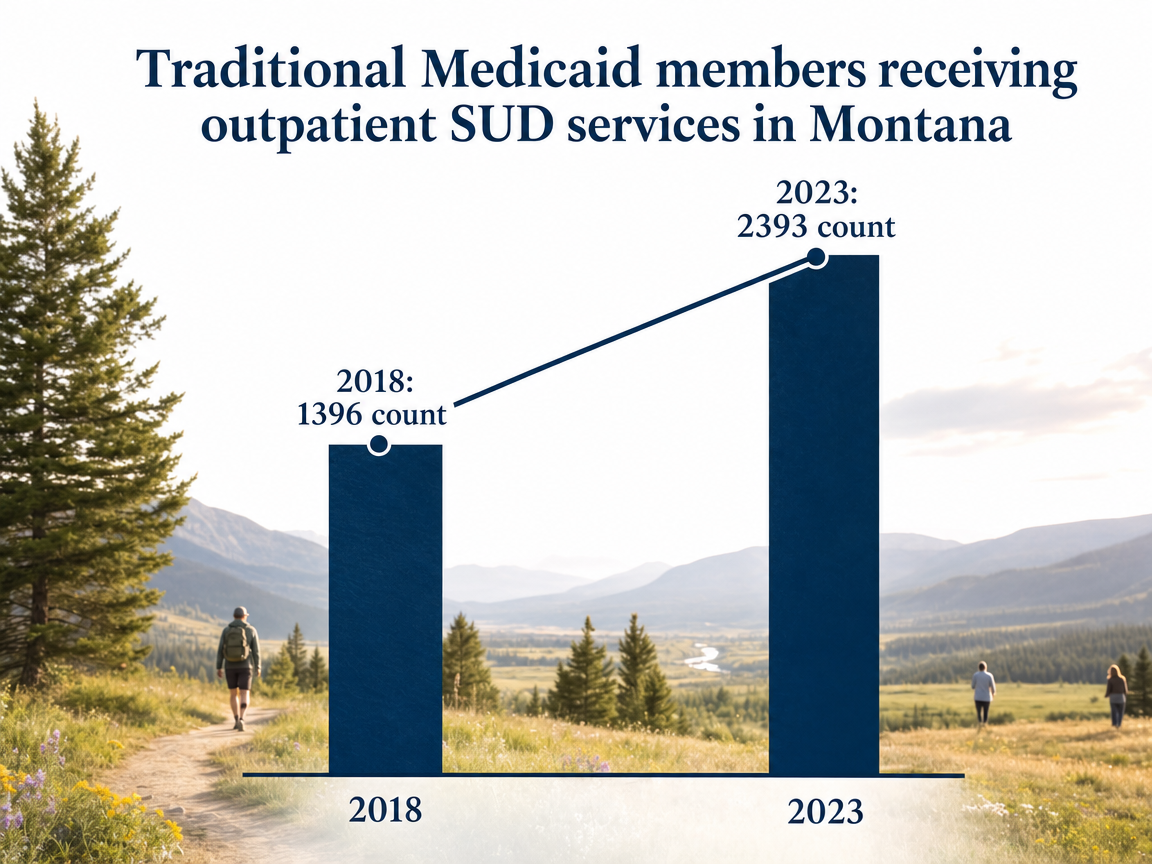
The utilization numbers show people are actually using it. Traditional Medicaid members receiving outpatient SUD services in Montana grew from 1,396 in 2018 to 2,393 in 2023, a 71.4% jump 1. The HEART Initiative's 2024 report says newly available Medicaid and grant services under HEART served 5,092 Montanans in state fiscal year 2024, and 1,612 members got treatment through the HEART-expanded Medicaid ASAM levels 2.
What does that mean for you sitting at a kitchen table trying to figure out next steps?
It means that if you have Montana Medicaid, or you qualify for it, a lot of the care you might need is a covered benefit on paper. Residential care. Withdrawal management. IOP. MAT with buprenorphine or naltrexone. Peer support from someone who has walked this road. You are not asking for anything exotic.
Where Montana Residents Can Verify In-State Options
Before you make any decision, in-state or out-of-state, you deserve to see the actual menu. Not a random Google result. Not a facility that paid for the top ad slot. The real, state-vetted list.
Three places worth bookmarking:
The DPHHS Behavioral Health and Developmental Disabilities (BHDD) approved provider lists show every state-approved SUD treatment provider by county, along with what services they offer (outpatient, ACT/DUI, MIP, group), whether they have telehealth, whether they offer MAT, what insurance they accept, and their hours 7, 10. This is the closest thing Montana has to a straight-talk directory.
The DPHHS Treatment Provider Information page lists community programs, residential facilities, recovery centers, and culturally specific programs like the White Sky Hope Center, which serves Native American women and men 8. If you're a tribal member or you want a program that centers Indigenous healing practices, that matters.
The DPHHS "Get Help" page points you to two federal locators, the SAMHSA Opioid Treatment Program Directory and the Behavioral Health Treatment Services Locator, which cover Montana programs and out-of-state programs alike 5.
Pull up those lists. Call two or three programs. Ask about wait times, what level of care they'd recommend after detox, and whether they take your insurance. If the answers you get feel workable, you have a plan. If they don't, that's real information too, and it's the start of the next section.
Real Recovery Starts in Portland, Oregon
Call now or verify insurance to take the first step toward lasting recovery in Portland.
Why Leaving Montana for Treatment Is Not Running Away
Triggers Are Places, People, and Routines
Recovery talk uses the word "triggers" so often it starts to lose meaning. So let's get concrete.
A trigger is the parking lot behind the bar on Grand Avenue. It's the coworker who always had a bump in their truck at lunch. It's the specific stretch of highway where you used to make the call. It's your own kitchen at 9 p.m. on a Tuesday, because that's when the craving used to hit hardest and your body remembers.
You can do a lot of internal work. You can learn coping skills, sit through group, take your medication, and still walk past three of those triggers on the way to the grocery store. That is not a character flaw. That is your nervous system doing exactly what it learned to do in the environment where the substance use lived.
Distance changes the math. When the coworker can't text you, when the parking lot is 900 miles away, when your morning routine is genuinely new because the sidewalk outside is new, your brain gets a break it can't get at home. That break is not the whole of recovery. It's a window where the new skills you're building actually have room to take hold.
Leaving for a stretch isn't abandoning your life. It's protecting the version of you that's trying to come back to it.
Privacy in a Small Community
Montana is a small state wearing a big state's clothes. A million people, spread thin, and everybody knows somebody.
If you walk into the outpatient clinic in your county seat, there's a real chance the person at the front desk went to high school with your sister. The person in the group two chairs over coaches your kid's team. The pharmacist who fills your naltrexone script sees you at church.
None of that means in-state care is wrong. Plenty of people in recovery find that being seen by their own community is exactly what keeps them honest. But if you've been putting off treatment because the thought of being recognized makes your stomach drop, that fear is worth taking seriously instead of arguing with.
Going somewhere else, for a defined period, lets you do the hardest early work without managing what the neighbors think at the same time. You get to be a person in treatment, not the person in treatment. When you come home, you come home with the work already done, and you get to choose who you tell and when.
What You Keep Access to When You Travel for Care
One of the biggest fears about going out of state is losing the things that anchor you. Your insurance. Your family. Your job. Your way home. Let's take those one at a time, because most of what you're worried about losing, you don't actually lose.
Your Montana Medicaid coverage doesn't vanish when you cross the state line. The 2026 Montana Medicaid Member Guide spells out the full menu of covered SUD services, including screening and assessment, medication-assisted treatment, clinically managed residential care, medically monitored non-hospital inpatient treatment, partial hospitalization, intensive outpatient, outpatient therapy, and peer support 12. When you're evaluating any out-of-state program, the question to ask is whether they can bill Montana Medicaid, or whether they can help you use another coverage source for the residential piece and then plug back into Medicaid-covered IOP and peer support once you're home. Programs that work with out-of-state clients have answered this question hundreds of times. Make them answer it for you.
Your family doesn't disappear either. Portland is a direct flight from Billings, Bozeman, Missoula, and Great Falls. Reputable programs schedule family therapy sessions by video, coordinate visits, and treat your people as part of the plan, not an interruption to it.
Your job or school may be protected under the Family and Medical Leave Act if you qualify. Ask your HR contact directly, or ask the program's admissions team what they've seen work.
You're not cutting ties. You're going to get well and coming back.
What a Post-Detox Transition Looks Like in the Pacific Northwest
Detox First, Through Pacific Crest Trail Detox
Before any residential program can do its work, your body needs a safe landing. If you haven't finished medical detox yet, that's the first stop, not the second.
Oregon Trail Recovery is not a detox facility. We want to be honest about that up front. For medical stabilization and withdrawal management, Oregon Trail partners with Pacific Crest Trail Detox, a medically supervised program in the Portland area. That's where the physical piece gets handled: medication support, vital signs, nursing coverage, sleep, food, and a quiet room to let your nervous system reset.
Why does this partnership matter for a Montana resident? Because it means you're not stitching together two unrelated programs by yourself. The handoff from detox into residential or intensive outpatient care is coordinated. Your intake team, your clinical team, and your case manager already know each other. You don't have to explain your story from scratch on day six.
If you're still in a Montana detox bed as you read this, or you're waiting for one, ask your discharge planner to call ahead about out-of-state options. A good discharge plan starts before you leave the detox unit, not after.
Residential, IOP, and Sober Living Through Oregon Trail Recovery
Once detox is behind you, the real work starts. This is the stretch where a lot of people relapse if they go home too soon, and it's the stretch Oregon Trail Recovery was built for.
Here's what a Pacific Northwest transition can look like, in plain terms.
Residential treatment comes first for many post-detox clients. You live in a structured recovery home, sleep on a regular schedule, share meals, and spend your days in clinical programming. Oregon Trail runs gender-specific homes, one for men and one for women, with plans to grow to three men's homes and one women's home over the next year. The therapies you'll encounter are the ones with the strongest evidence base for substance use disorders: cognitive behavioral therapy, dialectical behavior therapy, motivational interviewing, and mindfulness-based recovery. If you're carrying trauma or depression alongside the substance use, Oregon Trail offers co-occurring mental health support inside the SUD program, not as a separate specialty track.
Intensive outpatient (IOP) comes next. You step down to programming several days a week while you start rebuilding a normal schedule, often with employment or education assistance built in.
Sober living holds the whole thing together. You keep the structure, the roommates who understand, and the accountability, while your independence grows week by week.
The whole arc is designed to be the last treatment experience you need. Not because relapse is impossible, but because the skills, the community, and the follow-through are meant to actually stick.
Coming Home to Montana Stronger
Going to the Pacific Northwest for a season isn't a one-way ticket. Most people who travel for treatment come home. The question is what shape you're in when you get there.
A good transition plan starts talking about your return on day one, not week twelve. That means your care team in Portland is already asking about Billings or Bozeman or Kalispell. Who's your support person there? What does your work or school situation look like? Which Montana outpatient program or peer support meeting are you going to plug into the week you land?
The DPHHS provider lists and the Get Help page are the tools you'll use to build the Montana side of the plan: an approved outpatient program for continuing care, a MAT prescriber if you're on buprenorphine or naltrexone, a peer support connection, and a home group for whatever recovery community fits you 5, 7. Your Portland team can help you line those up before you fly back.
Coming home isn't the end of treatment. It's the test of it. The point of leaving was never to escape Montana. It was to come back to Montana with more to offer the people who love you.
If a Court, DUI, or Corrections Case Is Part of the Picture
If there's a judge, a probation officer, or a corrections case attached to your recovery, the treatment conversation gets more complicated, not impossible. You have real options, and some of them are actually good.
Montana's drug courts are the most visible example. Over a recent 48-month period, 1,743 people entered Montana drug courts and 619 graduated, a 67.7% graduation rate, at an average cost of $5,824 per admission 3. That's a stronger completion rate than a lot of people expect. Drug court isn't easy. It means frequent drug testing, regular court check-ins, mandated treatment, and consequences that stick. It also means a structured path that can end with your case handled and your life on different footing.
If your case is corrections-involved, the Montana Department of Corrections contracts with three nonprofit organizations to operate seven residential inpatient SUD facilities, including DUI treatment facilities, 90-day SUD programs, and long-term treatment options 13. Your case manager or attorney can tell you which pathway your specific case qualifies for.
For a straight DUI assessment or court-ordered outpatient piece, the DPHHS approved provider list flags ACT/DUI and MIP programs by county so you can find something within driving distance 7.
Questions to Ask Any Program Before You Say Yes
Whether you're calling a program in Missoula, Portland, or anywhere in between, the questions you ask on that first phone call matter more than the website copy. Write these down before you dial. It's okay to read them off a piece of paper. It's okay to say, "Hold on, let me write that down." You are not being difficult. You are being a good steward of your own recovery.
- About the level of care:
- What ASAM level do you provide, and what level do you think I need coming out of detox? How do you decide when someone steps down from residential to IOP, or from IOP to sober living?
- About cost:
- Do you take Montana Medicaid? If not, what do you take, and what happens if my coverage runs out mid-stay? Can you put the estimate in writing?
- About the clinical work:
- What therapies do you use? Do you treat co-occurring depression, anxiety, or trauma alongside the substance use, or do you refer that out?
- About coming home:
- How do you build a discharge plan for someone going back to Montana? Who on your team helps me line up outpatient care, MAT, and peer support before I leave?
- About honesty:
- What happens if I relapse during the program? Do you discharge me, or do you adjust the plan?
If a program dodges any of these, you have your answer.
Frequently Asked Questions
Does Montana Medicaid cover rehab if I go out of state for treatment?
Sometimes, yes, and sometimes you'll use another coverage source for the out-of-state piece and pick Medicaid back up when you're home. The 2026 Montana Medicaid Member Guide lists the full menu of covered SUD services 12, but each out-of-state program has to be able to bill it. Ask the admissions team directly whether they accept Montana Medicaid and get the answer in writing.
Is leaving Montana for rehab really better than staying local?
Not automatically. For some people, staying close to family and a familiar clinic is what keeps them in treatment. For others, especially after detox, physical distance from the people, places, and routines tied to the substance use is protective. If you've relapsed close to home before, or if privacy in a small community is stopping you from walking in the door, leaving for a defined stretch is worth considering.
What levels of care does Montana Medicaid cover for substance use treatment?
The 2026 Medicaid Member Guide covers screening and assessment, medication-assisted treatment, peer support, clinically managed low-intensity residential care, medically monitored non-hospital inpatient treatment, partial hospitalization, intensive outpatient, outpatient therapy, and recovery support 12. The 2022 HEART 1115 waiver added coverage for high-intensity residential (ASAM 3.3 and 3.5) and residential withdrawal management 4. The benefit book is broad. Actual availability depends on which program has an open bed.
What happens after detox if I'm not ready to go straight home?
Detox handles the physical piece, not the recovery skills. A common next step is residential treatment, then intensive outpatient, then sober living, with continuing care back in your home community. Oregon Trail Recovery partners with Pacific Crest Trail Detox in the Portland area for medical stabilization, then continues the arc through gender-specific residential, IOP, and sober living. Ask your discharge planner to help you build that bridge before you leave detox.
How do I find state-approved treatment providers inside Montana?
Start with the DPHHS Behavioral Health and Developmental Disabilities approved provider lists, which show state-vetted programs by county along with services, MAT, telehealth, and insurance details 7, 10. The DPHHS Treatment Provider Information page adds community, residential, and culturally specific programs like the White Sky Hope Center 8. The Get Help page links to SAMHSA's federal locators for in-state and out-of-state options 5. Call two or three before choosing.
Can I still get treatment if I have a DUI or court case pending?
Yes. Montana's drug courts have a 67.7% graduation rate at an average cost of $5,824 per admission 3, and the Department of Corrections contracts with three nonprofits to run seven residential SUD facilities, including DUI, 90-day, and long-term programs 13. For court-ordered outpatient or DUI assessments, DPHHS flags ACT/DUI and MIP providers by county 7. Some judges will approve an out-of-state program with a solid plan. Ask your attorney.
References
- Montana Substance Use Disorder Task Force Strategic Plan. https://dphhs.mt.gov/assets/publichealth/EMSTS/opioids/SUDsStrategicPlan2024.pdf
- DPHHS MCA 16-12-122: HEART Initiative Report 2024. https://dphhs.mt.gov/assets/heartinitiative/HEARTInitiativeReport2024.pdf
- Montana Drug Courts: An Updated Snapshot of Success and Hope. https://courts.mt.gov/external/drugcourt/report/2025drugcourt-report.pdf
- July 1, 2022 HEART Waiver Approval. https://dphhs.mt.gov/assets/MedicaidWaivers/MTHEARTApprovalDocument.pdf
- Get Help – Montana Opioid Use and SUD Resources. https://dphhs.mt.gov/opioid/gethelp
- Summary of Opioid Use in Montana. https://dphhs.mt.gov/assets/publichealth/EMSTS/Data/Opioid_Drug_Use_Summary.pdf
- Montana State Approved Substance Use Treatment Providers. https://dphhs.mt.gov/assets/BHDD/SubstanceAbuse/StateApprovedSubstanceUseTreatmentProviders.pdf
- Treatment Provider Information. https://dphhs.mt.gov/BHDD/SubstanceAbuse/treatmentproviderinformation
- Substance Use Disorder Services and Resources. https://dphhs.mt.gov/BHDD/SubstanceAbuse/
- Montana State Approved Substance Use Treatement Provider List (5‑26). https://dphhs.mt.gov/assets/BHDD/SubstanceAbuse/SUDProviderlist5-26.pdf
- Substance Use Disorders - Medicaid Provider. https://medicaidprovider.mt.gov/32
- 2026 Montana Medicaid Member Guide. https://dphhs.mt.gov/assets/hrd/MedicaidMemberGuide.pdf
- Residential Substance Use Disorder Treatment Centers. https://cor.mt.gov/Facilities/ResidentialSubstanceUseDisorderTreatmentCenters
Relapse Doesn't Mean the End Of Your Journey
Reach out today to explore programs that support real, long-term sobriety.