


Substance Abuse Treatment and Recidivism: What Helps?

Key Takeaways
- Treatment lowers rearrest, reconviction, and reincarceration rates, with the Minnesota RIVERS program showing overall reductions of about 20-27% for participants compared to non-participants, and the strongest reductions across outcomes appearing at a medium dose of roughly 301 to 400 hours—about four to five months 2.
- Oregon treatment-court graduates had three-year recidivism rates of 27% arrest, 19% conviction, and 4% incarceration—far below those discharged or terminated 14.
- When opioids are involved, buprenorphine, methadone, or naltrexone paired with behavioral treatment outperforms either alone, cutting new-offense reincarceration risk by an additional 8.5% 3.
- Ask any program five questions: treatment length, individualized assessment, medication access, co-occurring mental health care, and who owns the handoff into community housing and outpatient care.
The honest answer about treatment and staying out of trouble
Here's what the research actually says: substance abuse treatment can meaningfully reduce your chances of being arrested, convicted, or reincarcerated again—but only when it's long enough, matched to your specific needs, paired with medication if opioids are part of the picture, and connected to real support after you walk out the door. Short, disconnected treatment tends to produce short-lived gains 1.
You probably came here because something is on the line. A pending DUII. A probation officer waiting on paperwork. A reentry date circled on a calendar. Or a relapse that scared you and the people who love you. You deserve a straight answer, not a brochure.
So here it is. Treatment works when it's treated like the beginning of a longer process, not a box to check. The programs that move the needle on recidivism share a handful of features you can actually look for and ask about. The ones that don't share those features often leave people right back where they started—sometimes within a year.
The rest of this guide walks you through what to look for, what Oregon's own data shows, and how to tell the difference. You can use it for yourself, or for someone you love.
What recidivism actually means when you're facing a DUII, probation, or reentry
Recidivism is a word the system uses, but it means different things depending on who's measuring. In most research, it refers to one of three things: a new arrest, a new conviction, or a new incarceration within a set follow-up window—usually one to three years after someone exits treatment, probation, or custody 14. Those three outcomes don't move together. You can be arrested without being convicted. You can be convicted without going back to jail. That's why one program can claim it "reduces recidivism" while another measures something entirely different.
For you, the practical definition is simpler. Recidivism is the next thing that could pull you back into court—another DUII charge, a probation violation for a positive UA, a new offense during reentry, or a technical violation that lands you in front of a judge again.
Relapse and recidivism aren't the same thing, but they travel together. A return to use often precedes the legal event, which is why treatment that only addresses the drinking or the drug—without touching the thinking, the housing, the people around you, and the mental health underneath—tends to leave the legal risk intact 5. Keep that distinction in mind as you read on. The programs worth your time treat both.
What the research shows treatment can and can't do
Treatment reduces repeat offenses—when the dose is right
The clearest evidence that treatment moves the needle on recidivism comes from studies that measured dose, not just attendance. In a Minnesota Department of Corrections evaluation of a structured substance use disorder program called RIVERS, participants had a 20% lower rearrest rate, a 27% lower reconviction rate, and a 27% lower rate of being reincarcerated for a new offense compared to people who didn't go through the program 2. These are significant reductions that can change outcomes over three years.
Here's the part that matters for your decision: the biggest reductions showed up at a medium treatment dosage of roughly 301 to 400 hours—about four to five months of structured work 2. People who got less than that saw smaller effects. People who got more didn't always see proportionally larger ones, but short doses underperformed across every outcome measured.
That lines up with what the National Institute on Drug Abuse has said for years: treatment has to last long enough to produce stable behavioral changes 5. A 28-day program is a start, not a finish line. If you're being told you'll be "done" in a month, you're being told a story that the research doesn't support.
Older correctional research reaches a similar bottom line. A review of correctional treatment studies found that three-quarters favored treatment over no treatment, with therapeutic-community programs showing the strongest average effects 4. Different model, same lesson: structured, sustained care does more than a brief intervention squeezed into a sentence.

Where the evidence is honest about its limits
You deserve to hear the other side of this, too. A peer-reviewed commentary on treatment delivered inside correctional settings concluded that findings on recidivism are equivocal, and that even rigorous studies often find effects that are minimal and short-lived once people are back in the community 1. Treatment that happens in a locked facility and then stops at the gate doesn't carry very far on its own.
There's another honest caveat worth naming. The commentary's authors question whether recidivism should even be the headline outcome, because treatment can improve health, reduce overdose risk, and strengthen family life without immediately shifting arrest numbers 1. If your definition of success is only "did they get arrested again," you may miss gains that matter deeply to the person you love.
What this means practically: don't choose a program on the strength of a single statistic—including the ones in this article. Ask what happens after discharge. Ask how long the program lasts, what continuing care looks like, and who's responsible for the handoff. Those questions separate programs that produce lasting change from programs that produce a nice completion certificate.
What Oregon treatment courts tell us about completion
If you're facing a DUII or already in front of a judge in Multnomah, Washington, or Clackamas County, the Oregon Criminal Justice Commission's three-year recidivism analysis is worth knowing by heart. Treatment-court participants who completed or graduated had three-year recidivism rates of 27% for arrest, 19% for conviction, and 4% for incarceration. Participants who were discharged or terminated had rates of 52%, 49%, and 10% on the same measures 14. The gap between finishing and being kicked out is enormous, and it shows up on every outcome the state tracks.
That same analysis found that any treatment-court participation was associated with lower recidivism than a matched probation comparison group 14. So even people who didn't complete still, on average, did better than people on standard probation. The structure itself—regular court appearances, drug testing, treatment requirements, a judge who knows your name—seems to do some work.
Here's the honest piece. Completion isn't random. People who graduate often arrive with more stability, more support, less severe use, or fewer co-occurring crises than people who get terminated. Some of the completion-vs-termination gap reflects the treatment, and some of it reflects who was able to stay in the first place 14. That doesn't mean the court isn't working. It means the real question for you is: what will it take for you to be in the completion column?
Usually it comes down to the same things the research keeps pointing at—adequate treatment length, housing you can actually sleep in without triggers, medication if opioids are involved, and someone paying attention to the mental health piece underneath the use. If your treatment plan doesn't include those, the court structure alone isn't likely to carry you across the finish line.
Medication's role when opioid use is part of the picture
If opioids are part of your use history, medication isn't a side conversation—it's often the single biggest factor in whether treatment holds. The FDA has approved three medications for opioid use disorder: buprenorphine, methadone, and naltrexone 11. Each one works differently, and the right fit depends on your history, your health, and what's actually available where you live. All three are associated with reduced overdose risk and lower overall mortality, which matters because an overdose during a relapse can end the story before any legal consequence does 11.
For recidivism specifically, the Minnesota analysis of medications for opioid use disorder in prisons found that people who received MOUD had lower one-year recidivism than untreated counterparts. When behavioral SUD treatment was added on top of the medication, there was an additional 4.8% reduction in rearrest risk and an 8.5% reduction in new-offense reincarceration risk compared with MOUD alone. The same analysis did not find consistent evidence that MOUD reduced all-cause mortality or release violations across every model, so the paired benefit is strongest for arrest and reincarceration outcomes 3. Medication and counseling aren't competing options. They're a pair.
The hinge point for most people isn't whether to start the medication—it's whether it continues without a gap. CDC guidance is explicit that linkage to care during incarceration, community supervision, or after a hospital visit reduces illegal drug use, overdose risk, and drug-related crime 10. A missed dose at the moment of release, or a program that quietly pressures you off medication once you move into housing, is exactly how people end up back in court. If opioids are in your picture, ask any program—and any sober living home—whether MOUD is welcomed, protected, and planned for before day one.
What actually moves recidivism: a checklist to bring to any program
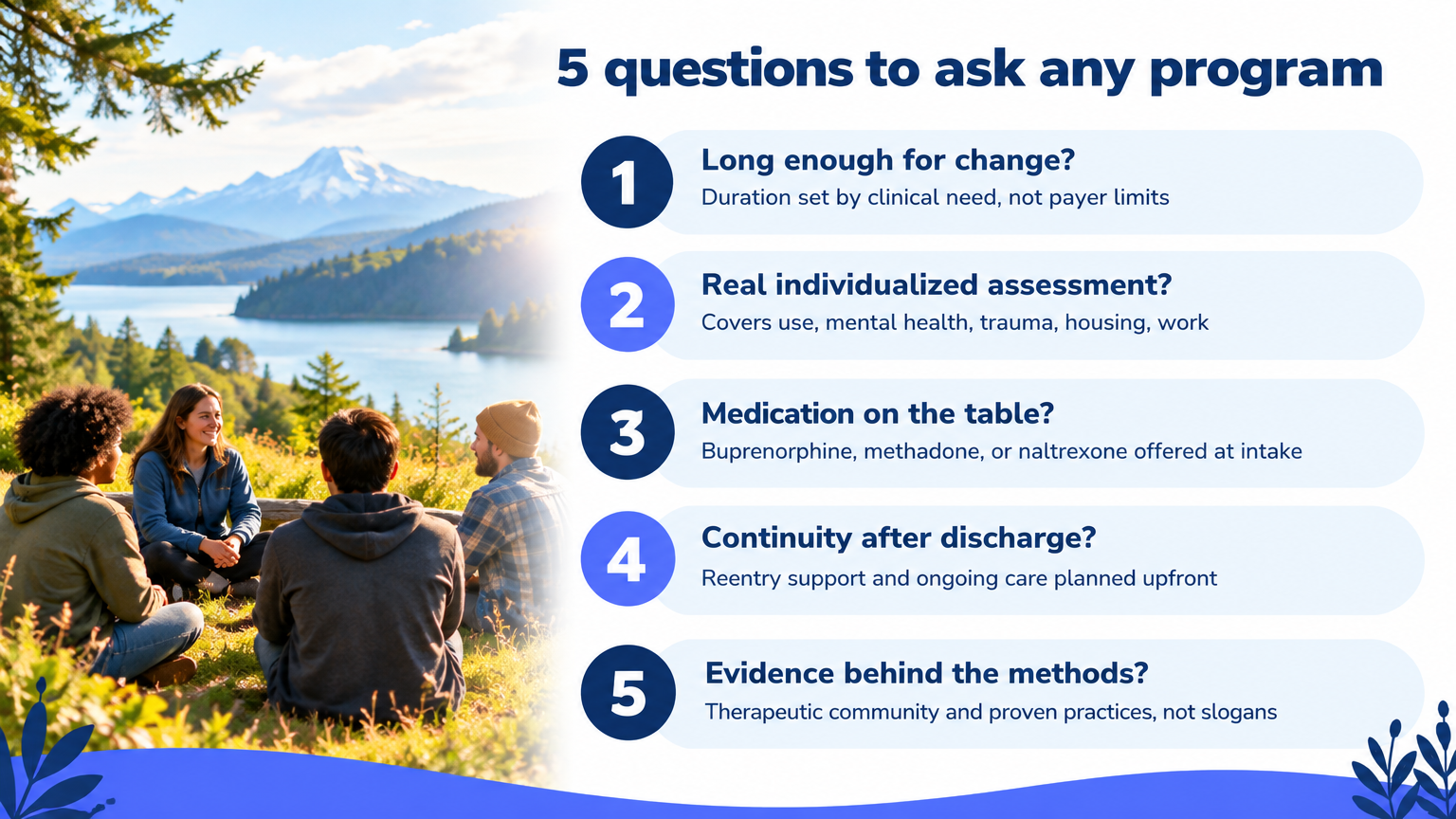
You can walk into any program interview with five questions that separate marketing from medicine. The National Institute on Drug Abuse has published these principles for years, and they map almost perfectly onto what the recidivism research keeps rediscovering 5. Write them down. Ask them out loud. The answers will tell you more than any brochure.
- Is the treatment long enough to produce stable change? NIDA's guide is blunt: treatment must last long enough to produce stable behavioral changes, and continuity of care is essential for people reentering the community 5. If a program's answer is "28 days and you're done," you've learned something important. Ask what the clinical team recommends based on need, not on when a payer stops paying.
- Does the plan start with a real individualized assessment? You're not a diagnosis code. A legitimate program evaluates substance use history, mental health, trauma, criminogenic risk, housing, family, and employment before writing a treatment plan 5. If the plan looks the same for everyone in the lobby, it's not a plan—it's a schedule.
- If opioids are part of the picture, is medication actually on the table? Buprenorphine, methadone, and naltrexone are the three FDA-approved medications for opioid use disorder, and access to an evaluation should be built into intake, not treated as an afterthought 11. A program that discourages medication, or a sober living home that quietly won't accept residents on it, is swimming against the evidence.
- Is co-occurring mental health care part of the model? Depression, anxiety, PTSD, and trauma travel with substance use for most people. Programs that treat the use without touching what's underneath it tend to produce short-lived results 5. Ask how trauma is addressed, which curriculums are used, and what happens when psychiatric care is needed beyond what the program itself provides.
- What does continuity into the community actually look like? This is the question most programs fumble. Who schedules the first outpatient appointment? Who confirms the housing placement? Who holds the medication script before day one? NIDA names continuing care in the community as essential, not optional 5. If no one on staff can answer those three questions by name, the handoff probably won't happen.
Bring this list to Oregon treatment courts, to Portland-area outpatient programs, to sober living interviews across the Pacific Northwest. Programs that answer honestly—even when the honest answer is "we partner with someone else for that piece"—are the ones worth your trust.
Why recovery housing belongs in the recidivism conversation
Where you sleep after treatment ends often decides whether treatment holds. A 2025 systematic review of recovery housing found that residents generally outperformed usual-care comparisons on abstinence, income, employment, and criminal charges, with smaller but real effects on incarceration 6. That matters because the first weeks after discharge are when relapse risk, overdose risk, and legal exposure all climb at once—and a couch in the same house where you used before is a setup for all three.
How long you stay in recovery housing turns out to matter as much as whether you enter. A Virginia observational study of 1,978 residents across 101 certified recovery residences found that retention of roughly six to 18 months was important for establishing and maintaining positive discharge outcomes, and that people with recent justice involvement needed extra retention supports to get there 7. A longitudinal study of mutual-help recovery homes found that stays of six months or longer were associated with lower self-reported criminal and aggressive behavior at one-year follow-up 8. Three weeks in a sober house is a place to land. Six-plus months is where the behavioral change tends to settle in.
What to look for when you tour a Portland-area or Pacific Northwest home: peer accountability that's actually enforced, clear links to outpatient care, and a written medication policy that welcomes buprenorphine, methadone, and naltrexone rather than quietly screening residents out. Oregon's funded recovery housing rule requires that residents be allowed to continue medication-assisted treatment, with intervention-before-eviction protections if things get wobbly—though that rule applies specifically to Oregon-funded recovery housing, and privately operated residences may set their own policies 13. If a home can't explain its MOUD policy in plain English, keep looking.
The reentry and probation handoff that often decides what happens next
The two weeks on either side of release or discharge are where most of the recidivism risk lives. A systematic review of reentry interventions that address substance use found that 18 of 31 studies reported reduced recidivism for the intervention group on at least one measure, and 7 of 13 found reduced substance use—but no single approach consistently outperformed the others 9. The lesson isn't that reentry programs don't work. It's that the handoff itself has to be built, not assumed.
A clean handoff has specific moving parts. The first outpatient appointment is scheduled before you walk out, not after. If you're on buprenorphine, methadone, or naltrexone, the script and the prescriber are confirmed so there's no gap at the moment overdose risk is highest—CDC guidance names this linkage as a direct driver of reduced illegal drug use, overdose, and drug-related crime 10. Housing is a confirmed address with a bed, not a phone number to call. And your probation officer knows the plan before you do.
If any of those pieces are missing, say so out loud to your treatment team or your PO this week. The handoff is fixable while you're still inside the structure. It's much harder to rebuild from a motel room after a missed appointment.
Co-occurring mental health support and trauma-informed care
For most people with a substance use disorder, something else is riding shotgun—depression that predates the drinking, anxiety that spikes before every use, PTSD from events you may have never named out loud. Treatment that only addresses the substance tends to leave the engine of the use untouched, which is why NIDA names integrated care for co-occurring disorders as a core principle for justice-involved populations 5.
Trauma-informed addiction treatment is the practical answer. Ask any Portland-area program which curriculums they use, how trauma is addressed alongside substance use, and how they refer out for psychiatric medication when it's needed—addiction programs don't provide primary mental healthcare, and honest ones say so.
If suicide is part of what you or your loved one is carrying, call or text 988 for the Suicide and Crisis Lifeline. Then bring that same honesty into intake. What gets named gets treated.
Oregon's current landscape and what it means for your options
Oregon has been pouring money into the gap you're trying to cross. The state's Alcohol and Drug Policy Commission reported that more than $85 million was allocated during the 2024 legislative session for residential SUD treatment, withdrawal management, and crisis-stabilization capital investments, plus another $18 million in recovery-housing funding through Senate Bill 1530, distributed across 27 grants 12. For you, that means more beds and more funded housing slots are coming online than were available even two years ago—especially in the Portland area and other population centers.
Oregon's funded recovery housing also now operates under a clearer rulebook. State administrative rules require a needs assessment before funded housing is provided, define recovery housing as a drug-free supportive community linked to outpatient treatment or ongoing recovery programming, and explicitly protect residents' right to continue medication-assisted treatment with intervention-before-eviction strategies if things wobble. Those requirements apply to Oregon-funded entities specifically and don't automatically describe every privately operated recovery residence 13. If a Portland or Pacific Northwest home can't speak to those standards, that tells you something.
Capacity isn't the same as access. Qualitative findings from 15 Oregon IMPACTS programs describe real wins in diverting people from jails, emergency departments, and hospitals—while also warning that service counts don't capture whether a person is actually getting well 15. Ask about outcomes, not just openings.
If you're the family member reading this
A quick scope note: this section is for the spouse, parent, sibling, or adult child doing the research tonight. Your person may not be ready to read any of this yet. You still have real work you can do.
Start with the right question. Not "where's the best program," but "which program will keep showing up after discharge?" The reentry research is clear that no single reentry approach consistently wins across studies—what separates outcomes is whether the handoff into community care actually happens 9. Ask any program who schedules the first outpatient appointment, who confirms the housing bed, and who holds the medication plan through release day.
Two more honest things. Pay for length, not luxury—short treatment tends to produce short-lived gains 1. And love with an edge: showing up isn't the same as covering up. If suicide is in the picture, 988 is the call or text to make tonight.
A supportive next step on the trail
You've read the honest version. Treatment can lower the odds of another arrest, another conviction, another trip back inside—but only when it's long enough, individualized, medication-supported when opioids are involved, and connected to the housing and continuing care that hold the work in place after discharge.
Whatever stage you're in—pending DUII, probation check-in next week, reentry date approaching, or a relapse that scared you—the next step is a conversation. Ask the five questions. Push on the handoff. Pick a program that will still be answering the phone six months from now.
When you're ready to talk through what that could look like in the Portland area, our team at Oregon Trail Recovery is here to listen and help you plan what comes next.
Frequently Asked Questions
Does substance abuse treatment actually reduce recidivism?
Yes, when it's structured and sustained. A review of correctional treatment studies found that three-quarters favored treatment over no treatment 4. But effects aren't automatic—a peer-reviewed commentary on correctional settings notes that findings can be equivocal and gains may fade without continuing care in the community 1. The treatment that moves recidivism is long enough, individualized, and connected to real support after discharge.
How long does treatment need to last to make a real difference?
Longer than most people expect. The National Institute on Drug Abuse is explicit that treatment must last long enough to produce stable behavioral changes 5. In the Minnesota RIVERS evaluation, the strongest reductions in rearrest, reconviction, and reincarceration showed up at roughly 301 to 400 hours of structured treatment—about four to five months 2. A 28-day program is a starting point, not a finish line, especially if legal exposure is on the table.
Do Oregon treatment courts lower the chances of being arrested again?
Yes, and the Oregon Criminal Justice Commission's three-year analysis found that any treatment-court participation was associated with lower recidivism than a matched probation comparison group 14. Completion matters most—graduates had far lower arrest, conviction, and incarceration rates than people who were terminated 14. Some of that gap reflects who was able to stay. Your odds of landing in the completion column depend on housing, medication if opioids are involved, and the mental health support underneath.
Is medication for opioid use disorder necessary, or is counseling enough?
If opioids are part of the picture, medication isn't optional—it's the backbone. CDC identifies buprenorphine, methadone, and naltrexone as FDA-approved for opioid use disorder, each associated with reduced overdose risk and mortality 11. Counseling adds to that foundation rather than replacing it. The Minnesota MOUD analysis found that pairing behavioral SUD treatment with medication produced an additional 8.5% reduction in new-offense reincarceration risk compared with medication alone 3. Both pieces together outperform either alone.
Does recovery housing really help someone stay sober and out of jail?
Yes, when the stay is long enough. A 2025 systematic review found recovery housing generally outperformed usual care on abstinence, income, employment, and criminal charges, with smaller but real effects on incarceration 6. A Virginia study of 1,978 residents identified roughly six to 18 months as the retention window where positive outcomes get established 7. A longitudinal study of mutual-help recovery homes linked stays of six-plus months to lower self-reported criminal and aggressive behavior at one year 8. Three weeks isn't enough.
What should a family member look for when choosing a program for a loved one?
Ask who schedules the first outpatient appointment, who confirms the housing bed, and who holds the medication plan through discharge day. The reentry research shows no single approach consistently wins across studies—what separates outcomes is whether the handoff actually happens 9. Pay for length over amenities, since short treatment tends to produce short-lived gains 1. And if suicide is anywhere in the picture, call or text 988 tonight before anything else.
References
- Providing substance use disorder treatment in correctional settings: knowledge gaps and proposed research priorities—overview and commentary. https://pmc.ncbi.nlm.nih.gov/articles/PMC9733039/
- Evaluation of the Recovery, Insight, Victorious, Enduring, Realistic, Self-Care (RIVERS) Substance Use Disorder Treatment Program. https://mn.gov/doc/assets/Evaluation%20of%20the%20RIVERS%20Substance%20Use%20Disorder%20Treatment%20Program_tcm1089-534706.pdf
- Medications for Opioid Use Disorder in Minnesota Prisons and its Effects on Recidivism and All-Cause Mortality. https://mn.gov/doc/assets/Medications%20for%20Opioid%20Use%20Disorder%20in%20Minnesota%20Prisons%20and%20its%20Effects%20on%20Recidivism%20and%20All-Cause%20Mortality_tcm1089-663007.pdf
- Treating Substance Use Disorders in the Criminal Justice System. https://pmc.ncbi.nlm.nih.gov/articles/PMC3859122/
- Principles of Drug Abuse Treatment for Criminal Justice Populations: A Research-Based Guide. https://nida.nih.gov/sites/default/files/principles-drug-abuse-treatment-criminal-justice-populations-research-based-guide_508.pdf
- Recovery housing for substance use disorder: a systematic review. https://pmc.ncbi.nlm.nih.gov/articles/PMC11922849/
- Modeling Recovery Housing Retention and Program Outcomes by Justice Involvement among Residents in Virginia, USA: An Observational Study. https://pmc.ncbi.nlm.nih.gov/articles/PMC11458352/
- A Longitudinal Analysis of Criminal and Aggressive Behaviors among a National Sample of Adults in Mutual-Help Recovery Homes. https://pmc.ncbi.nlm.nih.gov/articles/PMC2910431/
- Reentry Interventions that Address Substance Use: A Systematic Review. https://pmc.ncbi.nlm.nih.gov/articles/PMC6459737/
- Linking People with Opioid Use Disorder to Medication Treatment. https://www.cdc.gov/overdose-prevention/hcp/clinical-guidance/linkage-to-care.html/
- Opioid Use Disorder: Treating. https://www.cdc.gov/overdose-prevention/hcp/clinical-care/opioid-use-disorder-treating.html
- Status of Implementation and Progress on 2020-25 Comprehensive Addiction, Prevention, Treatment and Recovery Plan for Oregon. https://www.oregon.gov/adpc/Documents/July%202024%20Report%20FINAL%20-%20Updated%20September%202024.pdf
- OFFICE OF THE SECRETARY OF STATE. https://www.oregon.gov/oha/HSD/HSDRules/PERM_944_010_11012024.PDF
- Oregon Treatment Court Recidivism Analysis. https://www.oregon.gov/cjc/CJC%20Document%20Library/2025_TreatmentCourtRecidivism_Report.pdf
- Improving People's Access to Community-based Treatment, Supports, and Services (IMPACTS): Qualitative insights from 15 Oregon IMPACTS programs, 2024. https://www.oregon.gov/cjc/CJC%20Document%20Library/2025_7.10_IMPACTS_qualitative_report.pdf
Real Recovery Starts in Portland, Oregon
Call now or verify insurance to take the first step toward lasting recovery in Portland.
Relapse Doesn't Mean the End Of Your Journey
Reach out today to explore programs that support real, long-term sobriety.