


Private vs Public Rehab: Which Option Fits Your Needs?

Key Takeaways
- Roughly 91% of U.S. substance use treatment facilities are privately run, so the real choice is usually between types of private programs, not government versus private 1.
- Ownership and payment are separate questions: nearly half of facilities receive public funds, so a private program may still bill Medicaid, state contracts, or the Oregon Health Plan 2.
- Oregon's residential bed shortage affects everyone — the state counted 1,650 beds and needs roughly 1,156 to 2,169 more, making wait times a real factor regardless of coverage 14.
- Clinical quality cuts across the ownership label: licensing, accreditation, evidence-based therapies, medication when appropriate, and continuing support matter more than whether the lobby looks nice 9.
- Match your path to your situation — OHP or uninsured readers should prioritize nonprofit and community programs, privately insured readers should verify benefits first, and court-mandated readers can choose any licensed, accredited program that documents attendance 3, 9.
The Four Questions Hiding Inside "Private vs Public"
When you search "private vs public rehab," you're often asking four distinct questions: Who owns the facility? Who pays the bill? Who can get in? And what kind of clinical care is provided? These aspects are often conflated, but understanding each separately is key to finding the right program.
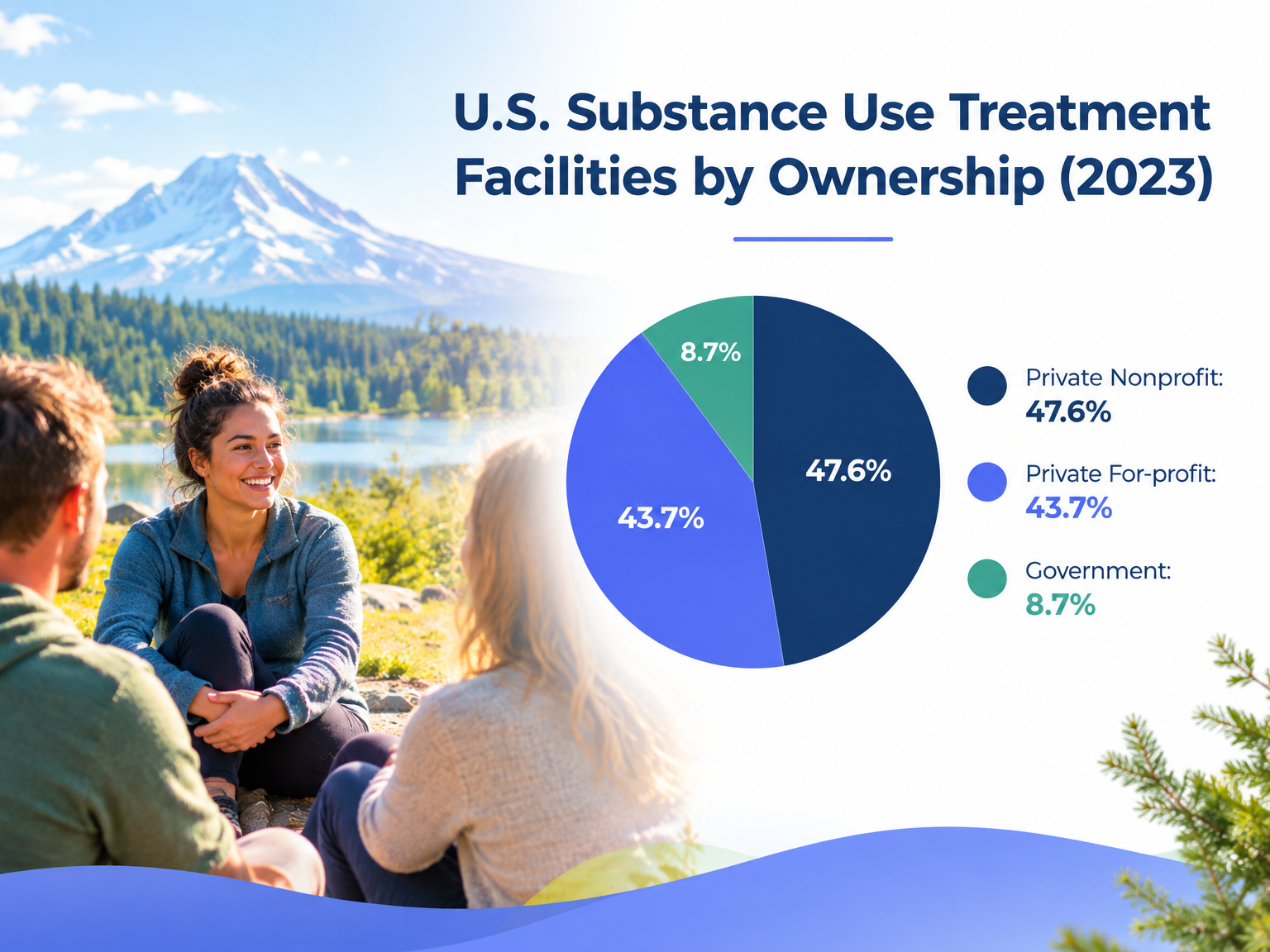
It may surprise you that in 2023, approximately 91% of the 14,620 substance use treatment facilities in the United States were privately run, almost equally split between nonprofit and for-profit organizations 1. This means your choice is usually between different types of private programs, some of which accept public funding like Medicaid or state contracts, and others that rely on private insurance and self-pay.
The following sections will clarify the distinctions between ownership, financing, access, and clinical quality. You'll also find guidance for three common scenarios—being uninsured or on the Oregon Health Plan, having private insurance, or facing court-mandated treatment—along with a checklist to evaluate programs in the Portland area or wider Pacific Northwest.
Ownership Is Not the Same as Who Pays the Bill
What "Private" and "Public" Actually Mean in the U.S. Treatment System
A "public" rehab is owned and operated by a government entity, such as a state agency, county health department, federal program like the VA, or a tribal government. A "private" rehab encompasses all other types: nonprofit organizations (e.g., community-based treatment centers, faith-affiliated programs) and for-profit companies (e.g., small local facilities, national chains).
In 2023, SAMHSA reported 14,620 substance use treatment facilities nationwide. Private nonprofits operated 47.6% of these, private for-profits ran 43.7%, and government entities (state, local, federal, and tribal combined) managed the remaining facilities, with state governments operating only about 2.0% 1. This means roughly 91% of the national treatment landscape is privately owned.
Therefore, when comparing "private vs public rehab" in the Portland area or Pacific Northwest, you're typically choosing between different private programs—a small nonprofit, a community-based organization, a locally owned treatment center, or a larger for-profit chain. Each has its own mission, culture, and financial model. Ownership indicates who runs the program, but not necessarily who pays, who gets admitted, or the quality of care provided.
The Financing Twist: Private Facilities That Run on Public Dollars
A "private" facility can still receive significant public funding. In 2023, 49.2% of U.S. substance use treatment facilities (7,192 out of 14,620) reported receiving public funds for their programs 2. This includes Medicaid payments, state and county contracts, federal block grants, and specialized program funds from agencies like the Oregon Health Authority.
This means a private nonprofit in Portland might bill Medicaid and accept state SUD contracts, while still operating as a community program. A privately owned treatment center might accept the Oregon Health Plan for certain levels of care and private insurance for others. Even programs marketing themselves as "private" may have beds reserved for publicly funded clients.
Instead of asking if a program is "private or public," inquire directly: Who owns and runs the program? And how are payments handled—through insurance, Medicaid, grant-funded slots, sliding scale, or self-pay? The payment structure often impacts your experience more than the ownership label. A private program covered by your insurance might be more accessible than a public program with a long waiting list.
Why Nonprofit and For-Profit Aren't Interchangeable
Within the private sector, nonprofit and for-profit programs often operate differently, and older national research highlights these distinctions. One study of outpatient facilities—based on national data that predates Medicaid expansion and current parity rules—found that public and private nonprofit programs offered significantly greater access for uninsured individuals or those unable to pay, compared to private for-profit programs. For-profit providers in that analysis were also more likely to restrict initial access and shorten treatment due to financial constraints 3. This doesn't mean all for-profits compromise care, or that all nonprofits excel, but it indicates that the business model can play a role.
The ownership landscape is also dynamic. A peer-reviewed study tracking changes through 2024 followed 2,826 facilities that were public or nonprofit in 2019 and found that approximately 20% (572 of them) had transitioned to for-profit ownership by 2024. This privatization was more prevalent in lower-income communities 5. A facility you knew as a community nonprofit years ago might now be part of a larger, investor-owned group.
When comparing programs, ask about the current ownership and if it has changed recently. A nonprofit label from the past isn't a guarantee of its current operational model.
Access, Eligibility, and the Waiting-List Reality in the Pacific Northwest
Who Can Actually Get In: Uninsured, Medicaid, and Private Insurance
Having coverage doesn't automatically mean immediate access to a bed. This is a critical factor in determining who can actually enter a program.
If you are uninsured or paying out-of-pocket at a rate you cannot sustain, your options become limited. Older national research on outpatient facilities—predating Medicaid expansion and current parity rules—found that public and private nonprofit outpatient programs offered significantly better access for individuals who were uninsured or unable to pay, compared to private for-profit programs, which were more likely to restrict initial access and shorten treatment when financial resources were depleted 3. If cost is your primary concern, a community-based nonprofit or a program with grant-funded slots is often a practical starting point.
If you are on the Oregon Health Plan (OHP), you have more options than you might realize. OHP covers outpatient and residential substance use disorder (SUD) treatment, medication-assisted treatment (MAT), detoxification, and individual, group, and family counseling. Members do not need a primary-care referral to begin SUD treatment 15. Washington's Apple Health operates similarly. However, OHP coverage does not guarantee a bed at every program; you must still find a provider that accepts OHP and has an opening.
Private insurance theoretically opens more doors but comes with its own challenges, including in-network requirements, prior authorization, and plan-specific definitions of medical necessity.
Oregon's Residential Bed Shortage and What It Means This Week
Oregon faces a significant shortage of residential addiction treatment beds, a reality no insurance card can immediately resolve.
For individuals seeking treatment, this means a residential program might quote wait times of two, three, or more weeks. Programs accepting OHP might have varying waitlists based on gender. Even privately insured beds are not immune to these delays, as the shortage impacts everyone.
When faced with a wait, two strategies can help. First, contact multiple programs and specifically ask about current wait times, rather than general availability. Second, inquire about starting a lower level of care, such as an intensive outpatient program (IOP)—structured group and individual therapy several days a week—while you await a residential opening, if that remains your goal.

The Parity Rules, Prior Authorization, and What Private Insurance Really Covers
By law, private insurance should cover addiction treatment on par with medical and surgical care, as mandated by the Mental Health Parity and Addiction Equity Act (MHPAEA). However, the practical application is often more complex.
In September 2024, federal regulators finalized new parity rules requiring plans to assess whether nonquantitative treatment limits—such as prior authorization and provider network standards—create materially worse access to substance use care compared to medical or surgical care 13. Separately, the 2024 MHPAEA Report to Congress reported progress but concluded that group health plans and insurers continued to fall short of parity requirements, leaving people with greater barriers to SUD benefits than to medical and surgical care 12.
This means your plan might cover residential treatment, IOP, and MAT, but you may still need prior authorization, demonstrate medical necessity, and stay within your plan's network for coverage. To protect yourself, take three practical steps: Call the member services number on your insurance card to ask about SUD benefits, prior authorization requirements, and in-network providers in the Portland area. Ask any program you contact if they bill your specific plan directly. If a prior-authorization denial occurs, inquire about the appeal process, as denials are often overturned with persistence.
Clinical Care Cuts Across the Ownership Label
What Both Private and Public Programs Should Deliver
Regardless of whether a program is run by a county agency, a community nonprofit, or a for-profit company, the same evidence-based principles apply. The National Institute on Drug Abuse states that treatment should be customized to an individual's drug-use patterns and their related medical, mental, and social needs. For opioid use disorder, medication is generally the primary treatment, typically combined with behavioral therapy or counseling 7. This forms the clinical foundation; how a program delivers it is its unique approach.
SAMHSA's quality-treatment checklist emphasizes key elements irrespective of ownership. Look for a licensed and accredited program that uses evidence-based practices like cognitive behavioral therapy (CBT) and dialectical behavior therapy (DBT). It should offer FDA-approved medication when clinically appropriate, involve family when beneficial, and provide robust support for housing, employment, medical needs, and long-term recovery after discharge 9. A private program with an appealing aesthetic that neglects these elements is not providing quality care. Conversely, a publicly funded program in a modest setting that incorporates all these components is delivering effective treatment.
When evaluating options in the Portland area or across the Pacific Northwest, focus on the program's actual practices and whether they align with research-backed methods, rather than relying solely on marketing materials.
Residential Isn't Automatically Better Than Outpatient
The common perception is that "real" rehab involves a 30, 60, or 90-day stay in a residential facility. However, research offers a more nuanced perspective: the setting of care is less important than its appropriateness for your current needs.
An Oregon study comparing residential and outpatient treatment for Medicaid patients with opioid use disorder found that while residential care was linked to greater six-month retention, this advantage did not persist at one year. Overdose rates and opioid-related emergency or hospital visits did not significantly differ between settings. The crucial factor in reducing overdose risk was medication for opioid use disorder, regardless of where it was received 16. A broader review of intensive outpatient programs (IOPs)—structured group and individual therapy several days a week—indicated that outcomes were generally comparable to inpatient or residential care in various studies 17. Another systematic review comparing long-term residential treatment with short-term outpatient care found no compelling evidence that longer residential stays produced superior results, noting that outpatient and short-term residential care might be more cost-effective 18.
This doesn't mean residential treatment is ineffective. Rather, it's one tool among many. If you can safely remain at home and attend treatment, an IOP may be as effective as a residential stay, allowing you to maintain employment while engaging in recovery work.
A Shared Evaluation Checklist You Can Use on Any Program
Here's a concise list of questions applicable to any program, whether it's a county clinic, a community nonprofit, or a privately insured residential facility. Have these ready before you make calls:
- Is the program licensed by the state and accredited by a recognized body such as The Joint Commission or CARF? 9
- What evidence-based therapies do you use—CBT, DBT, Seeking Safety for trauma and co-occurring concerns, motivational interviewing, contingency management? 7, 9
- If opioids are part of the picture, do you offer or coordinate medication such as buprenorphine, methadone, or naltrexone? 7
- How do you tailor treatment to a person's drug-use history, mental health, family situation, work, and housing? 7, 8
- How long is treatment, and can it adapt if my needs change? Most people benefit from at least three months of care, and longer often produces better outcomes 8.
- How do you involve family when that's helpful and safe? 9
- What continuing support—sober living, alumni groups, employment or education assistance, ongoing counseling—do you offer after the structured program ends? 9
If a program cannot answer these questions clearly, continue your search. The quality of care, not ownership, is the true indicator.
A Decision Path for Three Real Situations
If You're Uninsured or on the Oregon Health Plan
If you are uninsured and potentially qualify for the Oregon Health Plan (OHP), begin by checking your eligibility and enrolling if you qualify. OHP covers outpatient and residential SUD treatment, medication-assisted treatment, detoxification, and individual, group, and family counseling, without requiring a primary-care referral to start 15. This single fact can save considerable time in your search.
Next, contact two or three OHP-contracted providers on the same day. Ask about immediate availability for any level of care, the wait time for residential treatment if that's your goal, and whether you can start an intensive outpatient program (IOP)—structured group and individual therapy several days a week—while awaiting a residential opening. Community-based nonprofits and programs with grant-funded slots historically have offered broader access for uninsured individuals or those paying what they can, consistent with older national research showing that public and nonprofit outpatient programs provided significantly greater access for people unable to pay compared to for-profit providers 3.
If you encounter an initial "no," keep calling. Program capacity fluctuates weekly.
If You Have Private Insurance or Can Pay Out of Pocket
Before contacting programs, call your insurance provider. Ask member services three key questions: what SUD benefits your plan covers (outpatient, IOP, residential, MAT), what prior authorization entails, and which Portland-area or Pacific Northwest providers are in-network. The September 2024 federal parity final rules require plans to evaluate whether nonquantitative treatment limits like prior authorization and network standards create materially worse access to SUD care than to medical care 13, and the 2024 Report to Congress concluded that plans continued to fall short of parity requirements 12.
Then, create a shortlist of two or three in-network programs and ask each the same evaluation questions: accreditation, use of evidence-based therapies like CBT and DBT, MAT availability for opioid use disorder, how they individualize treatment, typical length of care, and continuing support after discharge 7, 8, 9. A visually appealing facility does not equate to clinical excellence.
If you are paying out of pocket, request a written, all-inclusive price, inquire about procedures for extending care, and ask if the program coordinates with external providers for medication or psychiatric support. While amenities can be pleasant, appropriate clinical care is what truly improves outcomes.
If You're Facing a DUII or Court-Mandated Requirement
You generally have more flexibility than the paperwork might suggest. Courts are typically concerned with treatment completion and compliance, not whether a program is privately or publicly operated. Courts and probation officers usually require a state-approved DUII evaluation, enrollment in treatment aligned with that evaluation's recommendation, documented attendance, and clean drug screens. Any licensed, accredited program that provides these records promptly typically meets the requirement 9.
Begin with the DUII evaluation, as this document will guide subsequent steps. Then, ask your probation officer or diversion coordinator if they have preferred providers or specific documentation formats. If not, you are free to choose a program that suits your schedule, insurance, and clinical needs—whether that's an IOP to maintain employment or residential care if your situation warrants it.
It's important to remember that a court mandate, while challenging, is not a judgment on your character. The work you undertake in treatment holds the same value, regardless of whether you entered voluntarily or by judicial direction.
Choosing a Program in Portland and the Pacific Northwest
Once you've narrowed your options to two or three programs, focus your comparison on the factors that genuinely impact outcomes: the clinical work, the professionals delivering it, and the support available after you leave. Inquire about licensing and accreditation, the specific therapies offered—such as cognitive behavioral therapy, dialectical behavior therapy, and Seeking Safety for co-occurring trauma and substance use—how the program tailors care to your individual situation, and what continuing support looks like after the structured program concludes 7, 9.
Also consider program fit. A gender-specific environment can help some individuals concentrate on their recovery without social distractions. A program that coordinates with a detox partner can help ensure a smooth transition from withdrawal management to the next level of care. At Oregon Trail Recovery, our partner detox program is Pacific Crest Trail Detox. Support for employment and education is often more crucial than brochures suggest, as rebuilding a career and a stable routine is an integral part of recovery, not an afterthought.
At Oregon Trail Recovery, we are a dedicated team in Portland offering outpatient and intensive outpatient services, along with sober living in our recovery homes, and we partner with Pacific Crest Trail Detox for withdrawal management. We are committed to helping you honestly compare your options across the Pacific Northwest, even if the best path for you lies elsewhere. Call us when you are ready to discuss what fits your unique situation.
Frequently Asked Questions
Is private rehab actually better than public rehab?
Not inherently. Quality depends on licensing, accreditation, evidence-based therapies like CBT and DBT, individualized care, adequate treatment length, and continuing support after discharge—not on who owns the building 9. A publicly funded program that meets these criteria can serve you better than a private program with a nicer lobby that does not.
Will the Oregon Health Plan cover residential addiction treatment?
Yes. OHP covers residential and outpatient SUD treatment, medication-assisted treatment, detoxification, and individual, group, and family counseling, and you don't need a referral from a primary-care provider to start 15. Coverage doesn't guarantee immediate placement, though—you still have to find an OHP-contracted program with an open bed, which can take time.
How long will I have to wait for a bed in Oregon?
It varies by week, program, and gender, but the shortage is real. Oregon's January 2024 facility study counted 1,650 residential SUD beds statewide and estimated the state needs 1,156 to 2,169 more to meet demand 14. Call multiple programs the same day, and ask about starting an intensive outpatient program while you hold a residential spot.
What's the difference between a private nonprofit and a private for-profit rehab?
Both are privately operated, but the business model matters. Older national research on outpatient facilities found that public and private nonprofit programs provided significantly greater access for people who were uninsured or unable to pay, while for-profits were more likely to restrict initial access and shorten treatment for financial reasons; this finding predates Medicaid expansion and current parity rules 3. Ask who owns the program today—ownership has been shifting rapidly 5.
If I have private insurance, do I still have to deal with prior authorization?
Often, yes. The September 2024 federal parity final rules require plans to evaluate whether nonquantitative treatment limits like prior authorization and network standards create materially worse access to SUD care than to medical care 13, and the 2024 Report to Congress concluded that plans still fall short of parity requirements 12. Call member services first to confirm covered levels of care, authorization steps, and in-network Portland-area providers.
I'm facing a DUII—does the court care whether I go to a private or public program?
Generally no. Courts and probation officers typically want a state-approved DUII evaluation, enrollment in treatment matched to that recommendation, documented attendance, and clean drug screens. Any licensed, accredited program that provides timely records usually meets the requirement 9. Confirm preferred providers or documentation formats with your probation officer, then choose the program that fits your schedule and clinical needs.
References
- National Substance Use and Mental Health Services Survey 2023. https://www.samhsa.gov/data/sites/default/files/reports/rpt53012/2023-nsumhss-annual-report.pdf
- NATIONAL SUBSTANCE USE AND MENTAL HEALTH SERVICES SURVEY Annual Detailed Tables. https://www.samhsa.gov/data/sites/default/files/reports/rpt53013/NSUMHSS-Annual-Detailed-Tables-23.pdf
- Influence of ownership on access in outpatient substance abuse treatment facilities. https://www.ncbi.nlm.nih.gov/pmc/articles/PMC2760741/
- Decline in Public Substance Use Disorder Treatment Centers Most Serious in Counties with High Shares of Black Residents. https://www.ncbi.nlm.nih.gov/pmc/articles/PMC5019357/
- Rising and disparate trends in the private/for-profit acquisition of nonprofit substance use treatment facilities, US, 2019-2024. https://pubmed.ncbi.nlm.nih.gov/41548536/
- Key Substance Use and Mental Health Indicators in the United States: Results from the 2024 National Survey on Drug Use and Health. https://www.samhsa.gov/data/sites/default/files/reports/rpt56287/2024-nsduh-annual-national-report.pdf
- Treatment and Recovery. https://nida.nih.gov/publications/science-addiction/treatment-recovery
- SEEKING DRUG ABUSE TREATMENT: KNOW WHAT TO ASK. https://nida.nih.gov/sites/default/files/treatmentbrochure_web.pdf
- Quality Treatment for Mental Health, Drugs and Alcohol. https://www.samhsa.gov/find-support/learn-about-treatment/finding-quality-treatment
- Medicaid Section 1115 Substance Use Disorder (SUD) Demonstrations: Experiences of Managed Care and SUD Provider Organizations with Changes in Care Coordination. https://www.medicaid.gov/medicaid/section-1115-demonstrations/downloads/sud-rcr-oy3-qual-care-coordination.pdf
- GAO-20-260, Accessible Version, MEDICAID: States' Changes to Payment Rates for Substance Use Disorder Services. https://www.gao.gov/assets/710/706790.pdf
- US Departments of Labor, Health and Human Services, Treasury issue 2024 Mental Health Parity and Addiction Equity Act Report to Congress. https://www.dol.gov/newsroom/releases/ebsa/ebsa20250117
- Departments of Labor, Health and Human Services, Treasury Issue Final Rules Strengthening Access to Mental Health, Substance Use Disorder Benefits. https://www.cms.gov/newsroom/press-releases/departments-labor-health-and-human-services-treasury-issue-final-rules-strengthening-access-mental
- Behavioral Health Residential+ Facility Study January 2024 Draft Report. https://www.oregon.gov/oha/HSD/AMH/docs/OR-BH-Residential-Facility-Study-January-2024.pdf
- Oregon Health Plan (OHP) Behavioral Health Coverage. https://www.oregon.gov/oha/hsd/ohp/pages/behavioral-health.aspx
- Association between treatment setting and outcomes among Oregon Medicaid patients with opioid use disorder: a retrospective cohort study. https://pmc.ncbi.nlm.nih.gov/articles/PMC9389731/
- Substance Abuse Intensive Outpatient Programs: Assessing the Evidence. https://pmc.ncbi.nlm.nih.gov/articles/PMC4152944/
- Long Term Institutional or Residential Treatment of Patients with Substance Abuse Compared to Short-Term Outpatient Treatment [Internet]. https://pubmed.ncbi.nlm.nih.gov/29320091/
Real Recovery Starts in Portland, Oregon
Call now or verify insurance to take the first step toward lasting recovery in Portland.
Relapse Doesn't Mean the End Of Your Journey
Reach out today to explore programs that support real, long-term sobriety.