



PHP Program for Addiction in Portland, OR

Key Takeaways
- PHP fills the gap after detox in Portland, offering at least 20 hours of weekly clinical programming at ASAM Level 2.5 while you sleep at home or in sober living 9.
- Oregon regulates Level 2.5 programs under OAR 309-019-0184, so asking a Portland provider about state certification is a fair way to vet quality 12.
- PHP sits between IOP's roughly 9 weekly hours and residential care, making it a fit when unsupervised evenings feel manageable but daily structure is still needed 5, 9.
- Compare programs on co-occurring mental health support, living situation fit, and aftercare planning, since outcomes hinge on what you build after PHP ends 2, 6.
What Comes After Detox: The Level of Care Most People Miss
You did the hardest part first. Detox took everything you had, and now you're standing on the other side of it wondering what happens next. That in-between space, after your body has stabilized but before life feels steady again, is where a lot of people quietly lose their footing. Going straight from 24-hour medical support back to a regular schedule is a bigger jump than most Portland families realize.
That's the gap a Partial Hospitalization Program is built to fill. PHP sits between residential care and a lighter outpatient schedule, offering roughly 20 or more hours of structured clinical programming each week while you sleep at home or in sober living 9. You get therapy, skills groups, psychiatric check-ins, and peer support during the day, then practice what you're learning in your real life at night. It's serious care without a hospital bed.
If you've just come through detox at Pacific Crest Trail Detox or another Pacific Northwest facility, PHP is often the next honest step. This guide walks through what a PHP week actually looks like in Portland, how Oregon regulates it, how it compares to IOP and residential, and how to tell whether it's the right level of care for where you are right now.
A Week Inside a Portland PHP
Your Typical Weekday, Hour by Hour
Let's take the mystery out of it. A weekday in a Portland PHP usually starts around 9 a.m. and wraps up in the mid-afternoon, and by the time you finish the week, you'll have spent at least 20 hours in clinically intensive programming 9. That's the ASAM Level 2.5 standard, and it's what separates PHP from a lighter outpatient schedule.
Here's roughly how a day flows. You arrive in the morning and start with a check-in group, where you and the other people in your cohort share how the night went, what came up, and what you're carrying into the day. This isn't small talk. It's the clinical team getting a read on where everyone is, and it's you practicing the honesty that recovery actually requires.
From there, mornings typically move into process group therapy, where you work through what's driving your substance use with a licensed counselor and your peers. After a short break, you might rotate into a skills group built around cognitive behavioral therapy, dialectical behavior therapy, or Seeking Safety, depending on the day and your treatment plan.
Lunch is usually built into the schedule. Afternoons often include individual therapy once or twice a week, a psychiatric or medical touchpoint when needed, and specialty groups like relapse prevention, family dynamics, or life skills. Level 2.5 programs are expected to give you access to psychiatric, medical, and lab services as part of that weekly footprint, not as a separate errand you have to arrange on your own 11.
By the time you leave, you've done real clinical work, not just filled a chair. You've also practiced something quieter but just as important: showing up on time, sitting with discomfort, and building a rhythm that starts to feel like a life again. That daily structure is a big part of why PHP works when you're ready for it.
Evenings, Weekends, and Where You Sleep
When programming ends for the day, PHP hands the next several hours back to you, and that's the part that surprises people. You're not in a locked unit. You go home, or to a sober living house, or back to a family member's place in the Portland metro. You cook dinner. You call your sponsor. You go to a 12-step meeting. You sleep in your own bed.
That structure is intentional. PHP is a testing ground for the life you're rebuilding, with the safety net of clinical support waiting for you the next morning. If a craving hits at 8 p.m. or an old trigger shows up on the MAX line home, you're practicing how to handle it in real time, then bringing it back to group the next day.
Weekends are lighter, and that can feel like both a relief and a risk. Most Portland PHPs don't run Saturday or Sunday programming, so you'll lean harder on recovery meetings, sober living house rules, family support, and the coping skills you're actively learning. Where you sleep matters here. A stable sober living environment often makes the difference between a weekend that reinforces your week and one that unravels it. If your home setting isn't safe or steady yet, sober living during PHP is worth taking seriously.
What PHP Actually Means: ASAM Level 2.5, Decoded
PHP stands for Partial Hospitalization Program, and the name is a little misleading. You're not partially in a hospital. There's no bed with your name on it. The "partial" part means you get hospital-level therapeutic intensity for part of your day, then go home for the rest of it.
In the clinical world, PHP has a more precise name: ASAM Level 2.5. ASAM stands for the American Society of Addiction Medicine, and their criteria are the standard framework treatment programs and insurers use to match people to the right level of care. Level 2.5 sits above intensive outpatient (Level 2.1) and below medically monitored residential care (Level 3.7), and it's defined by a specific commitment: at least 20 hours of clinically intensive programming per week 7, 9.
That 20-hour floor is what makes PHP different from a lighter outpatient schedule. It's enough time each week to actually work on the roots of a substance use disorder, not just check in about it. And because Level 2.5 is designed for people who need daily monitoring, the standard also expects you to have access to psychiatric services, medical care, and lab work as part of the program, so you're not chasing those pieces down separately 9, 11.
Put simply: PHP is the level of care for someone who's medically stable enough to sleep at home but still needs intensive, near-daily clinical support to keep moving forward. If that sounds like a lot, it is. It's also often exactly what post-detox recovery needs to hold.
How PHP in Portland Is Regulated
Here's something reassuring: when you enroll in a Portland PHP for substance use, you're not stepping into an unregulated space. Oregon has specific rules for what a Level 2.5 program has to look like, and those rules exist to protect you.
The main one to know is Oregon Administrative Rule 309-019-0184, which sets the standards for Partial Hospitalization Substance Use Disorder Services at ASAM Level 2.5. Under that rule, programs have to be certified by the state's Division to deliver outpatient SUD treatment and recovery services, and their programming has to align with the ASAM Criteria 12. In plain terms, a program can't just call itself a PHP. It has to prove it meets the standard.
The Oregon Health Authority (OHA) maintains the broader rulebook for addictions and mental health services under OAR Chapter 309, and any Portland provider offering ASAM 2.5 care has to work within it 8. OHA has also been actively updating those rules. A 2023 rulemaking notice specifically addressed Partial Hospitalization or Day Treatment SUD Services at Level 2.5, clarifying certification requirements and tightening how programs demonstrate alignment with ASAM criteria 3.
PHP vs. IOP vs. Residential: Where You Fit on the Continuum
The Intensity Gap Between IOP and PHP
The clearest way to tell PHP and IOP apart is to look at the calendar. An intensive outpatient program runs about 9 or more hours per week of structured treatment, usually spread across three days of programming that fits around work, school, or caregiving 5. A partial hospitalization program more than doubles that footprint, delivering at least 20 hours per week of clinically intensive care, typically five days a week during business hours 9.
That gap isn't just a scheduling detail. It changes what treatment can actually reach in a week. In 9 hours, you can build coping skills, work a relapse prevention plan, and stay honest with a counselor and a group. In 20-plus hours, you have room for all of that plus deeper trauma work, psychiatric follow-up, medication management, family sessions, and repetition of the skills you're trying to make automatic. Repetition is where new behavior actually sticks, and PHP gives you enough contact time for that to happen while you're still stabilizing.
Here's a useful way to think about it. If you're leaving detox and your days feel unstructured, your triggers feel loud, and one three-hour block on Tuesday, Wednesday, and Thursday would leave too much unsupervised space, PHP is probably the honest starting point. If you've already built a recovery rhythm, you're back at work, and you need clinical support that respects your schedule, IOP is usually the right next chapter. Most people in Portland don't skip from detox straight to IOP. They step down through PHP first, and then move to IOP as their footing steadies.
When Residential Still Makes More Sense
PHP asks something specific of you: the ability to leave programming each afternoon and stay safe until the next morning. That's not a small ask, and it isn't the right ask for everyone right out of detox.
Residential care makes more sense when:
- your home environment isn't safe or sober,
- active substances are still in the house,
- the people around you aren't in a place to support recovery,
- your cravings are intense enough that unsupervised evenings feel like a coin flip,
- you're managing a co-occurring mental health condition that needs closer monitoring than PHP can offer, or
- you've cycled through outpatient care before and know that structure alone isn't holding you.
Oregon Trail Recovery offers gender-specific residential treatment for exactly these situations, and partners with Pacific Crest Trail Detox on the front end for medical stabilization. If you're honest with yourself and residential sounds like relief rather than overkill, that's worth listening to. Stepping into PHP too early, before you can actually use those evenings well, is one of the more common ways people lose momentum after detox. There's no prize for choosing the lightest level of care your insurance will approve. The right level is the one you can actually work.
Real Recovery Starts in Portland, Oregon
Call now or verify insurance to take the first step toward lasting recovery in Portland.
What the Evidence Says About PHP Outcomes
Substance Use Outcomes After PHP
You deserve honest numbers, not marketing ones. So here's what the research actually shows about PHP, with the scope kept clear so you can weigh it against your own situation.
In a study of people receiving inpatient or partial hospitalization treatment for opioid use, roughly 40% reported complete abstinence one month after discharge, and among those who did use again, days of heroin and illicit prescription opioid use dropped significantly from baseline 1. That's a specific window, one month, and a specific population, opioid-focused treatment, so read it as a snapshot rather than a lifetime forecast. Even framed that way, it tells you something important: this level of care moves the needle for a meaningful share of people, and even those who slip often use less afterward.
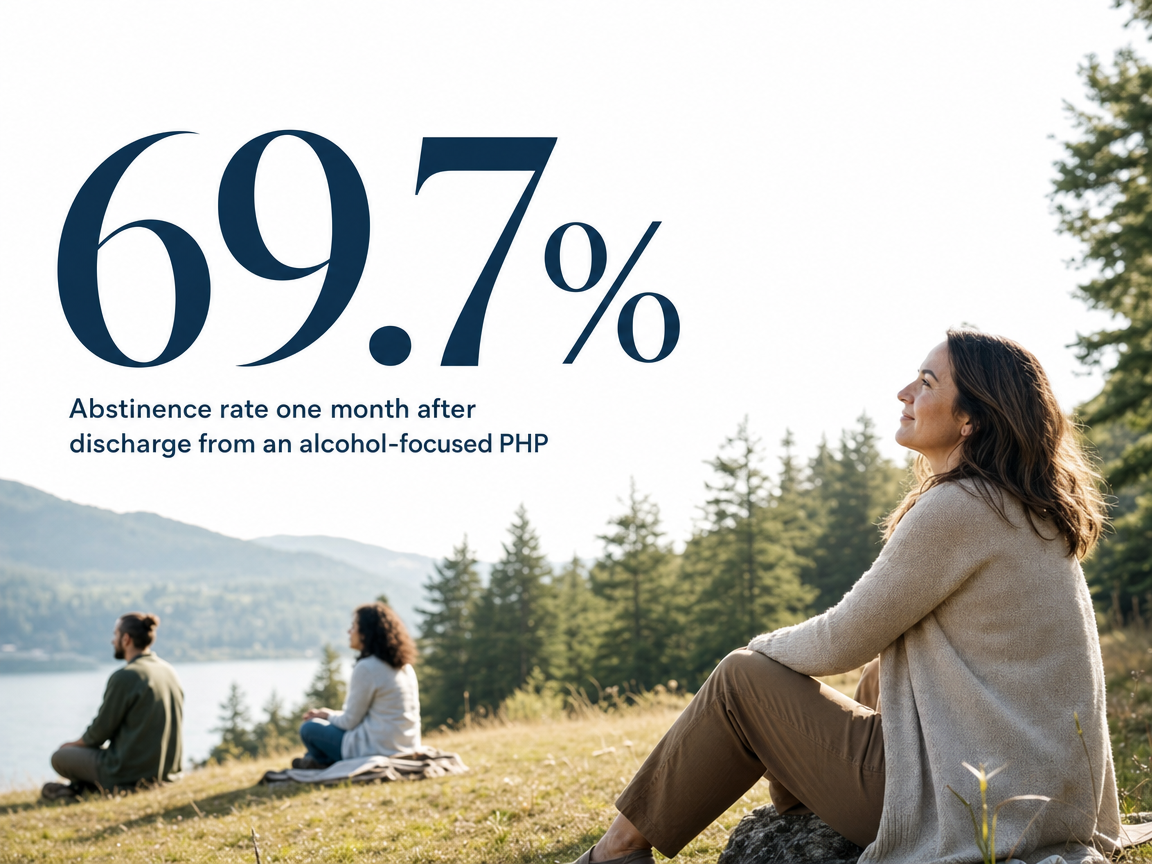
Alcohol-focused PHP shows a similar pattern. In one study tracking participants a month after discharge from an alcohol-focused partial hospitalization program, 69.7% were abstinent during the follow-up period 2. The researchers also found something worth carrying into your own planning: the strongest predictors of staying abstinent weren't how bad things were at intake. They were what people did after PHP ended, specifically seeing a mental health provider and attending 12-step meetings 2.
Read those two findings together, and the message gets practical. PHP can give you real traction while you're in it. What you build on the other side, aftercare, meetings, sober support, is what keeps that traction under your feet.
Co-Occurring Depression and Anxiety in PHP
If you're carrying depression, anxiety, or trauma alongside a substance use disorder, you already know the two feed each other. Treating one without the other usually means treating neither well. PHP is one of the few outpatient levels of care with enough weekly contact time to work on both at once, and the research on co-occurring outcomes is genuinely encouraging.
A study of a DBT-informed partial hospital program tracked depression scores from intake to discharge and found a meaningful drop: mean depression scores fell from 35.74 at intake to 21.82 at discharge, a change the researchers described as significant, alongside reductions in anxiety and increases in hope 4. Similar improvements showed up in the program's step-down IOP and among people moving between levels, suggesting the structured, skills-based content is doing a lot of the work 4.
A separate prospective study of adults with co-occurring psychiatric and substance use disorders in a PHP found significant reductions in both psychiatric symptoms and substance use severity by discharge, along with improved functioning 6. In other words, addressing mental health inside the same program that's addressing substance use appears to move both.
What this means for you: if you're leaving Pacific Crest Trail Detox or another Pacific Northwest facility and mental health is part of your picture, a PHP that offers co-occurring care, like the programming Oregon Trail Recovery provides alongside SUD treatment, gives you room to work both edges at once instead of picking which one gets attention.
When PHP Might Not Be the Right Fit
Being honest here matters more than being optimistic. PHP is a strong level of care, but it isn't the right fit for every moment in recovery, and choosing it when you actually need something more can set you back.
PHP probably isn't the right call if you're still medically unstable, if withdrawal symptoms haven't fully resolved, or if you haven't completed detox yet. That's what Pacific Crest Trail Detox handles on the front end, and skipping stabilization to jump into a day program almost never works. It also isn't the right fit if your living situation is actively unsafe, if the people you'd go home to each evening are using, or if you don't yet have a stable place to sleep. PHP hands you back your evenings, and those hours need to be something you can hold.
On the other side of the spectrum, PHP might be more than you need. If you've already completed a higher level of care, you're back at work or school, and your recovery has real momentum, a 20-plus-hour weekly commitment can crowd out the very life you're trying to rebuild 9. In that case, IOP at 9 or more hours per week may give you the right balance of structure and room to live 5.
The honest question isn't whether PHP is good. It's whether PHP matches where you are this week. A quick conversation with an admissions counselor at Oregon Trail Recovery can help you sort that out without pressure.
Stepping Into PHP After Detox in the Pacific Northwest
You've done the hardest part. Whatever it took to get through detox, the sleepless nights, the physical work, the honesty it demanded, you did it. That effort deserves a plan that meets it, not a discharge paperwork handoff and a hope you'll figure out the next few weeks on your own.
A Partial Hospitalization Program is often that plan. It gives you back your evenings while holding you inside a real clinical container during the day. You keep practicing what recovery actually looks like in your Portland life, on the MAX, in your kitchen, at the family dinner you weren't sure you could sit through, then you come back the next morning and process it with a team that knows your name.
If you or someone you love just came through Pacific Crest Trail Detox, or another Pacific Northwest facility, and you're trying to figure out what comes next, a conversation is a good place to start. Oregon Trail Recovery's admissions team can walk you through what a typical PHP week looks like at their Portland program, whether your situation fits ASAM Level 2.5, and how co-occurring mental health care would fit alongside your substance use treatment. If PHP isn't the right level for where you are this week, they'll tell you that too, and help you find what is.
You don't have to have this figured out before you call. That's what the call is for. Reach out to Oregon Trail Recovery to talk through whether PHP is the right next step in your recovery.
Frequently Asked Questions
How many hours a week does a PHP in Portland require?
A partial hospitalization program at ASAM Level 2.5 delivers at least 20 hours of clinically intensive programming per week 9. In most Portland programs, that means roughly five days a week of daytime treatment, with mornings and early afternoons filled by group therapy, skills work, individual sessions, and psychiatric or medical touchpoints as needed 11. Evenings and weekends are yours to practice what you're learning at home or in sober living.
What's the difference between PHP and IOP?
The biggest difference is time. An intensive outpatient program runs about 9 or more hours per week of structured treatment 5, while PHP more than doubles that at 20-plus hours weekly 9. PHP is designed for people who need near-daily clinical support and access to psychiatric and medical services as part of the program. IOP works better once you've steadied out and need care that fits around work, school, or family life. Many people step through PHP first, then into IOP.
Can I live at home or in sober living while attending PHP?
Yes, and that's actually the point. PHP is a non-residential level of care, so you sleep at home, at a family member's place, or in a sober living house in the Portland area, then come to programming during the day 9. Where you sleep matters, though. If your home isn't safe or sober, a structured sober living environment during PHP often makes the difference. Talk with your admissions counselor honestly about your living situation before you enroll.
Is PHP a good next step after detox?
For many people, yes. Detox stabilizes your body, but the first weeks afterward are when cravings, triggers, and old patterns tend to test your footing hardest. PHP gives you daily clinical support without keeping you in a bed, so you can practice recovery in real life with a team backing you up 9. If you've just come through Pacific Crest Trail Detox or another Pacific Northwest facility, PHP is often the honest bridge between round-the-clock care and lighter outpatient support.
Does PHP treat co-occurring mental health conditions?
A good PHP does. Research on partial hospitalization programs for adults with co-occurring psychiatric and substance use disorders shows significant reductions in both psychiatric symptoms and substance use severity by discharge, along with improved functioning 6. Oregon Trail Recovery offers co-occurring mental health care alongside substance use treatment, not standalone primary mental health services. If depression, anxiety, or trauma are part of your picture, ask directly how a program integrates that care into your PHP schedule.
How long does a typical PHP last?
Length varies with your clinical needs, but most Portland-area PHPs run somewhere between two and six weeks of full-time programming, with the exact timeline set by your treatment team based on progress and ASAM criteria. Some people move through faster and step down into IOP; others need more time before they're ready. What matters more than the calendar is what comes next. Aftercare, whether that's IOP, sober living, or 12-step meetings, is what protects the work you did in PHP 2.
References
- Quality of Life and Well-being following Inpatient and Partial Hospitalization Opioid Treatment. https://pmc.ncbi.nlm.nih.gov/articles/PMC5968820/
- Alcohol treatment outcomes following discharge from a partial hospitalization program. https://pmc.ncbi.nlm.nih.gov/articles/PMC6419972/
- NOTICE OF PROPOSED RULEMAKING – OAR 309-019 (Partial Hospitalization or Day Treatment Substance Use Disorder Services ASAM Level 2.5). https://www.oregon.gov/oha/HSD/HSDRules/309-019-02162023.pdf
- DBT-informed treatment in a partial hospital and intensive outpatient program: Outcomes and program design. https://pmc.ncbi.nlm.nih.gov/articles/PMC7513610/
- Intensive Outpatient Programs for Substance Use Disorder. https://pmc.ncbi.nlm.nih.gov/articles/PMC5409494/
- Outcomes of a partial hospitalization program for co-occurring psychiatric and substance use disorders. https://pubmed.ncbi.nlm.nih.gov/19637073/
- Substance Use Disorder Treatment in the United States: An Overview of the ASAM Criteria and Levels of Care. https://pmc.ncbi.nlm.nih.gov/articles/PMC3840388/
- Current Addictions and Mental Health Rules and Statutes – Oregon Health Authority. https://www.oregon.gov/oha/hsd/amh/pages/active-rules.aspx
- Overview of Substance Use Disorder Care Clinical Guidelines and ASAM Levels of Care. https://www.medicaid.gov/state-resource-center/innovation-accelerator-program/iap-downloads/reducing-substance-use-disorders/asam-resource-guide.pdf
- Intensive Outpatient Programs for Substance Use Disorder. https://www.ncbi.nlm.nih.gov/pmc/articles/PMC5409494/
- Level 2.5 Partial Hospitalization Services by Service Characteristics. https://www.pa.gov/content/dam/copapwp-pagov/en/ddap/documents/documents/asam/level%202.5%20by%20service%20characteristics.pdf
- Or. Admin. Code § 309-019-0184 - Partial Hospitalization Substance Use Disorder Services ASAM Level 2.5. https://www.law.cornell.edu/regulations/oregon/Or-Admin-Code-SS-309-019-0184
Relapse Doesn't Mean the End Of Your Journey
Reach out today to explore programs that support real, long-term sobriety.