


Finding Out of State Rehab for Wyoming Residents

Key Takeaways
- Wyoming's 2024 Behavioral Health Redesign expanded contracted care, yet roughly 69% of residents needing substance use treatment still went without it in the past year 6.
- Geography, workforce shortages, and the fragile 30-to-90-day window after detox often make in-state options insufficient, which is why Wyoming's own health department points residents to national treatment locators 18.
- Oregon's licensed continuum under the Oregon Health Authority covers residential, outpatient, and withdrawal management under one regulatory framework 11, giving Wyoming residents a structured container during the highest-risk weeks.
- Before traveling, verify commercial insurance benefits, confirm court documentation requirements with your probation officer, and cross-check any program against SAMHSA's FindTreatment.gov and Oregon licensing records 10, 11.
The Wyoming Reality Behind the Decision to Travel
If you're reading this from Cheyenne, Gillette, Riverton, or a ranch two hours from the nearest clinic, you probably already know something the rest of the country is slower to admit: staying alive in Wyoming after detox is harder than it should be. That isn't a criticism of your home. It's a fact reflected in the numbers your own state health department keeps.
In 2022, Wyoming's suicide rate was 26.3 per 100,000 people, compared with a national rate of 14.8 per 100,000 15. The following year, the Wyoming Department of Health recorded 157 suicide deaths among residents, roughly matching the 155 deaths in 2022 1. About 85 percent of those 2023 deaths were among men, and 72 percent involved firearms 1. Those aren't abstractions. They are neighbors, coworkers, brothers, and daughters.
You've likely felt what that reality does to the post-detox stretch. The first 30 to 90 days after medical stabilization are the most fragile window in recovery, and in a state where the nearest structured program can be a four-hour drive, that window can close fast. Isolation, easy access to means, and long distances to counselors are not personal failings. They are geography.
None of this means Wyoming has failed you. It means the math of a rural, high-plains state is unforgiving during the exact weeks you need the most contact, the most accountability, and the most people watching out for you. Deciding to leave the state for treatment isn't giving up on Wyoming. For some people, it's the most honest way to give yourself a real shot at coming back.
What Wyoming Built, and Where the Gap Still Sits
The 2024 Behavioral Health Redesign, in Plain Terms
Before you decide anything about leaving the state, it helps to know what Wyoming has actually put in place. The picture isn't as bare as some out-of-state marketing would have you believe.
On July 1, 2024, Wyoming launched the Behavioral Health Redesign Project, which allows the state's Behavioral Health Division to contract with Behavioral Health Centers (BHCs) across Wyoming to deliver outpatient and residential mental health and substance use disorder treatment 4. In plain terms: the state built a formal network of contracted centers with defined benefit plans, so that people who qualify can access a wider set of services through a more coordinated system than existed before 4.
Wyoming law also defines behavioral health services broadly, covering both mental health and substance use disorder treatment and the supports that go with them 5. That definition matters, because it means the state officially recognizes that recovery isn't just about detox or a single therapy session. It's about ongoing care.
So credit where it's due. If you live near one of the contracted centers and your situation fits the benefit plan, you may find real help without leaving home. The redesign is progress. The harder question is what happens when the nearest BHC is hours away, when the level of care you need after detox isn't offered locally, or when staying in your current environment is exactly what put you at risk.
The Treatment Gap the Redesign Cannot Close Alone
Here's where the numbers get honest. Even with the redesign in motion, a large share of Wyoming residents who need substance use treatment aren't getting it.
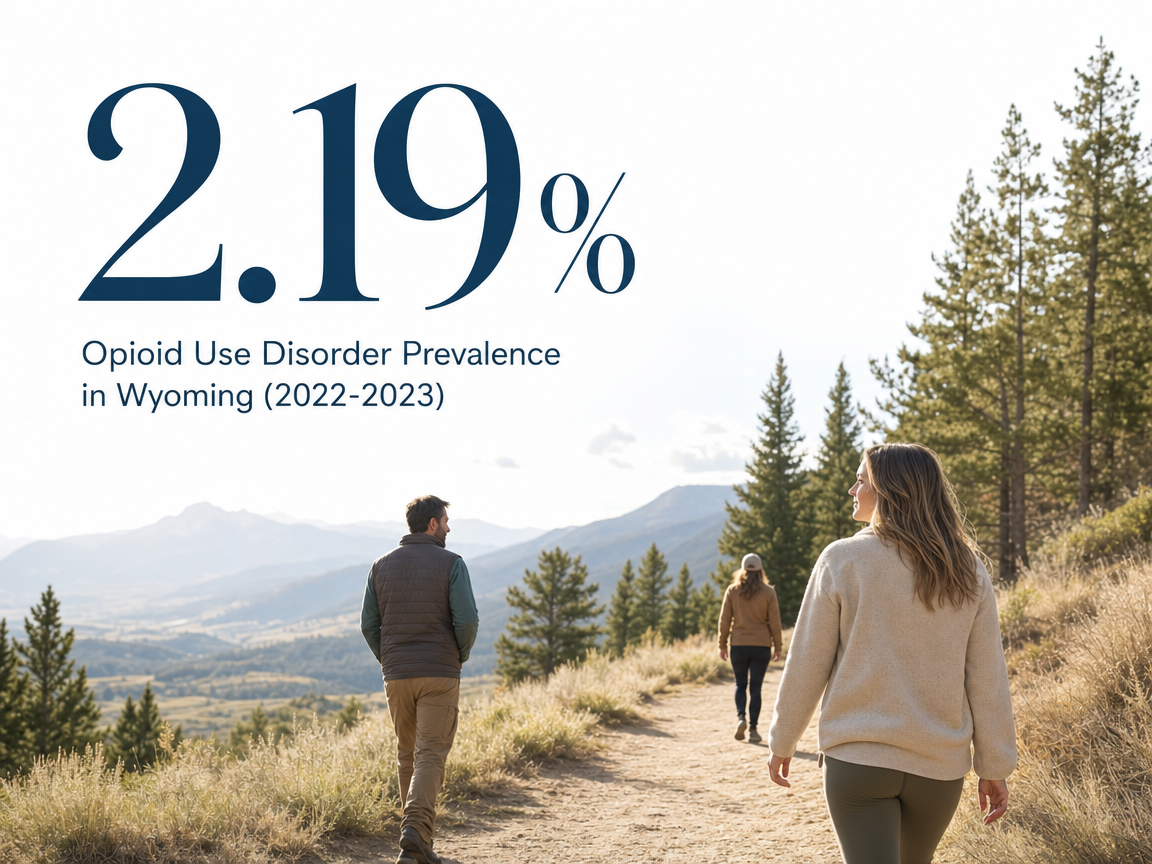
According to SAMHSA's 2022–2023 National Survey on Drug Use and Health estimates for Wyoming, about 20.14% of state residents aged 12 and older were classified as needing substance use treatment in the past year 6. Of that group, roughly 69% did not receive any substance use treatment in the past year 6. That gap is the central problem this article is asking you to think about. It isn't a rumor or a talking point. It's the state's own federal survey data.
The redesign is real, and it will help close part of this gap over time. But a contracted network, no matter how well built, still has to contend with Wyoming's geography and workforce. A benefit plan doesn't put a licensed residential program in every county. It doesn't shorten a four-hour drive to your therapist. It doesn't change the fact that the two months after detox are when your brain is still healing, your cravings are loudest, and your daily environment matters more than almost anything else.
If you're in the 69%, the question isn't whether you failed the system or the system failed you. The question is what to do next. For some people, the honest answer is a licensed program in another state that can hold you steady during the window when Wyoming's in-state options don't quite reach.
Why Wyoming Itself Points People Outward
You might expect the state's own health department to discourage anyone from looking beyond Wyoming's borders. It doesn't.
The Wyoming Department of Health's Substance Use – Community page tells residents plainly:"For mental health or substance abuse services outside of Wyoming, please visit https://findtreatment.samhsa.gov/"18. The department's main treatment-finder page recommends the same SAMHSA locator to search for facilities across the United States 16. Even the state's opioid and stimulant treatment page, which highlights State Opioid Response–funded providers that make treatment free or low-cost for nearly everyone who qualifies, is transparent about the fact that in-state options still have limits 17.
Read that carefully. Wyoming's own agencies point residents toward national tools because they know that sometimes the right bed, the right specialty, or the right distance from a triggering environment lives in another state. That isn't a state agency giving up. It's a state agency being honest with you.
If you've been carrying guilt about even considering out-of-state rehab, let it go. Looking outward isn't disloyal to Wyoming. It's the same move your health department already recommends when the fit isn't there at home.
The First 90 Days After Detox: What Actually Has to Happen
Weeks 1-2: The Handoff From Detox
You've already done the hardest part by getting through detox. Please let that sink in for a second, because what comes next is a different kind of work, and it starts before you even step out of the detox facility door.
The first two weeks after medical stabilization are a handoff, not a finish line. Your body is no longer in acute withdrawal, but your brain chemistry is still recalibrating, your sleep is probably off, and your cravings can arrive in waves you didn't expect. This is the window when going straight home, alone, tends to unravel people. It isn't weakness. It's biology plus environment.
A clean handoff looks like this: your detox provider communicates directly with your next level of care before you discharge, your bed at a residential program is confirmed, and someone has helped you pack, arrange travel, and understand what the first day looks like. For Wyoming residents choosing an Oregon program, Oregon Trail Recovery partners with Pacific Crest Trail Detox on that clinical handoff, so you're not left improvising between two states during the most fragile stretch.
If a program can't tell you exactly what happens in the 72 hours after detox, keep asking questions.
Weeks 3-8: Structured Living and Skill-Building
Somewhere in week three, the adrenaline of the decision fades and ordinary life starts pressing in. This is where structure earns its keep.
Weeks three through eight are typically the residential or structured living phase. You wake up at a set time. You eat with other people. You attend individual therapy, group therapy, and skill-building sessions on a schedule that isn't optional. If co-occurring depression, anxiety, or trauma is part of your picture, this is when it gets addressed alongside the substance use work, not as a separate errand. Oregon Trail Recovery's gender-specific residential homes are built for this stretch, with cognitive behavioral therapy, dialectical behavioral therapy, motivational interviewing, and Wellbriety options woven into the daily rhythm.
Continuity matters here more than almost anywhere else, and the Wyoming data explains why. Roughly 69% of Wyoming residents aged 12 and older who need substance use treatment aren't receiving any in the past year 6. The most common breaking point isn't detox itself; it's the empty weeks after, when structure disappears and people slide back into the same environment that fed the problem. A 90-day plan that stays connected across the detox handoff, residential care, and outpatient step-down is how you avoid becoming a statistic in that gap.
Ask the program how they measure whether people stay engaged through week eight. If they can't answer, that's information too.
Weeks 9-12: Outpatient, Sober Living, and Real Life
By week nine, the shape of your day starts to look more like a life again, and that's the point.
This is when intensive outpatient programming (IOP) takes over as the clinical anchor. You still show up for therapy several times a week, but the rest of the hours belong to you: work, school, family calls, meetings, walks, sleep. Sober living becomes the container that keeps accountability in the room after the residential structure loosens. For many people, this is where employment or education assistance quietly matters more than any single therapy session, because rebuilding a paycheck or a class schedule is what makes recovery feel possible past day 90.
Staying in Oregon for this phase, rather than flying home right after residential, is often the difference between a clean transition and a hard reset. You've already built rapport with a clinical team. Your sober living housemates know your patterns. Your IOP schedule is the muscle memory of your week. Snapping all of that off at day 60 and driving back to Casper or Sheridan asks your recovery to survive on willpower alone.
The goal isn't to keep you away from Wyoming. It's to send you home with 90 days of practiced skills, not 30 days of good intentions.
Real Recovery Starts in Portland, Oregon
Call now or verify insurance to take the first step toward lasting recovery in Portland.
Why Oregon, and What Licensing Actually Guarantees
Oregon's Licensed Residential and Outpatient System
If you're going to put your recovery in another state's hands, you deserve to know what that state actually stands behind. Oregon isn't a marketing story. It's a regulated system.
The Oregon Health Authority's Behavioral Health Division licenses and certifies residential programs for mental health, substance use disorder, withdrawal management, and problem gambling, along with the outpatient programs that carry people through the months after residential care 11. That means a licensed Oregon addiction treatment provider has to meet defined standards for staffing, clinical practice, and program structure to keep operating. It isn't a self-declared category.
Oregon's outpatient SUD rules go a level deeper. Under Chapter 309, outpatient substance use disorder treatment and recovery programs must be certified by the Division to deliver care, with specific requirements around clinical processes, documentation, and continuity 12. For a Wyoming resident, that regulatory floor matters in a practical way: the residential home you sleep in, the IOP schedule you attend, and the sober living continuum you step down into all sit inside the same licensing framework rather than existing as loosely connected businesses.
Oregon has also moved to strengthen equity inside that framework. A 2025 OHA order authorizes enhanced Medicaid payments for outpatient and residential SUD providers delivering culturally and linguistically specific services, including care attentive to structural discrimination 13. If Wellbriety or another culturally grounded track matters to you or your family, that infrastructure is a real feature of the Pacific Northwest system, not an add-on.
An Honest Note on Oregon's Own Struggles
Oregon is not a promised land, and pretending otherwise would insult your intelligence.
The Oregon Health Authority reports that the state's suicide rate rose from 19.4 per 100,000 in 2023 to 20.0 per 100,000 in 2024, with 941 deaths in 2024 compared with 888 the year before 14. That's still lower than Wyoming's rate, but it's a real number attached to real families. Oregon has its own rural counties, its own opioid crisis, and its own stretched providers.
Interstate Logistics: Searching, Insurance, and Court-Mandated Cases
How to Actually Search Across State Lines
The practical work of finding a licensed out-of-state program is less mysterious than it feels at 11 p.m. on a Tuesday.
Start with FindTreatment.gov, the federal SAMHSA locator that lets you search for mental illness and substance use disorder treatment services by state, county, and distance 10. Set the state to Oregon, filter by residential and outpatient SUD, and read the program details rather than the marketing. Wyoming's own Department of Health treatment page recommends this same national tool when residents are looking for facilities across the United States 16. You're not going around your state's guidance. You're following it.
When you narrow the list, cross-check each program against Oregon's licensing database. The Oregon Health Authority's Behavioral Health Division licenses and certifies residential programs for mental health, SUD, and withdrawal management, along with outpatient providers 11. A legitimate Oregon addiction treatment provider will tell you their license type without hesitation.
Then call two or three finalists and ask the same three questions of each:
- what levels of care they operate in-house,
- how they handle the detox handoff, and
- how their admissions team supports out-of-state travel.
The answers will sort your list faster than any brochure.
How Insurance and Medicaid Travel
This is the piece that keeps most families up at night, and it deserves a straight answer.
Wyoming Medicaid generally covers services delivered inside Wyoming, and out-of-state coverage is limited to specific circumstances such as emergencies or prior-authorized services. That means Wyoming Medicaid is usually not a portable payer for elective residential rehab in Oregon. Your Wyoming benefits, including the Behavioral Health Redesign's BHC benefit plans effective July 1, 2024, are structured around the state's contracted centers 4.
Commercial insurance is a different conversation. Most private plans, employer-sponsored coverage, and marketplace plans include out-of-network or national provider networks that a Portland-based program can bill. A good admissions team will run a verification of benefits before you commit, tell you what your plan will actually pay for residential and IOP, and give you the deductible and out-of-pocket picture in writing.
If your only coverage is Wyoming Medicaid, don't assume the door is closed. Call the program and ask about self-pay rates, sliding scales, and scholarship options before you rule anything out.
DUII, Probation, and Court-Mandated Cases
If a court order is part of your picture, the logistics get more specific, but they're workable.
Oregon's outpatient SUD rules under Chapter 309 require programs to be certified by the Division to render outpatient substance use disorder treatment, and the same chapter sets out how the state handles documentation for individuals completing an out-of-state intoxicated driving program, subject to defined conditions 12. Translation for the Wyoming reader: Oregon has a real framework for cross-state DUII cases, both directions. It isn't a legal dead end.
What that means practically is this. Before you commit to an Oregon program, put your Wyoming probation officer, DUII case manager, or attorney in contact with the Oregon program's clinical director. Ask two things in writing:
- what documentation the Wyoming court will accept for completion of an out-of-state SUD program, and
- whether the Oregon program is willing to provide that documentation format.
Oregon Trail Recovery performs DUII assessments and works with court-mandated clients, so the paperwork side is familiar territory, but confirm the specific language your Wyoming court needs before you fly.
Get the answer before the intake, not after week six.
For Clinicians, EAP Contacts, and Interventionists Making the Referral
A quick note to the professionals reading this over a client's shoulder or on behalf of an employee: the calculus is a little different for you, and the outline above already handles most of what a family needs to hear. Here's what to add to your own decision.
When you send a Wyoming client to an Oregon program, you're not outsourcing the case. You're extending your continuum. Ask the receiving program three things in writing before the referral goes out:
- their license type under Oregon Health Authority's Behavioral Health Division 11,
- their specific outpatient SUD certification under Chapter 309 12, and
- their process for sending clinical documentation back to you for continuity of care once the client returns to Wyoming.
For EAP contacts, verify commercial benefits before the plane ticket and confirm whether the Oregon program will coordinate directly with the employer's return-to-work protocol. For probation officers and DUII case managers, get the completion documentation format nailed down in advance rather than at week ten. For interventionists, know that Oregon Trail Recovery's admissions team can coordinate the detox handoff with Pacific Crest Trail Detox, which shortens the window where a client can change their mind mid-transit.
Your referral is the accountability that survives the state line.
What a Deliberate Change of Environment Looks Like at Oregon Trail Recovery
If you've read this far, you're not looking for a sales pitch. You're looking for a next step that matches the weight of the decision. Here's what that step looks like if it lands with us.
Oregon Trail Recovery runs the middle and later stretch of the continuum you've been reading about: gender-specific residential homes in Portland, intensive outpatient programming, sober living, and Wellbriety for people who want a culturally grounded track. Medical detox happens with our partner Pacific Crest Trail Detox before you arrive, so the clinical handoff is coordinated between two teams that already talk to each other. We provide co-occurring mental health support alongside substance use care, not primary mental health treatment, and we're honest about that line so you know what you're signing up for.
For Wyoming residents specifically, our admissions team will verify your commercial benefits, walk through travel logistics, coordinate with your probation officer or DUII case manager if a court order is part of your picture, and confirm what documentation your Wyoming court will accept before you fly. We'll also tell you if we're not the right fit. Sometimes a Wyoming BHC or an SOR-funded provider closer to home is the better call 4, 17.
When you're ready to talk, call Oregon Trail Recovery. Bring your questions, your skepticism, and whatever you already know about the person we'd be helping. We'll take it from there.
Frequently Asked Questions
Will my Wyoming Medicaid or private insurance cover rehab in Oregon?
Wyoming Medicaid generally pays for services delivered inside Wyoming, and the Behavioral Health Redesign's BHC benefit plans are built around contracted in-state centers 4. Most commercial and employer-sponsored plans, on the other hand, include out-of-network or national provider access that a Portland program can bill. Ask an Oregon admissions team to run a written verification of benefits before you commit.
How do I actually find a licensed out-of-state rehab from Wyoming?
Start with SAMHSA's FindTreatment.gov, which lets you filter by state, county, distance, and level of care 10. Wyoming's own Department of Health treatment page recommends the same national locator when residents look beyond state borders 16. Then verify each finalist against the Oregon Health Authority's licensing and certification records for residential and outpatient SUD providers 11.
If I have a Wyoming DUII or court-mandated treatment order, does completing an Oregon program count?
Oregon's Chapter 309 rules require outpatient SUD programs to be Division-certified and include specific provisions for documenting out-of-state intoxicated driving program completions 12. That framework exists, but your Wyoming court sets the final rules. Before you fly, get your probation officer or attorney and the Oregon program's clinical director aligned on exactly what documentation format Wyoming will accept.
Does Oregon Trail Recovery provide medical detox or primary mental health treatment?
No on both counts, and we'd rather you hear that straight. Medical detox is handled by our partner Pacific Crest Trail Detox before you arrive, with a coordinated clinical handoff between teams. Oregon Trail Recovery provides co-occurring mental health support alongside substance use disorder care, meaning we treat the depression, anxiety, or trauma tied to the SUD, not standalone primary psychiatric conditions.
How long should I plan to be in Oregon after finishing detox?
Plan on roughly 90 days as a working baseline, not a rigid rule. That covers the residential or structured living stretch through weeks three to eight, then intensive outpatient and sober living through weeks nine to twelve. Some people stay longer for extended IOP or continued sober living. The point is arriving home with practiced skills instead of good intentions.
What happens with family contact and support while I'm out of state?
Distance doesn't mean disappearance. Structured phone contact, video visits, and family therapy sessions are built into the clinical schedule, and family members can be included in treatment planning with your consent. For Wyoming families, that often means a weekly video session and a family therapy weekend during residential. Your people stay in the room, just through a different door.
References
- State's 2023 Death, Birth, Marriage and Divorce Totals Described. https://health.wyo.gov/states-2023-death-birth-marriage-and-divorce-totals-described/
- NCHS Data Brief, Number 541, September 2025. https://www.cdc.gov/nchs/data/databriefs/db541.pdf
- Mental Health and Substance Use Treatment Services. https://health.wyo.gov/behavioralhealth/mhsa/
- BHC Benefit Plans. https://health.wyo.gov/behavioralhealth/mhsa/treatment/bhc-benefit-plans/
- Chapter 1: General Provisions (Behavioral Health Services). https://health.wyo.gov/wp-content/uploads/2025/02/Chapter-1-Gen-Provs-1.pdf
- WYOMING – NSDUH State Estimates 2022–2023. https://www.samhsa.gov/data/sites/default/files/reports/rpt56188/2023-nsduh-sae-state-tables_0/2023-nsduh-sae-state-tabs-wyoming.pdf
- Behavioral Health Barometer: Wyoming, Volume 6. https://www.samhsa.gov/data/sites/default/files/reports/rpt32867/Wyoming-BH-Barometer_Volume6.pdf
- Behavioral Health Barometer: Wyoming, Volume 5. https://www.samhsa.gov/data/sites/default/files/cbhsq-reports/Wyoming-BH-BarometerVolume5.pdf
- WYOMING – NSDUH State Estimates 2022. https://www.samhsa.gov/data/sites/default/files/reports/rpt44486/2022-nsduh-sae-state-tables/NSDUHsaeWyoming2022.pdf
- FindTreatment.gov (English). https://www.samhsa.gov/resource/dbhis/findtreatmentgov-english
- Oregon Health Authority: Licensing and Certification – Behavioral Health. https://www.oregon.gov/oha/hsd/amh-lc/pages/index.aspx
- Behavioral Health Services – Chapter 309 (Outpatient Substance Use Disorders Treatment and Recovery Programs). https://www.oregon.gov/oha/HSD/RAC/309-019.pdf
- PERMANENT ADMINISTRATIVE ORDER – Culturally and Linguistically Specific Behavioral Health Services Enhanced Payments. https://www.oregon.gov/oha/BH/Rulemaking/PERM-309-065-03012025.pdf
- Oregon Health Authority: Suicide Prevention. https://www.oregon.gov/oha/ph/preventionwellness/safeliving/suicideprevention/pages/index.aspx
- Q6 Suicide Snapshot (Wyoming Department of Health). https://health.wyo.gov/wp-content/uploads/2024/10/2324-Q6-Snapshot.pdf
- Find Mental Health or Substance Use Treatment. https://health.wyo.gov/behavioralhealth/mhsa/treatment/
- Opioid and Stimulant Treatment Option. https://health.wyo.gov/behavioralhealth/mhsa/treatment/pain-medication-and-opioid-use-treatment/
- Substance Use – Community. https://health.wyo.gov/behavioralhealth/mhsa/treatment/csac/
Relapse Doesn't Mean the End Of Your Journey
Reach out today to explore programs that support real, long-term sobriety.