


Management of Drug Abuse PDF: A Practical Guide to Treatment

Key Takeaways
- Managing a substance use disorder is a sequence of decisions—assessment, level of care, therapies and medications, and continuing support—not a single appointment or a one-size plan.
- Detox stabilizes the body but does not change the patterns behind use; a real plan pairs withdrawal management with assessment, ongoing treatment, and continuing care 2, 3.
- Match intensity to need: residential when environment or clinical acuity requires structure, IOP at roughly 9+ hours weekly for adults, and standard outpatient when recovery is more stable 1.
- Focus next on continuing care—recovery housing, peer support, counseling, and help with work or school—plus using Oregon's provider directory and OHP access to start an assessment 8, 12, 13.
What a Real Treatment Plan Actually Looks Like
A real plan for managing a drug or alcohol problem is a sequence of decisions, not a single appointment. It involves choosing the type of assessment, the appropriate level of care, suitable therapies and medications, and ongoing support once formal treatment concludes. This structured approach is consistent with federal guidelines and what a counselor would guide you through.
In 2025, only about 16% (roughly 7.6 million people) of those aged 12 or older who needed substance use treatment received substance use treatment in the past year, according to SAMHSA's National Survey on Drug Use and Health 14. This highlights the importance of making the initial steps of care clear and accessible.
Effective treatment is based on consistent, research-backed principles: it should be individualized, long enough to facilitate lasting change, centered on behavioral therapy, include medications when appropriate, and connect to continuing support after the primary program ends 3. This guide is structured around these decisions, presented in the order you are likely to encounter them.

Detox Is Not Treatment: The Line That Changes Everything
Detoxification helps your body manage withdrawal symptoms, but it does not address the underlying patterns that led to substance use. The National Institute on Drug Abuse (NIDA) emphasizes that detox alone is insufficient for recovery 2. Without a subsequent treatment plan, individuals are at high risk of returning to substance use because the behavioral, mental health, and social factors remain unaddressed 2.
An effective sequence for recovery begins with stabilization, which may involve medically supervised withdrawal management for substances like alcohol, benzodiazepines, or opioids. Oregon Trail Recovery coordinates this step with partners like Pacific Crest Trail Detox. This is followed by a comprehensive clinical assessment of your substance use history, physical and mental health, housing, employment, and family situation 3. Based on this assessment, a suitable level of care is determined, leading to ongoing treatment and recovery supports 3.
If previous detox experiences have been followed by quick relapse, it indicates that detox alone was not equipped to provide comprehensive recovery support, not that treatment is ineffective for you.

Levels of Care: How Clinicians Match Intensity to Need
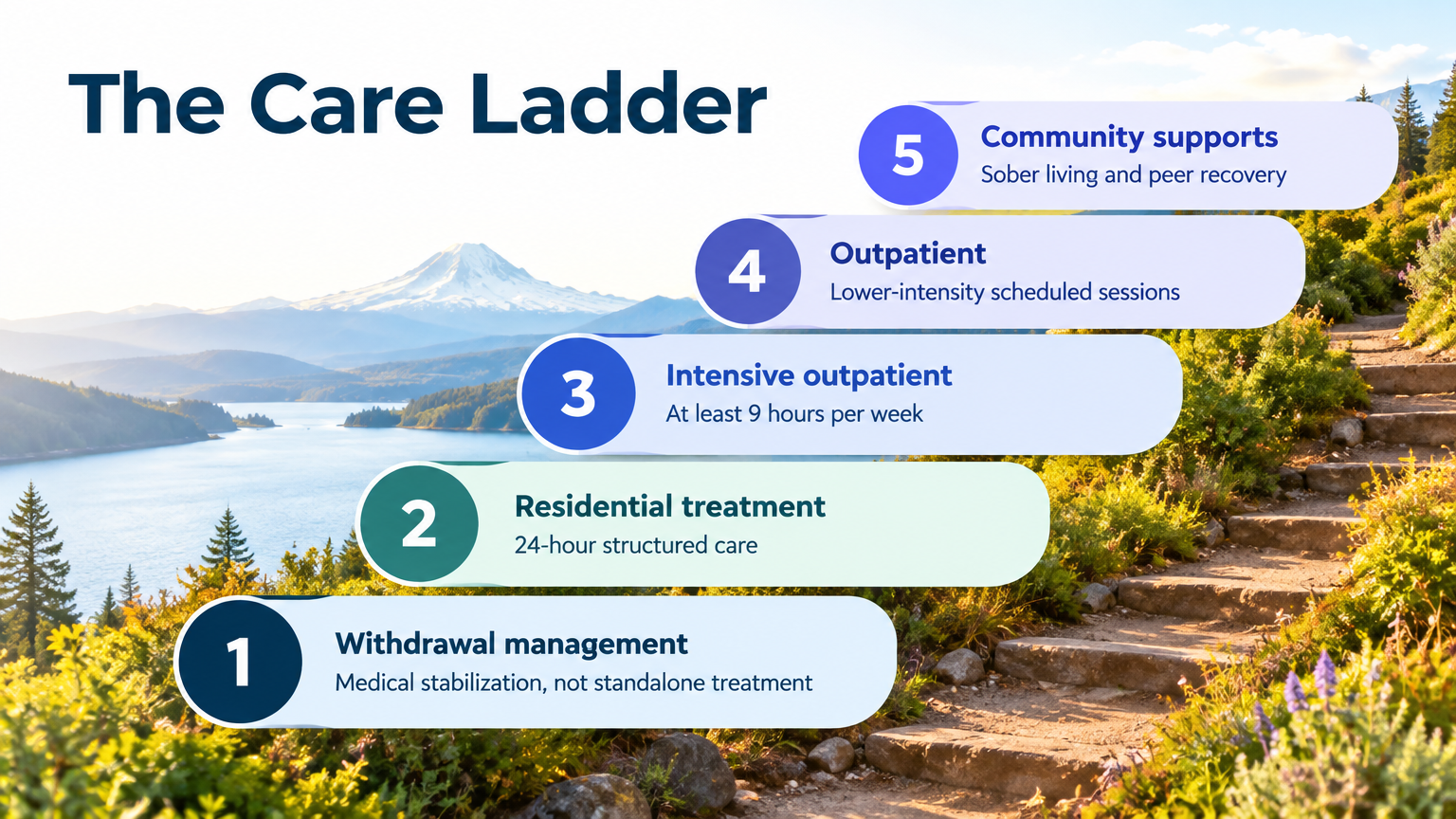
The appropriate level of care is determined by your current situation, including withdrawal risk, mental and physical health, home environment, work and family life, and the amount of structure needed. A thorough assessment matches these factors to a specific level of care, which can be adjusted as your needs evolve 3. Clinicians use a "care ladder" to conceptualize this matching process.
The Care Ladder From Withdrawal Management to Community Supports
Care can be viewed as a ladder, allowing individuals to enter at different points and move up or down as their needs change. Clinicians utilize a multidimensional assessment to evaluate acute intoxication and withdrawal risk, medical and psychiatric stability, readiness to change, relapse potential, and the individual's recovery environment 1.
Oregon Trail Recovery's own programming focuses on outpatient and intensive outpatient addiction treatment plus sober living supports; residential and withdrawal management needs are coordinated through partners such as Pacific Crest Trail Detox. The levels of care, from most intensive to most community-based, include:
- Withdrawal management (detox). Medically supervised stabilization for individuals at risk of severe withdrawal, particularly from alcohol, benzodiazepines, or opioids. This is a medical intervention, not a standalone treatment 2. In the Portland area, Oregon Trail Recovery coordinates this through its partner, Pacific Crest Trail Detox.
- Residential treatment. Provides 24-hour structured care for individuals who require a change in environment to stabilize and begin clinical work. Oregon Trail Recovery does not provide residential treatment directly.
- Intensive outpatient (IOP). Structured, nonresidential treatment typically involving at least 9 hours of services per week for adults 1. Individuals reside at home or in sober housing while attending programming several days a week.
- Standard outpatient. Involves fewer weekly contacts, often once-weekly individual or group sessions, suitable for individuals with stable recovery environments and lower clinical acuity.
- Recovery housing, peer support, and continuing care. Offers substance-free living environments, peer recovery support, and case management to integrate recovery into daily life 8.
Movement between these levels is common. SAMHSA notes that IOP can serve as primary treatment, a step-down from inpatient or residential care, or a step-up for those not maintaining stable recovery with standard outpatient services 1. If a current approach isn't working, it provides valuable clinical information, indicating a need to reassess whether the current level of care aligns with present challenges.
What Intensive Outpatient Really Involves
Intensive outpatient (IOP) is often what people envision when considering treatment that allows them to maintain their daily lives. For adults, IOP generally entails at least 9 hours of structured services weekly, spread across multiple days 1. This typically includes group therapy, individual counseling, skills development, and ongoing assessment of progress.
IOP is effective because it provides sufficient weekly contact to facilitate behavioral change while allowing individuals to live at home, work or attend school, and practice new skills in their real-world environment. SAMHSA indicates that for individuals with minimal risk of acute withdrawal, serious medical conditions, or severe psychological symptoms, IOP outcomes can be comparable to residential services 1.
However, IOP is not suitable for individuals in active withdrawal, those who are medically unstable, or those living in environments where maintaining sobriety is currently impossible. In such cases, a higher level of care is initially necessary 1.
Residential Care and When It Is the Right Starting Point
Residential care is appropriate when an individual's environment actively hinders recovery or when their clinical needs are too complex to manage at home. Indicators for residential care include:
- Relapse shortly after completing outpatient or IOP treatment.
- A home or neighborhood environment that facilitates active substance use and cannot be changed immediately.
- Significant co-occurring mental health symptoms requiring daily structure alongside addiction treatment.
- Transitioning directly from withdrawal management without a stable living situation.
Residential treatment is a supportive tool for individuals who need a protected environment to engage in early clinical work, establish routines, and prepare for step-down care such as outpatient services and recovery housing 1, 3. The effectiveness of residential care is largely determined by the plan for continuing support that follows it.
Therapies That Carry Most of the Clinical Weight
Behavioral therapies are central to addiction treatment, involving structured conversations and skill-building to help individuals understand the drivers of their substance use and develop alternative responses. NIDA identifies behavioral therapy as a core component of effective treatment, alongside individualized care, adequate duration, and appropriate medication use 3. Common behavioral therapies include Cognitive Behavioral Therapy (CBT), Dialectical Behavior Therapy (DBT), Motivational Interviewing, and Seeking Safety for trauma-related symptoms.
Each therapy serves a distinct purpose: CBT helps identify thoughts and situations that trigger substance use and practice new responses. DBT provides skills for managing intense emotions and urges without acting on them. Motivational Interviewing helps individuals clarify their personal reasons for change. Seeking Safety is a structured curriculum for individuals with co-occurring trauma symptoms and substance use, focusing on present-day stability and coping skills.
For stimulant use disorders, SAMHSA highlights CBT, motivational interviewing, the community reinforcement approach, and contingency management as evidence-based behavioral interventions 5. Contingency management uses immediate, verified incentives for behaviors like negative drug screens or treatment attendance, proving effective across various substance use disorders 4. These therapies are often integrated into a comprehensive plan, with the specific mix adapting as an individual progresses.
Medications and Behavioral Care by Substance
The management of a substance use disorder is highly dependent on the specific substance involved, as available medications and effective behavioral approaches vary. The following sections detail management strategies for alcohol, opioids, and stimulants, and how co-occurring trauma and mental health symptoms are addressed within this framework.
Alcohol, Opioids, and Stimulants: What Management Looks Like
Effective treatment plans are tailored to the specific substance. A generic, one-size-fits-all approach is generally insufficient.
Alcohol use disorder. The National Institute on Alcohol Abuse and Alcoholism (NIAAA) identifies three FDA-approved medications: naltrexone, acamprosate, and disulfiram 6. These can be used alone or with counseling, with the choice depending on medical status, goals (abstinence or reduced drinking), and adherence. Behavioral care often includes CBT, motivational work, and skills for identifying triggers, developing coping strategies, and building social support 6.
Opioid use disorder. Medications for opioid use disorder (MOUD) are a cornerstone of treatment, delivered through certified opioid treatment programs that integrate medication, counseling, and patient-centered care under federal guidelines 7. These guidelines also recognize contingency management as an evidence-based practice within opioid treatment services 7. A comprehensive program for opioid use should offer both medication and counseling, supported by robust continuing care.
Stimulant use disorder. Currently, there are no FDA-approved medications specifically for stimulant use disorder, making behavioral approaches paramount. SAMHSA highlights cognitive behavioral therapy, motivational interviewing, the community reinforcement approach, and contingency management as the most evidence-based strategies 5. Contingency management for stimulant use typically reinforces treatment attendance, adherence to other prescribed medications, or stimulant-negative urine screens, with incentives provided immediately upon verification 4, 5. SAMHSA considers contingency management a proven intervention effective across multiple substance use disorders 4.
When discussing treatment options, inquire directly about medication integration for alcohol or opioid use, including who prescribes it and how counseling is coordinated. For stimulant use, ask about the behavioral curriculum, whether contingency management is included, and how progress is tracked. These questions help determine if a program aligns with research-based practices.
Co-Occurring Trauma and Mental Health, Handled Honestly
Trauma and substance use frequently co-occur, and effective treatment acknowledges this link without misrepresenting its scope. Trauma-informed addiction treatment is distinct from psychiatric care. SAMHSA's guidance on trauma-informed services emphasizes programs that recognize trauma prevalence, ensure safety, prevent retraumatization, and adapt services to cultural and gender needs 9. While essential for any good addiction program, this approach is not a substitute for specialized psychiatric care.
At Oregon Trail Recovery, individuals with co-occurring trauma symptoms and substance use are supported using the Seeking Safety curriculum, which focuses on present-day stability and coping skills. For psychiatric diagnosis, medication management, or specialized trauma therapy, clients are referred to appropriate clinicians. This ensures comprehensive care without gaps.
Continuing Care: What Keeps Recovery Intact After Treatment
The period following primary treatment is crucial for solidifying recovery. Continuing care involves a plan for this phase, including lower-intensity counseling, peer support, case management, safe housing, and practical assistance with work, education, and family life. NIDA recognizes continuing care planning as a research-based component of effective treatment, alongside behavioral therapy and medications 3. A treatment program that concludes without a clear continuing care plan is incomplete.
Recovery housing is a significant support during this time. SAMHSA describes safe, substance-free living environments with peer support and connections to treatment as a key strategy for achieving and sustaining recovery, especially for individuals whose home environment presents challenges to sobriety 8. When combined with peer recovery support, case management, and culturally appropriate services, this aligns with SAMHSA's broader recovery framework of health, home, purpose, and community 17.
The outcomes of a continuing care plan are tangible. SAMHSA's Treatment Episode Data Set tracks housing stability, employment, criminal-justice involvement, social support, treatment retention, and abstinence as core outcome domains 16. A comprehensive plan addresses not only substance use but also practical aspects like housing, employment, legal matters, and social connections. Assistance with employment and education, and access to sober living environments, are essential components that prevent clinical progress from unraveling in the long term.
How Oregon's System Actually Works
For those seeking care in Oregon, understanding the state's definitions of services and access points is beneficial. The following sections outline Oregon's requirements for outpatient and IOP programs and how the Oregon Health Plan facilitates access to care.
Oregon's Rules for Outpatient and IOP Care
Oregon's Chapter 309 outlines expectations for outpatient addiction treatment. Intensive outpatient is defined as structured, nonresidential evaluation, treatment, and continuing care for individuals requiring more therapeutic contact than standard outpatient services 10. Programs offering this level of care must be state-certified 11. Because Oregon periodically amends its behavioral-health regulations, readers and programs should verify the current version of Chapter 309 directly with the Oregon Health Authority before relying on specific requirements.
State rules also specify the scope of a comprehensive assessment. Oregon-certified programs are required to evaluate domains beyond substance use, including housing, physical health, parenting, domestic violence, social isolation, and financial concerns. They must then develop a service plan that coordinates necessary supports 10. Trauma-informed and culturally responsive care are integral to this framework 10.
When contacting a Portland-area program, it is advisable to ask directly about their Oregon certification for the specific level of care, the scope of their assessment, and how they coordinate non-clinical supports like housing or employment.
Accessing Care Through the Oregon Health Plan
Oregon Health Plan members have significant access to substance use treatment. The Oregon Health Authority states that behavioral health services do not require prior authorization, and a referral is not needed to seek help for alcohol or drug problems, subject to plan and provider arrangements 12. This means you can directly contact a certified program to begin the assessment process.
OHP behavioral health coverage may include screening, assessment, medication-assisted treatment, detoxification, outpatient and residential treatment, and individual, group, or family counseling 12. While coverage is broad, appointment availability depends on a program's capacity and network status. Confirm your current benefits, prior authorization requirements, and in-network status directly with OHP or your coordinated care organization. Oregon also publishes a Substance Use Disorders Treatment Provider Directory, listing certified providers and their services, which can be used to confirm a program's certification for your specific needs 13.
If You Are Reading This for Someone You Love
Supporting a loved one through substance use challenges can be exhausting. Begin by clarifying key terminology and making an initial phone call that is not directly to them.
First, understand that detox is a medical step for withdrawal management, not a complete recovery solution; treatment is needed to address underlying patterns 2. Intensive outpatient (IOP) is structured, nonresidential care, typically at least 9 hours per week for adults, and can serve as primary treatment or a step-down from residential or withdrawal management 1. Grasping these distinctions can prevent misunderstandings about what "help" truly entails.
Next, make a call for yourself. In the Portland area, you can contact a certified program directly; no referral or prior authorization is required for Oregon Health Plan behavioral health services for the assessment conversation 12. The state's provider directory can help confirm a program's certification for the level of care your loved one needs 13. Many quality programs also offer family counseling, which can be beneficial for you.
True support involves setting boundaries; enabling consequences is not care, and waiting for a "rock bottom" is not a plan. If your loved one is in crisis, call or text 988 for the Suicide and Crisis Lifeline.
How to Use This Guide and Take the Next Step
Print this guide, highlight sections relevant to your situation, and bring your notes to your initial conversation with a treatment program. You face important decisions: whether withdrawal management is needed first, the appropriate level of care for your current life, which therapies and medications to include, and what continuing supports will sustain your recovery 3. You do not need to figure all of this out alone before making contact.
If you are in the Portland area or elsewhere in Oregon, you can reach out to Oregon Trail Recovery directly to start an assessment conversation. Taking an honest step today is more valuable than waiting for a perfect plan tomorrow.
Frequently Asked Questions
Is there a downloadable PDF for the management of drug abuse?
Yes, several authoritative resources are available as free PDFs. NIDA's Principles of Drug Addiction Treatment 3 and SAMHSA's advisories on intensive outpatient treatment 1 and recovery housing 8 are excellent examples. This guide is designed to be used similarly: read it, mark what applies to your situation, and use your notes during your first call to a program.
What is the difference between detox and addiction treatment?
Detoxification safely manages physical withdrawal symptoms. Addiction treatment, however, addresses the behavioral patterns, thought processes, and life circumstances that contribute to substance use. NIDA clearly states that detox alone is not sufficient for long-term recovery 2. An effective plan integrates detox (when medically necessary) with assessment, ongoing therapy, and continuing support 3.
How do I know whether outpatient, intensive outpatient, or residential care is right?
A clinical assessment provides an honest answer. Clinicians evaluate factors such as withdrawal risk, medical and psychiatric stability, your home environment, and your capacity to engage in treatment 1. Intensive outpatient (IOP) typically involves at least 9 hours of structured services per week for adults and can serve as primary treatment or a step-down from residential care or detox 1. Residential care is suitable when your environment or clinical needs require a more structured setting initially.
Are there medications that help manage substance use disorders?
Yes, depending on the substance. For alcohol use disorder, NIAAA identifies three FDA-approved medications—naltrexone, acamprosate, and disulfiram—which can be used with or without counseling 6. For opioid use disorder, medications are a fundamental part of treatment, delivered through certified opioid treatment programs that combine medication with counseling 7. For stimulant use disorder, behavioral approaches, including contingency management, are the primary interventions 4, 5.
Does the Oregon Health Plan cover substance use treatment?
Yes. The Oregon Health Authority states that behavioral health services do not require prior authorization, and a referral is not needed to access help for alcohol or drug problems 12. Covered services may include screening, assessment, medication-assisted treatment, detoxification, outpatient and residential treatment, and individual, group, or family counseling 12. Confirm current benefits, prior authorization requirements, and in-network status directly with OHP or your coordinated care organization, and use Oregon's provider directory to confirm a program is certified for the specific care you need 13.
What can I do if I am reading this for a loved one in the Pacific Northwest?
Take two initial steps. First, understand the distinctions: detox addresses withdrawal, not the underlying patterns of use 2, and intensive outpatient (IOP) is structured, nonresidential care typically involving at least 9 hours per week for adults 1. Second, make a call for yourself: contact a certified Oregon program directly to inquire about assessment and family counseling 12, 13. If your loved one is in crisis, call or text 988 for the Suicide and Crisis Lifeline.
References
- Clinical Issues in Intensive Outpatient Treatment for Substance Use Disorders. https://library.samhsa.gov/sites/default/files/pep20-02-01-021.pdf
- Treatment and Recovery. https://nida.nih.gov/publications/drugs-brains-behavior-science-addiction/treatment-recovery
- Principles of Drug Addiction Treatment. https://nida.nih.gov/sites/default/files/podat_1.pdf
- Using SAMHSA Funds To Implement Evidence-Based Contingency Management Services. https://library.samhsa.gov/sites/default/files/contingency-management-advisory-pep24-06-001.pdf
- Treatment of Stimulant Use Disorders. https://library.samhsa.gov/sites/default/files/pep20-06-01-001.pdf
- Treatment for Alcohol Problems: Finding and Getting Help. https://www.niaaa.nih.gov/publications/brochures-and-fact-sheets/treatment-alcohol-problems-finding-and-getting-help
- Federal Guidelines for Opioid Treatment Programs. https://library.samhsa.gov/sites/default/files/federal-guidelines-opioid-treatment-pep24-02-011.pdf
- Best Practices for Recovery Housing. https://library.samhsa.gov/product/best-practices-recovery-housing/pep23-10-00-002
- Trauma-Informed Care in Behavioral Health Services. https://library.samhsa.gov/sites/default/files/sma15-4420.pdf
- Health Systems Division: Behavioral Health Services - Chapter 309. https://www.oregon.gov/oha/HSD/RAC/309-019.pdf
- PERMANENT ADMINISTRATIVE ORDER. https://www.oregon.gov/oha/HSD/HSDRules/Perm309-019.04072023.pdf
- Oregon Health Plan (OHP) Behavioral Health Coverage. https://www.oregon.gov/oha/hsd/ohp/pages/behavioral-health.aspx
- Oregon Substance Use Disorders Treatment Provider Directory. https://www.oregon.gov/oha/HSD/AMH/Publications/provider-directory.pdf
- Results from the 2025 National Survey on Drug Use and Health. https://www.samhsa.gov/data/sites/default/files/reports/rpt57150/2025-nsduh-annual-national-html/2025-nsduh-annual-national.htm
- 2024 Data on Substance Use and Mental Health Treatment Facilities. https://www.samhsa.gov/data/report/2024-n-sumhss-annual-report
- Treatment Episode Data Set (TEDS) 2024: Admissions to and Discharges From Substance Use Treatment Services Reported By Single State Agencies. https://www.samhsa.gov/data/report/treatment-episode-data-set-teds-2024-admissions-and-discharges-substance-use-treatment
- Building Communities of Recovery (Short Title: BCOR). https://www.samhsa.gov/sites/default/files/grants/pdf/fy-2024-bcor-ti-24-003.pdf
Real Recovery Starts in Portland, Oregon
Call now or verify insurance to take the first step toward lasting recovery in Portland.
Relapse Doesn't Mean the End Of Your Journey
Reach out today to explore programs that support real, long-term sobriety.