


LGBTQ-Friendly Drug Rehab in Portland, OR

Key Takeaways
- Portland LGBTQ+ people need rehabs that changed intake forms, policies, staff training, and group structure—not just added a rainbow to the website.
- Affirming care reduces early dropout by removing minority stress inside treatment, which drives a substantial share of mental health burden for LGB people 5.
- Before committing, compare written non-discrimination policies, staff training cadence, intake form fields, restroom access, group model, and how each provider handles the detox-to-continued-care handoff.
- Oregon Trail Recovery partners with Pacific Crest Trail Detox for medical stabilization, then offers residential, IOP, sober living, Wellbriety, and co-occurring mental health support in Portland.
The Fear You Bring Through the Door
You have probably rehearsed this call in your head more than once. Maybe you already got through detox and know the next step matters. Maybe a partner or a chosen-family member is the one asking. Either way, there is a specific fear sitting on your chest, and it is not really about the paperwork.
It is the fear of being misgendered by an intake worker who means well. The fear of a group where you are the only queer person and everyone knows it by the third check-in. The fear of being outed to a family member or a probation officer. The fear of being tolerated instead of welcomed, which anyone who has been on the wrong side of a healthcare setting can spot within about ten minutes.
That fear is reasonable. LGBTQ+ people carry higher exposure to substance use risk and to the minority stress that fuels it, and much of that stress comes from institutions that were supposed to help 6. Walking into another one takes real nerve.
So this page is not going to tell you Portland is diverse and leave it there. You already know that. What you need is a way to tell the difference between a rehab that put a rainbow on the website and a rehab that changed its intake forms, its policies, its staff training, and its group structure to actually hold you. The rest of this article gives you those markers, names what changes after detox, and shows how Oregon Trail Recovery fits into your next step in Portland.
Why Affirming Care Changes Who Actually Stays in Treatment
Here is the quiet part out loud: affirming care is not about making anyone feel special. It is about removing the reasons LGBTQ+ people quit treatment early or never start it. When an intake feels safe, when a group does not require you to translate yourself, when a counselor already knows what minority stress is, you spend your energy on recovery instead of on managing other people's reactions to who you are.
The research points the same direction. Minority stress processes—chronic experiences of stigma, rejection, and internalized shame—explain a substantial share of the mental health disparities LGB people carry into any healthcare setting, including addiction treatment 5. Those same stressors are woven through substance use patterns, which is why treatment that ignores them tends to lose people 4.
National survey data also complicate the easy story that LGBTQ+ people just need "more" treatment. Past-year substance use disorder treatment use runs unevenly across subgroups: 10.4% for heterosexual men versus 15.5% for gay men and 7.1% for bisexual men; among women, 9.9% for heterosexual versus 11.9% for gay or lesbian and 13.2% for bisexual women 3. That is self-reported past-year treatment use from nationally representative surveys, not Portland-specific, and it is not an outcomes measure—it tells you who walked through a door, not who stayed. But the pattern matters. Bisexual men use treatment at markedly lower rates than either their heterosexual or gay peers. Bisexual women use it at higher rates than their heterosexual peers. Gay men use it at higher rates than heterosexual men. A program that treats "LGBTQ+" as a single average will miss the specific reasons a bisexual man in Portland might not call, or the specific supports a bisexual woman needs when she does.
That is what affirming care is trying to fix. Not a slogan. A set of practices that recognize you are not a category, and that the fear you carry into the room has a history worth respecting. When those practices are in place, more people finish what they started after detox—and that is the outcome that actually matters.
What an Actually LGBTQ-Affirming Rehab Looks Like
Policy and Intake: The First Twenty Minutes
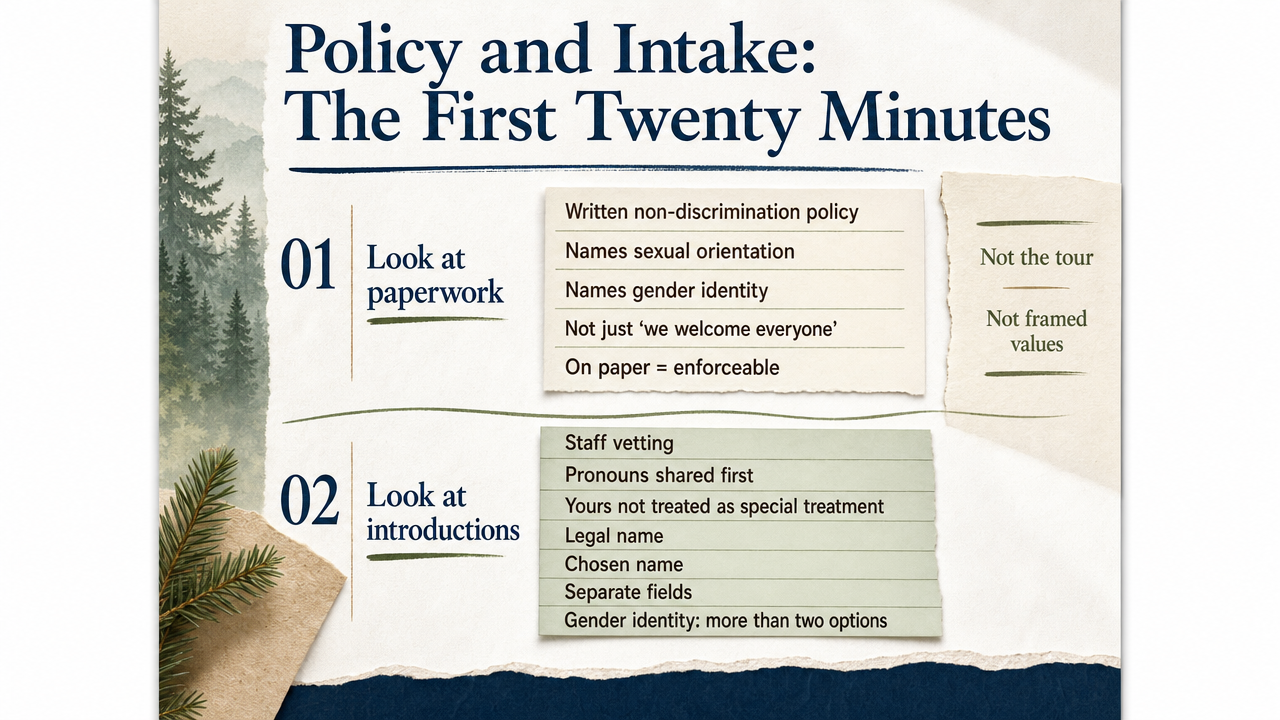
You can usually tell within twenty minutes. Not from the tour, and not from the framed values on the wall. From the paperwork on the clipboard and the way the person across from you introduces themselves.
An affirming program has a written non-discrimination policy that names sexual orientation and gender identity out loud, not tucked inside a vague "we welcome everyone" line. Community stakeholders working on best practices for LGBTQ+ substance use treatment point to that policy language, plus staff vetting, as foundational—if it is not on paper, it is not enforceable when a shift changes at 7 a.m. 1. The intake worker shares their pronouns first, which signals they will not treat yours as a request for special treatment. Your intake form asks for your legal name and your chosen name separately. It asks about gender identity with more than two boxes. It asks about sexual orientation as a matter of clinical relevance, not curiosity 1.
Here is a short checklist you can use to vet any Portland provider, not only this one:
- A written non-discrimination policy that names sexual orientation and gender identity
- Staff who share pronouns during introductions
- Intake forms with expanded gender and sexual orientation fields, plus a chosen-name field
- Gender-neutral restroom access
- LGBTQ+-specific groups where feasible, and broad inclusion in every other group 1
- Documented staff sensitivity training, not a one-time module from 2019
- A clear answer to the question, "Who will know I am here, and what will they be told?"
Staff Training, Language, and the Cost of Getting It Wrong
Training is where good intentions either become clinical skill or stay decorative. Best-practice guidance for LGBTQ substance use treatment is direct about this: providers need training on cultural competency and on minority stress, or they end up repeating the same stigma that pushed people out of care in the first place 2.
What that looks like in a room: a counselor who does not flinch when you describe a partner, a chosen family, or a history that does not fit the standard family-genogram template. A group facilitator who redirects a comment that others it. A clinician who understands that when you talk about a rough week with your parents, the weight of that story is not the same as a cisgender, heterosexual peer's rough week—and who does not turn your identity into the whole treatment plan either 4.
Getting it wrong is not a minor bruise. Misgendering, assumptions about your relationships, or a counselor who treats your orientation as a symptom to be worked through will do more than sting. It will pull you out of the work. You will spend the next session managing the room instead of your recovery. For someone who just came out of detox, that loss of momentum is expensive.
So when you interview a program, ask how often clinical staff receive LGBTQ-specific training, who delivers it, and what happens when a staff member gets a pronoun wrong twice. The answers should be specific. "We are a welcoming environment" is not an answer. "Our staff complete annual training led by an outside consultant, and repair conversations are documented" is.
The Physical Environment: Restrooms, Rooms, and Reading Materials
The building talks before anyone in it does. Practice recommendations for LGBTQ young adults in substance use care are specific about this: welcoming environments include gender-neutral restrooms and LGBTQ-specific reading materials, alongside inclusive screening and affirming interactions 4. Small details, big signal.
Walk in and look. Is there at least one restroom you can use without doing a mental cost-benefit analysis? Are the pamphlets on the rack about relationships written as if only one kind of relationship exists? Are the books in the group room, the posters in the hallway, the language on the whiteboard broad enough that a queer or trans person does not have to translate themselves before they sit down? In gender-specific residential settings—men's homes, women's homes—does the program handle placement in a way that respects how you identify, rather than a rigid reading of a chart?
Portland has a large enough LGBTQ+ community that a serious provider should have thought all of this through already. If the environment feels like an afterthought, the clinical work often is too. If the environment feels considered—if you can breathe when you sit down in the waiting room—you have found a place where the rest of the work has room to happen.
Real Recovery Starts in Portland, Oregon
Call now or verify insurance to take the first step toward lasting recovery in Portland.
After Detox: The Transition Nobody Prepares You For
From Pacific Crest Trail Detox Into Continued Care
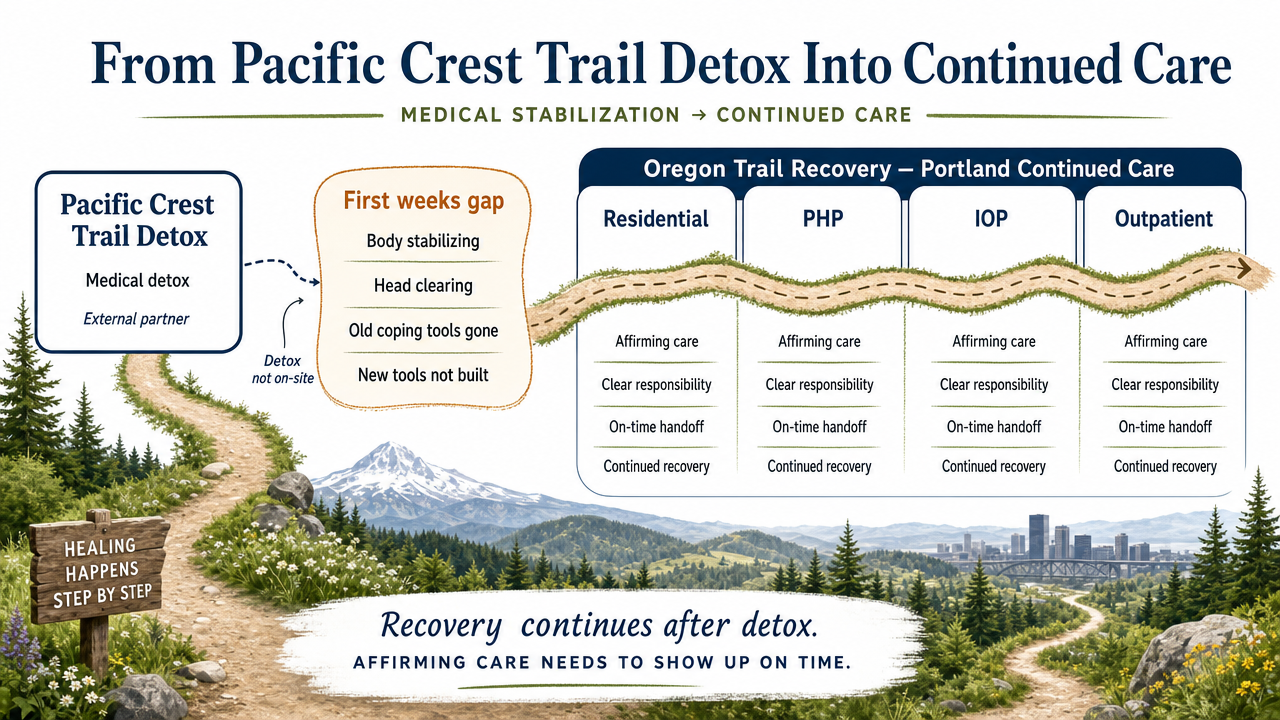
Detox is a medical event. What comes after it is the actual recovery, and nobody warns you how strange those first weeks feel. Your body is stabilizing. Your head is clearing. The old coping tools are gone, and the new ones have not been built yet. That gap is where most people slip, and it is where affirming care has to show up on time.
Oregon Trail Recovery does not run detox on-site. Medical stabilization happens through a partnership with Pacific Crest Trail Detox, and then you move into continued care in Portland. Saying that out loud matters. Programs that blur the line, or that hint at services they do not provide, are the same programs that leave people confused about who is actually responsible for what. You deserve to know the map before you step onto it.
That map looks roughly like this: medical detox at Pacific Crest Trail Detox, then residential or transitional rehab, then intensive outpatient programming, then sober living, with Wellbriety and ongoing group support running alongside for as long as you want them. At each stage, the affirming markers from the earlier sections still apply—pronoun-sharing at intake, a written non-discrimination policy, inclusive group composition, gender-neutral facilities where you need them, and clinicians who understand minority stress as a clinical variable, not a personality trait 4. If any handoff between stages loses those markers, the continuum is not really continuous. Ask about the handoff.
Transitional Rehab, IOP, and Sober Living in Portland
Each level of care asks something different of you, and each one has a different shape of risk if the environment is not affirming. It helps to know what you are walking into.
Transitional and residential rehab is the closest thing to a container. You live in a structured home, days are scheduled, and clinical work happens on-site. Oregon Trail Recovery runs gender-specific residential homes for men and women in Portland, which for many LGBTQ+ people is a real question mark. Gender-specific programming can be genuinely supportive—shared experience in a group lowers the translation cost—but it has to be handled with care around how you identify, not a rigid reading of a paper chart. If a program cannot describe how it thinks about placement for trans, nonbinary, and gender-diverse clients, that is worth pausing on.
Intensive outpatient programming is the level most people underestimate. You go home at night. You may work or attend school around your sessions. That freedom is the point, and it is also the risk, because the room you go back to is now part of the treatment. IOP works when the clinical hours are dense enough to build real skills—CBT, DBT, motivational interviewing, relapse prevention, life skills—and when the group you sit in does not require you to be the queer educator for the rest of the cohort.
Sober living is the quiet part of the plan. A recovery home gives you structure, peer accountability, and a landing pad while you rebuild routines. For an LGBTQ+ person, the culture of the house matters more than the amenities. You want a place where you do not have to guess whether the person across the kitchen has your back. Ask how house culture is set and maintained. If the answer is thin, keep looking.
Co-Occurring Mental Health Support Alongside SUD Treatment
Substance use rarely travels alone. Depression, anxiety, trauma responses, and suicidal thinking sit alongside it more often than not, and for LGBTQ+ people the overlap is not a coincidence. Minority stress processes—chronic experiences of victimization, rejection, and internalized stigma—account for a substantial share of the mental health burden LGB people carry, including depression and suicidal ideation 5. If a treatment plan only addresses the substance and ignores the weight underneath it, you are being asked to build recovery on top of an unaddressed load.
Here is where scope matters. Oregon Trail Recovery provides co-occurring mental health support alongside substance use disorder treatment. That means the clinical team can work with depression, anxiety, and trauma as they show up inside your SUD care using approaches like CBT, DBT, rational emotive behavior therapy, and mindfulness-based recovery. It does not mean Oregon Trail Recovery is your primary mental health provider. If you have a psychiatric condition that needs a dedicated specialist, medication management outside the SUD scope, or an ongoing therapist you already trust, those relationships stay in place, and a good SUD program will coordinate with them rather than compete.
The honest version: co-occurring support is not everything, but it is the difference between treatment that sees you and treatment that only sees the substance. After detox, that difference is what keeps you in the room next week.
Questions to Ask a Rehab Before You Commit
Screenshot this if it helps. When you or someone helping you calls a Portland treatment provider, these are the questions that separate a program you can trust with your recovery from one that will cost you weeks you cannot afford to lose.
- Do you have a written non-discrimination policy that specifically names sexual orientation and gender identity, and can you send it to me? 1
- How are staff trained on LGBTQ+ cultural competency and minority stress, how often, and who leads the training? 2
- What do your intake forms ask about gender identity, sexual orientation, chosen name, and pronouns? 1
- Are there gender-neutral restrooms on-site, and how do you handle placement in gender-specific residential settings for trans, nonbinary, and gender-diverse clients? 4
- Do you offer LGBTQ+-specific groups, or is inclusion handled inside general groups? What is the reasoning behind your model? 1
- What co-occurring mental health support is available alongside SUD treatment, and where does that scope end? If I need a psychiatrist or an outside therapist, how do you coordinate?
- What is the handoff between detox and your program? Who calls whom, and what information moves with me?
- Confidentiality: who will know I am here, what will be shared with family or a probation officer or an employer, and what do I have to sign for anything to leave the building?
- What does a first week look like? What clinical hours, what groups, what expectations?
- If a staff member misgenders me or a peer says something harmful in group, what actually happens next?
You do not need every answer to be perfect. You need the answers to be specific, and you need the person on the phone to treat the questions as reasonable instead of as a threat. If you get vague reassurance, that is your answer. If you get concrete detail and a willingness to keep talking, that is also your answer.
Where Portland Care Sits Inside Oregon's Broader System
Portland is not an island. The care you choose here plugs into a state framework that has been steadily building out LGBTQIA2S+ supports, and knowing what surrounds a program tells you something about the program itself.
Oregon addiction treatment operates under a defined regulatory framework through the Oregon Health Authority, which maintains the current addiction services rules that outpatient and residential providers work within 8. That is a floor, not a ceiling. It means a licensed Portland provider is accountable to a real rulebook, which matters when you are trusting a program with a piece of your life.
The state has also been more visible about LGBTQIA2S+ supports in recent years. Oregon Health Authority messaging points people toward the 988 Suicide & Crisis Lifeline for any behavioral health crisis, including substance use crises, and it is available 24/7 10. If you are between calls, between programs, or waiting for an intake appointment and the ground gets shaky, that number is there. Keep it saved. A Portland rehab worth your time will know about 988, will coordinate with outside supports, and will treat the broader Pacific Northwest safety net as part of your plan, not a competitor to it.
A Confidential Next Step at Oregon Trail Recovery
If you have read this far, you are not looking for a pep talk. You are looking for a place that will not cost you more than the substance already has. That is a fair thing to want, and it is a fair thing to ask for out loud.
Oregon Trail Recovery is a Portland outpatient and transitional recovery program built on compassion, honesty, and accountability. That includes an intake process you can ask hard questions about, a clinical team trained to work with minority stress alongside substance use, and a continuum of care that connects with Pacific Crest Trail Detox on the front end and follows you through residential, IOP, sober living, and Wellbriety support. Your identity is not a footnote in that plan. It is part of who shows up for treatment, and it will be treated that way.
When you are ready, call. The conversation is confidential. You can ask every question from the checklist above. You can bring a partner, a chosen-family member, or a referring clinician on the line. You do not have to have your whole story organized. You only have to make the next call, and let the people on the other end do their part of the work.
Frequently Asked Questions
What makes a drug rehab actually LGBTQ-friendly and not just marketed that way?
Look for operational specifics, not slogans. An affirming program has a written non-discrimination policy that names sexual orientation and gender identity, staff who share pronouns during introductions, intake forms with expanded gender and orientation fields plus a chosen-name field, gender-neutral restrooms, and documented staff training on LGBTQ+ cultural competency and minority stress 1, 2. If a provider cannot describe those things concretely on the first call, the safety you need has not been built into the structure yet.
Does Oregon Trail Recovery provide detox on-site?
No. Medical detox is handled through a partnership with Pacific Crest Trail Detox. Once you are medically stabilized there, you move into continued care at Oregon Trail Recovery in Portland—residential or transitional rehab, intensive outpatient programming, sober living, and Wellbriety support. Stating that split honestly matters. You should always know which organization is responsible for which stage of your care, and how information moves at the handoff.
Can I get mental health support alongside substance use treatment?
Yes, as co-occurring support. Oregon Trail Recovery works with depression, anxiety, and trauma responses as they show up inside your substance use disorder care, using approaches like CBT, DBT, REBT, and mindfulness-based recovery. That matters because minority stress accounts for a substantial share of the mental health burden LGB people carry 5. Oregon Trail Recovery is not a primary mental health provider, so an outside psychiatrist or ongoing therapist stays in your circle of care.
Will my sexual orientation or gender identity be shared with my family or referral source?
Not without your consent. Treatment records are protected, and anything shared with a family member, partner, probation officer, employer, or referring clinician requires a release you sign. On your first call, ask exactly who will know you are in treatment, what will be communicated to any referral source, and what documentation is required for anything to leave the building. Specific answers are the point. Vague reassurance is not.
What levels of care are available after I finish detox?
After detox at Pacific Crest Trail Detox, the continuum at Oregon Trail Recovery includes gender-specific residential and transitional rehab, intensive outpatient programming, sober living, and Wellbriety and ongoing group support. Individual and group therapy, family therapy, relapse prevention skills training, life skills, and employment and education assistance run alongside these levels. Affirming markers—pronoun-sharing, inclusive groups, gender-neutral facilities, minority-stress-informed clinical work—should carry from one stage to the next 4. Ask about the handoffs.
How do I start a confidential conversation with Oregon Trail Recovery?
Call. The conversation is confidential, and you do not need your whole story organized before you dial. You can bring a partner, a chosen-family member, or a referring clinician onto the line. Ask every question from the checklist earlier in this article. If you are between calls and things get shaky, the 988 Suicide & Crisis Lifeline is available 24/7 for any behavioral health crisis, including substance use crises 10.
References
- Support – Affirming substance use treatment and services for LGBTQ+ clients: Recommendations from community stakeholders. https://pmc.ncbi.nlm.nih.gov/articles/PMC10491328/
- Best Practices in Care for LGBTQ Individuals in Substance Use Treatment. https://pubmed.ncbi.nlm.nih.gov/31243405/
- Disparities in substance use disorder treatment use by sexual identity: Findings from nationally representative surveys. https://pmc.ncbi.nlm.nih.gov/articles/PMC8477369/
- Stress, coping, and context: Examining substance use among LGBTQ young adults. https://pmc.ncbi.nlm.nih.gov/articles/PMC7002176/
- Minority Stress and Mechanisms of Risk for Depression and Suicidal Ideation among Lesbian, Gay, and Bisexual Youth. https://www.ncbi.nlm.nih.gov/pmc/articles/PMC5405500/
- Substance use in the sexual minority population: A review of the literature. https://www.ncbi.nlm.nih.gov/pmc/articles/PMC3683417/
- YRBS Data Summary & Trends Report - CDC. https://www.cdc.gov/yrbs/dstr/index.html
- Current Addictions and Mental Health Rules and Statutes. https://www.oregon.gov/oha/hsd/amh/pages/active-rules.aspx
- LGBT-identifying females are at increased risk of substance use in early adolescence. https://news.oregonstate.edu/news/lgbt-identifying-females-are-increased-risk-substance-use-early-adolescence
- As summer begins, OHA connects LGBTQIA2S+ youth, families with support across Oregon. https://www.oregon.gov/oha/erd/pages/as-summer-begins-oha-connects-lgbtqia2s+-youth-families-with-support-across-oregon-06.05.2026.aspx
Relapse Doesn't Mean the End Of Your Journey
Reach out today to explore programs that support real, long-term sobriety.