



Kratom Withdrawal: Symptoms, Timeline, and Getting Help

Key Takeaways
- Kratom withdrawal mirrors a milder opioid withdrawal because mitragynine and 7-OH act on opioid receptors, with reported symptoms including muscle aches, GI upset, insomnia, anxiety, and cravings when daily use stops 1, 4.
- Acute symptoms are commonly described as starting within about 12 hours and often resolving within several days to roughly one week for dependent users, while sleep and mood can lag longer; individual experiences vary 4, 3.
- Concentrated 7-OH gummies, shots, and tablets behave more like prescription opioids than traditional leaf, and polysubstance use sharply raises the odds of serious medical outcomes 9, 14.
- Home tapering fits only modest leaf use without other substances; heavy doses, 7-OH products, or mixed use call for supervised detox and outpatient care, with 988 available for crisis moments.
What You're Feeling Has a Name
If you stopped taking kratom and your body feels like it's turning on you — the restless legs at 2 a.m., the runny nose that isn't a cold, the knot in your stomach, the anxiety that showed up uninvited — what you're experiencing has a name. It's withdrawal. You are not weak, you are not imagining it, and you are not the first person to be surprised that a product sold in a gas station could do this.
Here's the honest picture: regular kratom use can produce real withdrawal symptoms when you stop, including muscle aches, GI upset, sleep problems, anxiety, irritability, and cravings 1, 4. For many people who've been using daily, it looks and feels like a milder opioid withdrawal — uncomfortable, draining, and usually manageable, but sometimes serious enough to need clinical help 1, 2.
This guide walks you through what to expect hour by hour, which symptoms are red flags, how concentrated 7-OH products change the picture, and what real help looks like in the Pacific Northwest. Read it like a counselor is sitting across from you — because that's how it's written.
Why Kratom Causes Withdrawal in the First Place
Kratom isn't just a tea or a mild herbal pick-me-up. Its two main active compounds — mitragynine and 7-hydroxymitragynine (7-OH) — interact with the same opioid receptors in your brain that drugs like morphine and oxycodone act on, which is part of why kratom can ease pain, lift mood, and quiet cravings in the short term 1. That's also why your body eventually pushes back.
When you use kratom daily for weeks or months, your brain adjusts. It expects that chemical signal and dials down its own balancing systems to compensate. That adjustment is called dependence. It isn't a character flaw and it isn't the same thing as addiction — plenty of people who take prescribed medications become physically dependent too. It just means your nervous system has recalibrated around the drug being there 1, 8.
Pull the kratom out, and the balance tips the other way. The receptors that were being soothed are suddenly unsoothed. Pain pathways get loud. Sleep, mood, and gut function wobble. That's withdrawal, and reports describe it as resembling a milder version of opioid withdrawal because the underlying mechanism overlaps 4, 8. The heavier your use and the more potent the product — especially anything concentrated with 7-OH — the harder that rebound tends to hit 9.
The Symptoms People Actually Report
Physical Symptoms: Aches, Chills, and a Body in Revolt
Your body hits first, and it hits in ways that are hard to ignore. The physical side of kratom withdrawal is commonly reported as muscle aches that feel like you fought the flu overnight, a runny nose that keeps coming back, hot flashes alternating with chills, sweating, and shakiness in your hands 4. Your gut gets loud too — nausea, stomach cramps, loose stools, and the kind of appetite loss that makes food feel like an idea instead of a want 4, 2.
Sleep is often the cruelest part. Even when you're exhausted, you may lie awake with restlessness that won't settle, drenching the sheets one hour and shivering the next 4. Yawning fits, watery eyes, and a vague full-body ache round out the picture. If any of this sounds like a milder version of what people describe coming off prescription opioids, that's because the mechanism overlaps — kratom's alkaloids interact with the same receptor system 1, 8.
None of these symptoms mean something is wrong with you. They mean your nervous system is recalibrating. That doesn't make them easier to sit with, but it does mean they have a shape, a middle, and an end.
Psychological Symptoms: Anxiety, Irritability, and Cravings
The mental side is often what blindsides people. You expect the aches. You don't always expect the dread. Anxiety has been reported to climb within about the first day of stopping and can feel disproportionate to anything happening in your actual life — a chest-tight, can't-sit-still kind of worry that doesn't have a subject 4, 2. Irritability stacks on top of it, and small things that normally wouldn't register start setting you off.
Mood can dip hard. Low motivation, flat affect, and a gray fog that makes everything feel pointless are commonly reported 9, 4. On top of that, cravings arrive — sometimes as a specific thought about a dose, sometimes as a vague pull toward whatever will make the discomfort stop. Psychological symptoms like anxiety, irritability, and low mood are commonly described in observational reports of kratom withdrawal, though expert reviewers note that two controlled clinical studies using standardized withdrawal instruments did not observe withdrawal, so the overall evidence is mixed 3.
Red Flags That Mean You Need Medical Help Now
Most kratom withdrawal is miserable but not dangerous. Some of it is. Knowing the difference matters.
CDC poison-center surveillance from 2010–2015 reviewed 660 kratom exposure calls and found that 41.7% resulted in moderate medical outcomes and 7.4% in major outcomes — meaning real hospital-level problems, not just discomfort. The most commonly reported effects were tachycardia (a racing heart), agitation, drowsiness, nausea, and hypertension, with seizures and tremor noted in later surveillance 13, 15. Those aren't numbers to panic over, but they're a reason to take severe symptoms seriously.
Call 911 or go to an emergency department if you have a seizure, chest pain, trouble breathing, a dangerously fast or irregular heartbeat, confusion you can't shake, uncontrolled vomiting with signs of dehydration, or thoughts of ending your life. The same goes if you've been using concentrated 7-OH products or mixing kratom with opioids, benzodiazepines, or alcohol — those situations outrun home management 9, 14. Reaching out early isn't weakness. It's the move that keeps withdrawal survivable while you figure out the next step.
The Kratom Withdrawal Timeline, Hour by Hour
Here's the honest answer to the question you're probably Googling at 3 a.m.: clinical literature generally describes acute withdrawal in dependent users as lasting from several days to roughly one week, with substantial individual variation. Your dose, your frequency, what product you were using, and whether anything else is in the mix all shift the picture 4, 2.
Hour 0 to 12: The body speaks first. Somatic symptoms are commonly reported to show up within about 12 hours of your last dose 4. You'll likely feel it in your muscles and joints first — a deep ache, like you overdid a workout you never did. A runny nose and watery eyes creep in. Your stomach gets unsettled, maybe cramping, maybe loose. You may start sweating one minute and feel chilled the next. Many people describe this stage as feeling like the flu is coming on.
Hour 12 to 24: Anxiety takes the stage. Around the 24-hour mark, the psychological side has been reported to ramp up, with increased anxiety noted after approximately 24 hours 4. Restlessness builds. Your mind won't settle. Sleep starts to break down — you may drift off and jolt awake, or lie there with legs that won't stop moving. Irritability sharpens. If you're going to feel disproportionate anxiety, this is often when it arrives, and it can catch you off guard because the physical symptoms were already uncomfortable enough 2.
Day 2 to 4: The hardest stretch for many. Clinical descriptions commonly identify the middle days as the toughest window, though the exact peak varies by person. Muscle aches, GI symptoms, sweating, and insomnia tend to pile up together. Cravings get loud. Mood dips. You may feel like you can't do this — which is exactly when the discomfort is at its loudest and your judgment is at its most tired. Case reports describe this window as the one where people are most likely to use again just to make it stop 2, 3.
Day 5 to 7: Acute symptoms often ease. For many people with uncomplicated dependence, symptoms often resolve within several days, with clinical descriptions pointing to roughly a week for the sharpest physical symptoms to settle 4, 1. The flu feeling lifts. Appetite starts to return. You begin to recognize yourself again.
Week 2 and beyond: The long tail. Sleep and mood often lag behind the body. Low energy, blunted motivation, uneven sleep, and intermittent cravings can stretch on for weeks 3, 1. This is the stage where a lot of people quietly relapse, not because the pain is unbearable but because the gray feels permanent. It isn't. But it's the stretch where real support — a counselor, a group, a structured program — makes the biggest difference.

Not All Kratom Is the Same: Leaf vs. Concentrated 7-OH Products
The word "kratom" on a label can mean very different things, and that difference matters a lot when you're trying to understand what's happening in your body. Traditional kratom leaf — the green powder brewed into tea or packed into capsules — contains mostly mitragynine, with only trace amounts of 7-hydroxymitragynine (7-OH), the alkaloid responsible for the stronger opioid-like effects 11. In the last few years, a different category of product has flooded gas stations, smoke shops, and online stores: tablets, gummies, shots, and drink mixes with 7-OH added or enhanced far above what the plant produces naturally 11.
That's not a minor tweak. FDA's scientific review found 7-OH to be substantially more potent than morphine in preclinical studies 12. FDA has called these concentrated 7-OH products potent opioid products that have not been proven safe or effective for any use, with reported effects including addiction, anxiety, depression, insomnia, seizures, body aches, fatigue, irritability, and cold sweats on discontinuation 9. In July 2025, FDA recommended scheduling action for certain concentrated 7-OH products and issued warning letters to companies selling them — while explicitly distinguishing that action from ordinary kratom leaf 10, 11.
What this means for you: if your daily product was a 7-OH tablet, gummy, or shot rather than loose leaf or capsules, expect withdrawal that behaves more like coming off a prescription opioid — more intense, longer tailed, and harder to manage alone. If you don't know which category your product falls into, check the label for "7-OH," "7-hydroxy," or "enhanced," and tell a clinician exactly what you were taking. The honest conversation starts there.
When Kratom Isn't the Only Substance in the Picture
If kratom is the only thing in your system, withdrawal is usually a hard week. If it isn't, the risk profile changes — sometimes dramatically. CDC's 2026 surveillance report found that in 2025, 60% of multi-substance kratom poison-center reports resulted in serious medical outcomes and roughly half required hospitalization. Of 233 kratom-associated deaths during the study period, 184 involved multiple substances, not kratom alone 14. That isn't a reason to panic. It's a reason to be honest with yourself and whoever is helping you.
The combinations that worry clinicians most are kratom with other opioids (prescription or illicit), with benzodiazepines like alprazolam or clonazepam, with alcohol, or with stimulants. Each one stacks a different kind of risk — breathing suppression, seizures during benzodiazepine withdrawal, cardiac strain, dangerous blood pressure swings 15. Stopping one substance while continuing another doesn't make withdrawal safer; it can make it less predictable.
Tell the truth about everything you've been taking, including the gas-station gummies, the leftover pills, the nightly drinks, the vape. A clinician can't help you plan a safe withdrawal if the picture is incomplete. The people who've done this work before you aren't going to flinch at your list. They just need the real one.
Can You Quit Kratom at Home? An Honest Answer
Self-Managed Tapering: Who It Actually Fits
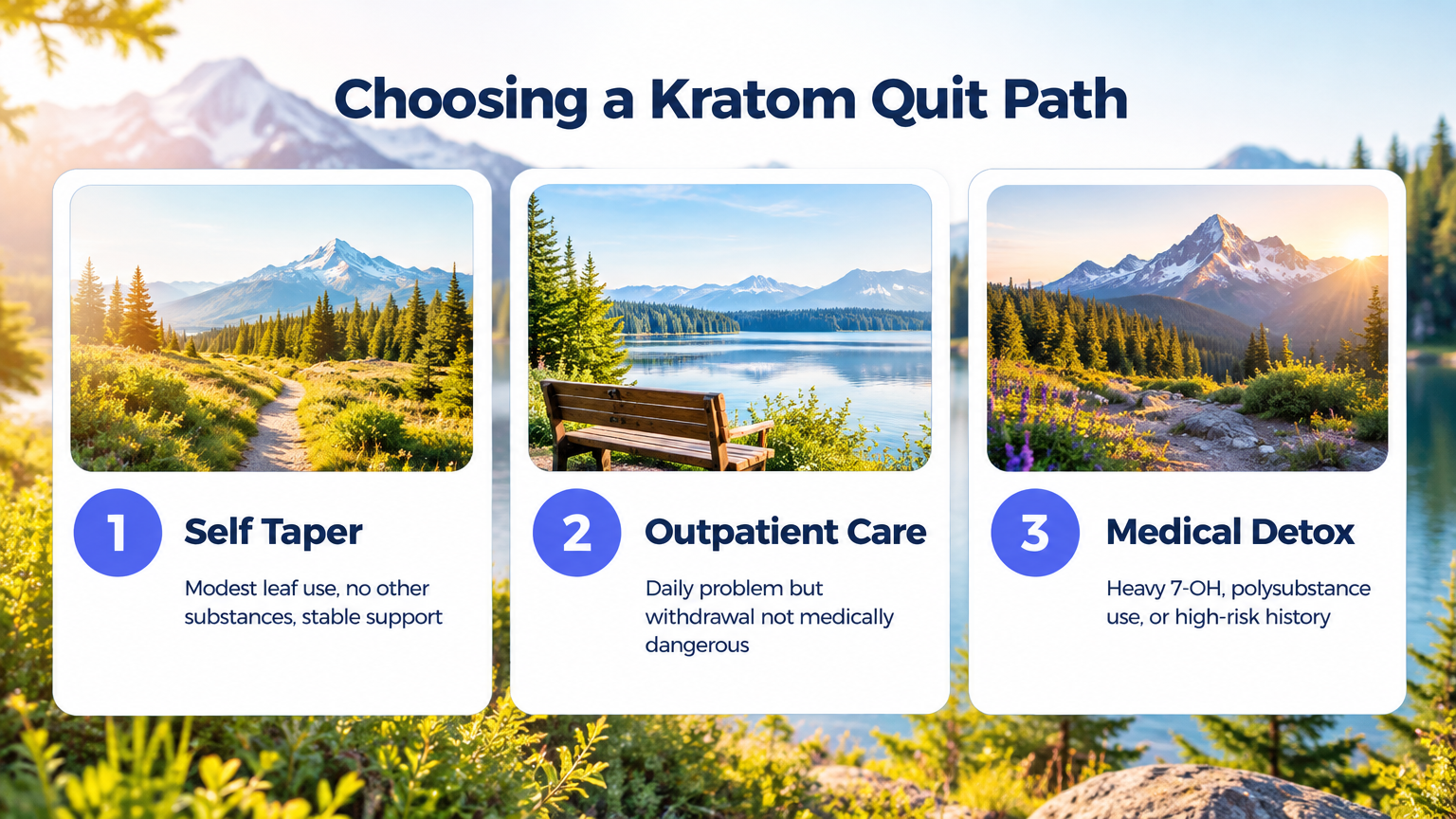
Tapering at home can work for a narrow slice of people — and it's worth being honest about who you are before you try it. If you've been using a modest daily amount of ordinary kratom leaf for a few months, you have no other substances in the picture, you have stable housing and someone who knows what you're doing, and you don't have serious medical or mental health conditions, a slow reduction over a couple of weeks is a reasonable first attempt 1, 4.
A common patient-reported approach is to reduce your daily dose gradually, hold steady when symptoms spike, and avoid skipping ahead because you had a good morning. The specifics of a safe taper schedule should be worked out with a clinician who knows your history. Expect sleep to get worse before it gets better. Keep hydration, electrolytes, and simple food within reach.
If you're using heavy daily doses, concentrated 7-OH products, or anything alongside opioids, benzos, or alcohol, this is not your path 9, 14. Call a clinician before you start.
Outpatient Clinical Support: Structure Without Leaving Home
Outpatient care is the middle lane, and it's where a lot of people end up once they realize willpower alone keeps running out around day three. You keep sleeping in your own bed, keep working if you can, and keep showing up for your family — but you have a counselor, a treatment plan, and a group of people doing the same hard thing on the same week you are.
At Oregon Trail Recovery, our outpatient approach to substance use disorder combines individual therapy (cognitive behavioral therapy and dialectical behavior therapy), group work, and a trauma-informed curriculum like Seeking Safety when there's co-occurring anxiety or PTSD. If a prescriber decides medication is appropriate for kratom use disorder, buprenorphine was the most commonly reported medication in an expert survey in the clinical literature — but that's a clinician's call, not a self-service decision 7, 6.
Intensive outpatient programming fits people whose use has become a daily problem but whose withdrawal isn't medically dangerous. It's structure without disappearing from your life.
Medical Detox: When Supervised Withdrawal Is the Safer Start
Some situations outrun what you can safely manage at home or in outpatient. Medical detox means starting your withdrawal under 24-hour clinical supervision, usually for a few days to a week, with staff who can treat symptoms as they come, manage medications, and watch for complications.
Consider supervised detox if you've been using high daily doses of concentrated 7-OH products, if kratom has been stacked with opioids, benzodiazepines, or alcohol, if you have significant heart, liver, or seizure history, if past quit attempts have crashed into severe symptoms, or if you're pregnant 9, 14, 8. The CDC's recent surveillance of serious outcomes in polysubstance kratom exposures is a loud argument for not doing this alone 14. The buprenorphine case literature also underscores that medication-assisted starts belong in clinical hands, not DIY ones 5, 6.
In the Portland area, Oregon Trail Recovery partners with Pacific Crest Trail Detox for medically supervised withdrawal, so you can start safely and move into outpatient care without a gap. If thoughts of self-harm come up during withdrawal, call or text 988.
What Clinicians Use: Medications and Therapies for Kratom Use Disorder
There's no FDA-approved medication specifically for kratom use disorder, but clinicians aren't working from scratch. Because kratom's alkaloids act on opioid receptors, the medications and therapies developed for opioid use disorder have become the working toolkit — used case by case, not from a standardized playbook 7, 1.
On the medication side, buprenorphine is the most commonly reported option in the clinical literature. A systematic review of pharmacotherapy for kratom use disorder identified 14 reports of longer-term management and found buprenorphine was the most commonly reported medication in an expert survey, with naltrexone and methadone appearing in selected cases 7. A published case series on buprenorphine-naloxone offered proposed starting doses based on reported daily kratom use, while noting the evidence base is thin 6. A 2024 case report described a 36-year-old man with severe kratom use disorder successfully stabilized on sublingual buprenorphine and transitioned to extended-release injections 5. These are case examples, not proof of a universal plan — and the decision to start any medication belongs to a prescriber who knows your full history.
On the therapy side, the behavioral work tends to look like what helps with other substance use disorders: cognitive behavioral therapy to interrupt the thought-use loop, dialectical behavior therapy for emotion regulation when cravings and anxiety spike, and a trauma-informed curriculum like Seeking Safety when PTSD or chronic anxiety is part of the picture. Group work matters too — sitting in a room with people who've felt what you're feeling cuts through the isolation faster than any worksheet.
Getting Help in Oregon, Washington, and the Pacific Northwest
If you live in the Portland area, elsewhere in Oregon, or across the river in Washington, you don't have to figure this out alone. Help for kratom use disorder in the Pacific Northwest looks a lot like help for any other opioid-related dependence: an honest assessment of what you've been taking, a plan matched to how heavy your use has been, and a team that stays with you past the first hard week.
For most people whose kratom use has become a daily problem but whose withdrawal isn't medically dangerous, intensive outpatient treatment is the practical starting point. You keep your job, your housing, and your family close while a counselor helps you break the thought-use loop and a group gives you people who get it. When withdrawal needs 24-hour supervision — heavy daily doses, concentrated 7-OH products, or anything stacked with opioids, benzodiazepines, or alcohol — a medically supervised start comes first 9, 14.
Oregon Trail Recovery provides trauma-informed outpatient care in Portland and partners with Pacific Crest Trail Detox for supervised withdrawal when that's the safer start. Reaching out early isn't giving up. It's the move that makes the first clean week survivable.
Frequently Asked Questions
How long does kratom withdrawal usually last?
For most people who've been using kratom daily, acute withdrawal commonly runs about three days to a week, with the hardest stretch often described in the middle of that window 4, 2. Sleep problems, low mood, and cravings can linger for several weeks after the physical symptoms fade 3, 1. Heavier use and concentrated 7-OH products tend to stretch that timeline 9.
Can I quit kratom cold turkey at home, or do I need help?
It depends on what you've been taking and how much. A modest daily habit on ordinary leaf, with no other substances in the picture and someone around who knows what you're doing, can sometimes be managed at home with a slow taper 1, 4. Heavy daily use, concentrated 7-OH products, or anything stacked with opioids, benzodiazepines, or alcohol belongs in clinical hands from the start 9, 14.
Why is withdrawal from 7-OH products different from regular kratom leaf?
Concentrated 7-hydroxymitragynine products behave more like prescription opioids than like traditional leaf. FDA's scientific review found 7-OH substantially more potent than morphine in preclinical studies 12, and reported discontinuation effects include anxiety, insomnia, body aches, irritability, and cold sweats 9. If you've been using 7-OH tablets, gummies, shots, or drink mixes 11, expect a more intense, longer-tailed withdrawal and plan to work with a clinician.
When is kratom withdrawal a medical emergency?
Call 911 or go to an emergency department for a seizure, chest pain, trouble breathing, a racing or irregular heartbeat, confusion, uncontrolled vomiting with dehydration, or thoughts of self-harm. CDC poison-center surveillance has flagged tachycardia, hypertension, agitation, seizures, and tremor as effects reported with kratom exposures 15. Mixed-substance situations and concentrated 7-OH products raise the risk and warrant urgent evaluation 14, 9. If suicide feels close, call or text 988.
What medications do clinicians use for kratom use disorder?
There's no FDA-approved medication specifically for kratom use disorder, so clinicians borrow from the opioid use disorder toolkit. A systematic review found buprenorphine was the most commonly reported medication in an expert survey, with naltrexone and methadone appearing in selected cases 7. Published case reports describe buprenorphine and buprenorphine-naloxone used to stabilize people with severe kratom use disorder 5, 6. These decisions belong to a prescriber who knows your full history, not a self-service choice.
Where can someone in Oregon or Washington get help for kratom use?
Help in the Pacific Northwest starts with an honest assessment and a plan matched to how heavy the use has been. Intensive outpatient addiction treatment is the practical starting point when withdrawal isn't medically dangerous 1. When supervision is safer — heavy daily doses, 7-OH products, or polysubstance use — a medically supervised start comes first 9, 14. In Portland, Oregon Trail Recovery partners with Pacific Crest Trail Detox for that pathway.
References
- Kratom | National Institute on Drug Abuse. https://nida.nih.gov/research-topics/kratom
- Kratom Withdrawal: A Systematic Review with Case Series. https://pubmed.ncbi.nlm.nih.gov/30614408/
- Kratom withdrawal: Discussions and conclusions of a scientific expert forum. https://pmc.ncbi.nlm.nih.gov/articles/PMC10311168/
- Understanding Kratom Use: A Guide for Healthcare Providers. https://pmc.ncbi.nlm.nih.gov/articles/PMC8924421/
- Isolated Kratom Use Disorder Treated With Extended-Release Buprenorphine Taper. https://pubmed.ncbi.nlm.nih.gov/38776432/
- Treatment of Kratom Withdrawal and Dependence With Buprenorphine-Naloxone. https://pubmed.ncbi.nlm.nih.gov/32858563/
- Pharmacotherapy for Management of 'Kratom Use Disorder'. https://pubmed.ncbi.nlm.nih.gov/33974767/
- FDA and Kratom. https://www.fda.gov/news-events/public-health-focus/fda-and-kratom
- Products Containing 7-OH Can Cause Serious Harm - FDA. https://www.fda.gov/consumers/consumer-updates/products-containing-7-oh-can-cause-serious-harm
- FDA Takes Steps to Restrict 7-OH Opioid Products Threatening American Consumers. https://www.fda.gov/news-events/press-announcements/fda-takes-steps-restrict-7-oh-opioid-products-threatening-american-consumers
- FDA Issues Warning Letters to Firms Marketing Products Containing 7-Hydroxymitragynine. https://www.fda.gov/news-events/press-announcements/fda-issues-warning-letters-firms-marketing-products-containing-7-hydroxymitragynine
- HHS Recommends Science-Based Thresholds to Target Dangerous Enhanced Kratom Products. https://www.hhs.gov/press-room/hhs-recommends-thresholds-enhanced-kratom-products-7-oh-mgpi.html
- Notes from the Field: Kratom (Mitragyna speciosa) Exposures Reported to Poison Centers—United States, 2010–2015. https://www.cdc.gov/mmwr/volumes/65/wr/mm6529a4.htm
- Increases in Kratom-Related Reports to Poison Centers. https://www.cdc.gov/mmwr/volumes/75/wr/pdfs/mm7511a1-H.pdf
- Increase in Poison Center Reports Linked to Kratom-Containing Products and Kava. https://www.cdc.gov/mmwr/volumes/75/wr/mm7512a1.htm
Real Recovery Starts in Portland, Oregon
Call now or verify insurance to take the first step toward lasting recovery in Portland.
Relapse Doesn't Mean the End Of Your Journey
Reach out today to explore programs that support real, long-term sobriety.