


IOP Group Rules: What to Expect and Why They Matter

Key Takeaways
- IOP group rules function as clinical scaffolding, not punishment — attendance, confidentiality, sobriety, and respect each exist to keep the room safe enough for honest work.
- Confidentiality under 42 CFR Part 2 binds the program and its staff, but peers agree to it as an ethical commitment, so share honestly in group and save the heaviest material for individual sessions 12.
- Showing up consistently is the strongest predictor of progress; research links longer time in intensive outpatient care to fewer drug-related problems, better employment, and cleaner screens at follow-up 20.
- Before your first session, ask how the schedule, individualized service plan, confidentiality limits, virtual logistics, and family involvement work — walking in informed steadies nerves and sets up the work ahead.
Walking Into Your First IOP Group
The first time you walk into an intensive outpatient group, your nervous system usually gets there before you do. You scan the chairs. You wonder who else is in the room, what they'll ask you to say, and whether you can leave if it gets too intense. That nervousness is normal, and the rules you're about to be handed are built around it.
Here's the honest version: IOP group rules aren't a disciplinary checklist designed to catch you failing. They're the scaffolding that lets a room of strangers do difficult, honest work together without hurting each other. Attendance, confidentiality, sobriety during sessions, how phones get handled, what happens when someone misses a week — each rule is doing a specific job, and once you see the job, the rule stops feeling arbitrary.
This guide walks you through what to expect in an Oregon IOP group, what the law actually protects (and what it can't), how virtual sessions change the contract, and what happens if a rule gets broken. Whether you're stepping down from residential care, stepping up from standard outpatient, or starting here because of a DUII, you deserve to know the room before you sit in it.
What an IOP Group Actually Is (and Isn't)
Where Group Fits in the Oregon Level 2.1 Standard
An intensive outpatient program sits between residential care and standard weekly outpatient. You live at home, work or go to school around your schedule, and show up for structured treatment several days a week. In Oregon, that structure isn't a vague promise — it's a specific regulatory standard tied to ASAM Level 2.1.
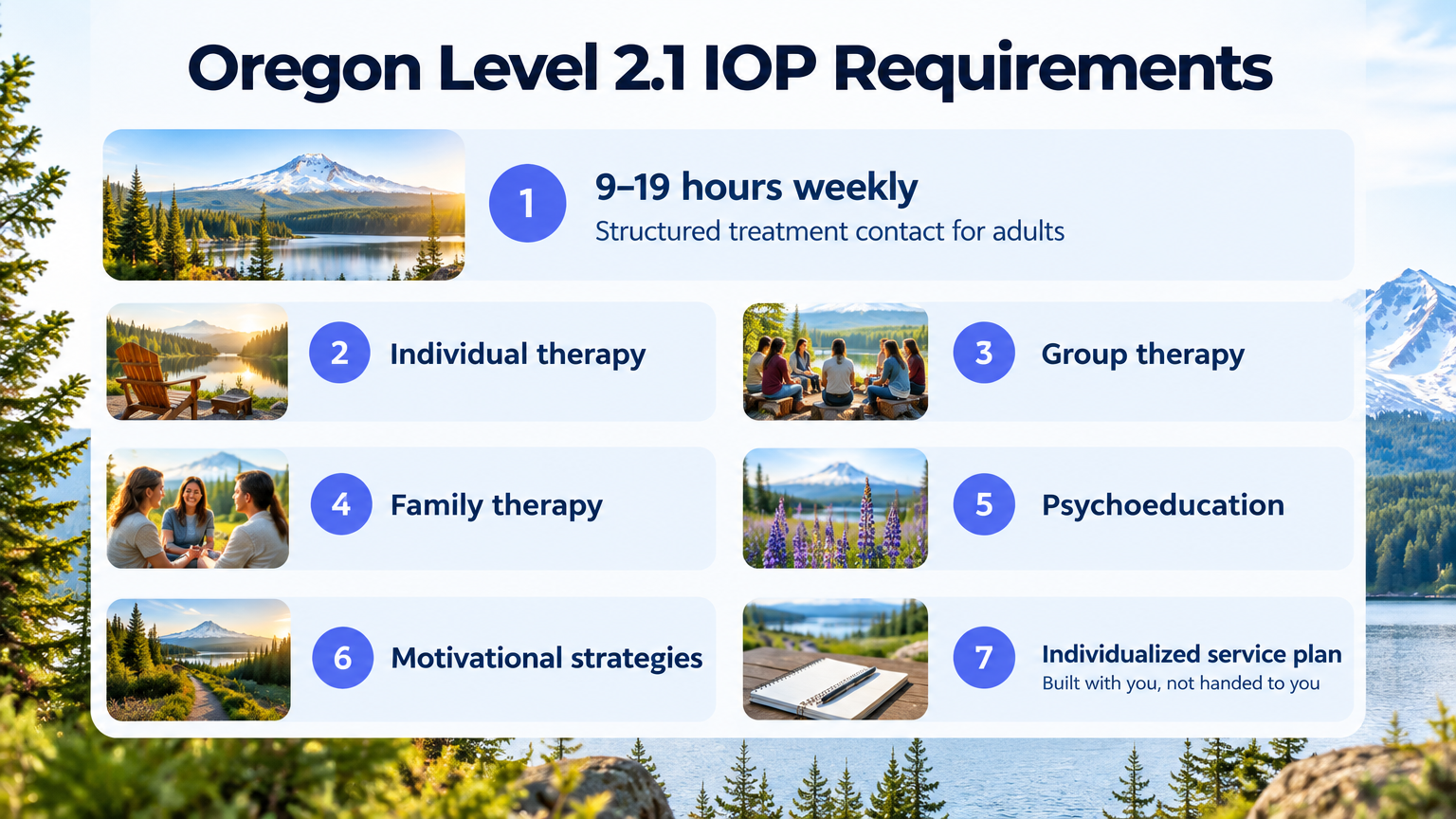
For adults, Oregon requires 9 to 19 hours of weekly treatment contact at Level 2.1, and that contact has to include individual therapy, group therapy, and family therapy, along with psychoeducation and motivational strategies 4. Group is the part most people picture when they think about IOP, but it's one piece of a required set. If a program is advertising itself as Oregon IOP and offering only group sessions, that's a question worth asking.
Oregon's rules also direct programs to develop an individualized service plan — one that reflects your assessment, names your objectives, and gets built with you and, when applicable, family or support participants, rather than handed to you 3. So the group rules you'll be asked to follow sit on top of a treatment plan that's supposed to fit your actual life.
One more piece of context worth knowing: Oregon has set July 1, 2027, as the date substance use disorder and co-occurring providers must be licensed or certified for their levels of care under ASAM Criteria, Fourth Edition 5. Expect the Level 2.1 framework to keep tightening, not loosen.
Group as the Core, Not the Whole Program
Group counseling is the center of most IOP schedules, and there's a clinical reason for that. Clinical reviews describe groups as the core of many IOP programs and point to an optimal group size of roughly 8 to 15 members — a guideline, not a legal cap 15. The size matters because it's big enough to hear different stories and small enough that your voice doesn't disappear.
But group alone isn't the program. The same clinical sources are clear that IOP should pair group counseling with individual counseling, relapse-prevention work, family services, and continuing care planning 15. NIDA puts it the same way from a different angle: effective treatment addresses more than substance use, including medical, psychological, social, and employment needs, and uses individual, family, and group formats together 22.
So when you see the group rules — the attendance expectations, the confidentiality agreements, the ground rules for how people speak to each other — read them as the operating agreement for one important room, not a contract for your whole recovery. Your individual sessions, your family work, your case management, and whatever outside support you're building all sit alongside the group. The rules make the group work. The rest of the plan makes the group count.
Rules That Protect the Group
Confidentiality: What the Law Covers and What It Can't
Confidentiality is the rule most people worry about before they ever walk in. It's also the rule that gets explained the least honestly on other pages. So here's the clean version.
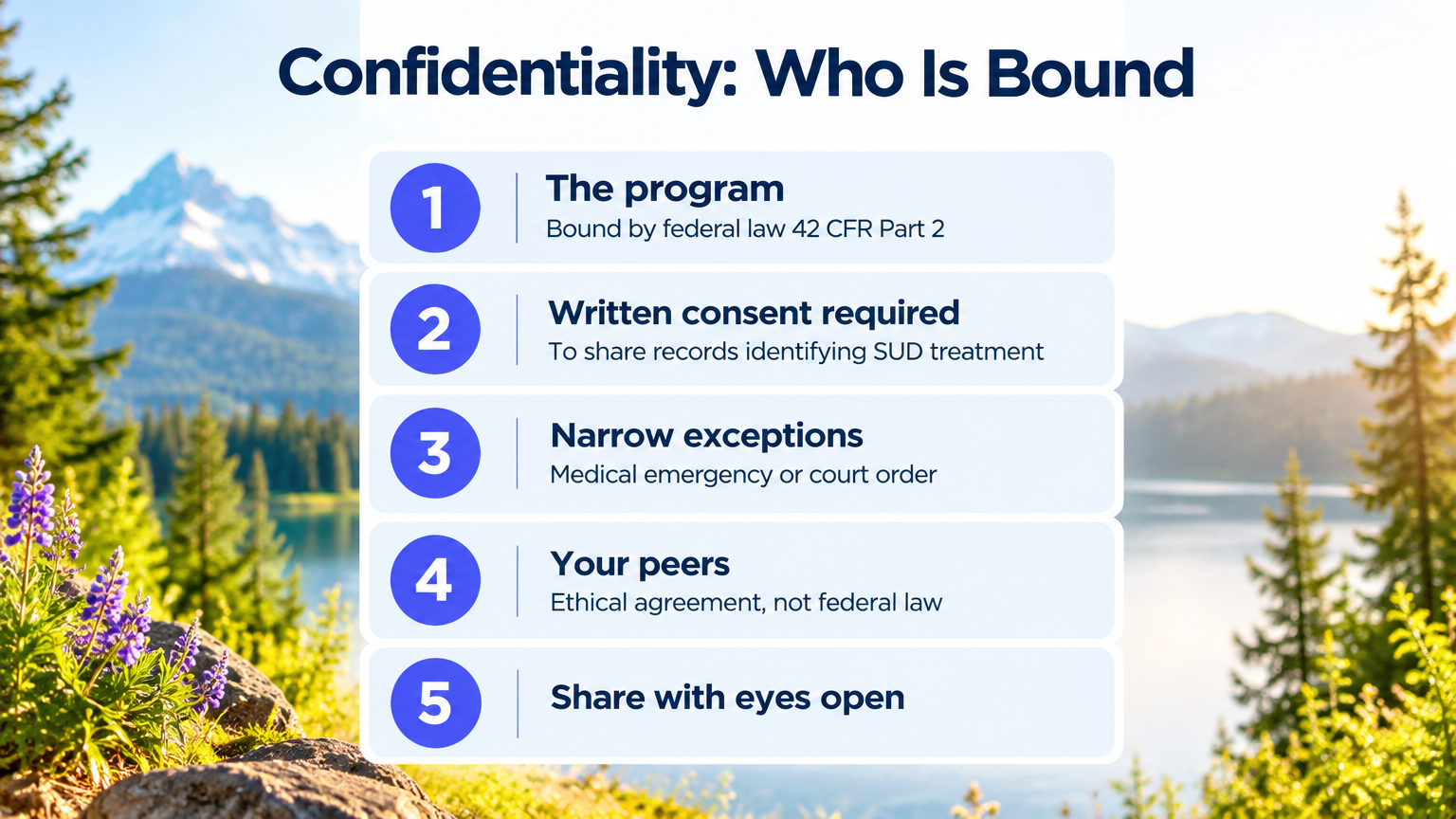
The program and its staff are bound by a federal rule called 42 CFR Part 2, which protects records that identify someone as having a substance use disorder. Under the 2024 final rule — with a compliance deadline in early 2026 per HHS — the program can use a single written consent for future disclosures tied to treatment, payment, and health care operations, and you have rights to an accounting of disclosures, restrictions, and breach notification 11. Outside of narrow exceptions like a medical emergency, a valid written consent, or a court order, your records can't be shared in a way that identifies you as a person receiving SUD treatment 12. Oregon's own behavioral-health rules reinforce confidentiality and your right to consent to disclosure under both state and federal law 3.
Showing Up Sober: Why Intoxicated Participation Ends the Session
If you come to group under the influence, the facilitator will pull you aside and the session will end for you that day. That's not a punishment and it's not a moral verdict. It's a clinical boundary, and SAMHSA's group-therapy guidance is direct that leaders should intervene decisively when a participant arrives intoxicated or actively using 6.
Here's why. A group only works when people can trust what they hear and feel safe with what they say. Someone who's impaired can't track the conversation, can't give consent to difficult material, and can unintentionally destabilize other people in the room who are white-knuckling their own sobriety. Trauma-informed guidance adds another layer: screening, assessment, and heavy disclosure shouldn't happen while someone is under the influence of alcohol or drugs, because the person can't do that work safely 14.
What usually happens instead is a conversation. Your counselor talks with you about what led up to the use, whether withdrawal is in play, whether you're safe to get home, and what the next right step is — often an individual session, a safety plan, and sometimes a referral for a higher level of care. A slip isn't the end of your treatment. Showing up to group high is the signal that triggers a different kind of help, not a door closing on you.
Respect, Safety, and the Line Against Shaming
Every group you'll join has some version of the same conduct rules: no threats, no name-calling, no personal attacks, no cornering someone into disclosing more than they want to share. These aren't manners rules borrowed from an office handbook. They're drawn from trauma-informed care, which treats physical and emotional safety, trustworthiness, and preventing retraumatization as the baseline conditions for any healing to happen 13.
What that looks like in practice: you can disagree with someone's thinking without attacking them. You can share your experience without being pressured to share more. You can ask the facilitator to redirect a conversation that feels unsafe, and that request is treated as useful feedback, not disruption. Culturally responsive placement matters here too — facilitators are trained not to assume everyone in a demographic group shares the same experience, beliefs, or needs 8.
There's a reason this rule earns its own line. Early trust in group is linked to better attendance and retention; one study of women in group treatment for PTSD and substance use found that higher therapeutic alliance early on predicted whether people stayed 17. Respect isn't a soft rule. It's the thing that keeps the chairs filled long enough for the work to take hold.
Rules That Protect Your Progress
Attendance and Punctuality as a Clinical Tool
Attendance isn't about perfect scores. It's about building the one thing that actually predicts whether treatment works for you: time in the room. The randomized research on intensive outpatient care found that people who stayed in treatment longer had fewer drug-related problems, cleaner urine screens, better employment status, and fewer psychological problems at nine-month follow-up than people who left earlier 20. Showing up is doing the work, even on the days you don't feel like you did much.
So programs ask you to attend every scheduled group and to arrive on time or a few minutes early 9. Punctuality isn't a nitpick. When you walk in ten minutes late, the facilitator has to reset, your peers have to re-center, and you miss the opening check-in, which is often where the day's clinical thread gets set. In a group of 8 to 15 people 15, one late arrival ripples through the whole room.
If life is making attendance hard — a shift change, a childcare gap, a bus that keeps running late — tell your counselor before you miss, not after. NIDA's guidance is clear that effective treatment addresses the medical, social, and employment barriers that get in the way, not just the substance use 22. The schedule should bend when it can. What it can't do is bend around you if you don't say anything.
Honest Participation: Speaking, Listening, and Phones Down
The participation rules sound simple on paper: listen when others speak, support the people in the room, and be honest with your counselor about what you're actually thinking and feeling 9. In practice, each one takes some getting used to.
Listening means your phone is off or face-down, not just silenced in your lap. A screen in your hand pulls your attention out of the room and tells the person speaking that their disclosure isn't worth your full presence. It also pulls at everyone else — attention is contagious in a group.
Speaking honestly is the harder part. You don't have to share your worst story on day one, and good facilitators won't push you to. Trauma-informed guidance specifically warns against pressuring disclosure or doing heavy trauma work before safety is established 14. What honest participation does ask is that when you do speak, you say what's actually true for you — the craving you had Tuesday night, the argument with your partner, the thought that scared you. Half-sharing to look okay is the pattern that keeps a lot of people stuck. The group can only help with what you let into the room.
Missed Sessions and What Actually Happens Next
Missing a session isn't the end of your treatment, and it isn't a secret you have to carry alone. Most programs ask you to call ahead when you can, and to expect a check-in call or message when you don't show up. That outreach is clinical, not punitive. Your counselor needs to know whether you're safe, whether you've used, whether something changed at home or at work, and what support you need to get back in the room.
What happens after depends on the pattern, not the single absence. One missed group with a reason usually results in a conversation and a plan to make up the material. Repeated no-shows trigger a more serious look at your individualized service plan — the one Oregon directs programs to develop with you and, when applicable, family or support participants 3— to figure out what's actually in the way. Sometimes the plan needs a schedule change. Sometimes the clinical picture suggests a different level of care. The 2025 outcomes review is a useful reminder here: treatment success is measured across substance use, retention, adherence, and quality of life, not by attendance alone 21.
If you've already missed sessions and you're nervous about coming back, come back anyway. Walking in after a gap is one of the harder things people do in IOP, and it's also one of the most clinically meaningful. Your counselor would rather have that conversation than lose track of you.
Virtual and Hybrid Groups: Different Room, Same Contract
When your group meets on a screen, the clinical contract doesn't change. The logistics do. You still owe the room your attention, your honesty, and your respect for other people's privacy — but now you're also responsible for the space around your laptop, who can hear you, and what happens if the connection drops in the middle of someone's hardest sentence.
SAMHSA's telehealth guidance for substance use and mental health groups spells out what good programs plan for before the first virtual session: privacy on both ends, where each participant is physically located, how emergencies get handled across distance, what to do when the technology fails, and how facilitators review group expectations with everyone at the start 10. That's why most online IOP groups will ask you to join from a private room, keep your camera on, use headphones, and confirm your location at check-in. If you're sharing a wall with a roommate, a car counts. A coffee shop usually doesn't.
The evidence on format is worth sitting with honestly. A 2024 observational study across seven rural Minnesota IOP programs found that hybrid exposure was associated with 1.88 times higher odds of treatment completion than virtual-only exposure, with a 95% confidence interval of 1.50 to 2.41 18. Because the study was observational and limited to rural Minnesota sites, it doesn't prove hybrid delivery alone caused the gap, and the finding shouldn't be stretched to every population. A separate 2024 patient-perception study pointed the same direction: hybrid groups matched in-person groups on most measures, while virtual-only groups rated significantly worse on 6 of 8 questions covering alliance, cohesion, satisfaction, and insight 19.
What that means for you is simple. Virtual access is real access — for people managing childcare, shift work, a long drive from outside the Portland area, or a disability that makes a weekly commute unsustainable, logging in is far better than not showing up. But if an in-person option is available to you some of the week, use it. The rules about camera, privacy, and location aren't gatekeeping. They're the online version of closing the door behind you when you walk into the room.

When a Rule Gets Broken: Repair, Not Punishment
You will break a rule at some point. Most people do. You'll miss a session, snap at someone during a check-in, pick up your phone when you shouldn't have, or walk in carrying a weekend you don't want to talk about. What happens next tells you a lot about whether a program is set up for recovery or set up for compliance theater.
Good programs treat a rule break as clinical information, not evidence against you. SAMHSA's group-therapy guidance frames leader intervention as a way to protect the group and re-engage the person, not to shame them 6. In practice, that usually looks like a short, direct conversation: what happened, what was going on underneath it, what needs to change so it doesn't repeat, and what support you need to walk back in. Trauma-informed care backs this up — safety and accountability can share the same room, but shaming someone almost always ends the work 13.
The repair isn't just between you and the facilitator. If the break affected someone else in the room — an interrupted disclosure, a comment that landed hard — you may be asked to acknowledge it when you return. That's not performative. It's how trust gets rebuilt in a group of 8 to 15 people 15who are watching to see whether the rules are real.
Some breaks do change the plan. Repeated intoxicated arrivals, threats, or a pattern of absences will prompt a review of your individualized service plan 3and an honest conversation about whether a different level of care would serve you better right now. That's not failure. It's the system working the way it's supposed to — matching the intensity of help to what your recovery actually needs this week.
DUII, Court-Mandated Clients, and Family Members in the Room
If you're in IOP because of a DUII or a court order, the rules in the room are the same rules every other participant follows. What's different is the paperwork around them. Your attendance, your participation, and sometimes your drug-test results are documented and reported to whoever ordered the treatment, which usually means your probation officer, the court, or an attorney. That reporting only happens with your written consent, and under 42 CFR Part 2 that consent has to name who gets the information and what gets shared 12. Read it before you sign it. You can ask questions about it. You can also ask what a missed session or a positive screen will trigger on the compliance side, so there are no surprises later.
Here's what helps: the clinical work in group doesn't change because a judge is watching. You still get to say what's actually true. People who treat IOP as a box to check tend to log the hours and lose the recovery. People who use the mandate as the push they needed often leave with both — the compliance letter and a different life. Your counselor can hold both of those things at once.
Family members are usually not in your peer group. Oregon's rules direct programs to develop the individualized service plan with the person and, when applicable, family or support participants 3, and SAMHSA's advisory notes that family involvement can improve engagement, retention, and outcomes when the person consents to it 23. That typically happens in separate family sessions or psychoeducation, with a release of information on file for anyone invited. If a family relationship involves coercion, violence, or ongoing harm, say so — family inclusion isn't automatic, and it shouldn't be.
Questions to Ask Before Your First Session
Walking in with a few questions ready is one of the easiest ways to steady your nerves. You're not interviewing the program to catch them failing — you're making sure the room you're about to sit in is the right room for you right now.
Ask what the weekly schedule actually looks like, which service categories are included beyond group 4, and how your individualized service plan gets built 3. Ask who facilitates the group, what curriculum they use 16, and how they handle someone who arrives intoxicated. Ask how confidentiality is explained to the group and what the limits are under 42 CFR Part 2 12. If sessions are virtual or hybrid, ask about privacy, location rules, and what happens when the connection drops 10. If family will be involved, ask whether those sessions are separate from your peer group and what consent you'll sign 23.
Frequently Asked Questions
What happens if I show up late or miss an IOP group session?
One late arrival or absence usually prompts a check-in call and a plan to make up the material, not a penalty. Call ahead when you can. Repeated no-shows trigger a review of your individualized service plan, which Oregon directs programs to develop with you and, when applicable, family or support participants 3, so your counselor can figure out what's actually in the way and adjust the schedule or level of care.
Is what I share in group actually confidential?
Your records and anything staff learn about you are protected under 42 CFR Part 2, which generally bars the program from identifying you as someone in SUD treatment without your written consent or a narrow exception like a medical emergency or court order 12. The other people in the circle agree to confidentiality as an ethical commitment, but no federal law makes it a crime for them to repeat what you said 6. Share honestly, and save the heaviest pieces for individual sessions.
What happens if someone comes to group under the influence?
The facilitator will step in and end the session for that person. SAMHSA's group-therapy guidance is direct that leaders should intervene when a participant arrives intoxicated, because the group can't do safe work around someone who's impaired 6. What follows is a conversation about safety, withdrawal, and the next step — often an individual session, a safety plan, or a referral — not a door closing on your treatment.
How many hours a week will I need to attend IOP in Oregon?
For adults in an Oregon ASAM Level 2.1 program, expect 9 to 19 hours of weekly treatment contact, delivered across individual, group, and family therapy plus psychoeducation and motivational strategies 4. The exact schedule gets set in your individualized service plan 3, so your actual week depends on your assessment, your goals, and whether you're stepping down from residential care or stepping up from standard outpatient.
Do the same rules apply if my IOP group meets online?
Yes — attendance, honesty, and confidentiality carry over. What changes is the logistics around them. SAMHSA's telehealth guidance expects programs to plan for privacy on both ends, confirm where each participant is located, set rules for cameras and headphones, and have a procedure when the connection drops or an emergency comes up 10. Expect to join from a private space, keep your camera on, and check in with your location at the start.
I'm in IOP because of a DUII or court order. How do the rules affect my compliance?
You follow the same group rules every other participant does. The difference is paperwork: your attendance, participation, and sometimes test results get reported to whoever ordered the treatment, but only through a written consent that names who receives what under 42 CFR Part 2 12. Read that release before you sign it, and ask your counselor what a missed session or positive screen will trigger on the compliance side so nothing catches you off guard.
References
- Clinical Issues in Intensive Outpatient Treatment for Substance Use Disorders. https://library.samhsa.gov/sites/default/files/pep20-02-01-021.pdf
- Clinical Issues in Intensive Outpatient Treatment. https://library.samhsa.gov/sites/default/files/sma13-4182.pdf
- Health Systems Division: Behavioral Health Services - Chapter 309. https://www.oregon.gov/oha/HSD/RAC/309-019.pdf
- 309-019-0183 Intensive Outpatient Substance Use Disorder Services ASAM Level 2.1. https://www.oregon.gov/oha/HSD/Medicaid-Policy/SUDWaiver/309-019-Highlighted-040723.pdf
- Behavioral Health Outpatient Treatment Programs : Providers. https://www.oregon.gov/oha/BH/Providers/Pages/OP.aspx
- TIP 41: Substance Abuse Treatment: Group Therapy. https://library.samhsa.gov/product/tip-41-substance-abuse-treatment-group-therapy/sma15-3991
- Quick Guide for Clinicians Based on TIP 41, Substance Abuse Treatment: Group Therapy. https://library.samhsa.gov/sites/default/files/sma15-4024.pdf
- Module 3: Criteria for the Placement of Clients in Groups. https://library.samhsa.gov/sites/default/files/tip41_mod3_0.pdf
- Client's Handbook: Matrix Intensive Outpatient Treatment for People With Stimulant Use Disorders. https://library.samhsa.gov/sites/default/files/sma15-4154.pdf
- Telehealth for the Treatment of Serious Mental Illness and Substance Use Disorders. https://library.samhsa.gov/sites/default/files/pep21-06-02-001.pdf
- Fact Sheet 42 CFR Part 2 Final Rule. https://www.hhs.gov/hipaa/for-professionals/regulatory-initiatives/fact-sheet-42-cfr-part-2-final-rule/index.html
- Understanding Confidentiality of Substance Use Disorder (SUD) Patient Records. https://www.hhs.gov/hipaa/part-2/index.html
- Trauma-Informed Care in Behavioral Health Services. https://library.samhsa.gov/sites/default/files/sma15-4420.pdf
- TIP 57 Trauma-Informed Care in Behavioral Health Services. https://library.samhsa.gov/sites/default/files/sma14-4816.pdf
- Chapter 4. Services in Intensive Outpatient Treatment Programs. https://www.ncbi.nlm.nih.gov/books/NBK64094/
- Chapter 8. Intensive Outpatient Treatment Approaches. https://www.ncbi.nlm.nih.gov/books/NBK64102/
- Helping Alliance, Retention, and Treatment Outcomes. https://pmc.ncbi.nlm.nih.gov/articles/PMC3639137/
- Transitioning Virtual-Only Group Therapy for Substance Use Disorder Patients to a Hybrid Model. https://pubmed.ncbi.nlm.nih.gov/38681859/
- Patient Perceived Impact of Outpatient Group Substance Use Disorder Treatment in a Hybrid Model or Virtual-Only Model Relative to In-Person Delivery. https://pubmed.ncbi.nlm.nih.gov/39474206/
- A randomized controlled study of the effectiveness of intensive outpatient treatment for cocaine dependence. https://pubmed.ncbi.nlm.nih.gov/9634157/
- Substance Use Disorder Treatment Outcomes: Methodological Overview of Metrics and Criteria. https://pmc.ncbi.nlm.nih.gov/articles/PMC12180564/
- Principles of Drug Addiction Treatment: A Research-Based Guide. https://nida.nih.gov/sites/default/files/podat-3rdEd-508.pdf
- The Importance of Family Therapy. https://library.samhsa.gov/sites/default/files/pep20-02-02-016.pdf
- Substance Use Disorder Treatment for People With Co-Occurring Disorders. https://library.samhsa.gov/sites/default/files/pep20-06-04-006.pdf
Real Recovery Starts in Portland, Oregon
Call now or verify insurance to take the first step toward lasting recovery in Portland.
Relapse Doesn't Mean the End Of Your Journey
Reach out today to explore programs that support real, long-term sobriety.