

Hiking & Outdoor Recovery Activities in Portland

Key Takeaways
- Portland's Forest Park, Powell Butte, Mt. Tabor, and Columbia River Gorge sit within a short drive of treatment, giving Oregon Trail Recovery scheduled terrain that a sealed indoor program cannot match.
- Outdoor time functions as a clinical adjunct, not a substitute for CBT, DBT, Seeking Safety, or medical detox, and roughly 85% of studied nature-based interventions reported positive outcomes when layered on standard care 1.
- A one-hour walk in green space measurably lowered craving intensity in people with SUD compared to urban walks, which is why midweek disc golf and Saturday hikes are treated as tracked programming 2.
- Before choosing a program, compare how detox handoffs work, whether outdoor activities are staff-supervised and attendance-tracked, and how hikes integrate with therapy rather than sitting beside it as a reward.
A Saturday Morning on the Wildwood Trail
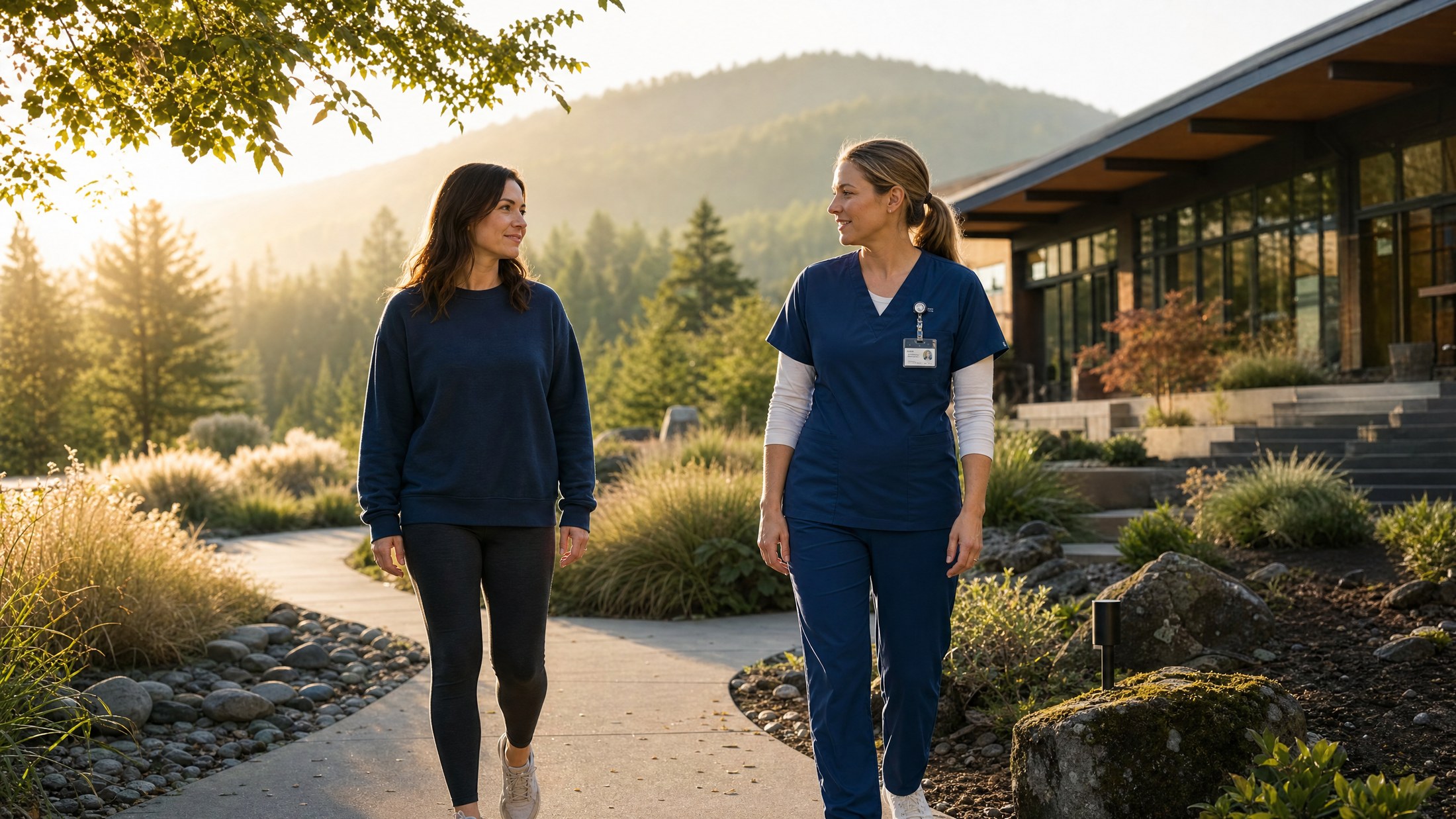
It is 8:47 on a Saturday morning in Portland. The van pulls into a small gravel lot off Northwest Thurman, and you step out into that specific Pacific Northwest air—cool, wet enough to bead on your jacket sleeve, smelling like Doug fir and wet stone. Someone from the group hands you a water bottle. Nobody talks much yet. That is normal.
You are three weeks past detox. Your legs feel heavier than they should. The Wildwood Trail unrolls in front of the group, forty miles of packed dirt threading through Forest Park, though today you are only walking a few of them. A staff member does a quick head count, checks in with the two people who mentioned rough nights at group on Thursday, and then the group starts moving.
This is not a field trip. It is not a reward for good behavior. It is Saturday morning programming at Oregon Trail Recovery, and it counts the same way your CBT session on Tuesday counts.
The next few miles will be quieter than you expect, harder than you expect, and, if you let them, more useful than you expect. That is what the rest of this piece is about—why Portland's trails, courses, and green corners belong inside a treatment plan, not beside it.
Why Portland's Outdoors Belongs in a Treatment Plan
The Local Picture Behind the Programming
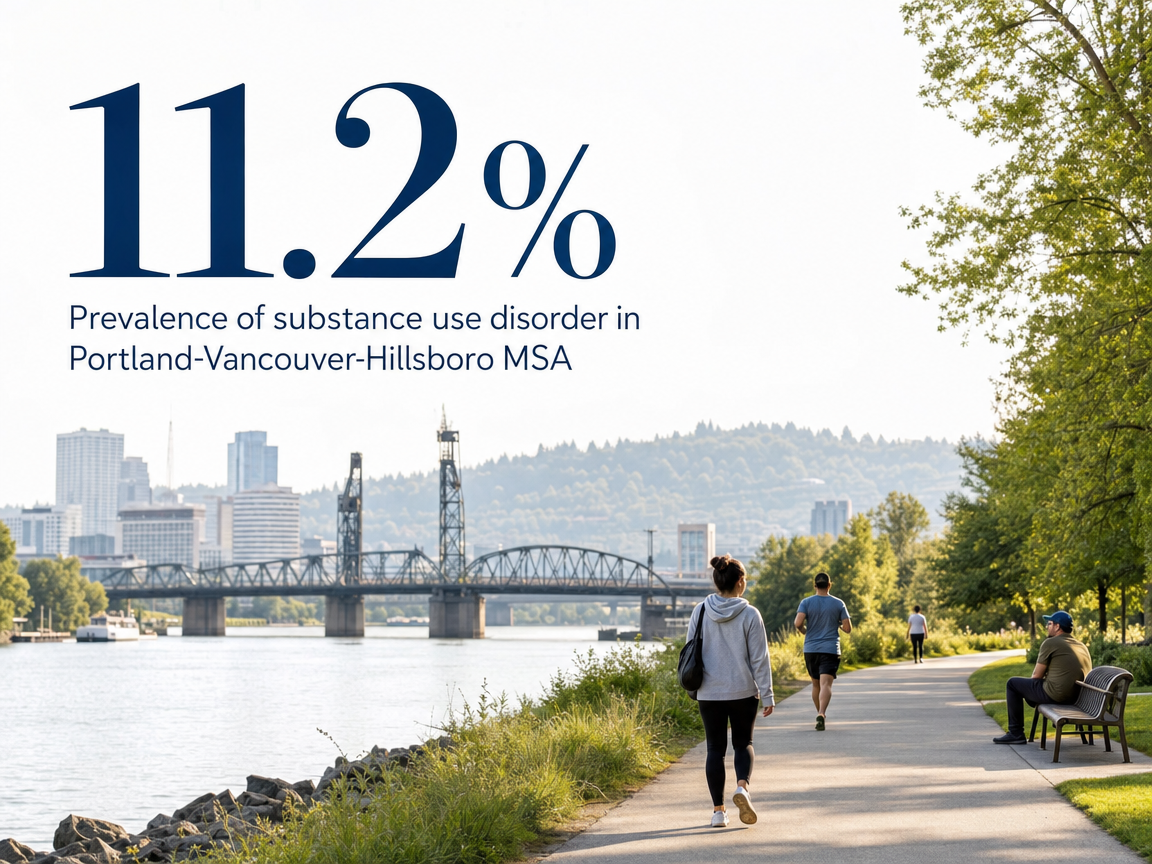
You are not imagining the weight of it. Portland carries a heavier substance use load than most of the country. In the Portland-Vancouver-Hillsboro metro area, 212,000 people aged 12 and older were classified as having a substance use disorder in the past year—about 11.2% of the population, a rate that runs higher than both Oregon's statewide figure and the national average 4. That is your neighbor, your coworker, the person on the next barstool you used to close down, and, if you are reading this, quite possibly you.
Numbers like that shape what a treatment program has to do. When one in nine of your neighbors is walking around with an active SUD, recovery cannot happen in a sealed room for an hour on Tuesday and then release you back into a city that has not changed. The environment you spend the rest of the week in matters. Where you go on Saturday matters.
Portland happens to give you something back for that math. Forest Park sits inside the city limits, over five thousand acres of it. The Columbia River Gorge starts twenty minutes east of downtown. Powell Butte, Mt. Tabor, and a scatter of neighborhood disc golf courses are all reachable by van in under half an hour.
A treatment program built here has an obligation to use that. Not as scenery. As a scheduled part of the week that pulls you into a version of Portland that has nothing to do with where you used to buy or drink.
What the Research Actually Says About Nature and Recovery
Here is where a lot of recovery writing goes soft. Someone quotes a forest-bathing study, someone else drops a line about cortisol, and you are left wondering whether any of it holds up when you are actually shaking on a trailhead at three weeks sober.
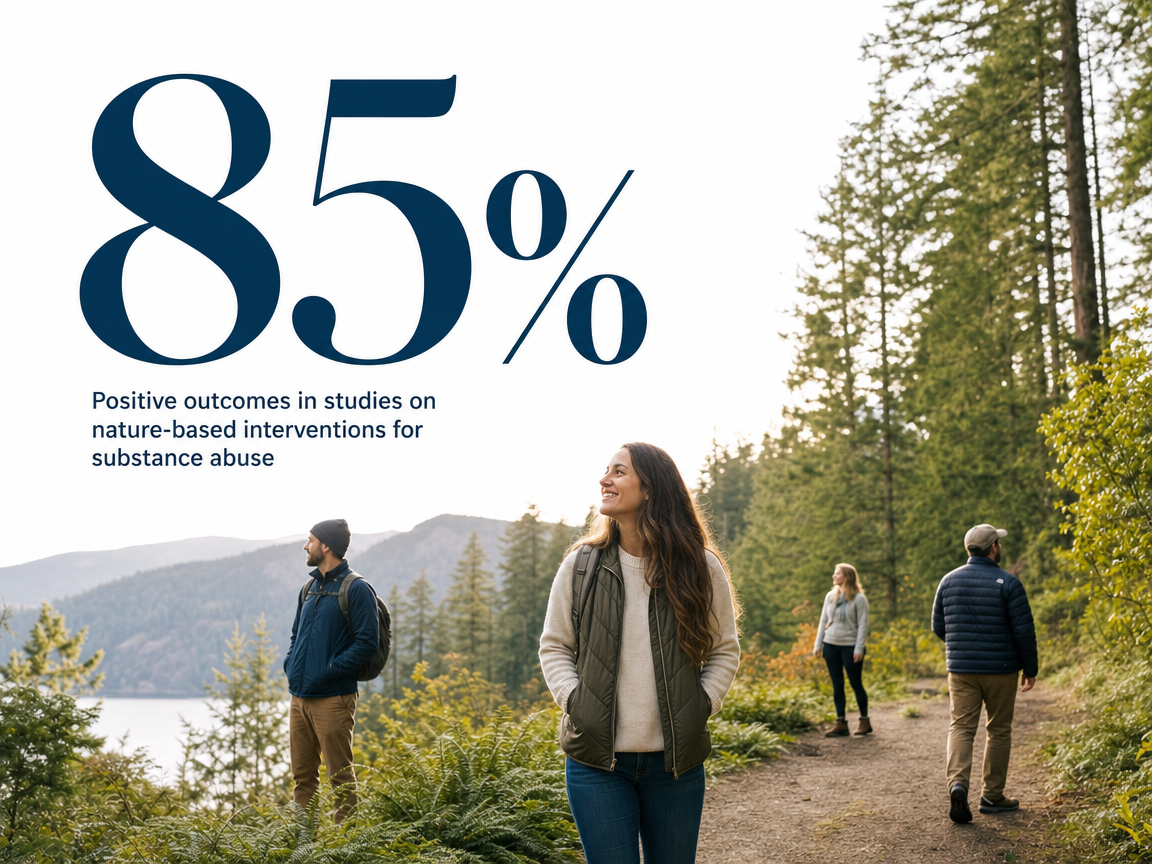
The honest answer is that the evidence is real, useful, and narrower than a brochure would suggest. A 2024 review of natural interventions used inside substance abuse treatment—hiking, gardening, forest programs, outdoor group activities—found that roughly 85% of the studies included reported positive outcomes. Those outcomes covered reductions in substance use and improvements in self-efficacy, self-esteem, stress, anxiety, and depression 1. That is a strong signal.
Read the fine print with us, though. The same review flagged that study quality varies, some designs are small, and every one of those interventions was layered on top of standard clinical care, not used instead of it 1. Nobody in that literature is arguing you can hike your way out of a substance use disorder. What they are showing is that when you add structured outdoor time to a real treatment plan, most of the time, people do better.
A separate 2021 umbrella review of nature-based, wilderness, and adventure therapies reached a similar place. Across fourteen reviews, the strongest and most consistent gains showed up in self-esteem, locus of control, behavioral change, and interpersonal skills—the exact muscles a person in early recovery needs to rebuild 3.
That is the frame to hold. Outdoor programming at Oregon Trail Recovery is not a substitute for CBT, DBT, Seeking Safety, or 12-step work. It is an adjunct with a track record, scheduled deliberately so the two sides reinforce each other.
The First Hike at Three Weeks Sober
Nobody tells you that your first sober hike will feel like your body is snitching on you. The uphill grade on Wildwood is gentle by Portland standards, and you are still winded by the second switchback. Your calves burn in a way that has nothing to do with the trail and everything to do with what the last few months, or years, took out of you. That is honest information, not failure.
Post-acute withdrawal does not clock out because you finished detox. Sleep is still ragged. Your appetite has opinions it did not have last month. You may be one bad night away from wanting to bail on the whole morning. And here you are, walking uphill anyway, with six other people you barely know.
Something else happens on that trail, though, and it is worth naming. About twenty minutes in, the small talk thins out. You notice the sound your boots make on wet leaves. Somebody points at a pileated woodpecker and everyone stops. For the first time in a while, your brain is not running the loop it usually runs. You are just here, breathing, moving, being a person on a path.
That is not a spiritual experience. It is your nervous system, finally getting a minute to reset. It is also the exact reason your Saturday morning is scheduled the way it is.
How Cravings, Nervous Systems, and Green Space Interact
Cravings do not knock politely. They arrive in your chest, your jaw, your hands. And the frustrating part, especially in early recovery, is that they show up whether you have done everything right that week or not. So the practical question is not whether cravings will happen. It is what actually turns the volume down when they do.
Notice what that is saying, and what it is not. It is not saying a hike cures a craving. It is saying that structured time in a green environment measurably lowers the intensity of what you are feeling, right now, in a way that a walk down a busy street does not.
Your nervous system knows the difference between a basalt cliff face along the Columbia and a stoplight on Powell Boulevard. Give it the cliff face, on schedule, and cravings become something you can move through instead of something that moves through you.
Named Trails and Courses Oregon Trail Recovery Actually Uses
Forest Park, Powell Butte, and Mt. Tabor
Forest Park is the anchor. Over five thousand acres inside Portland city limits, laced with Wildwood, Leif Erikson, and a web of shorter connectors that let a group choose the right effort level for the people in the van that morning. Somebody in week three of sobriety and somebody in month four can walk the same trail without one of them getting left behind or bored, and that matters more than it sounds.
Powell Butte gives you a different shape of day. Open meadow at the top, views east to Mt. Hood on a clear morning, and a loop that a group can actually finish inside a programming block without anyone feeling rushed. It is a good place for a first hike, honestly. The grade is forgiving. The sightlines are open. Your nervous system gets to see the horizon.
Mt. Tabor is the neighborhood option. An extinct volcano inside Southeast Portland, quick to reach when the weather closes in on the Gorge or when the schedule has less runway. You can walk the reservoirs, climb the summit road, and be back at group therapy the same afternoon without losing the whole day.
Columbia River Gorge Days and Multnomah Falls
Gorge days are the bigger outings. Twenty minutes east of downtown, the Columbia carves through basalt cliffs that go straight up out of the water, and the trailheads along Historic Highway 30 open onto waterfalls most people move to Oregon hoping to see. Multnomah Falls is the obvious one, six hundred and twenty feet of water falling in two drops, usually crowded, and worth it anyway the first time a group stands in front of it together.
The quieter trails matter more for the work. Wahkeena, Latourell, Angel's Rest on a clear day when the group has the legs for it. These are hikes with real elevation and real payoff, and finishing one at eight or twelve weeks sober lands differently than any group exercise indoors can. You did something hard. You did it with other people. You did it without using. Those three facts stack up.
Disc Golf at Rooster Rock and Other Portland Courses
Disc golf earns its spot on the schedule for reasons that only become obvious once you have played a round sober with a group of people you are still getting to know. Rooster Rock State Park sits along the Columbia east of Troutdale, and its course threads through cottonwood flats with river views most rounds. It is beginner-friendly, which matters, because most people in early recovery have not thrown a disc since middle school, if ever.
Portland has more courses than you would guess. Pier Park in North Portland runs through mature Doug fir. Blue Lake and Milo McIver a little further out give you full eighteen-hole rounds when the group wants a longer day. The specific course matters less than what happens on it.
Disc golf is walking, talking, missing throws, laughing at your own missed throws, and taking turns. It rebuilds the social muscles substance use eroded in a setting where nobody is asking you to sit in a circle and share. Sometimes that is exactly the format your recovery needs that week.
How Outdoor Time Fits a Weekly IOP Schedule
A hike on Saturday is not doing much for you if the rest of your week is unstructured. That is worth saying plainly. What makes outdoor programming clinically useful is the way it locks into everything else on your calendar.
Here is roughly what a week looks like in intensive outpatient at Oregon Trail Recovery. Group therapy runs three evenings, usually anchored by CBT and DBT skill work. You have an individual therapy session woven in, plus a Seeking Safety group if trauma is part of the picture, plus 12-step mapping and integration on another night. Somewhere midweek, disc golf shows up on the schedule—two to three hours at Pier Park or Rooster Rock, depending on weather and daylight. Saturday morning is the longer outing, a hike in Forest Park, Powell Butte, or the Gorge.
Watch what that rhythm does. Tuesday's CBT group gives you language for a craving that hit you Monday night. Wednesday's disc golf round lets you practice being a person in a group without a drink in your hand. Thursday's individual session unpacks whatever came up on the course. Saturday's hike gives your nervous system a long stretch of green space, which is exactly the environment associated with lower craving intensity in people with SUD 2.
You are not moving from indoor work to outdoor reward and back again. You are running the same treatment plan on different surfaces. Attendance at the Saturday hike is expected the same way attendance at Tuesday's group is expected. Skipping it has the same clinical consequence—your team notices, your peers notice, and the two of you have a conversation about what got in the way.
That is the accountability piece nobody puts in the pamphlet. Outdoor time only works when it is scheduled, tracked, and treated as programming. Otherwise it drifts into the same category as a good intention, and good intentions do not hold up against a Tuesday night craving.
Real Recovery Starts in Portland, Oregon
Call now or verify insurance to take the first step toward lasting recovery in Portland.
Group Hikes, Disc Golf, and Rebuilding Social Muscles
Substance use is lonely work, even when it happens in a crowd. By the time you land in treatment, there is a good chance the people you spent the most time with were not people who knew your actual name, and the people who did know your actual name had learned to keep some distance. That leaves a specific kind of hole.
Group outdoor time is one of the more direct ways to start filling it. The 2021 umbrella review of nature-based and adventure therapies found that the most consistent gains showed up in self-esteem, locus of control, and interpersonal skills—the social scaffolding of a person, not just their symptoms 3. That tracks with what happens on the trail and on the course.
On a group hike, you fall into step with someone you would not have picked in a lineup. You end up talking, or not talking, and both are fine. On a disc golf hole, somebody hands you their disc so you can try their throw. You miss. They laugh. You laugh. Nobody is performing recovery. You are just being a person alongside other people, sober, on a Tuesday.
That is the muscle. It rebuilds by use.
The Pacific Crest Trail Detox Handoff
If you are still stabilizing, the trail is not your first step. Detox is. Oregon Trail Recovery does not provide medical detox directly, and that is by design. For clients who need supervised withdrawal, the handoff goes to Pacific Crest Trail Detox, a partner program that handles the medical piece so nobody is being asked to hike, sit in group, or make decisions about their life while their body is still in acute withdrawal.
Here is how the continuum tends to work. You stabilize at Pacific Crest Trail Detox under medical supervision. When your care team clears you to step down, you transition into Oregon Trail Recovery's residential or intensive outpatient programming, depending on what your clinical picture calls for. That is the point where the Saturday hike, the midweek disc golf round, the CBT group, and the Seeking Safety work all start showing up on your calendar as one connected plan.
For referring clinicians reading this, that handoff is the whole reason to know both programs exist. Detox without a real step-down is a setup. A step-down without outdoor structure, peer accountability, and clinical rigor is a different kind of setup. The two programs together give a person somewhere to go on Monday, and somewhere to be on Saturday.
What Outdoor Programming Is Not
It is worth being direct about the ceiling here, because the internet is full of pages that overpromise what a hike can do. Outdoor programming is not a replacement for clinical care. It is not a cure for a substance use disorder. It is not a spiritual retreat, and it is not going to fix a week you have been white-knuckling on your own.
The research is careful about this, and so are we. Nature-based interventions in SUD treatment are studied as adjuncts, layered on top of standard care, and the authors of that literature are explicit that outdoor activities complement therapy rather than stand in for it 1. A Saturday hike does not cancel a missed group session. A round of disc golf does not do the work of a Seeking Safety module.
Outdoor time also is not a substitute for medical detox, and it is not primary mental health treatment. Oregon Trail Recovery provides co-occurring mental health support alongside SUD care, not standalone psychiatric services. Knowing the ceiling is how you use the tool correctly.
Taking the Next Step
If you have read this far, something in you is already leaning toward the next call. That counts. Whether you are three weeks out of detox and looking for a step-down, a family member trying to find a program that actually uses Portland's trails, or a clinician at Pacific Crest Trail Detox mapping a handoff for a client, Oregon Trail Recovery has a seat at the Saturday hike and a place in the Tuesday group waiting.
Call Oregon Trail Recovery to talk with someone about intensive outpatient, residential, or the Pacific Crest Trail Detox continuum. One conversation is not a commitment. It is a start.
The trail will still be there. So will we.
Frequently Asked Questions
Do I need to be in good physical shape to join the outdoor recovery activities?
No. Trails and courses are chosen for a range of fitness levels, and staff pick routes based on who is in the van that morning. Powell Butte and Mt. Tabor loops work for someone still rebuilding stamina after detox. Longer Gorge hikes come later, if and when your body is ready. Walking at your own pace counts.
How often do outdoor activities happen during a typical week at Oregon Trail Recovery?
Expect a longer hike on Saturday morning and a shorter disc golf round midweek, alongside your CBT, DBT, Seeking Safety, individual therapy, and 12-step programming. The exact rhythm shifts with weather, daylight, and your treatment plan, but outdoor time is scheduled programming, not an optional add-on. Attendance is tracked the same way it is for indoor groups.
Who supervises the hikes and disc golf outings, and are they clinically structured?
Oregon Trail Recovery staff run the outings, and they are built into your treatment plan rather than being casual meetups. Conversations that come up on the trail often carry into your next individual or group session. The clinical intent is deliberate: outdoor time reinforces the skills you are learning inside as an adjunct to standard care, not a replacement for it 1.
Can I transition to Oregon Trail Recovery directly from Pacific Crest Trail Detox?
Yes, and that handoff is one of the main reasons the two programs work together. Oregon Trail Recovery does not provide medical detox directly. You stabilize at Pacific Crest Trail Detox under medical supervision, and once your care team clears you to step down, you transition into residential or intensive outpatient programming at Oregon Trail Recovery. The continuum is designed to be continuous.
What if it is raining or the weather is bad on a scheduled hike day?
You go anyway, most of the time. Portland rain is not a cancellation event, and moving through drizzle in a rain shell is part of learning what your body can actually handle sober. Staff make the call if conditions get genuinely unsafe, like ice on Gorge trails or wind warnings. On those days, the group shifts to a closer, lower-risk option.
Does outdoor programming replace traditional therapy like CBT or group work?
No, and it is not designed to. Hiking and disc golf sit alongside CBT, DBT, Seeking Safety, individual therapy, and 12-step work as adjunctive programming. The research on nature-based interventions treats them the same way, as additions to standard clinical care rather than substitutes for it. Skipping group therapy and hiking twice as much is not the plan.
References
- A review of natural interventions in substance abuse treatment and .... https://pmc.ncbi.nlm.nih.gov/articles/PMC11570648/
- Recovery Horizons: Nature-Based Activities as Adjunctive .... https://pmc.ncbi.nlm.nih.gov/articles/PMC11571177/
- Nature's Role in Outdoor Therapies: An Umbrella Review. https://pmc.ncbi.nlm.nih.gov/articles/PMC8150931/
- Substance Use and Mental Disorders in the Portland-Vancouver-Hillsboro Metropolitan Statistical Area. https://www.samhsa.gov/data/sites/default/files/NSDUHMetroBriefReports/NSDUHMetroBriefReports/NSDUH-Metro-Portland.pdf
- Behavioral Health Barometer: Oregon, Volume 6. https://www.samhsa.gov/data/sites/default/files/reports/rpt32854/Oregon-BH-Barometer_Volume6.pdf
- 2023 NSDUH State Estimates: Oregon. https://www.samhsa.gov/data/sites/default/files/reports/rpt56188/2023-nsduh-sae-state-tables_0/2023-nsduh-sae-state-tabs-oregon.pdf
- Behavioral Health Barometer: Oregon, Volume 4. https://www.samhsa.gov/data/sites/default/files/Oregon_BHBarometer_Volume_4.pdf
- Oregon (OR) | CBHSQ Data. https://www.samhsa.gov/data/report/oregon-or
- Oregon – 2022 NSDUH State Estimates. https://www.samhsa.gov/data/sites/default/files/reports/rpt44486/2022-nsduh-sae-state-tables/NSDUHsaeOregon2022.pdf
- OREGON – Substate Region Tables. https://www.samhsa.gov/data/sites/default/files/substate2k12-StateTabs/NSDUHsubstateStateTabsOR2012.htm
- Annual Report: Oregon Substance Use and Overdose Prevention Coordination in Funded Regions, September 2024 – August 2025. https://www.oregon.gov/oha/PH/PREVENTIONWELLNESS/SUBSTANCEUSE/OPIOIDS/SiteAssets/Lists/FentanylFactsAccord/AllItems/Annual%20Report%20Oregon%20Substance%20Use%20and%20Overdose%20Prevention%20Coordination%20in%20Funded%20Regions%20September%202024%20-%20August%202025.pdf
Relapse Doesn't Mean the End Of Your Journey
Reach out today to explore programs that support real, long-term sobriety.