


High End Drug Treatment: How to Compare Care Options

Key Takeaways
- Judge upscale addiction care by verifiable clinical quality: level-of-care fit, evidence-based therapies, honest co-occurring support, licensing, continuity, and transparent cost, not amenities or brochure photos 1.
- Residential and intensive outpatient can produce comparable outcomes for appropriately matched patients, so the right setting depends on clinical need, home stability, and safety rather than price or length 4.
- Verify state licensing through the Oregon Health Authority, confirm accreditation, and ask about current availability, since Oregon's residential bed supply still falls well short of projected need 2, 8.
- Bring scripted questions to every admissions call covering assessment, named therapies, psychiatric referral pathways, detox partners, step-down planning, and coverage under 2024/2025 parity rules 7.
What "Upscale" Should Actually Mean in Addiction Care
If you're searching for high-end drug treatment, you've probably already waded through a lot of brochure photos: ocean views, chef-prepared meals, private rooms with linen so crisp it looks like a hotel ad. Here's the honest part: none of that heals addiction. A beautiful setting can make treatment more comfortable, and comfort matters when someone is doing hard emotional work. But comfort isn't the thing that changes a life.
What actually belongs under the word "upscale" is clinical quality you can verify. That means the program matches the person's level of care to real clinical need, uses evidence-based therapies, supports co-occurring mental health challenges honestly, holds verified licensing, carries people through a real continuum from detox into recovery housing, and talks straight about cost and access. NIDA's research-based guidance makes the same point from a different angle: individualized care, adequate duration, treatment of co-occurring conditions, and continuing care are what move the needle 1.
So as you read this guide, you're going to compare programs the way an experienced counselor would, not the way a marketing team wants you to. You deserve a framework that separates a nice-looking lobby from care that gives someone their life back.
The Six-Pillar Clinical Quality Rubric
Level-of-Care Fit Before Anything Else
The first question a premium program should answer isn't "what's included?" It's "what level of care actually fits this person?" A thorough multidimensional assessment looks at withdrawal risk, medical status, emotional and behavioral conditions, readiness to change, relapse history, and the recovery environment waiting at home. That assessment should drive the recommendation, not the other way around.
Here's the test you can run on any admissions call: ask what their assessment process looks like, who conducts it, and how they decide between detox, residential, partial hospitalization, intensive outpatient, or standard outpatient. If the answer sounds like "we recommend our longest residential stay for everyone who can pay for it," something's off. NIDA's guidance is clear that no single approach fits every person, and that individualized care matched to the full picture of someone's needs is what moves outcomes 1.
You want a program that will say, honestly, "this person probably needs more structure than we offer" or "this person could do well in IOP while living at home." That kind of candor is a quality signal. A beautiful residential setting is the wrong answer if the clinical need points somewhere else.
Evidence-Based Therapies, Not Just Nice Rooms
Ask what therapies the clinical team actually uses, and ask them to name the models. You're listening for things like Cognitive Behavioral Therapy, Dialectical Behavior Therapy, Motivational Interviewing, and Seeking Safety for trauma-affected clients. Those names should come out easily. If the admissions counselor pivots to describing the gym, the chef, or the view, that tells you where the program's energy actually goes.
Evidence-based doesn't mean cold or clinical. CBT helps people notice the thoughts that drive drinking or using, and build different responses. DBT builds skills for riding out intense emotions without reaching for a substance. Seeking Safety is designed for people carrying trauma alongside addiction, and keeps the work grounded in present-day safety instead of forcing someone to relive the worst day of their life before they're ready.
A premium program layers these models deliberately across individual sessions, group work, and skill-building. The nicer rooms are fine. The real question is what happens inside them for three hours in the afternoon. If the schedule is thin on structured clinical hours and heavy on amenity time, you're paying for a resort, not treatment.
Co-Occurring Mental Health Support Done Honestly
Depression, anxiety, PTSD, and bipolar disorder show up alongside substance use often enough that any serious program should have a straight answer about how they handle it. NIDA treats co-occurring conditions as a core principle of effective care, not an optional add-on 1. The question is whether the program handles the mental health side with real clinical honesty.
Here's what honest looks like. A quality addiction program will use trauma-informed therapies, often including Seeking Safety, to support mental health challenges within the recovery work. When someone needs psychiatric medication management or diagnosis of a complex mental health condition, a quality program refers out to licensed psychiatric providers rather than pretending to do everything in-house. That referral pathway is a feature, not a weakness.
Licensing and Accreditation You Can Actually Verify
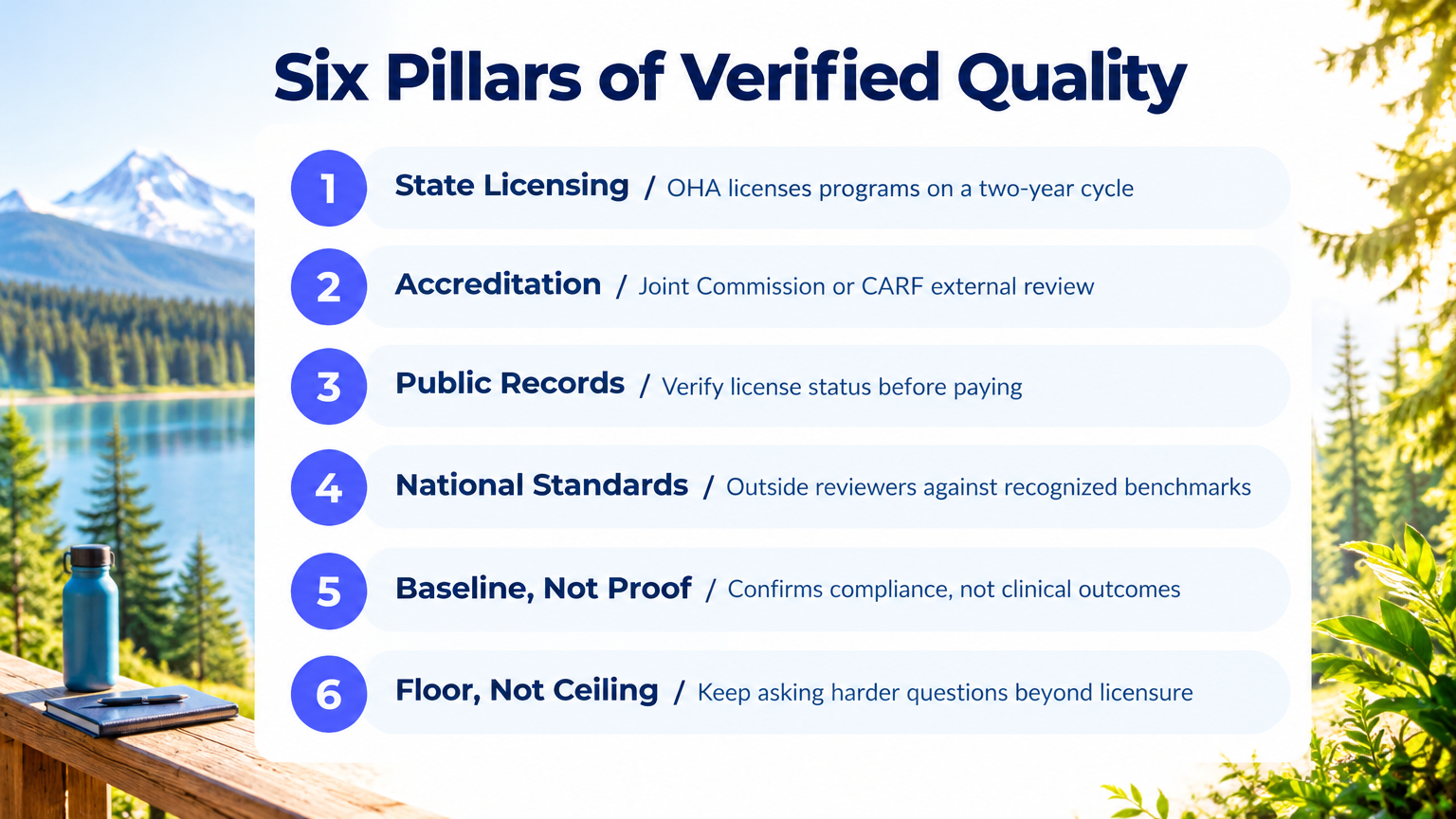
Marketing claims are easy. Licensing is a public record. In Oregon, residential substance use disorder programs are licensed through the Oregon Health Authority's Licensing and Certification Unit, which licenses programs on a two-year cycle with additional inspections possible 8. You can look up a program's current license status directly through OHA before you ever write a check.
Accreditation adds another layer. The Joint Commission and CARF are the two names you'll see most often, and both involve outside reviewers evaluating a program against national standards. Neither accreditation guarantees a specific outcome for a specific person, but together with state licensing they tell you the program is operating inside recognized boundaries of care.
One honest caveat: licensure confirms regulatory compliance. It doesn't by itself prove clinical outcomes, quality of relationships between staff and clients, or amenity level 8. Use licensing as a floor, not a ceiling. If a program isn't licensed in the state where it operates, stop there. If it is licensed and accredited, you've cleared the baseline and can keep asking harder questions about the rest of the rubric.
Continuity of Care From Detox Through Recovery Housing
Addiction treatment that ends abruptly tends to unwind. NIDA names continuing care as one of the principles that distinguishes programs that work from ones that look good on paper 1. A premium program should be able to draw you a map, step by step, from the first phone call through the first year of recovery.
That map usually includes medically supervised detox when it's needed, often through a partner provider rather than the same facility that runs the residential or outpatient program. From detox, the path moves into residential care, intensive outpatient, or standard outpatient depending on clinical fit. From there, structured sober living extends the recovery environment while someone returns to work, school, or family life. Alumni groups, continuing therapy, and recovery-support meetings carry it forward.
Ask the program two concrete questions. First: who do you partner with for detox, and how does the handoff work? Second: what happens on day 31, or day 91, when the main program ends? If the answer is a shrug and a brochure, that's a gap. If it's a specific recovery housing option, a step-down IOP schedule, and a named alumni contact, that's continuity.
Transparent Cost and Access Under 2024/2025 Parity Rules
Money is one of the hardest parts of this search, and premium programs should talk about it clearly rather than hiding costs behind a form. Federal parity rules updated in 2024 strengthened protections for mental health and substance use coverage, and most provisions apply to plan years beginning on or after January 1, 2025 7. The rules require health plans to evaluate how nonquantitative treatment limitations, like prior authorization or medical necessity reviews, affect access to care, and to make changes when data shows the limits create unequal access compared to medical and surgical benefits 7.
What parity doesn't do: it doesn't force insurers to cover every program or every length of stay. Medical necessity criteria, in-network status, deductibles, and plan terms still shape what you'll actually pay. A premium program should walk you through whether they take your plan, what single-case agreements look like if they don't, and what the private-pay options cover.
Residential vs. Intensive Outpatient: Choosing by Clinical Need
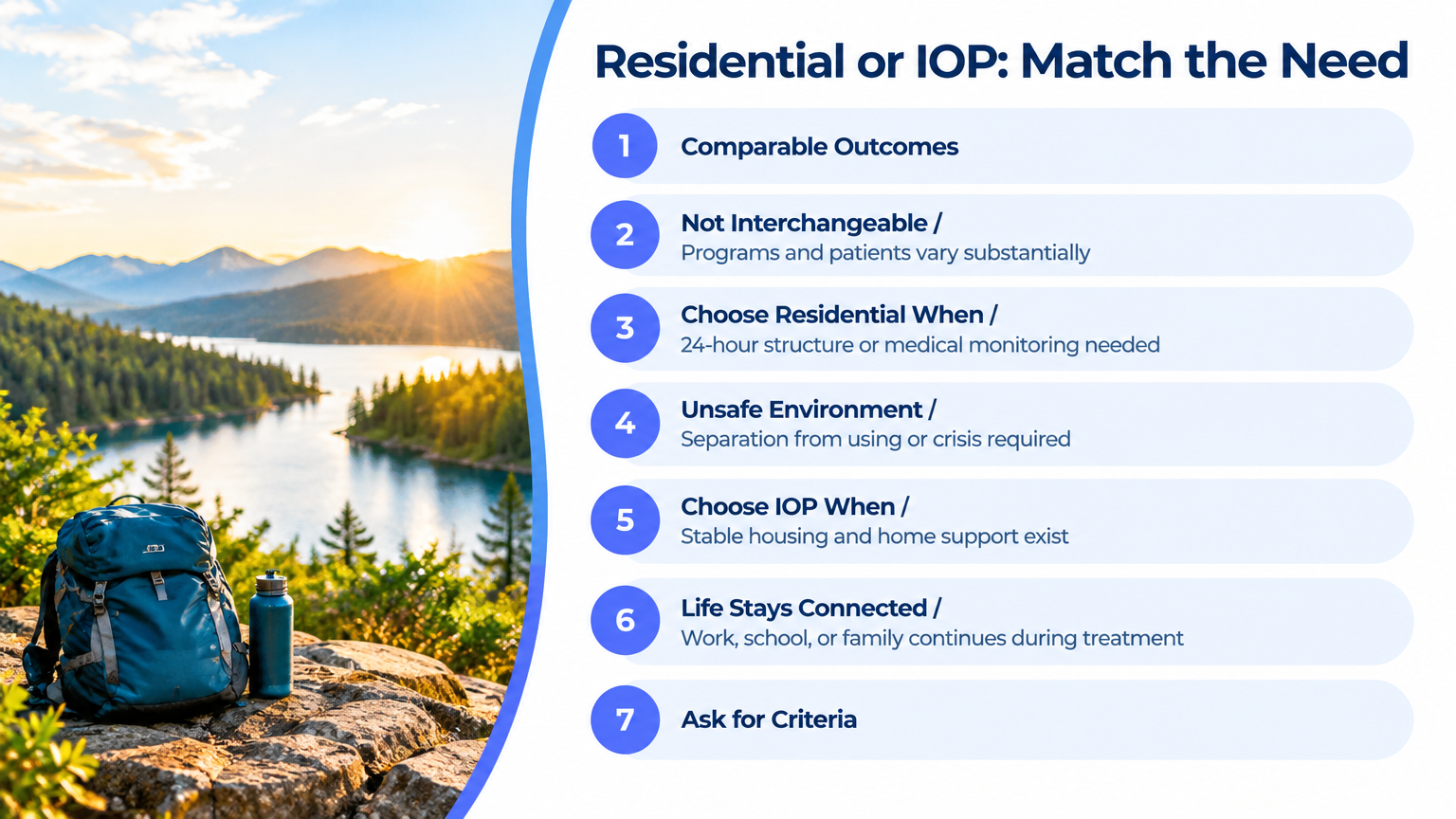
One of the biggest mistakes families make while comparing high-end options is assuming that longer residential stays automatically beat intensive outpatient. The honest picture is more interesting. A peer-reviewed review of IOP research found that multiple randomized and naturalistic studies reported comparable outcomes for intensive outpatient and inpatient or residential care, with reductions in alcohol and drug use across studies. The review also noted that IOP definitions, service components, patient populations, and outcome measures varied substantially, so these findings do not mean the two settings are interchangeable for everyone 4.
What that evidence actually tells you is this: the right level of care is the one that matches the person in front of you, not the one with the nicer brochure. Residential care earns its weight when someone needs 24-hour structure, medical monitoring, separation from a using environment, or protection from a crisis that outpatient hours cannot contain. IOP earns its weight when someone has a stable, safe place to sleep, enough support at home, and a life (work, school, kids) that benefits from staying partly connected during treatment.
Ask any premium program how they decide, case by case, between the two. If they can describe clinical criteria rather than a default, you're talking to the right people.
Why Verified Availability Matters in Oregon and the Pacific Northwest
Here's a reality that doesn't show up in brochure photos: Oregon doesn't have enough residential substance use treatment beds to meet the need. OHA's 2024 Behavioral Health Residential+ Facility Study reported 1,374 SUD residential treatment beds across the state against a projected statewide need of approximately 3,775 beds under its updated forecast 2. That's a gap wide enough to shape what your search actually feels like, even at the premium end of the market. The study measured statewide capacity against a planning forecast, not individual-level demand on any given week, but the direction of the gap is real.
Oregon lawmakers responded. The 2025 End-of-Session Legislative Report documents HB 2059's $65 million appropriation to increase adult residential behavioral-health capacity, with an estimated 196 new beds and preservation of more than 100 existing beds 3. That's meaningful. It also takes time. New beds have to be built, staffed, licensed, and brought online, and statewide investment doesn't automatically translate into a bed waiting for your family member this month at the specific private-pay program you're considering.
What this means for you, practically, is that verified availability belongs on your comparison list alongside clinical quality. When you call a program, ask three things: do you have current availability, what does your waitlist actually look like, and if you're full, who do you refer out to that meets similar standards? A premium program that is honest about capacity is more useful than one that promises a bed and strings you along. The same question applies if you're calling from Washington or traveling into the Pacific Northwest for care—regional capacity shapes what's realistically available, and a program willing to say "not this week, try these two" is doing you a bigger favor than one that keeps you waiting.

What a Real Continuum of Care Looks Like
A real continuum isn't a brochure diagram. It's a sequence where each handoff is already planned before the person needs it, so nobody falls through a gap on a Friday afternoon. Picture it as five connected stages: assessment, medically supervised detox when it's clinically needed, residential or intensive outpatient care, structured sober living, and ongoing outpatient support with alumni and recovery community involvement.
The first thing to notice is that detox is often provided through a partner program rather than the same facility running residential or outpatient care. That's not a weakness. It's a specialization. The right question is whether the partnership is formal, whether the clinical records travel with the person, and whether an intake slot is already held on the other side.
From there, residential or intensive outpatient covers the main treatment work using trauma-informed, evidence-based therapies such as CBT, DBT, and Seeking Safety for trauma-affected clients. Structured sober living extends the recovery environment while someone returns to work or school, and recovery housing outcomes vary by model and population, so ask what model they use and what support is built in 5. Ongoing outpatient, alumni groups, and community recovery meetings carry the first year forward. A premium program should name every stage, name the partners, and name the person responsible for each handoff.
Scripted Vetting Questions for Any Admissions Call
Admissions calls are designed to sound reassuring. Your job is to walk away with specific answers, not warm feelings. Keep this list on a notepad and ask every program the same questions so you can compare apples to apples.
On clinical fit: What does your assessment process look like, who conducts it, and how do you decide between residential, partial hospitalization, intensive outpatient, and standard outpatient? Will you tell me honestly if someone needs more or less structure than you offer?
On therapy: Which evidence-based models do your clinicians use by name, and how many structured clinical hours happen each week? Who provides individual therapy, and what's their credential?
On co-occurring care: How do you handle depression, anxiety, PTSD, or bipolar disorder alongside substance use? Who prescribes and manages psychiatric medication, and what's your referral pathway if someone needs that level of care 1?
On licensing and accreditation: What's your current state license number and accrediting body, so I can verify both before admission 8?
On continuity: Who do you partner with for detox, and what happens on the day the main program ends? Is there a named sober living option and a step-down IOP schedule already mapped out?
On cost and access: Walk me through what my plan covers, what single-case agreements look like, and what private-pay includes. If a program dodges any of these, that's your answer.
Reading Outcome Claims Without Getting Fooled
Watch for the glossy success rate on a program's homepage. A "78% success rate" sounds impressive until you ask what it measures. A 2025 systematic review of substance use disorder treatment outcomes found that studies differ widely in how they define retention, abstinence, relapse, functioning, and follow-up timing 6. That makes provider-to-provider comparisons unreliable, even when every program sounds confident.
Ask three questions when you see an outcome claim. What exactly was measured, like 30-day abstinence, 90-day retention, or self-reported wellbeing? Who was included, and who dropped out before the data was collected? How long after discharge was the follow-up, and who paid for the study?
A program that answers plainly, including the limits of its own data, is telling you something more valuable than a percentage. A program that waves the number without context is selling you one. The honest truth is that no reputable provider can guarantee sobriety, and anyone who implies otherwise has stopped doing clinical work and started doing marketing.
For Family Members: Love With an Edge When You're Comparing Programs
If you're the parent, spouse, or sibling making these calls while someone you love is in crisis, this part is for you. The search is exhausting, and the ambivalence on the other end of it can feel like a moving target. You get to be tired. You also get to be clear-eyed.
Love with an edge means two things at once. First, you treat the person you love like a whole human being, not a project to be fixed by the most expensive brochure you can find. Second, you stop confusing comfort with care. A beautiful setting that lets your person coast through group therapy, skip the hard conversations, and come home unchanged isn't love. It's a very nice version of enabling.
Use the rubric. Ask the scripted questions. Compare clinical fit, not thread count. If a program promises a cure, a guaranteed outcome, or a timeline that lines up suspiciously well with your insurance limit instead of clinical need, keep looking. And protect yourself along the way. Your own therapy, a family support group, and a few honest friends are not optional extras. They're how you stay standing long enough to be useful.
A Next Step That Respects How Hard This Search Is
You started this search because someone's life is on the line, maybe your own, and you deserve more than a brochure. The rubric you've just read is the same one an experienced counselor would use at a kitchen table: match the level of care to real clinical need, verify licensing, insist on evidence-based therapy, plan the continuum from the first call forward, and talk honestly about money.
If you're ready to talk through what fits, Oregon Trail Recovery is here when you're ready. One honest conversation beats another week of comparison tabs. The trail forward starts with a phone call.
Frequently Asked Questions
What actually makes drug treatment "high end"?
Clinical quality you can verify, not amenities. A genuinely upscale program matches level of care to real need, uses evidence-based therapies by name, supports co-occurring mental health challenges honestly, holds current licensing and accreditation, plans the continuum from detox through recovery housing, and talks straight about cost. Nice rooms are fine. They're not what changes a life 1.
Is residential treatment always better than intensive outpatient?
No. A peer-reviewed review found comparable outcomes between IOP and inpatient or residential care for appropriately selected patients, though definitions and populations varied 4. Residential earns its weight when someone needs 24-hour structure or separation from a using environment. IOP fits when home is stable and work, school, or family connection supports recovery.
How do I verify that an Oregon addiction treatment program is properly licensed?
Check the Oregon Health Authority's Licensing and Certification Unit directly. OHA licenses residential substance use disorder programs on a two-year cycle, with additional inspections possible 8. Ask the program for its current license number and accrediting body, then confirm both before admission. Licensure is your floor, not your ceiling, so keep asking about clinical quality.
Can insurance cover a premium or private-pay program under parity rules?
Sometimes, but parity doesn't force every plan to cover every program. The 2024 federal rules strengthened protections around nonquantitative treatment limitations like prior authorization, with most provisions applying to plan years starting January 1, 2025 7. Medical necessity, in-network status, and plan terms still shape your out-of-pocket cost. Ask about single-case agreements and private-pay options.
How should a program handle co-occurring mental health challenges?
With real clinical honesty. NIDA treats co-occurring conditions as a core principle of effective care 1. A quality addiction program uses trauma-informed therapies like Seeking Safety and refers out to licensed psychiatric providers for medication management or complex diagnosis. That referral pathway is a feature. If anyone is having thoughts of suicide, call or text 988 right away.
What questions should I ask during an admissions call?
Ask how they assess level-of-care fit, which evidence-based therapies clinicians use by name, how they handle co-occurring mental health concerns, their current license and accreditation, who they partner with for detox, what sober living and step-down look like, and exactly what your plan covers. If a program dodges any of these, keep looking.
References
- Principles of Drug Addiction Treatment: A Research-Based Guide. https://www.nida.nih.gov/sites/default/files/podat-3rdEd-508.pdf
- Oregon Behavioral Health Residential+ Facility Study. https://www.oregon.gov/oha/HSD/AMH/DataReports/Behavioral-Health-Residential-Facility-Study-June-2024.pdf
- 2025 End-of-Session Legislative Report - Oregon.gov. https://www.oregon.gov/oha/ERD/Documents/OHA-2025-End-of-Session-Legislative-Report.pdf
- Substance abuse intensive outpatient programs: assessing the evidence. https://pubmed.ncbi.nlm.nih.gov/24445620/
- Recovery housing for substance use disorder: a systematic review. https://pmc.ncbi.nlm.nih.gov/articles/PMC11922849/
- Substance Use Disorder Treatment Outcomes. https://pmc.ncbi.nlm.nih.gov/articles/PMC12180564/
- Departments of Labor, Health and Human Services, Treasury Issue Final Rules Strengthening Access to Mental Health and Substance Use Disorder Care. https://www.cms.gov/newsroom/press-releases/departments-labor-health-and-human-services-treasury-issue-final-rules-strengthening-access-mental
- Oregon Health Authority : Residential Treatment Facilities. https://www.oregon.gov/oha/hsd/amh-lc/pages/rt.aspx
Real Recovery Starts in Portland, Oregon
Call now or verify insurance to take the first step toward lasting recovery in Portland.
Relapse Doesn't Mean the End Of Your Journey
Reach out today to explore programs that support real, long-term sobriety.