




Fentanyl Detox Near Me in Portland, OR

Key Takeaways
- Fentanyl lingers in the body far longer than heroin or oxycodone, so plan for a seven-to-ten-day Portland detox stay rather than the older three-to-five-day window.1
- Ask any facility how they handle buprenorphine induction for fentanyl specifically, since precipitated withdrawal risk means standard protocols often need higher doses, longer waits, or micro-induction.9
- Oregon's HB 4002 blocks prior authorization for opioid use disorder medications on public plans and requires early-refill coverage, removing a major friction point between detox discharge and ongoing care.7
You're making the call today—here's what actually happens next
You've already done the hard part. You've stopped Googling long enough to pick up the phone, or you're about to. Whether you're the person using fentanyl and finally ready, or the family member who has been holding this together for months, the next few hours matter more than the last few weeks did.
Here's what a good fentanyl detox in Portland actually does: it stabilizes someone through the acute withdrawal window under medical supervision, starts medication for opioid use disorder in-house, and hands them off to ongoing care before discharge. That last piece is the whole game. A study out of Boston University found that people who started buprenorphine during detox and were linked directly to primary-care-based treatment were less likely to use opioids illicitly over the following six months and more likely to stay in treatment. Detox alone doesn't hold. Detox as day one of a longer plan does.3
Portland's landscape has shifted in your favor since 2024. Oregon's HB 4002 removed prior authorization for medications like buprenorphine and methadone, and state investments have expanded withdrawal management capacity. You're walking into a system that's finally catching up. This piece walks you through what to expect, what to ask, and how to line up a bed this week.7,8
Why fentanyl changes the detox math
Prolonged clearance and what it means for length of stay
Here's the thing nobody tells families upfront: fentanyl doesn't leave the body on the same schedule as heroin or prescription oxycodone. It lingers in fatty tissue and keeps showing up on urine screens well past the point where you'd expect withdrawal to be winding down.
An inpatient cohort study of people admitted for opioid withdrawal found that individuals who tested positive for fentanyl at admission continued to test positive for an average of 7.46 days. That's a specific finding from a specific inpatient population under medical stabilization, not a universal law—but it maps closely to what Portland detox teams see in practice. Interestingly, the same study found that standardized withdrawal scores (using the Clinical Opioid Withdrawal Scale) didn't differ dramatically between fentanyl-positive and fentanyl-negative admissions. The symptoms your loved one feels may not be worse on paper. They just last longer.
What this means for you, practically: a detox stay for someone using fentanyl often runs longer than the three-to-five-day timelines older brochures still quote. Plan for a full week to ten days in the bed, with the acute peak somewhere in days two through four and lingering discomfort trailing into the second week. That extra time is not wasted. It's the window where medication gets started, dosed, and stabilized before your loved one walks out the door. Rushing discharge to hit an older benchmark is how people end up back where they started.
Buprenorphine induction is harder—and why that matters at intake
Buprenorphine is the medication most detox programs will want to start your loved one on. It works. It cuts cravings, blocks other opioids from getting a foothold, and holds people through the messy first weeks. But starting it with someone who has been using fentanyl is trickier than starting it with someone coming off heroin or pills.
The problem is called precipitated withdrawal. Buprenorphine can knock other opioids off their receptors, and if it's given too early—while fentanyl is still saturating the system—it can trigger a sudden, brutal withdrawal that feels worse than what the person was already going through. Clinicians describe fentanyl's high potency and rapid onset as posing unique challenges for buprenorphine induction, sometimes requiring higher doses, longer waits before the first dose, or alternative approaches like micro-induction.9
Why does this matter when you're calling around? Ask whether the facility has protocols specifically for fentanyl induction. A team that says "we start bup on day two, standard" without asking about fentanyl use is behind the curve. A team that talks about waiting for withdrawal scores to reach a certain threshold, or mentions micro-induction, or has a medical director actively adjusting protocols for high-potency synthetic opioids—that's who you want. This one question tells you a lot about whether the program has updated its playbook for what's actually in the Portland drug supply right now.
Polysubstance is the rule, not the exception
The fentanyl your loved one is using probably isn't just fentanyl. It rarely is anymore.
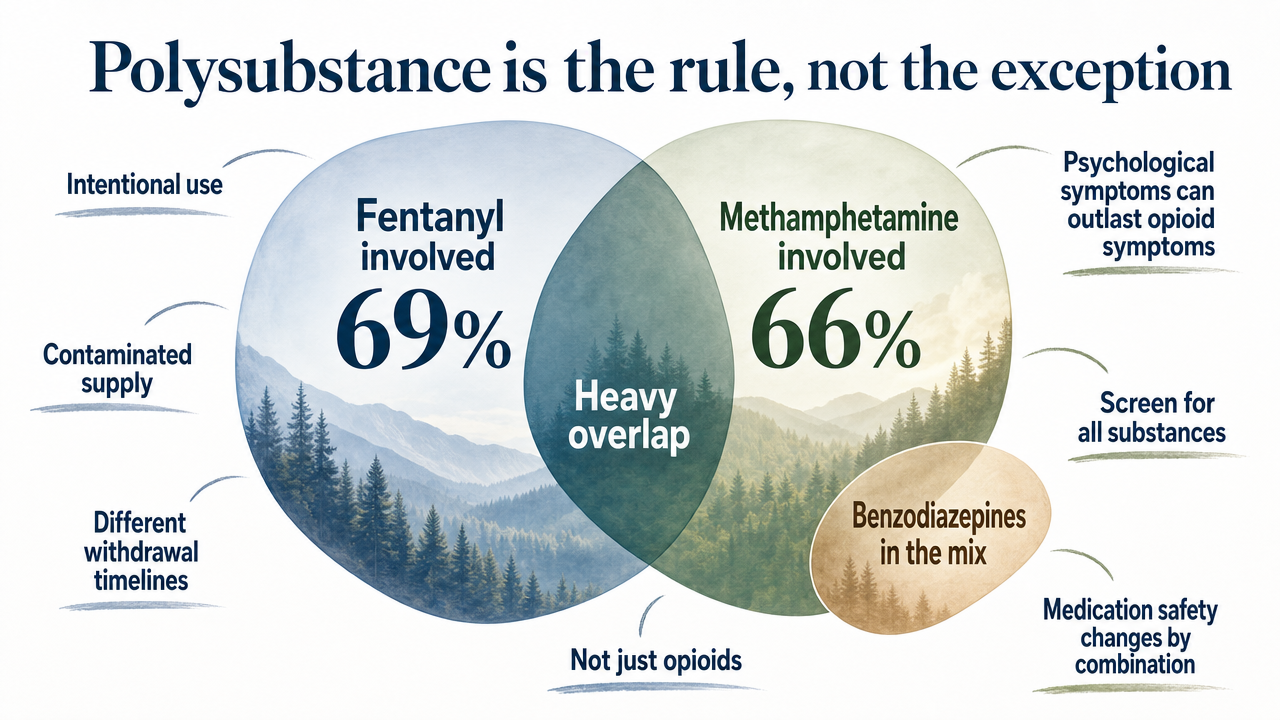
Oregon's 2024 overdose data tells the story bluntly: fentanyl was involved in 69% of overdose deaths that year, and methamphetamine was involved in 66%. Those numbers overlap heavily. People are using both, sometimes intentionally, sometimes because the supply is contaminated. Benzodiazepines show up in the mix too, and each combination changes what withdrawal looks like and what medications are safe to start.6
A good Portland detox intake will screen for all of it—not just opioids. If your loved one has been using meth alongside fentanyl, the crash on the stimulant side happens on a different timeline than opioid withdrawal, and the psychological piece (depression, fatigue, sleep disruption) can outlast the opioid symptoms by weeks. If benzodiazepines are in the picture, that's a medical situation of its own, because benzo withdrawal can cause seizures and needs its own taper plan running parallel to the opioid protocol.
When you call, be honest about everything your loved one is using, even if you're guessing. The intake team can't build a safe plan around information they don't have. Withholding to protect someone from judgment is the one thing that actually puts them at more risk in the first 48 hours.
Why access looks different in Portland right now
If you tried to get a loved one into detox in Portland two or three years ago, you probably ran into a wall of prior authorizations, waitlists, and case managers explaining that the medication your loved one needed wasn't covered until someone signed off. That system has changed materially in the last eighteen months, and it's worth knowing what's different before you start dialing.
Oregon's overdose deaths dropped 22% between December 2023 and December 2024, according to provisional CDC data cited by the Oregon Health Authority. That's not the end of the crisis—deaths are still well above pre-pandemic levels—but it's the first real downward move in years, and the state credits a mix of expanded treatment infrastructure, naloxone distribution, and shifts in the drug supply. On the capacity side, OHA reports 260 beds dedicated to substance use disorder treatment and 41 beds dedicated to withdrawal management currently in development across the state. Those beds aren't all in Portland, and they aren't all open yet, but the pipeline is real.8
The bigger change for your phone calls this week is HB 4002. Passed in 2024, the law prohibits coordinated care organizations and public payers from requiring prior authorization for reimbursement of FDA-approved medications for substance use disorders. In plain terms: your loved one's Oregon Health Plan or commercial insurance can't make them wait for a bureaucratic signoff before starting buprenorphine or methadone. The law also broadens the definition of medication-assisted treatment and requires coverage of early refills that pharmacists can dispense. That matters because the friction point that used to derail people between detox discharge and their first outpatient appointment—running out of medication over a weekend—now has a legal fix behind it.7
None of this means a bed is guaranteed the day you call. It does mean the ground has shifted. When you're asking a facility about medication access, insurance holdups, or refill continuity, you're now asking about things the state has taken sides on. That's leverage you didn't have before.
What the first 72 hours in a Portland detox bed actually look like
Intake, screening, and stabilization
The first few hours are less dramatic than you might be picturing. Your loved one arrives, gets checked in, and sits with a nurse and usually a medical provider who runs through a full screening: what they've been using, how much, how recently, what else is in their system, medical history, mental health history, any medications they take, any prior detox attempts. Bring what you know. If your loved one is too sick or too scared to answer clearly, your notes matter.
Vitals come next—blood pressure, heart rate, temperature—along with a urine drug screen and a withdrawal assessment using the Clinical Opioid Withdrawal Scale. That score guides what happens in the next several hours. The team is looking at whether your loved one is already in withdrawal, still comfortable, or somewhere in the middle where medication timing gets tricky. Sedatives, benzodiazepines, and alcohol history get flagged here because those change the safety picture in ways opioids alone don't.
Stabilization in the first day usually means fluids, anti-nausea medication, something for muscle aches, and a quiet room. The clinical goal isn't to fix everything at once. It's to get your loved one safe, oriented, and physically stable enough that the real work—starting maintenance medication—can begin on the right timeline.
Starting medication in-house, not at discharge
This is the piece that separates a detox that holds from a detox that doesn't. Medication for opioid use disorder—buprenorphine or methadone—needs to start while your loved one is still in the bed, not handed to them as a prescription on their way out the door.
With fentanyl, the timing is the hard part. Because fentanyl lingers in the system longer than other opioids, the team can't just wait a standard 12 to 24 hours and dose. They watch the withdrawal score climb, they look at how the person is presenting, and they make a judgment call. Some Portland programs use a traditional induction once the score hits a specific threshold. Others use micro-induction, starting with very small doses of buprenorphine while your loved one is still technically on fentanyl, then building up. Both approaches are on the table because fentanyl's pharmacology creates real challenges for standard buprenorphine induction protocols.1,9
Methadone is the other path, particularly for people who have tried buprenorphine and struggled with it, or whose tolerance is high enough that buprenorphine won't hold them. Methadone requires enrollment in an opioid treatment program, which the detox team will start setting up during the stay so the first outpatient dose is waiting on the day of discharge. That handoff is not optional. A person walking out of detox without their first maintenance dose already lined up is walking out into the same risk they came in with.
Symptom management beyond the medication
Buprenorphine or methadone does the heavy lifting on cravings and the deeper opioid symptoms, but it doesn't touch everything. The first three days still involve real discomfort, and a good Portland program treats each piece.
Expect the team to have standing orders for the muscle aches, the restless legs, the stomach cramps, the diarrhea, the sweating, and the insomnia. Clonidine helps with the autonomic symptoms—the racing heart, the sweating, the anxiety spikes. Anti-nausea medication makes the difference between your loved one being able to keep fluids down or ending up on an IV. Sleep is its own battle in early withdrawal, and non-habit-forming options are used because adding a benzodiazepine to someone coming off opioids creates a new problem.
The emotional piece matters just as much. Your loved one is going to feel raw, ashamed, angry, and scared, sometimes all in the same hour. A program with peer support staff, counselors doing brief check-ins, and nurses who don't treat withdrawal as a moral event is doing more clinical work than it looks like from the outside. That environment is what makes day three survivable.
Real Recovery Starts in Portland, Oregon
Call now or verify insurance to take the first step toward lasting recovery in Portland.
Detox is day one, not the finish line
Here's the honest part. A week in a detox bed can get your loved one physically stable and started on medication, but it does not, by itself, treat opioid use disorder. What happens in the 48 hours after discharge determines whether the stay was a real turning point or an expensive pause.
The evidence on this is unusually direct. In the Boston University study cited earlier, people who started buprenorphine during detox and were handed directly to primary-care-based treatment were less likely to use opioids illicitly over the next six months and more likely to stay engaged in care. The buprenorphine mattered. The warm handoff mattered more. People who left with a prescription and a phone number did worse than people who left with an appointment already on the calendar and a provider who knew their name.3
What this looks like in Portland: before your loved one is discharged, the detox team should have booked the first outpatient appointment, confirmed the pharmacy has the medication ready, and ideally introduced the outpatient provider by phone or video while your loved one is still in the bed. If residential treatment is the next step—which it often is for someone who has been using fentanyl heavily—the bed at the next facility should be confirmed before the current one is vacated. No gaps. No "call us Monday."
Ask about this at intake, not at discharge. "What does the handoff look like on day seven?" is the question that separates a program running a revolving door from a program running a bridge.
How to line up a bed this week
What to have ready when you call
Intake teams can move faster when you walk in prepared. Before you dial the first number, write down what you know so you're not fumbling while a nurse is trying to triage.
Have your loved one's full legal name, date of birth, and current address. Note their insurance carrier and member ID, or confirm they have Oregon Health Plan coverage. Write down what they've been using—fentanyl, yes, but also anything else you know or suspect: methamphetamine, benzodiazepines, alcohol, prescription pills. Include rough amounts and how recently they last used. List any medical conditions, current medications, mental health diagnoses, and prior detox or treatment attempts. Note allergies.
Have a phone number where your loved one can be reached and a plan for who is driving them to intake. Ask the facility upfront these four questions that filter out programs that aren't equipped for what fentanyl actually requires:
- When is the earliest bed available?
- Is a medical provider on-site 24/7?
- What medications for opioid use disorder do they start in-house?
- What does the discharge handoff to outpatient care look like?
Insurance, MOUD coverage, and what HB 4002 changed
The insurance conversation used to be the place where families lost days. Not anymore, at least not for the medication piece. Oregon's HB 4002 prohibits coordinated care organizations and public payers from requiring prior authorization for reimbursement of FDA-approved medications for substance use disorders. If your loved one is on Oregon Health Plan and someone tells you buprenorphine or methadone needs a signoff before it can be started or refilled, that's a claim worth pushing back on.7
The law also mandates coverage of early refills for opioid use disorder medications that pharmacists can dispense. Ask the detox program how they coordinate with a receiving pharmacy so your loved one doesn't hit a Sunday-night gap between doses.7
For commercial insurance, verify in-network status for both the detox facility and the outpatient provider taking the handoff. Confirm whether the plan requires any pre-certification for the residential portion, even though the medication itself no longer does. If a plan denies the detox stay, ask the facility's admissions team about single-case agreements or self-pay bridge options while an appeal runs.
If your loved one is ambivalent
Ambivalence is the norm, not the exception. Very few people arrive at detox certain. Most arrive scared, exhausted, half-in and half-out—and that's still enough to work with.
What you're aiming for is a small window of agreement, not a permanent conversion. If your loved one says yes today and might say no tomorrow, today is when the intake call happens. Meet them where they are: acknowledge that stopping fentanyl is one of the hardest things a body can do, that the medical team's job is to make withdrawal survivable, and that walking in the door doesn't mean signing away control of the rest of their life.
Structured interventions can help when repeated conversations aren't landing. Trained interventionists use models designed to lower defensiveness and get to a concrete next step in one sitting. If you've been circling this for months and losing ground, that's a signal to bring in help rather than run another kitchen-table conversation.
One caution: don't oversell what detox does. Framing it as a cure sets up disappointment. Framing it as a supervised week to get physically stable and start medication, followed by real ongoing treatment, is honest and actually easier to say yes to.
Before the call: keeping the person alive tonight
If your loved one is still using while you're reading this, tonight is its own problem. Detox intake happens tomorrow. Staying alive happens now.
Have naloxone in the house and in a bag by the door. Fentanyl reversals often take more than one dose because of how potent the drug is—clinical reviews specifically note that with high-potency opioids like fentanyl, more than one naloxone dose may be needed to restore breathing. Two doses minimum within reach. Know how to use it before you need it.4
Ask your loved one not to use alone. If they're going to use anyway, someone sober in the next room, a phone unlocked, the door unlocked. Never Use Alone hotlines exist for exactly this reason. Sleeping on their side, not their back, matters. So does not mixing with benzodiazepines or alcohol tonight, even if that's part of the pattern—the combination is what kills people between the decision to get help and the moment they walk through the door.
You are not enabling by keeping them breathing until intake. You are buying the next 24 hours. That's the only job tonight.
The next step from here
You know what you need now. A bed with 24/7 medical coverage, a team that has updated its buprenorphine induction protocol for fentanyl, and a discharge plan that hands your loved one to outpatient or residential care with the first appointment already booked. Nothing less than that holds.
Make the call today, even if today feels imperfect. Ask the four questions from earlier: earliest bed availability, on-site medical coverage, in-house medication for opioid use disorder, and what the day-seven handoff looks like. If you're in the Portland area and want a single starting point that coordinates detox through Pacific Crest Trail Detox and ongoing outpatient or residential care through Oregon Trail Recovery, reach out. One call, one warm handoff, no revolving door.
Frequently Asked Questions
How long does fentanyl detox actually take in Portland?
Plan for seven to ten days in the bed, not the older three-to-five-day window. An inpatient cohort study found people testing positive for fentanyl at admission continued to test positive for about 7.46 days on average. The acute peak lands around days two through four, with medication stabilization filling the rest of the week.1
Can we get a detox bed this week, or is there a waitlist?
Availability shifts daily, so call now rather than tomorrow. Oregon has 41 withdrawal management beds currently in development on top of existing capacity, and intake teams can often place someone within 24 to 72 hours. Ask directly: what's the earliest bed, and can you hold it while transportation gets arranged?8
Will insurance cover fentanyl detox and medication for opioid use disorder in Oregon?
For Oregon Health Plan and public payers, HB 4002 prohibits requiring prior authorization for FDA-approved medications for substance use disorders, and mandates coverage of early refills pharmacists can dispense. Commercial plans vary, so verify in-network status for the detox facility and the outpatient provider taking the handoff before admission.7
Why is buprenorphine induction harder with fentanyl?
Fentanyl's high potency and rapid onset create unique challenges for standard buprenorphine induction, sometimes triggering precipitated withdrawal if dosed too early. Programs may use higher doses, longer waits, or micro-induction protocols. Ask any facility how they handle induction for people using fentanyl specifically—the answer tells you if their playbook is current.9
What happens after detox ends—does my loved one just come home?
Coming straight home without ongoing care is the pattern that fails. Research shows people who start buprenorphine during detox and are linked directly to primary-care-based treatment use opioids less and stay in care longer at six months. Expect a handoff to outpatient or residential treatment with the first appointment already booked.3
What if my loved one isn't fully ready to stop using?
Full readiness is rare. Most people arrive scared and ambivalent, and that's still enough to start. Aim for one small window of agreement today rather than a perfect conversion. If repeated conversations aren't moving anything, a trained interventionist can help reach a concrete next step in one sitting without escalating defensiveness.
References
- Fentanyl Withdrawal: Understanding Symptom Severity and Onset. https://pmc.ncbi.nlm.nih.gov/articles/PMC9992259/
- The Evolving Overdose Epidemic: Synthetic Opioids and Rising Stimulant-Related Deaths. https://pmc.ncbi.nlm.nih.gov/articles/PMC9200066/
- Instead of Opioid Detox ‘Revolving Door,’ a ‘Bridge’ to Long-Term Treatment. https://www.bu.edu/sph/news/articles/2019/instead-of-opioid-detox-revolving-door-a-bridge-to-long-term-treatment/
- The Changing Opioid Crisis: Development, Challenges and Responses. https://pmc.ncbi.nlm.nih.gov/articles/PMC7398847/
- Tapering and Withdrawing Opioids: Guidance Informed by a Rapid Review and Expert Consensus. https://pmc.ncbi.nlm.nih.gov/articles/PMC12579163/
- Annual Report: Oregon Substance Use and Overdose Prevention Coordination in Funded Regions, Sept 2024–Aug 2025. https://www.oregon.gov/oha/PH/PREVENTIONWELLNESS/SUBSTANCEUSE/OPIOIDS/SiteAssets/Lists/FentanylFactsAccord/AllItems/Annual%20Report%20Oregon%20Substance%20Use%20and%20Overdose%20Prevention%20Coordination%20in%20Funded%20Regions%20September%202024%20-%20August%202025.pdf
- Oregon Laws 2024, Chapter 70 (HB 4002): Relating to the addiction crisis. https://www.oregonlegislature.gov/bills_laws/lawsstatutes/2024orLaw0070.pdf
- Oregon overdose deaths are down, CDC data shows. https://www.oregon.gov/oha/erd/pages/oregon-overdose-deaths-are-down-cdc-data-shows.aspx
- Fentanyl and the Evolving Opioid Epidemic: Considerations for Treatment. https://www.ncbi.nlm.nih.gov/pmc/articles/PMC8266649/
Relapse Doesn't Mean the End Of Your Journey
Reach out today to explore programs that support real, long-term sobriety.