


How to Make Addiction Treatment Referrals: Next Steps

Key Takeaways
- A strong addiction treatment referral is active linkage, not a handoff — you stay engaged through the first call, the first appointment, and the weeks that follow 9.
- Check safety first: naloxone for opioid risk, medical detox for heavy alcohol or benzodiazepine use, and 988 or the ER for acute suicide risk before any treatment referral.
- Open the conversation in a sober moment with what you've noticed and how you feel, then let silence do the work instead of pushing past a no.
- Match the person to the right level of care by gathering use history, co-occurring mental health needs, insurance, and transportation before narrowing providers 1.
- Get a valid 42 CFR Part 2 consent in writing before expecting any provider communication; the 2024 final rule allows one consent to cover ongoing treatment coordination 3, 4.
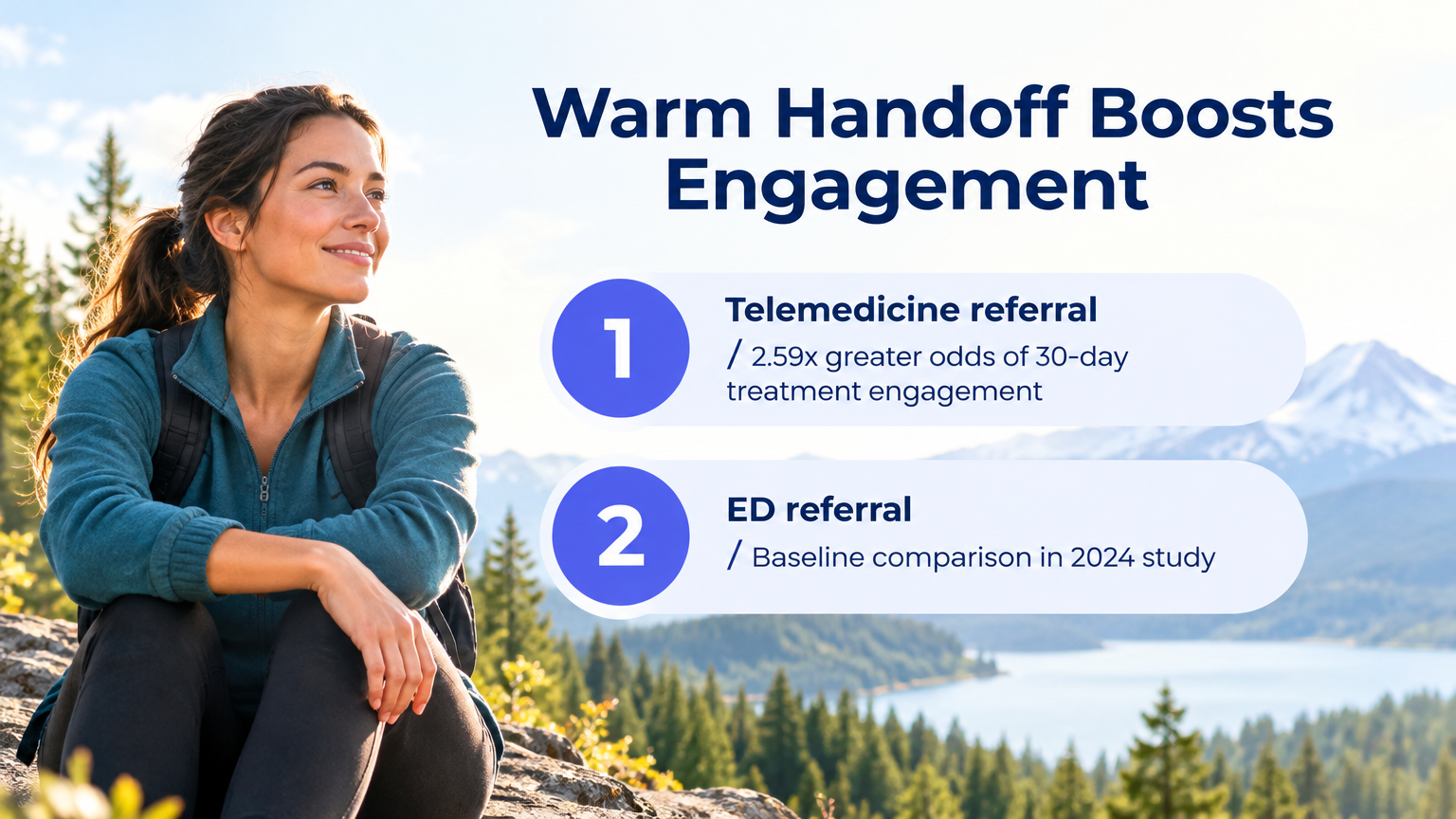
- Use a warm handoff — dial together, confirm the appointment, and consider telemedicine intake, which was associated with 2.59 times greater odds of 30-day engagement in one 2024 study 7.
- Keep following up for weeks after the referral; continued outreach more than doubled three-month treatment engagement compared with a one-time referral 5.
- Solve for the specific barrier in front of you — transportation, medication access, insurance, housing — rather than layering on generic navigation that research shows may not move the needle 6, 11.
What a Good Referral Actually Looks Like
A good addiction treatment referral is not a phone number scribbled on a napkin at 2 a.m. It's a relationship. You're not transferring a problem to someone else; you're walking alongside a person while they take the next hard step.
Picture the difference. A bad referral sounds like, "Here, call this place." A good one sounds like, "I found two programs that fit what you're dealing with. I'll sit with you while you call. I'll drive you Monday. I'll check in Thursday." One is a handoff. The other is a bridge.
SAMHSA TIP 35 describes active linkage and referral interventions as approaches that can enhance engagement and retention in substance use disorder treatment — meaning someone stays involved with the person until they're actually connected to care, and often beyond 9. AHRQ puts it the same way for clinical teams: referral is ongoing coordination, not a one-time transfer 10.
So what does a real referral include? A quick safety check. An honest conversation. A match between the person's needs and the right level of care. Proper consent before anyone shares records. A warm handoff to a specific provider. And follow-up in the days and weeks that follow. The rest of this guide walks you through each piece, in the order you'll actually use them.
Start With Safety Before Anything Else
Before you dial a single treatment center, pause and ask one question: is the person safe right now? Everything else in this guide waits until you have an honest answer.
Safety has a few specific faces. Overdose risk is the first. If the person is using opioids — prescription pills, heroin, or anything that might be mixed with fentanyl — they and the people around them need naloxone on hand, and they need to know how to use it. CDC guidance is direct about this: when someone is at elevated overdose risk, overdose education and naloxone belong in the same conversation as the referral itself, not weeks later 2. Put it in the glove box. Put it in the kitchen drawer. Then make the call.
The second face is withdrawal. For people with heavy daily alcohol use or regular benzodiazepine use, outpatient referral isn't the first stop — medical detox typically is. In the Portland area, that often means a partner program like Pacific Crest Trail Detox before any outpatient work begins.
The third is suicide. If the person has talked about ending their life, has a plan, or is in acute crisis, treat that first. Call or text 988 to reach the Suicide & Crisis Lifeline, or go to the nearest emergency department. A referral to addiction treatment can wait a few hours. A life cannot.
Once the person is physically safe and not in immediate crisis, you've earned the right to have the longer conversation.
The Conversation: What to Say When You Bring It Up
Opening the Door Without Shutting It
Pick a sober moment. Not after a blowup. Not at midnight. A Tuesday morning on the porch is better than a Saturday night in the kitchen.
Lead with what you've noticed and how you feel, not with what they've done wrong. "I've been worried about you, and I love you" lands differently than "You need to get help." The first opens a door. The second slams it. SAMHSA's TIP 35 calls this permission-based communication, and it's the backbone of motivational interviewing: you ask before you advise, you reflect before you push, and you treat the person as the expert on their own life 9.
A few phrases that tend to work:
- "Can I share something I've been sitting with?"
- "What's it been like for you lately?"
- "If you ever wanted help looking into options, I'd help you with that. No pressure, no timeline."
Then stop talking. Let the silence do some work. You are not there to win an argument. You are there to let the person know the door is open and that you'll walk through it with them when they're ready.
When They Say No, Not Yet, or Maybe
Most first conversations don't end with "Yes, book me a bed." They end with a shrug, a deflection, or a flat no. That's not failure. That's the normal shape of this.
If they say no, don't argue the point. Thank them for being honest. Say something like, "I hear you. I'm not going anywhere, and the offer stands." Then keep the relationship intact so they can come back to you later. Pressure tends to harden ambivalence; patience tends to soften it.
If they say maybe, that's a real opening. Ask what a next step the size of a phone call might look like. Offer to sit next to them while they make it. SAMHSA TIP 35 describes this kind of active linkage — staying engaged with the person until they're actually connected to care — as an approach that can improve engagement in treatment 9.
If they say not yet, ask what "yet" would look like. A rough week? A conversation with their doctor? A specific limit they haven't crossed? Naming the trigger gives both of you something concrete to watch for together.
Match the Person to the Right Level of Care
Treatment isn't one thing. Sending someone to the wrong level of care is almost as unhelpful as sending them nowhere. The goal is to match what the person is actually dealing with to what a specific program can actually do.
Here's a working map. Someone with milder alcohol use and no serious medical or mental health complications may do fine in primary care, with brief counseling and, where appropriate, medication. People with more severe symptoms, long use histories, or co-occurring mental health challenges usually need specialty behavioral and pharmacologic care — that's NIAAA's framing, and it holds up across substances 1. If daily life is still intact — a job, a safe place to sleep, people who can hold the person accountable — an intensive outpatient program often fits. If the home environment is the trigger, residential care gives distance and structure. If withdrawal is medically risky, detox comes first, and outpatient waits.
Before you narrow in, gather a few honest answers: What is the person using, how much, and how often? Any co-occurring depression, anxiety, or trauma? What does insurance actually cover? Is transportation reliable? Can the person step away from work, or do they need evening programming?
NIAAA's Alcohol Treatment Navigator is a solid starting point for vetting providers — credentials, services offered, payment options, and real availability, not just a slick website 1. For opioid use disorder, confirm the program offers or coordinates evidence-based medication; CDC guidance treats medication as the standard of care, not an optional add-on 2. Ask every program two concrete questions: how soon can you see them, and how do you handle co-occurring mental health needs? The answers tell you more than any brochure.
Consent and Privacy Under 42 CFR Part 2
Substance use disorder records sit under a stricter federal shield than most medical information. If you want a treatment program to talk with you — a parent, a spouse, a primary care doctor, an EAP contact — the person being referred almost always has to say yes in writing first. That rule lives in 42 CFR Part 2, and it exists because people avoid treatment when they fear their records will leak into a custody case, a job application, or a courtroom.
A valid Part 2 consent isn't a verbal "go ahead." The regulation spells out what has to be on the form: who the patient is, who's authorized to receive the information, exactly what information gets disclosed, the purpose of the disclosure, an expiration date or event, the patient's signature and date, and specific statements about redisclosure and the right to refuse 3. A generic hospital release you signed last year does not cover this. Ask the treatment program for their Part 2 consent form and have the person fill it out before you expect any back-and-forth about appointments, attendance, or progress.
Two practical moves. First, ask the person what they're comfortable sharing and with whom — don't assume. Second, keep a copy of the signed consent where you can find it. If a provider ever says, "I can't talk to you," you want to be able to answer, "Here's the consent on file," instead of starting over.
The Warm Handoff: Why the Access Channel Matters
A warm handoff is the moment the referral stops being an idea and becomes an actual connection to a human being. Instead of giving the person a number and hoping they call, you stay with them while the first contact happens. You dial the intake line together. You pass the phone to a scheduler who already knows the name. You confirm the time, the address, and who's driving.
CDC guidance names this directly: emergency departments improve linkage to care when referrals use a warm handoff and when higher-risk patients receive naloxone and overdose-response training before they walk out the door 2. The same principle holds in a living room. The handoff is a shared moment, not a text message sent into a void.
How the handoff happens also matters. In a 2024 observational study of patients with opioid use disorder, telemedicine referrals were associated with 2.59 times greater odds of 30-day treatment engagement compared with emergency department referrals 7. A VA study pointed the same direction, finding that telehealth referrals had 2.6 times greater odds of initiating treatment than in-person referrals from the pre-COVID comparison period 8. Neither study proves telemedicine is better for every person — selection, technology access, and infrastructure all play a role — but both suggest the channel you choose shapes whether the person actually stays in care.
What this means for you: when you can, help the person book an appointment they can keep. A video intake tomorrow morning often beats an in-person slot three weeks out across town. If transportation is shaky, telehealth may be the difference between showing up and disappearing.
Follow-Up Is Where Most Referrals Succeed or Fail
The handoff is not the finish line. It's closer to the starting block. The weeks right after a referral are when ambivalence creeps back in, when the first appointment gets rescheduled, when a bad day becomes a reason to skip the next one. Your job isn't done when the intake call ends. It's barely begun.
The research on this is unusually clear. In a 2022 randomized trial of primary care adults with unhealthy alcohol or substance use, 46% of people who received SBIRT plus recovery-management checkups were in SUD treatment at three months, compared with 20% of people who received SBIRT alone 5. Same screening. Same initial referral. The difference was continued outreach and reassessment — someone staying in the loop instead of walking away after the first appointment was booked. AHRQ makes the same point from the clinical side: care coordination is deliberately organized communication across time, not a one-time transfer 10.
What follow-up actually looks like in a kitchen or an office is pretty plain. A text the night before the first appointment: "Thinking of you tomorrow. Need a ride?" A check-in a few days after: "How'd it go? Anything I can help with?" A standing weekly call for the first month. Noticing when the person stops answering, and showing up anyway — not to lecture, but to ask what shifted and what they need.
If the person misses an appointment, don't disappear. Missed sessions are information, not a verdict. Call the program together. Reschedule. Ask what got in the way — transportation, work, a rough weekend — and solve for that specific thing. Treating a stumble as a reason to keep going, instead of a reason to quit, is often the quiet work that turns a referral into a recovery.

Honest Limits: When Adding a Navigator Isn't Enough
Not every referral upgrade actually moves the needle. If you're going to spend time, money, or hope on a particular approach, it's worth knowing when the evidence pushes back.
Consider strengths-based case management, a navigator-style intervention where a trained person helps someone with opioid use disorder identify personal resources, set goals, and get connected to care. On paper, it should outperform a basic referral every time. In practice, a randomized trial of emergency department patients with opioid use disorder found treatment initiation at 57.4% with strengths-based case management compared with 49.7% for screening, assessment, and referral alone — a difference that was not statistically significant 6. Same patients, same hospital, more hands on the handoff, and the gap didn't hold up.
That's not a reason to dismiss navigators. It's a reason to be honest about what a referral add-on can and can't do. If the next appointment is three weeks out, if the person has no ride, if the program doesn't offer medication, no amount of warm follow-up will overcome those gaps. Spend your energy on the specific barrier in front of you — access, timing, medication, housing — not on a generic navigation layer that promises everything and changes little.

Barriers That Show Up After the Handoff
Even a well-made referral runs into real-world friction. Knowing what's likely to show up lets you solve for it before it quietly derails everything.
A 2025 qualitative study of people navigating opioid use disorder treatment after an emergency department visit named the barriers plainly:
- stigma
- structural obstacles
- confusing navigation
- untreated mental health concerns
- racism
- housing insecurity
- insurance gaps
- unreliable transportation 11
None of those get solved by the referral itself. They get solved by someone — often you — paying attention and troubleshooting in real time.
Access to medication is another barrier that hides in plain sight. In a 2024 study of alcohol use disorder treatment, non-Hispanic Black and Hispanic participants were less likely than non-Hispanic White participants to receive FDA-approved medications for alcohol use disorder in adjusted analyses, with additional differences by insurance category 12. The study doesn't prove that referral practices caused the gap, but it tells you to ask directly: Does this program offer medication? Does it accept the person's coverage? Does the clinical team reflect the community the person comes from, or at least have real experience serving it?
Translate that into questions you can actually ask. Who's paying for the first month, and what happens if the plan denies a visit? Who's driving on Tuesday if the car breaks down? Where is the person sleeping tonight, and is that place safe for recovery? Is the therapist someone they can be honest with about culture, faith, or past experiences with the system? Pick the one or two barriers most likely to trip this specific person, and have a plan for each before the first appointment — not after they've already missed it.
Referring in Oregon and the Pacific Northwest
Local Pathways, DUII Referrals, and Partner Detox
If you're in Oregon, Washington, or the broader Pacific Northwest, the referral landscape has some specific contours worth knowing before you make a call.
For medical stabilization first. If the person has been drinking heavily, using opioids daily, or taking benzodiazepines regularly, outpatient programs will usually ask that they complete detox before starting. In the Portland area, Oregon Trail Recovery coordinates with Pacific Crest Trail Detox for that medical piece, then picks up the clinical work in outpatient care. Knowing that sequence ahead of time saves a frustrating week of being bounced between phone numbers.
For DUII-mandated referrals, the person's attorney or the court will typically direct them through Oregon's established evaluation and treatment process. You can help the person find a provider who handles both the court paperwork and the clinical work in one place, so they're not managing two separate relationships.
Ask any Oregon or Washington program three questions up front:
- Do you handle DUII clients and the court reporting that comes with them?
- Do you accept Oregon Health Plan or the person's commercial coverage?
- How soon can intake happen?
Those answers narrow the field fast.
If You're Referring as a Clinician or EAP Contact
A quick audience switch here: if you're a primary care clinician, social worker, DUII evaluator, school counselor, or EAP contact rather than a family member, the workflow shifts a little even though the principles don't.
You're accountable for documentation the family isn't. Screen with a validated tool, document the result, and record the specific referral — program name, intake contact, appointment date — in the chart. For opioid use disorder, confirm the receiving program offers or coordinates evidence-based medication, since CDC guidance treats medication as the standard of care rather than optional 2. For alcohol use disorder, NIAAA's framing holds: milder presentations may be managed in primary care, while more severe or complex cases need specialty behavioral and pharmacologic treatment 1.
Build the Part 2 consent into intake, not into cleanup. A single well-written consent now, under the 2024 Part 2 final rule, lets you coordinate with the treatment program across future appointments without starting from zero each time 4. AHRQ frames the handoff the same way clinically: referral is ongoing coordination across the care team, not a one-time transfer 10. Schedule a check-in on your calendar for seven and thirty days out — not for the person's benefit alone, but so your referral loop actually closes.
A Short Script and Checklist You Can Actually Use
Keep this near the phone. When you're actually making the call, you don't want to improvise.
What to say to start the conversation: "I love you, and I've been worried. I'm not here to argue with you. If you ever want help looking into options, I'll sit with you while we figure it out — on your timeline, not mine."
Before you dial a program, have these answers ready:
- What they're using, how much, how often, and how long
- Any co-occurring depression, anxiety, trauma, or recent crisis
- Insurance card or Oregon Health Plan information
- Transportation and work or school constraints
- Whether withdrawal risk means detox comes first
Ask every program:
- How soon can intake happen?
- Do you offer or coordinate medication for opioid or alcohol use disorder?
- How do you handle co-occurring mental health needs?
- Do you accept this coverage?
- Will you send a Part 2 consent form before our first conversation?
After the handoff, put these on your calendar:
- A text the night before the first appointment
- A check-in 48 hours after
- A standing weekly call for the first month
- A 30-day review
If an appointment gets missed, call the program together and reschedule — don't disappear.
Frequently Asked Questions
What's the difference between giving someone a phone number and making a real referral?
A phone number is a wish. A real referral is active linkage — you stay involved until the person is actually connected to care, and often past that first appointment. SAMHSA TIP 35 describes active linkage as an approach that can enhance engagement and retention in substance use disorder treatment 9. You help them call, you confirm the appointment, and you check in afterward.
Do I need the person's written consent before I can share their information with a treatment provider?
Yes, almost always. Substance use disorder records are protected under 42 CFR Part 2, and a valid consent must name the patient, the recipient, the specific information disclosed, the purpose, an expiration, and the patient's signature 3. Under the 2024 Part 2 final rule, one well-written consent can cover future treatment, payment, and health care operations exchanges instead of a new form each time 4.
What do I say when the person I'm trying to help refuses treatment?
Don't argue. Thank them for being honest, and keep the door open: "I hear you. I'm not going anywhere, and the offer stands." SAMHSA's TIP 35 frames this as permission-based communication — you ask before you advise, and you treat the person as the expert on their own life 9. Pressure hardens ambivalence. Patience, paired with staying in relationship, is usually what softens it.
How do I know what level of care someone actually needs?
You match severity and co-occurring needs to the program. NIAAA's guidance is a useful map: milder presentations may do fine in primary care, while more severe symptoms or mental health complications usually need specialty behavioral and pharmacologic treatment 1. Ask what they're using, how often, any depression or trauma, whether withdrawal is risky, and what daily life looks like. A good intake assessment will narrow it from there.
Does someone need to complete detox before starting outpatient addiction treatment?
Sometimes, and the stakes are medical. For people with heavy daily alcohol use or regular benzodiazepine use, medical detox typically comes first before outpatient treatment begins. In the Portland area, outpatient programs like Oregon Trail Recovery coordinate with Pacific Crest Trail Detox for that medical stabilization step.
How long should I keep following up after the referral is made?
Longer than feels necessary. The first three months are where ambivalence returns and appointments quietly get skipped. AHRQ frames referral as ongoing care coordination across time, not a one-time transfer 10. A practical rhythm: a text the night before the first appointment, a check-in 48 hours after, a weekly call for the first month, and a 30-day review. If a session is missed, call the program together and reschedule.
References
- Make Referrals: Connect Patients to Alcohol Treatment That Meets Their Needs. https://www.niaaa.nih.gov/health-professionals-communities/core-resource-on-alcohol/make-referrals-connect-patients-alcohol-treatment-meets-their-needs
- Linking People with Opioid Use Disorder to Medication Treatment. https://www.cdc.gov/overdose-prevention/hcp/clinical-guidance/linkage-to-care.html
- 42 CFR 2.31 -- Consent requirements. https://www.ecfr.gov/current/title-42/chapter-I/subchapter-A/part-2/subpart-C/section-2.31
- Fact Sheet 42 CFR Part 2 Final Rule. https://www.hhs.gov/hipaa/for-professionals/regulatory-initiatives/fact-sheet-42-cfr-part-2-final-rule/index.html
- Using recovery management checkups for primary care to improve treatment engagement among adults with unhealthy alcohol use or other substance use. https://pubmed.ncbi.nlm.nih.gov/36208061/
- A randomized clinical trial of strengths-based case management to link emergency department patients to opioid use disorder treatment. https://pubmed.ncbi.nlm.nih.gov/35341615/
- Comparison of 30-day retention in treatment among patients referred to opioid use disorder treatment from emergency department and telemedicine settings. https://pubmed.ncbi.nlm.nih.gov/38950782
- Comparing substance use treatment initiation and retention between telehealth delivered during COVID-19 and in-person treatment pre-COVID-19. https://pubmed.ncbi.nlm.nih.gov/36645267/
- TIP 35 Enhancing Motivation for Change in Substance Use Disorder Treatment. https://library.samhsa.gov/sites/default/files/tip-35-pep19-02-01-003.pdf
- Care Coordination and Patient Referral Sources. https://integrationacademy.ahrq.gov/products/playbooks/moud-playbook/coordinate-care/care-coordination-and-patient-referral-sources
- Racial and Ethnic Factors and Opioid Use Disorder Treatment After an Emergency Department Visit. https://pmc.ncbi.nlm.nih.gov/articles/PMC12260995/
- Disparities in Treatment for Alcohol Use Disorder Among All of Us Participants. https://pmc.ncbi.nlm.nih.gov/articles/PMC11632673/
Real Recovery Starts in Portland, Oregon
Call now or verify insurance to take the first step toward lasting recovery in Portland.
Relapse Doesn't Mean the End Of Your Journey
Reach out today to explore programs that support real, long-term sobriety.