


6 Month Drug Treatment Program: How to Choose the Right One

Key Takeaways
- A strong six-month plan is staged, not static, moving through residential, intensive outpatient, standard outpatient, and recovery housing with coordinated handoffs between each stage 4, 5.
- Six months fits best when the picture is complex, including co-occurring mental health conditions, unstable housing, or prior relapses, while simpler situations may need less and severe cases may need more 7, 10.
- The continuum works only when transitions are protected with written plans, warm handoffs, same-week scheduling, and medication continuity so momentum doesn't collapse between levels of care 6, 10.
- Evaluate programs by verifying licensing and accreditation, asking for specific evidence-based therapies by name, and confirming trauma-informed care and coordinated psychiatric support for co-occurring conditions 1, 2, 16.
- In Oregon, confirm the provider's OHA license, understand what the Oregon Health Plan covers, and request the written client-rights policy before admission 17, 18, 22.
- Month six should hand off to continuing care, including step-down outpatient, alumni groups, recovery housing, and active follow-up during the first ninety days post-discharge 11, 15.
- Family members should ask the same clinical questions the person would, recognize that length alone doesn't equal quality, and call 988 first if suicide is part of the picture 1, 11.
What a Strong Six-Month Plan Actually Looks Like
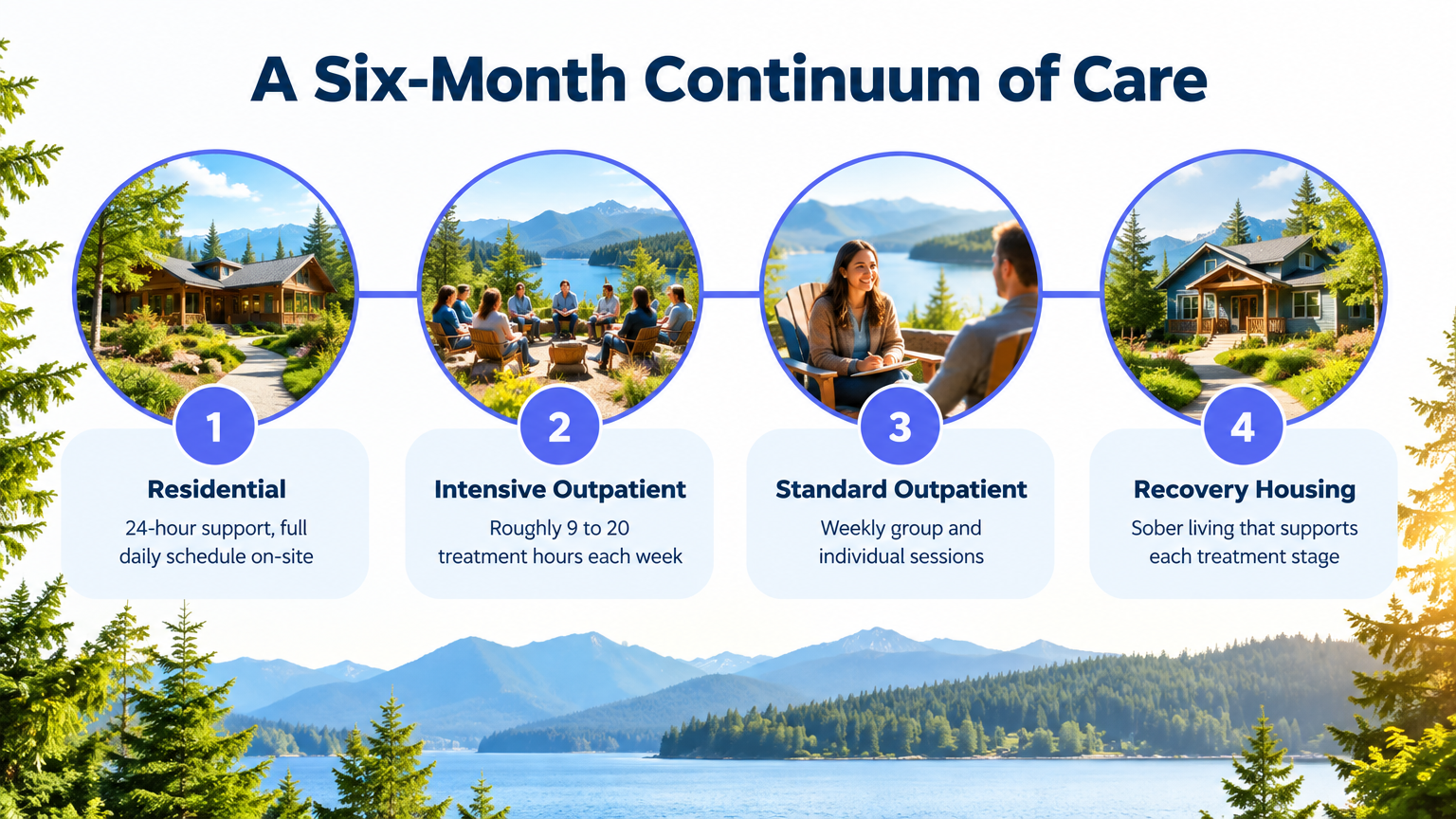
A strong six-month drug treatment program is not one room you sit in for 180 days. It's a staged plan that changes shape as you do. You might start in residential care after detox, move into an intensive outpatient schedule once you're stable, step down to standard outpatient while you rebuild work or school, and lean on recovery housing and continuing care the whole way through 4, 5. The length is the container. What matters is what gets built inside it.
Here's the honest version: six months earns its name when the program matches your clinical needs, uses therapies that actually have evidence behind them, coordinates care for any co-occurring mental health conditions, and protects the handoffs between stages so you don't fall through the cracks 1. A program that promises six months but can't tell you how week 20 differs from week 4 is selling you a calendar, not a plan.
You should expect a few things from a good one. A real clinical assessment at intake covering substance use history, mental health, medical needs, trauma, and recovery environment, not a sales call 2, 3. Evidence-based therapies like cognitive behavioral therapy and motivational interviewing 1. Family involvement when it's safe and helpful. A written plan for what happens after discharge 10. And people who treat you like a whole person with a story worth hearing, not a case number with a diagnosis.
Why Six Months, and When It's the Right Length for You
The Research Behind Longer Treatment Stays
There's no magic number. NIDA is clear that there's no predetermined treatment length that fits every person, and that participation of less than 90 days is generally of limited or no effectiveness for residential or outpatient treatment, with significantly longer stays often indicated for people with more complex needs 7. Six months exists in that longer-than-90-days space for a reason, not as a sales pitch.
The supporting evidence is real but should be read carefully. A continuing-care review reports that, in the studies it examined, people who received three months or more of long-term residential or outpatient treatment had better 12-month outcomes than those who received less than three months, while cautioning that benefits may reflect engagement, retention, and patient characteristics rather than duration alone 10. For people with co-occurring mental health and substance use conditions, at least 90 days in a residential episode paired with at least 12 weeks of outpatient mental health treatment was linked to lower substance use at the six-month mark 13. The pattern is consistent: more time, when it's time well spent, tends to help.
At the same time, a Cochrane review of therapeutic communities found little evidence that one specific duration model is clearly superior to another, and the research base involves substantial variation across studies 12. So treat the six-month window as a well-supported option for many people, not a guarantee for anyone. The quality of what fills those months, and whether you stay engaged, matters as much as the number on the calendar.

When Six Months Is More, or Less, Than You Need
Six months tends to be a strong fit when the picture is complicated. If you've cycled through 30-day programs and relapsed, if you're coming out of detox with no stable housing to return to, if you have a co-occurring mental health condition like PTSD or depression that needs coordinated care alongside substance use treatment 2, 13, or if your home environment is actively unsafe for early recovery, a longer plan gives you room to actually change the conditions around you, not just the chemistry inside you.
Six months may be more than you need if your substance use is less severe, your home and work life are stable, and you have strong social support ready to show up. For some people, a shorter residential stay followed by a robust outpatient schedule works well. SAMHSA's treatment-type guidance supports matching the level and length of care to clinical need, not to a program's advertised duration 1, 4.
The Continuum Inside Six Months: Levels of Care That Fit Together
Residential, IOP, Outpatient, and Recovery Housing Explained
Think of six months as a path with distinct stretches, not one long room. Each stretch has a different intensity, a different purpose, and a different relationship to your daily life. A strong program will tell you upfront which stretches it offers directly, which it partners for, and how it decides when you're ready to move.
Residential treatment is the most structured. You live on-site with 24-hour support and a full daily schedule of groups, individual counseling, and skill-building. SAMHSA describes residential care as generally lasting from a few weeks to a few months, with longer stays possible for more serious conditions 4, 5. For many people, residential is where the first chapter of a six-month plan happens, often right after detox when the body is stable but the ground still feels unsteady.
Intensive outpatient (IOP) is the middle stretch for most people. You live at home or in recovery housing and come to treatment several days a week. SAMHSA notes that IOP commonly involves roughly nine to twenty hours of treatment activities each week 5, with more coordination and structure than standard outpatient visits 4. This is where you start practicing recovery in real life: going to work or school, handling a bad day, calling your counselor before you call your dealer.
Standard outpatient steps down the hours further. You might attend a weekly group and an individual session while you rebuild routines, relationships, and finances. Recovery housing runs alongside these clinical stages. SAMHSA describes recovery housing as a key support strategy for initiating and sustaining recovery and improving health outcomes 15. A safe, sober place to sleep is not a luxury during early recovery. It's often the difference between a plan that holds and a plan that collapses.
Protecting the Handoffs Between Stages
The handoffs are where good plans get fragile. You can do everything right in residential and still lose momentum if the move to IOP takes two weeks, your counselor changes, and nobody calls to check in. Ask any program how they protect those seams, because the answer tells you how seriously they take your whole six months.
Look for a few specific things:
- A written transition plan before you leave each stage, not during the car ride home.
- Warm handoffs where your current counselor talks directly to your next one, ideally in a meeting you're part of.
- Same-week scheduling for the next level of care so there's no gap in appointments.
- A clear plan for medication continuity if you're taking anything prescribed, since NIDA notes that medications and behavioral therapies work together to help people stay engaged and reduce return to use 6.
- A recovery housing option already lined up if you need one, not a phone number for a waitlist 15.
If a program can't walk you through the first two weeks after residential discharge in concrete detail, that's a yellow flag. The research on continuing care is consistent: active retention efforts and ongoing engagement matter as much as the initial episode of care 11. Six months only earns its length when nobody drops the baton.
How to Evaluate a Program: Credentials, Therapies, and Safety
Licensing, Accreditation, and Evidence-Based Care
Start with the paperwork. A strong six-month program can show you current state licensing, national accreditation, and a clear description of the therapies they actually use. SAMHSA's quality-treatment checklist is a useful backbone here: look for programs that are licensed and accredited, use evidence-based practices such as motivational interviewing and cognitive behavioral therapy, include family when it's safe, support medical and social needs, and offer appropriate FDA-approved medications when clinically indicated 1. If a program can't answer those five questions cleanly, keep looking.
Licensing confirms a program is authorized to operate. Accreditation, from a body like The Joint Commission, means an outside reviewer has looked at clinical, safety, and operational standards. Neither one proves a program will fit you specifically, but together they filter out a lot of noise. Ask for the license number and expiration date. Ask who accredits them and when the last review happened. A good admissions team will not blink at these questions.
Then push on the therapies. "Evidence-based" is a phrase that gets stretched. You want specifics. Cognitive behavioral therapy helps you notice the thoughts that lead to use and build different responses. Dialectical behavior therapy adds skills for managing intense emotions. Motivational interviewing meets you where you are and helps you move forward 1. If someone describes their approach as "holistic" without naming the actual therapies behind the groups and individual sessions, ask what a Tuesday afternoon looks like. The schedule tells the truth.
Co-Occurring Mental Health and Trauma-Informed Support
If depression, anxiety, PTSD, or past trauma is part of your story, the right six-month program needs to handle that honestly. Not every addiction treatment center is a mental health provider, and that's not a flaw as long as they're upfront about it. What you want is a program that screens for co-occurring conditions, coordinates with psychiatric care when needed, and uses a trauma-informed approach throughout the day, not just in one specialty group 2, 3.
There's real evidence this coordination matters. A study of people with co-occurring disorders found that at least 90 days in a residential episode paired with at least 12 weeks of outpatient mental health treatment was associated with lower substance use at the six-month mark 13. In other words, the addiction program and the mental health care work together, over time, or the plan tends to wobble. Ask directly: Do you have a psychiatrist or psychiatric nurse practitioner on staff or on contract? How do you handle medication continuity if I'm already on something? What's your referral network for ongoing therapy after I discharge?
Trauma-informed care is a service-delivery approach, not a diagnosis treatment. SAMHSA describes it as establishing safety, preventing retraumatization, building trust, supporting empowerment, and using culturally and gender-responsive services 16. In practice, that means staff don't demand you tell your worst story on day one. It means the environment feels predictable, respectful, and physically safe. It means trauma-informed groups can address the overlap of PTSD and substance use without putting you in a position to be re-wounded by the process.
Your Admissions Interview: Questions to Ask and Answers to Expect
Treat the admissions call like an interview, because that's what it is. You're hiring a team for six months of your life. Write your questions down before you dial, because nerves will erase them. Here's a working script, with the kind of answers that should reassure you and the kind that should raise an eyebrow.
"How do you structure a six-month plan? Walk me through week 1, week 10, and week 22." A strong answer describes staged care: residential or post-detox stabilization, intensive outpatient at roughly nine to twenty hours a week, standard outpatient, and recovery housing alongside 4, 5, 15. A weak answer is vague about what changes over time.
"What assessments do you do at intake, and how often do you reassess?" Expect a real clinical assessment that screens for co-occurring conditions and considers substance use history, mental health, medical needs, and functional limitations 2, 3. If the answer sounds like a sales pitch, that's your signal.
"Which therapies will I actually be doing, and who runs them?" You want specific names (CBT, DBT, motivational interviewing) and specific credentials behind the people leading them 1.
"How do you measure progress?" AHRQ identifies 30-day, 60-day, 90-day, six-month, and one-year retention as useful markers, along with quality of life, functional outcomes, and treatment participation 23. A program that tracks something beyond "did you complete the program" is paying attention.
"How are family members included, and when?" Family involvement, when safe, is part of SAMHSA's quality checklist 1. The answer should describe education sessions, family therapy, or clear communication rhythms.
"What happens after month six?" If they don't bring up continuing care, alumni support, and a written discharge plan on their own, that's a program selling a calendar, not a path 10, 11.
Verifying Oregon and Pacific Northwest Programs
Oregon Licensing, OHP Coverage, and Client Rights
Before you sign anything, verify the program with the state. In Oregon, the Oregon Health Authority (OHA) licenses and certifies behavioral health providers, with outpatient programs certified for up to three years and residential programs licensed every two years under applicable Oregon Administrative Rules 18. Ask for the facility's current license, the expiration date, and the OHA rule chapter it operates under. OHA also maintains dedicated pages for residential and outpatient substance use programs, which point prospective clients toward licensed providers and the state's treatment-provider directory 19, 20. Oregon rulemaking defines substance use disorder treatment and recovery services to include outpatient, intensive outpatient, and residential services, so a six-month plan that moves across levels of care should stay inside that regulated continuum 21.
If cost is a concern, start with the Oregon Health Plan. OHP covers behavioral health services including outpatient and residential care, withdrawal management, medications, and individual, group, and family counseling, and you don't need a primary-care referral to seek substance use treatment 17. Coverage doesn't automatically approve any specific placement, so confirm medical necessity, network status, and your coordinated care organization's authorization steps with the program directly.
You also have rights once you're admitted. Oregon rules protect informed written consent, access to clinically indicated medication, grievance procedures, freedom from abuse and neglect, religious freedom, and freedom from retaliation when you speak up 22. Ask for the program's written client-rights policy before day one.
Traveling to the Pacific Northwest for Treatment
If you're coming to Oregon or Washington from out of state, the verification steps don't change, but a few logistics do. Confirm the program accepts your insurance across state lines or offers a self-pay path you can actually afford. Ask how they handle the first flight or drive in: Is someone picking you up? Is there a quiet intake room, or does the clock start in a lobby?
Think through continuing care from day one. A strong Pacific Northwest program will coordinate with providers back home for the step-down phases, or help you plan a longer stay that includes IOP and recovery housing in the Portland area before you travel back 15. If family involvement matters to you, ask how they handle sessions by video and in-person visits. Distance is a real variable in your plan, not a footnote.
What Happens After Month Six: Continuing Care That Earns the Length
Month six is a transition, not a finish line. The strongest programs treat the last few weeks of your plan as the first weeks of continuing care, with specific supports already scheduled on your calendar before you discharge. NIDA frames treatment and recovery as an ongoing process, with medications, behavioral therapy, and continuing support working together to reduce return to use 6. Your six months should hand you off to something, not drop you into open air.
Ask what continuing care actually looks like after month six. A good answer includes a step-down to lower-intensity outpatient check-ins, alumni groups that meet weekly or monthly, a recovery housing option if your home environment is still shaky 15, and a plan for how your counselor stays in touch during the first ninety days post-discharge. NIAAA's continuing-care review found that positive studies more often used planned durations of at least twelve months and active retention efforts, which tells you something important: the programs that help people most don't go silent at discharge 11.
Measure the plan by what gets scheduled, not what gets promised. AHRQ identifies six-month and one-year retention, quality of life, functional outcomes, and treatment participation as meaningful markers 23. If your program tracks those and still calls you in month seven, the length earned its name.
If You're a Family Member Reading This
If you're reading this for someone you love, take a breath. You don't have to pick the perfect program today. You do need to ask the same questions your person would ask if they had the energy: Is it licensed? What therapies do they actually use? How do they handle co-occurring mental health needs, and do they coordinate psychiatric care rather than claim to replace it 1, 2? What does family involvement look like, and when does it start?
Here's the harder truth. Enabling isn't love, and neither is choosing a program just because it says six months. Length alone doesn't equal quality, and a plan that doesn't include continuing care tends to lose ground after discharge 11. Ask how they'll include you in a way that supports recovery without putting the whole weight of it on your shoulders.
If your person is talking about suicide, call or text 988 for the Suicide & Crisis Lifeline first. The program search can wait a few hours. Your person's safety can't.
Taking the Next Step This Week
You don't have to solve the whole six months today. You have to make one phone call this week. Pick two or three programs in the Portland area or across the Pacific Northwest that look like they match what you've learned here, write down your questions from the admissions script, and dial. If you get stuck on cost, start with your insurance or the Oregon Health Plan to confirm what's covered before you narrow the list 17.
If detox comes first, say that out loud on the call so they can coordinate the handoff rather than leave you waiting. Recovery is work. You don't have to do it alone, and you don't have to do it perfectly. You just have to start.
Frequently Asked Questions
Is a 6 month drug treatment program always better than a 30- or 90-day program?
Not automatically. NIDA notes there's no predetermined length that fits everyone, though participation under 90 days is generally of limited effectiveness for residential or outpatient care 7. Six months tends to help when needs are complex, housing is unstable, or shorter stays haven't held. The quality of what fills those months, and whether you stay engaged, matters as much as the number.
Do I have to stay in one residential facility for the full six months?
No. A well-built six-month plan usually moves across levels of care: residential or post-detox stabilization, intensive outpatient at roughly nine to twenty hours a week, standard outpatient, and recovery housing alongside 4, 5, 15. Oregon rules recognize this continuum, defining treatment to include outpatient, intensive outpatient, and residential services 21. Ask any program how they sequence stages and protect the handoffs between them.
Does the Oregon Health Plan (OHP) cover a six-month treatment program?
OHP covers behavioral health services that may include outpatient and residential treatment, withdrawal management, medications, and individual, group, and family counseling, and you don't need a primary-care referral to seek substance use treatment 17. Coverage doesn't automatically approve a specific placement, so confirm medical necessity, your coordinated care organization's authorization steps, and the program's network status directly with admissions before you commit.
What should I ask during an admissions call to tell a strong program from a weak one?
Use SAMHSA's quality checklist as your spine: ask about current licensing and accreditation, the specific evidence-based therapies they use (CBT, DBT, motivational interviewing), how family is included, how they support medical needs, and whether appropriate FDA-approved medications are available 1. Then ask what weeks 1, 10, and 22 look like, and what continuing care gets scheduled before discharge 10.
Can a six-month program help with co-occurring mental health conditions like PTSD or depression?
Yes, when the program screens for co-occurring conditions and coordinates psychiatric care rather than claiming to replace it 2, 3. Trauma-informed approaches address PTSD and substance use together without pushing disclosure before you're ready 16. One study linked at least 90 days of residential care paired with 12 weeks of outpatient mental health treatment to lower substance use at six months 13.
What happens after I finish six months of treatment?
Discharge should be a handoff, not a finish line. Expect step-down outpatient check-ins, alumni groups, a recovery housing option if home is still shaky 15, and a counselor who stays in touch during the first ninety days post-discharge. NIAAA's review found that positive continuing-care studies more often used planned durations of at least twelve months with active retention efforts, so ask what gets scheduled 11.
References
- Quality Treatment for Mental Health, Drugs and Alcohol. https://www.samhsa.gov/find-support/learn-about-treatment/finding-quality-treatment
- Substance Use Disorder Treatment for People With Co-Occurring Disorders. https://library.samhsa.gov/sites/default/files/pep20-06-04-006.pdf
- Substance Use Disorder Treatment for People With Co-Occurring Disorders (based on TIP 42). https://www.samhsa.gov/resource/ebp/advisory-substance-use-disorder-treatment-people-co-occurring-disorders-based-tip-42
- Treatment Types for Mental Health, Drugs and Alcohol. https://www.samhsa.gov/find-support/learn-about-treatment/types-of-treatment
- What is substance abuse treatment?. https://library.samhsa.gov/sites/default/files/sma14-4126.pdf
- Treatment and Recovery. https://nida.nih.gov/publications/science-addiction/treatment-recovery
- Understanding Drug Abuse and Addiction: What Science Says. https://nida.nih.gov/sites/default/files/1921-understanding-drug-abuse-and-addiction-what-science-says_1.pdf
- Relationship between treatment length and outcome in a therapeutic community. https://pubmed.ncbi.nlm.nih.gov/8034382/
- Effectiveness of long-term residential substance abuse treatment for women: findings from three national studies. https://pubmed.ncbi.nlm.nih.gov/15540492/
- The Continuing Care Model of Substance Use Treatment. https://pmc.ncbi.nlm.nih.gov/articles/PMC4007701/
- Impact of Continuing Care on Recovery From Substance Use Disorder. https://arcr.niaaa.nih.gov/sites/default/files/2021-01/impact-of-continuing-care-on-recovery-from-substance-use-disorder.pdf
- Therapeutic communities for substance related disorder. https://pubmed.ncbi.nlm.nih.gov/16437526/
- Stability of Outcomes Following Residential Drug Treatment for Patients With Co-Occurring Disorders. https://pmc.ncbi.nlm.nih.gov/articles/PMC3146302/
- Advisory: Low Barrier Models of Care for Substance Use Disorders. https://library.samhsa.gov/sites/default/files/advisory-low-barrier-models-of-care-pep23-02-00-005.pdf
- Best Practices for Recovery Housing. https://library.samhsa.gov/product/best-practices-recovery-housing/pep23-10-00-002
- Trauma-Informed Care in Behavioral Health Services. https://library.samhsa.gov/sites/default/files/sma15-4420.pdf
- Oregon Health Plan (OHP) Behavioral Health Coverage. https://www.oregon.gov/oha/hsd/ohp/pages/behavioral-health.aspx
- Oregon Health Authority: Licensing and Certification: Providers. https://www.oregon.gov/oha/BH/Providers/Pages/Licensing-Certification.aspx
- Oregon Health Authority: Residential Treatment Facilities. https://www.oregon.gov/oha/HSD/AMH-LC/Pages/RT.aspx
- Behavioral Health Outpatient Treatment Programs. https://www.oregon.gov/oha/HSD/AMH-LC/pages/op.aspx
- NOTICE OF PROPOSED RULEMAKING. https://www.oregon.gov/oha/HSD/HSDRules/309-018-02152023.pdf
- Health Systems Division: Addiction Services - Chapter 415. https://www.oregon.gov/oha/HSD/Medicaid-Policy/SUDWaiver/415-050-Highlighted-040723.pdf
- Monitor Patient Outcomes. https://integrationacademy.ahrq.gov/products/playbooks/moud-playbook/implement-moud-treatment/monitor-patient-outcomes
Real Recovery Starts in Portland, Oregon
Call now or verify insurance to take the first step toward lasting recovery in Portland.
Relapse Doesn't Mean the End Of Your Journey
Reach out today to explore programs that support real, long-term sobriety.