



Building a New Life with the 12 Steps for Recovery

Key Takeaways
- The Steps move through four clusters: surrender (1-3), honest inventory (4-7), repair (8-9), and maintenance and service (10-12), forming a daily practice rather than a checklist.
- Active involvement, having a sponsor, doing step work, and taking service commitments, predicts post-treatment outcomes more strongly than passive meeting attendance alone.6
- Intensive outpatient care and 12-step work are designed to layer rather than compete, with structured clinical hours and mutual-help meetings holding each other up during early recovery.4
- When the Steps feel stuck, name it to one person and shrink the next move; rural members can build rhythm through hybrid and online meetings that still count.
What the Steps Actually Ask of You
If you've been around the rooms for a while, you already know the Steps aren't a quiz. They're not something you pass. They're a sequence of honest moves you make, again and again, with other people who are doing the same work.
Here's what the Steps actually ask of you: that you admit something you've probably been avoiding, that you become willing to look at it, and that you let other people in on the process. That's it. The rest is rhythm and repetition. You go to a meeting. You call your sponsor. You write a Fourth Step you've been dreading. You make a phone call you owe. You help someone newer than you find a chair.
The Steps were laid out in 1935 when AA began, and the basic shape hasn't changed because the human work hasn't changed. What has changed is the evidence around them. Decades of peer-reviewed research now back what members have said for years: showing up and getting involved leads to less substance use over time.5,14
You don't have to believe everything on day one. You just have to be willing to do the next honest thing. That's the whole ask.
The Arc Behind the Numbered List
Surrender: Steps One Through Three
- The first three Steps are about loosening your grip. Step One asks you to admit that the substance has been running the show and that your own willpower hasn't been enough. That's not a character verdict. It's an honest read of what's actually happened.
- Step Two introduces the idea that something outside of just-you can help. Step Three asks you to be willing to lean on it. Notice the language there: willing. Not certain. Not converted. Just willing.
If you're agnostic, atheist, or shaped by a tradition that doesn't sit easily with mainstream fellowship language, this cluster can feel like a wall. It doesn't have to be. Plenty of long-time members work these Steps with the group itself as their higher power, or with the simple idea that something bigger than the disease has to be in the room. The Steps are spiritual, not religious, and the research on AA effectiveness highlights mechanisms like self-governance and group support, not doctrine.9
What surrender looks like in real life: you stop arguing with the fact that you can't drink or use safely. You go to the meeting even when you don't feel like it. You let someone else hold the map for a while. That's it. That's the work of the first cluster.
Honest Inventory: Steps Four Through Seven
Step Four scares almost everyone. That's normal. You're being asked to write down a searching look at your resentments, fears, and the harm you've caused. People put it off for months. Some put it off for years. The page stays blank because the page feels like a verdict.
Here's the reframe most sponsors offer: a Fourth Step is not a confession. It's a map. You're trying to see the patterns that kept you stuck so you can stop running them. Resentment toward a parent, fear of being seen as a failure, the same broken loop with money or relationships, that's the territory.
Step Five is where you read it out loud to another human, usually your sponsor. Something shifts when secrets stop being secret. Step Six asks if you're ready to let those patterns go. Step Seven asks for help letting them go. The willingness from the surrender cluster shows up again here, in a different costume.
This is also where specific 12-step activities start to do real work. Research on involvement, not just attendance, shows that activities like sponsor contact and step work relate meaningfully to post-treatment outcomes. You don't get the benefit by sitting in the back of the room. You get it by writing the inventory you've been avoiding and reading it to someone who's been there.6
Go slow if you need to. Go honest more than you go fast.
Repair: Steps Eight and Nine
Step Eight is a list. Step Nine is the action. You write down the people you've harmed, and then, where it's safe and wise, you make direct amends.
Read that again: where it's safe and wise. Amends are not a free pass to reopen wounds for the other person's benefit or to ease your own guilt. If contacting someone would hurt them, frighten them, or destabilize a situation, you don't make that direct amends. You talk it through with your sponsor, and you may make a living amends instead, which means changing how you show up, every day, without announcing it.
Most amends are smaller than people imagine. Paying back money you owe. Calling a sister you ghosted for two years. Showing up to a kid's recital instead of promising and bailing. Sometimes it's a hard conversation with a former partner. Sometimes it's a letter to someone who has died, read aloud at a meeting or to your sponsor.
This cluster tends to surprise people. The fear before is enormous. The relief after, even when the conversation goes imperfectly, is often bigger than expected. You're not asking for forgiveness. You're cleaning up your side of the street. That's the whole job.
Maintenance and Service: Steps Ten Through Twelve
Steps Ten through Twelve are how you keep what you've found. Step Ten is a daily inventory, short and practical. Did you act out of fear today? Did you owe an apology? Did you skip something that would have helped? You catch it close to the moment, not six months later.
Step Eleven is a daily practice of prayer or meditation, however you understand those words. Many members translate it as a few quiet minutes in the morning and a check-in at night. Step Twelve carries the work outward: you help the next person, and you try to live the principles in the rest of your life, not just at meetings.
Service is where the model gets quietly powerful. Making coffee. Setting up chairs. Sponsoring someone newer than you. The research on AA effectiveness identifies self-governance through the Steps and ongoing group involvement as core mechanisms behind sustained recovery. You're not just receiving help. You're becoming part of how the help works.9
Seen as four clusters, Surrender (1-3), Honest Inventory (4-7), Repair (8-9), and Maintenance and Service (10-12), the Steps stop looking like a checklist and start looking like a daily practice you return to. Not a finish line. A way of walking.
Why Showing Up Changes the Outcome
Recovery rewards the people who keep showing up. Not the people who get it perfect, not the people who say the right things at the right meeting, just the ones who keep walking back through the door.
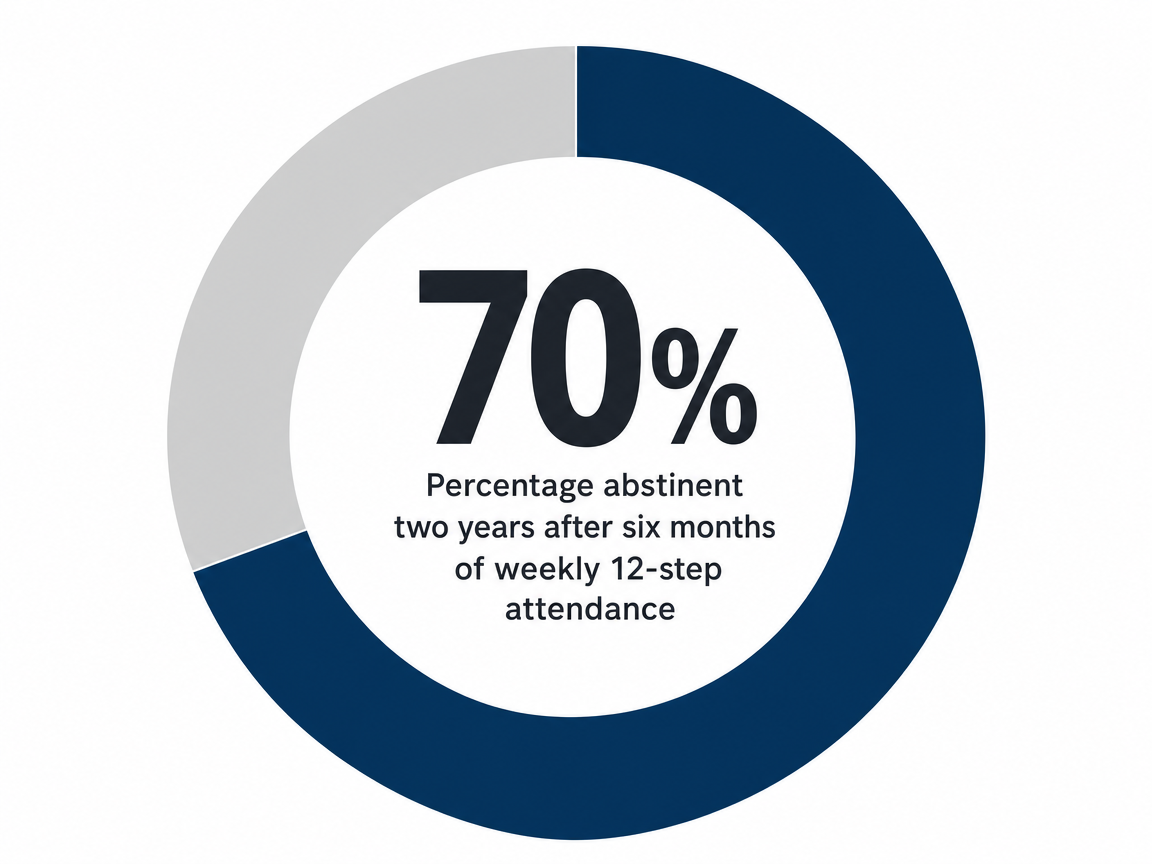
The numbers back this up in a way that's hard to argue with. In one of the most cited reviews of AA effectiveness, more than 70% of people who attended 12-step groups weekly for six months were abstainers at the two-year follow-up. Read the scope carefully: this is AA and 12-step attenders, followed for two years, with weekly attendance as the threshold. It's not a promise. It's a pattern that shows up across studies and decades, and it points to something simple. The people who keep coming back tend to keep getting better.9
That pattern has a name in the research: dose-response. The more meetings and involvement someone has, the less substance use tends to follow. It's not that any single meeting saves you. It's that the rhythm of weekly contact, week after week, builds something steady underneath your day.5
If you're newly out of detox or residential, this is the part where a lot of people quietly stall. The structure is gone. The schedule is yours again. And six months of weekly meetings sounds like a long time when you're staring at a Tuesday night and don't feel like leaving the house.
Here's the encouragement: you don't have to feel like going. You just have to go. Members say it a hundred different ways, but the core of it is this: motivation tends to follow action, not the other way around. The night you least want to be there is often the night you most need to be. You'll know that one when it happens. Go anyway. The chair holds you up. The coffee is bad. Someone shares the exact thing you needed to hear, and you didn't even know you needed it.
Showing up isn't the whole program. But it's the floor every other piece of Step work stands on.
The Sponsor Relationship and the Work Between Meetings
A sponsor is not a sage. A sponsor is someone a few steps ahead of you who picks up the phone. That's the actual job description, and it's the part of Step work that does the most quiet heavy lifting between Tuesday and Thursday.
What that relationship looks like in practice: you call before the urge gets loud, not after. You read your Fourth Step out loud, even the parts you'd rather edit. You text on a hard morning. You meet for coffee and walk through Step Nine before you make the phone call you're afraid of. The sponsor isn't a therapist and isn't a crisis line. They're a guide who knows the terrain because they've crossed it.
This is where the research gets specific in a way that's worth pausing on. When investigators looked at which 12-step behaviors actually moved the needle on post-treatment outcomes, they didn't find that simple meeting attendance was the whole story. They found that involvement activities, having a sponsor and using them, doing step work, taking on service commitments, reading program literature, related more strongly to staying sober than passive attendance alone. Sitting in the room matters. What you do between rooms matters more.6
If you don't have a sponsor yet, the standard advice still holds: pick someone of the same gender, in your fellowship, with stable time and a sponsor of their own. Listen for someone whose share sounds like a person, not a performance. Then ask. Most members say yes, and the ones who can't will usually point you toward someone who can.
Does the Model Still Hold Up?
It's a fair question, and you should ask it. A model from 1935 deserves to be checked against modern evidence, not just defended out of loyalty.
The short answer: yes, with honest caveats. The cochrane review of AA and 12-step facilitation for alcohol use disorder, the highest tier of evidence reviewers use, found AA and structured 12-step facilitation perform as well as or better than other established treatments for producing abstinence. A 2025 review of mutual-help groups for drug use disorders, looking at studies from 2019 to 2024, also found supportive evidence for abstinence and recovery outcomes. This isn't a fringe practice with a few believers. It's one of the most studied recovery interventions in the field.1,10
Now the caveats, because they matter. Some researchers have raised real concerns about how 12-step discourse can frame substance use as a moral failing, which can push people away from medication-assisted treatment or other paths that work. That critique is worth holding. The Steps work best when they're a practice, not a verdict on someone else's recovery.11
There are also alternatives. SMART Recovery, Wellbriety for Native and Indigenous communities, and other mutual-help groups show comparable satisfaction and outcomes for people they fit better. If the 12-Step room isn't yours, that doesn't mean recovery isn't yours. It means the door is somewhere else.12,13
If the Steps are working for you, keep going. The evidence is on your side.
Where Intensive Outpatient Care Fits
What the First Months Feel Like
The first months out of detox or residential are strange. The structure that was holding you up is gone. You have your phone back, your schedule back, your life back, and that's both the gift and the problem.
This is the gap where intensive outpatient care does its quiet work. The clinical guidance on IOP describes it plainly: the program's job in the early recovery phase is to help you begin active involvement in a 12-step or other mutual-help program while you're still in clinical care. You're not choosing between therapy and the rooms. You're using each to hold the other up.4
What that feels like, week to week, is busy in a way that's actually useful. Group three or four times a week. An individual session. A meeting most nights. A sponsor call you almost skipped. A 2025 study of clients finishing a four-month integrated intensive program found that the combination, not any single piece, was what people pointed to when they described what kept them steady.8
You're tired. You're also, slowly, somebody you recognize again. Both are true. Keep going.
A Sample Week When the Steps and Structured Care Overlap
Here's what an ordinary week can look like when IOP and Step work are running in parallel. Treat it as a pattern, not a prescription. Yours will look different.
- Monday morning, you have IOP group. Relapse prevention skills, a check-in, maybe a Seeking Safety module if trauma is part of your picture. Monday night, you go to your home group meeting. You raise your hand once, even briefly. Tuesday, individual therapy in the afternoon, where you and your counselor talk through the resentment that's been eating at you since Sunday. Tuesday night, you call your sponsor and read the next section of your Fourth Step.
- Wednesday is another IOP group. Thursday is a meeting plus coffee with someone you sponsor, or someone who's been around longer than you if you're newer. Friday you might have a family session or a skills group. Saturday morning is a step study. Sunday is service: you make coffee at the noon meeting, or you set up chairs, or you stay after and help clean up.
That rhythm matches the IOP continuum-of-care model, where structured outpatient programming and 12-step involvement are designed to layer rather than compete. The clinical work gives you tools and language. The fellowship gives you people who use the same tools, every day, for free, for the rest of their lives. You need both. The week holds you.3,4
Real Recovery Starts in Portland, Oregon
Call now or verify insurance to take the first step toward lasting recovery in Portland.
Pacific Northwest Recovery Life
The geography matters more than people expect. Recovery looks different depending on where you wake up.
If you're in Portland, you're working with one of the densest meeting cultures on the West Coast. There's a meeting somewhere most hours of the day, in church basements, in clubhouses off Sandy and Division, in community centers across the river. You can find a step study on a Tuesday morning, a young people's meeting on Thursday night, a women's meeting on Saturday, a men's stag on Sunday. Building a home group in Portland is mostly a matter of showing up to a few until one feels like the right room. The density is a gift. Use it.
Outside the metro, the math changes fast. If you're in Central Oregon, eastern parts of the state, or across the line in Wyoming, you may be driving thirty or sixty minutes to the nearest in-person meeting. That's where hybrid and online meetings have quietly reshaped recovery life. A laptop on the kitchen table at 7 p.m. is a real meeting. Members in rural areas often build a week that mixes one or two in-person meetings with online ones, plus phone calls with a sponsor who might live two states away.
Wherever you are in the Pacific Northwest, the principle is the same: you need a rhythm you can actually keep. The clinical guidance on outpatient continuum-of-care names ongoing mutual-help involvement as part of how recovery holds after structured treatment ends. The room can be a folding chair in Northeast Portland or a video tile from a kitchen in Bend. It still counts.4
When the Steps Feel Stuck
Almost everyone hits a wall somewhere in the Steps. It usually isn't dramatic. You just stop calling your sponsor for a week. The Fourth Step notebook sits on the nightstand. You make the meeting but leave before the closing.
If that's where you are, you're not failing the program. You're in the part nobody talks about much. Here's what helps: name the stuck place out loud to one person. Your sponsor, a sober friend, your IOP counselor, anyone who won't try to fix it in thirty seconds. Stuck shrinks when it stops being secret.
Then make the next move smaller. If Step Four feels impossible, write one resentment, not the whole list. If meetings feel hollow, try a different format, a step study, a literature meeting, a meditation meeting. The research on involvement keeps pointing the same direction: it's the active pieces, sponsor contact, step work, service, that move outcomes, not white-knuckled attendance alone.6
Stuck is information, not a verdict. The work picks back up the moment you do.
Your recovery journey is unique, but you don’t have to walk it alone. Oregon Trail Recovery is here to provide the support, guidance, and evidence-based treatment you need to succeed. Take that first step today—your future self will thank you.
Frequently Asked Questions
Do I have to believe in God to work the 12 Steps?
No. The Steps use the phrase higher power as we understood Him, and members interpret that widely. Your sponsor, your home group, the ocean, the program itself, plenty of people work the Steps with something other than a traditional God concept. The mechanism researchers credit for AA's outcomes is self-governance and group involvement, not doctrine. Willingness matters more than theology.9
How do I find a sponsor, and when should I ask?
Go to meetings for a few weeks and listen. When someone shares in a way that sounds honest and grounded, and they have stable time and a sponsor of their own, ask after the meeting. Same gender is the standard suggestion. Don't wait until you're in crisis. Sponsor contact and active step work track with better post-treatment outcomes, so the earlier you build that relationship, the better.6
Can I do the Steps if I'm on medication for opioid or alcohol use disorder?
Yes. Medication for opioid or alcohol use disorder is a medical treatment, not a violation of any Step. Some older fellowship culture has been hostile to this, and that pressure can push people away from care that works. Find a home group that welcomes members on medication, work with a sponsor who respects your prescribing clinician, and keep both pieces of your recovery in place. Both belong.11
What if I live somewhere with few in-person meetings?
Hybrid and online meetings are real meetings. Members in Central Oregon, eastern Oregon, and rural Wyoming often build a week that mixes one or two in-person meetings with several online ones, plus phone calls with a sponsor who may live far away. The continuum-of-care guidance still names ongoing mutual-help involvement as part of how recovery holds. A laptop on the kitchen table counts. Build the rhythm.4
How is a home group different from just attending meetings?
A home group is the one meeting you commit to. You show up weekly, take a service position eventually, and the regulars learn your name. That commitment is where casual attendance turns into involvement, which is the piece the research actually links to staying sober, not seat-warming. Try a few meetings until one feels like the right room. Then plant yourself there and keep coming back.6
I'm a family member. How can I support someone working the Steps without overstepping?
Let them have their program. Don't read their Fourth Step, quiz them on Step Nine, or chase them to meetings. What helps: protect their meeting time, welcome their sponsor's calls, and consider Al-Anon or Nar-Anon for yourself. Recovery in younger adults and adolescents holds better when family supports involvement without controlling it. Your steadiness matters. So does letting them do the honest work themselves.2
References
- Effectiveness of Mutual Help Groups for Illicit Drug Use Disorders. https://pmc.ncbi.nlm.nih.gov/articles/PMC12360454/
- The Twelve Steps and Adolescent Recovery: A Concise Review - PMC. https://pmc.ncbi.nlm.nih.gov/articles/PMC6997953/
- Chapter 8. Intensive Outpatient Treatment Approaches - NCBI - NIH. https://www.ncbi.nlm.nih.gov/books/NBK64102/
- Chapter 3. Intensive Outpatient Treatment and the Continuum of Care. https://www.ncbi.nlm.nih.gov/books/NBK64088/
- 12-Step Interventions and Mutual Support Programs for Substance .... https://pmc.ncbi.nlm.nih.gov/articles/PMC3753023/
- Involvement in 12-step Activities and Treatment Outcomes - PMC. https://pmc.ncbi.nlm.nih.gov/articles/PMC3558929/
- TWELVE-STEP FACILITATION - Integrated Care Training Program. https://ictp.uw.edu/wp-content/uploads/2024/03/UWPACC-2021_08_05_12_Step_Facilitation_Rick_Ries_MD.pdf
- Clients' Experiences and Satisfaction with an Integrated Intensive .... https://pmc.ncbi.nlm.nih.gov/articles/PMC11898248/
- Alcoholics Anonymous Effectiveness: Faith Meets Science - PMC. https://pmc.ncbi.nlm.nih.gov/articles/PMC2746426/
- Alcoholics Anonymous and 12-Step Facilitation Treatments for .... https://pmc.ncbi.nlm.nih.gov/articles/PMC8060988/
- The Trouble with Morality: The Effects of 12-Step Discourse ... - PMC. https://pmc.ncbi.nlm.nih.gov/articles/PMC4788510/
- Comparison of 12-step Groups to Mutual Help Alternatives for AUD .... https://pmc.ncbi.nlm.nih.gov/articles/PMC5193234/
- Efficacy of 12-step mutual-help groups other than Alcoholics .... https://pubmed.ncbi.nlm.nih.gov/37755487/
- A Brief History of Alcoholics Anonymous - Origins osu.edu. https://origins.osu.edu/read/brief-history-alcoholics-anonymous
Relapse Doesn't Mean the End Of Your Journey
Reach out today to explore programs that support real, long-term sobriety.