





Portland, OR Transitional Rehab Program Options

Key Takeaways
- Transitional rehab in Portland typically pairs ASAM 2.1 intensive outpatient care — nine or more clinical hours a week for adults — with structured sober living for 90 to 180 days 18.
- Oregon's residential bed shortage means most post-detox referrals land at the transitional tier, and outcomes for well-run IOP are comparable to inpatient for most adults 19, 23.
- Recovery housing changes the picture: Portland Medicaid data shows lower detox readmissions and fewer ER visits at 90 and 180 days compared to unhoused peers 12.
- Before committing, verify OHA certification and OAR 309-019-0183 compliance, ask about co-occurring care designations, confirm OHP or insurance coverage, and get sober living costs in writing 2, 5, 7.
The Quiet Week After Detox in Portland
The week after detox is a strange kind of quiet. Your body is finally still. Your phone has fewer messages than it used to. Someone handed you a discharge sheet with a phone number on it and told you the next step is a transitional program, and now you're sitting in a car in Southeast Portland trying to figure out what that actually means.
You are not behind. You are exactly where the system expects you to be.
What comes next in Portland usually looks like this: intensive outpatient treatment several days a week, a structured sober living house, and someone helping you sort through work, court dates, and family calls. It's less dramatic than detox. It's also where the real work of the next six months happens.
This guide walks you through what a transitional rehab program in Portland should include, how Oregon's rules define it, what the Oregon Health Plan pays for, and the questions to ask before you say yes to any program.
What a Transitional Rehab Program Actually Is
Where Transitional Care Sits on the Continuum
A transitional rehab program is the middle stretch. It sits between the acute stabilization you just finished and the lower-intensity outpatient care that eventually becomes your normal week.
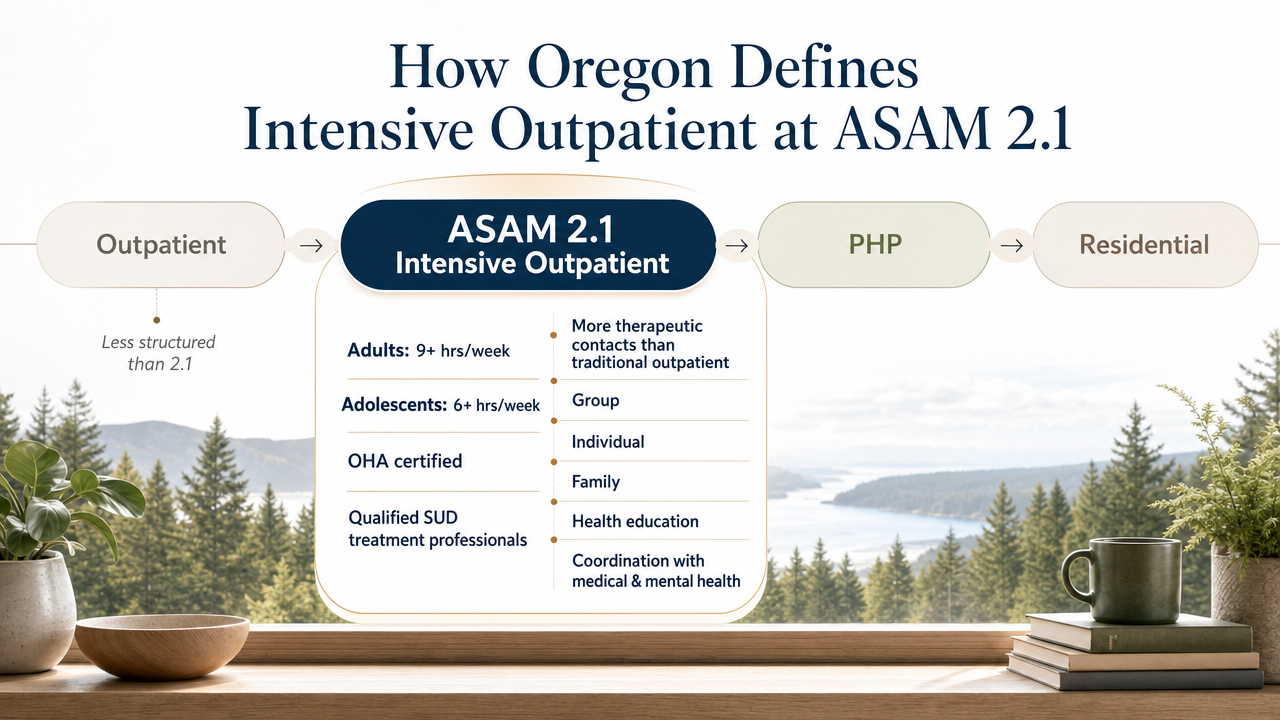
Oregon organizes substance use disorder care along the ASAM continuum, from outpatient (Level 1.0) up through intensive outpatient (2.1), partial hospitalization (2.5), and residential (3.1 through 3.7) 18. Transitional rehab in Portland almost always means ASAM 2.1 intensive outpatient paired with a structured living environment, whether that's a sober living house, a family home with clear boundaries, or transitional housing through a community program 14.
The word "transitional" matters. You're not stepping backward. You're stepping into the level of care Oregon's system is designed to hold you at while you rebuild the parts of life detox couldn't touch — sleep, routine, relationships, work, court dates, food that isn't from a vending machine.
Most people spend 90 to 180 days in this tier. Some longer. The right length depends on how your week is holding together, not on a calendar someone printed for you.
How Oregon Defines Intensive Outpatient at ASAM 2.1
Here's the part that helps you tell a real program from a marketing wrapper.
Oregon's SUD 1115 demonstration defines ASAM Level 2.1 intensive outpatient as nine or more hours per week for adults, or six or more hours per week for adolescents 18. That's the floor. A program calling itself IOP that offers you two group sessions a week and a check-in call is not operating at 2.1, and it will not be billed to the Oregon Health Plan as such.
OAR 309-019-0183 goes further. An ASAM 2.1 program has to be certified by the Oregon Health Authority, staffed by qualified substance use disorder treatment professionals, and structured around more therapeutic contacts per week than traditional outpatient care 2, 22. Group counseling, individual counseling, family sessions, health education, and coordination with medical and mental health providers all have to be on the menu 3.
If you or a family member also live with depression, anxiety, PTSD, or another mental health condition, ask whether the program is co-occurring capable or co-occurring enhanced under Oregon's Integrated Co-occurring Disorders rules 7. Those designations mean the clinicians in the room have been approved to treat both sides of what you're carrying, not just the substance use piece.
You don't have to memorize the OAR numbers. You just have to know they exist, so when you ask the intake coordinator which rules govern their license, silence isn't an acceptable answer.
Why Step-Down Care Holds Up in the Research
If part of you is worried that stepping down from residential means stepping down in seriousness, the evidence says otherwise.
A systematic review of intensive outpatient programs found that 50% to 70% of participants reported abstinence at follow-up, and outcomes were comparable to inpatient and residential treatment for most people who complete a course of IOP 19. "Most people" is doing real work in that sentence — there are situations where a longer residential stay is the right call, and a good intake assessment will name them. But for the majority of adults leaving detox in Portland, a well-run 2.1 program is the treatment, not a placeholder for it.
What actually predicts whether you'll be better in six months isn't the label on the door. It's whether you show up to the hours, whether the clinical work matches what's actually driving your use, and whether the roof over your head at night is set up to help instead of hurt.
That last piece — the roof — is why Portland's transitional programs almost always pair clinical hours with structured housing. We'll come back to that.
A Realistic Week Inside a Portland Transitional Program
Clinical Hours: Group, Individual, and Co-Occurring Care
Most weeks in a Portland transitional program look like this: three days of group, one individual session, and either a family session or a health education block somewhere in the middle. That adds up to the nine or more clinical hours a week that ASAM 2.1 requires for adults 18.
Groups are the backbone. You'll spend time on relapse prevention skills, cognitive behavioral therapy work, and the slow practice of naming what you're feeling before it turns into a decision you regret. Individual sessions are where the harder, quieter conversations happen — the ones about your family, your trauma history, the reasons the last time didn't stick.
If you also live with depression, anxiety, PTSD, or bipolar disorder, your program should be treating both at once. Oregon's rules allow programs to be designated co-occurring capable or co-occurring enhanced, meaning the clinicians can hold the mental health piece alongside the substance use piece 7. Coordinated behavioral health care produces better handoffs and fewer people falling through the cracks between systems 20. Ask about that designation on the intake call.
Evenings and Weekends: Sober Living, Meetings, and Real Life
Clinical hours are the frame. Evenings and weekends are the picture.
If you're in a structured sober living house in Southeast Portland or St. Johns, your night probably has a rhythm to it — dinner with housemates, a house meeting on Sunday, a curfew that felt insulting for about a week and then quietly started helping. You'll do chores. You'll get drug tested on a schedule you don't control. You'll sit through conversations that would have sent you out the door a month ago.
Somewhere in there, most people add outside recovery meetings. AA, NA, SMART Recovery, Refuge Recovery, Wellbriety circles — Portland has all of them, most nights of the week, from Belmont to Gresham. Your program may require a certain number per week and ask you to get a signature.
Weekends are the test. No group to show up for, more unstructured time, old friends texting. The whole point of pairing IOP with structured housing is that when Saturday afternoon gets long, you are not alone in it. Recovery housing changes what that afternoon looks like, and the local data on that is real — we'll get to it in section 5.
Work, School, and DUII or Probation Obligations
Here is where transitional care earns its name. You are supposed to be doing life while you're in it.
Most Portland IOPs run at least two tracks — a morning schedule for people working evenings or nights, and an evening schedule that lets you keep a day job or stay enrolled at PCC. Ask for the schedule in writing before you commit. Ask whether they'll flex around a class at Cascade or Sylvania. Ask what happens when your shift at Fred Meyer runs late.
If you're court-involved — a DUII diversion, probation, a treatment mandate — your program should be fluent in the paperwork. That means signed attendance verification for your PO, structured DUII assessments if that's what the court asked for, and documentation your attorney can actually use. If the intake coordinator gets vague when you ask about court reporting, that's your answer.
You do not have to choose between staying employed and getting real treatment in Portland. The program is supposed to be built for people whose lives don't pause.
Why Portland's System Leans on Transitional Care
The Residential Bed Shortage Behind Your Referral
If you left detox expecting a 30- or 60-day residential bed and got routed to intensive outpatient instead, you probably wondered whether someone was cutting corners on your care. Here is the honest answer: the shape of your next step is being set as much by Oregon's math as by your clinical picture.
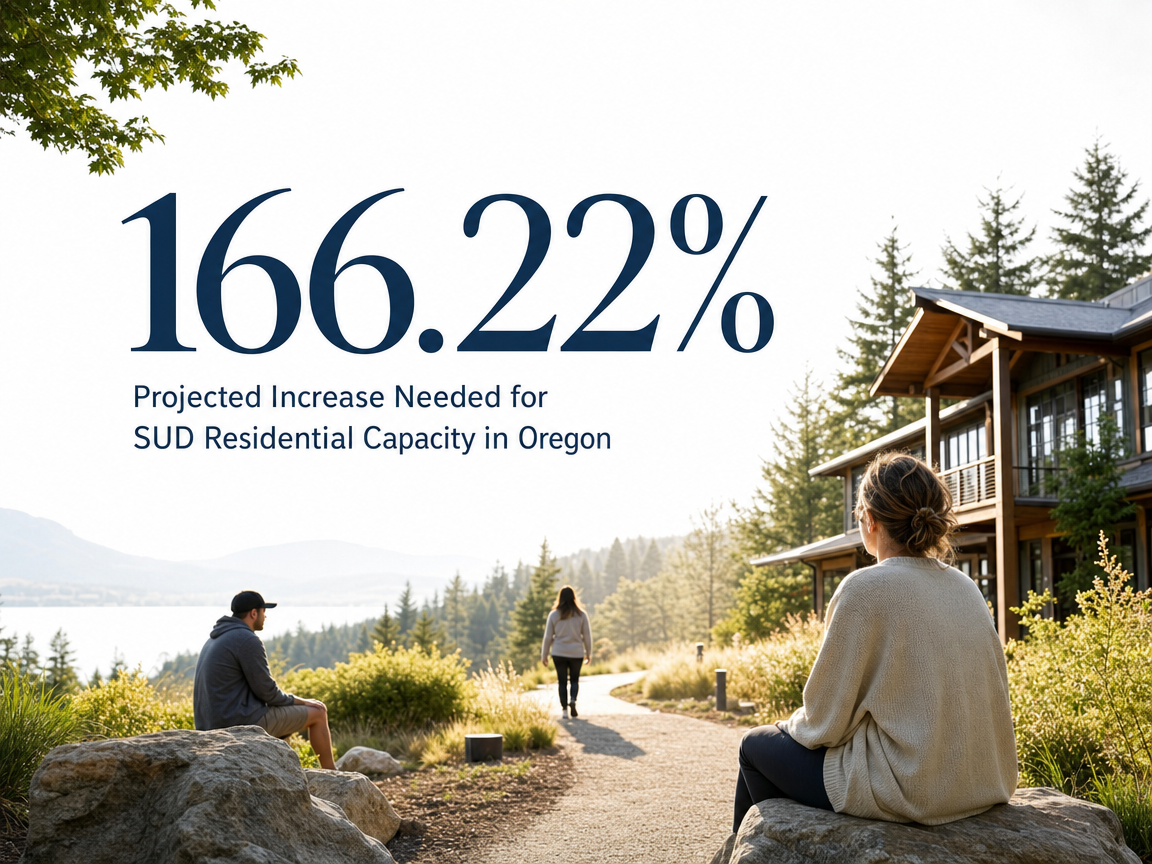
The June 2024 Behavioral Health Residential+ Facility Study counted 1,374 substance use disorder residential treatment beds statewide — about 32.44 per 100,000 Oregonians 23. The state's own capacity analysis puts projected total need at roughly 3,775 SUD residential beds, meaning Oregon is looking at a 166.22% increase when current, pending, and needed beds are added together 10. For a Portland metro of well over two million people in its catchment, that gap is not abstract. It's the reason your intake counselor moved fast when a slot opened, and why so many post-detox referrals land at ASAM 2.1 with structured housing instead of a longer residential stay.
What Oregon Is Building by End of 2026
The state is trying to close that gap, and it's worth knowing what's coming — because it tells you what the next few years of care in Portland will realistically look like.
In 2024, Governor Kotek and the Oregon Health Authority announced a plan to add 465 behavioral health treatment beds and recovery housing units statewide by the end of 2026 9. That number breaks down into:
- 301 residential treatment facility beds (a 31% increase)
- 42 secure residential treatment beds (8%)
- 48 withdrawal management beds (15%)
- 74 substance use disorder residential beds (5%) 9
Read that last number again. A 5% bump in SUD residential capacity, against a system that needs to roughly triple. The withdrawal management side is growing faster because that's the acute front door. Longer-term residential SUD growth is modest.
What that means for you, sitting in Portland right now: the transitional tier — IOP paired with structured sober living — is going to keep carrying most of the work through 2026 and beyond. Getting good at this level of care isn't a fallback plan. It's the plan. And knowing that changes how you show up for it.
Real Recovery Starts in Portland, Oregon
Call now or verify insurance to take the first step toward lasting recovery in Portland.
Sober Living: The Other Half of a Transitional Program
What Recovery Housing Changes in the First 180 Days
The clinical hours in an IOP are only half of what carries you through the next six months. The other half is where you sleep.
A peer-reviewed study using Oregon Medicaid claims data looked at what actually happens to people leaving inpatient substance use treatment in Portland, comparing those discharged into recovery housing at the Blackburn and Harris sites with those discharged as unhoused. The people who went into recovery housing had a lower risk of being readmitted to inpatient detox at both 90 and 180 days. Their emergency department visits went down. Their unhoused peers' ED visits went up. And the recovery-housing group actually saw a primary care doctor more often — meaning they were getting the boring, ordinary medical care that keeps a body upright, instead of showing up in a crisis 12.
Read that again as your own week. Fewer nights back in a detox bed. Fewer 2 a.m. rides to the ER. More Tuesday-morning appointments with someone who actually knows your name. That is what a structured house is doing under the surface while you're just trying to get through group and cook dinner.
The house isn't the whole answer. But without it, the clinical work has nowhere to land.
Signs a Sober Living House Is Actually Structured
Not every house with a "sober living" sign on the porch is doing the work. Some are. Some are just cheap rent with rules on the fridge. Here's how to tell the difference before you sign anything.
Ask about drug and alcohol testing. A real house tests on a random schedule, not just when someone "seems off." Ask about house meetings — a weekly one, run by a house manager who actually lives on site or is there most days, is the baseline.
Ask what happens after a relapse. "You're out that night, no exceptions" and "we'll work with you" are both wrong answers. The right answer sounds like a specific protocol: a same-day clinical conversation, a possible bump back to a higher level of care, clear conditions for return.
Ask about chores, curfew, employment or school expectations, and how guests are handled. Ask whether the house coordinates with your IOP clinicians. If your therapist and your house manager aren't allowed to talk to each other with your written consent, you're paying for two separate silos instead of one recovery.
You are allowed to ask all of this out loud.
How Coverage Works Under OHP and Private Insurance
The money question is usually the one that keeps people up at night. Here's the short version for Portland.
If you have the Oregon Health Plan, the SUD 1115 waiver covers the full continuum you're likely to use — outpatient (ASAM 1.0), intensive outpatient (ASAM 2.1), day treatment (2.5), residential (3.1 through 3.7), and withdrawal management 5, 6. That means the clinical hours in a real 2.1 IOP are covered when the program is properly certified and billing under Oregon's SUD codes 21. Your coordinated care organization handles authorization. Your intake coordinator should walk you through it in the first call.
Sober living rent is a separate line. OHP does not pay your monthly rent at a recovery house. Some houses run on sliding scale, some are subsidized through state recovery housing investments, and some charge a flat rate you pay out of pocket, usually monthly. Ask for the number in writing before you move in, and ask what it includes — utilities, food, drug testing, transportation.
If you have private insurance, the questions are different. Call the number on the back of your card and ask three things:
- whether the program is in-network,
- what your out-of-pocket max looks like this year, and
- whether ASAM 2.1 intensive outpatient requires prior authorization.
Ask the program's billing office the same questions and compare answers. If the numbers don't match, keep asking until they do.
You are allowed to ask what something costs before you agree to it. That is not rude. That is recovery-adjacent budgeting, and it's part of the work.
Questions to Ask Before You Commit to a Program
Clinical Fit: Modalities, Co-Occurring Care, and Clinician Access
Before you sign an admission packet, ask the intake coordinator to walk you through what an actual week of treatment looks like. Not the brochure version — the hours, the therapies, the names of the modalities.
You want to hear specific words: cognitive behavioral therapy, dialectical behavior therapy, motivational interviewing, relapse prevention skills training. Ask whether the program uses trauma-informed approaches like Seeking Safety if that's part of your story. Ask how family sessions work and whether they can happen by phone if your people are out of state.
If you're carrying depression, anxiety, PTSD, or bipolar disorder alongside the substance use, ask directly whether the program is co-occurring capable or co-occurring enhanced under Oregon's Integrated Co-occurring Disorders rules 7. Ask who your individual therapist would be, how often you'd see them, and how quickly you can reach a clinician between sessions when a Tuesday afternoon goes sideways. If the answer is vague, keep asking.
Structure Fit: Duration, Sober Living Linkage, and Accountability
Clinical quality is one axis. The rest of your week is the other.
Ask how long the program typically runs at the ASAM 2.1 intensity, and what stepping down to Level 1.0 outpatient looks like when you get there 18. Ask what the plan is if you're not ready to step down on their default timeline. A real program will tell you the length is set by your progress, not a billing cycle.
Ask whether they run their own sober living houses or partner with specific ones, and how the two sides talk to each other. You want a signed release of information between your clinical team and your house manager to be standard, not a special request. Ask about drug testing frequency in the house and in the clinic.
Then ask the accountability question straight: what happens if you use again? A program that can't answer that clearly, in specifics, is not the one to trust with the next six months.
Verifying a Program's Oregon Licensing in Ten Minutes
You can check a Portland program's credentials from your phone before you ever walk in.
Ask the intake coordinator for the program's Oregon Health Authority certification number and the specific ASAM levels of care listed on their license 5. A properly certified 2.1 program will have that level printed on the certificate itself — providers must have each ASAM level reflected on their license to bill Medicaid 5. Ask which OARs govern their services. You should hear OAR 309-019-0183 for intensive outpatient 2.
If they hesitate, name the rules yourself and see how they respond. Then call the Oregon Health Authority Health Systems Division to confirm the certification is current. Ten minutes of due diligence up front is worth more than months of untangling the wrong choice.
Choosing a Next Step This Week
You don't have to solve the next six months today. You have to make two phone calls this week.
Call one is to a Portland IOP that meets the ASAM 2.1 standard — nine or more clinical hours a week for adults, certified under OAR 309-019-0183, and honest about co-occurring care 18, 2. Ask for their certification number. Ask which OARs they operate under. Ask what Tuesday actually looks like.
Call two is about where you'll sleep. A structured sober living house, a family home with real boundaries, or a transitional housing slot — pick the option that makes Saturday afternoon safer than last Saturday was 14.
Detox was the loud part. This next stretch is quieter, and it's the part that holds. Show up to the hours. Answer the door for the drug test. Go to the Tuesday appointment even when you don't want to.
If you're in the Portland metro and looking for a program built for this exact stretch, Oregon Trail Recovery is one of the places that does this work.
Frequently Asked Questions
How long does a transitional rehab program in Portland usually last?
Most people spend 90 to 180 days at the ASAM 2.1 intensive outpatient level before stepping down to standard outpatient care 18. The length isn't set by a calendar. It's set by how your week is holding together, how the clinical work is landing, and whether your housing is stable.
What's the difference between IOP and a transitional rehab program?
IOP is the clinical piece — nine or more hours a week of group, individual, and family sessions at ASAM 2.1 18. A transitional rehab program in Portland usually means IOP plus structured sober living or transitional housing 14. Same clinical hours, but with the rest of your week built around recovery too.
Does the Oregon Health Plan cover transitional rehab and sober living?
The Oregon Health Plan covers the clinical side — outpatient, IOP at ASAM 2.1, day treatment, residential, and withdrawal management — under the SUD 1115 waiver 5, 6. OHP does not pay your monthly rent at a sober living house. Some houses use sliding-scale fees or state recovery housing subsidies. Ask the house directly.
Can I work or go to school while in a transitional program?
Yes. Most Portland IOPs run morning and evening tracks so you can keep a job or stay enrolled at PCC. Ask the intake coordinator for the written schedule before you commit, and ask whether they'll flex around a shift change or a class. That flexibility is the whole point of ASAM 2.1.
Do I have to complete residential treatment before entering a transitional program?
No. Many people go straight from detox into IOP and sober living, and the research supports it — outcomes for well-run intensive outpatient care are comparable to inpatient for most adults 19. A good intake assessment will tell you if your clinical picture calls for residential first. If not, transitional care is a legitimate first step, not a shortcut.
How do I verify that a Portland transitional program is properly licensed?
References
- Division 19 - Outpatient Behavioral Health Services. https://www.law.cornell.edu/regulations/oregon/chapter-309/division-19
- Or. Admin. Code § 309-019-0183 - Intensive Outpatient Substance Use Disorder Services ASAM Level 2.1. https://www.law.cornell.edu/regulations/oregon/Or-Admin-Code-SS-309-019-0183
- PERMANENT ADMINISTRATIVE ORDER – Outpatient Behavioral Health Services. https://www.oregon.gov/oha/HSD/HSDRules/309-022-0100-0192-01252019.pdf
- Oregon Revised Statutes Chapter 430 – Mental Health; Alcoholism and Drug Abuse. https://www.oregonlegislature.gov/bills_laws/ors/ors430.html
- ASAM Implementation of the SUD 1115 Waiver. https://www.oregon.gov/oha/hsd/medicaid-policy/pages/asam.aspx
- Oregon Health Plan Substance Use Disorder 1115 Demonstration – Special Terms and Conditions. https://www.oregon.gov/oha/HSD/Medicaid-Policy/SUDWaiver/STCs-040821.pdf
- ASAM Levels of Care – Oregon Health Authority Presentation. https://www.oregon.gov/oha/HSD/Medicaid-Policy/SUDWaiver/ASAM-Slides-090523.pdf
- Oregon Health Authority – Behavioral Health Data and Reports. https://www.oregon.gov/oha/hsd/amh/pages/data.aspx
- Governor Kotek, Oregon Health Authority Announce 465 Added Treatment Beds by End of 2026. https://apps.oregon.gov/oregon-newsroom/OR/GOV/Posts/Post/governor-kotek-oregon-health-authority-announce-465-added-treatment-beds-by-end-of-2026
- Behavioral Health Residential+ Study Overview and Findings. https://olis.oregonlegislature.gov/liz/2023I1/Downloads/CommitteeMeetingDocument/285584
- OHA Behavioral Health Residential+ Facility Study (Legislative Document). https://olis.oregonlegislature.gov/liz/2024R1/Downloads/CommitteeMeetingDocument/282803
- Assessing the Impact of Recovery Housing on Healthcare Utilization. https://pmc.ncbi.nlm.nih.gov/articles/PMC10563008/
- Oregon 2024 Uniform Reporting System Mental Health Data – Substance Abuse and Mental Health Services Administration. https://www.samhsa.gov/data/sites/default/files/reports/rpt56415/Oregon.pdf
- Transitional Housing – State of Oregon. https://okb.oregon.gov/Pages/transitional-housing.aspx
- 2024 Child Welfare Data Book. https://www.oregon.gov/odhs/data/cwdata/cw-data-book-2024.pdf
- Children’s Residential Treatment Capacity and Oregon’s Child Welfare System. https://olis.oregonlegislature.gov/liz/2025R1/Downloads/PublicTestimonyDocument/163932
- Oregon Substance Use Disorder Services Inventory and Gap Analysis Report. https://www.oregon.gov/oha/HSD/AMH/DataReports/SUD-Gap-Analysis-Inventory-Report.pdf
- Oregon Health Plan Section 1115 SUD Demonstration: Special Terms and Conditions Attachment (May 29, 2020). https://www.medicaid.gov/medicaid/section-1115-demonstrations/downloads/or-health-plan-sud-demo-pa.pdf
- Substance Abuse Intensive Outpatient Programs: Assessing the Evidence. https://pmc.ncbi.nlm.nih.gov/articles/PMC4152944/
- Substance Use Disorder Integration Report. https://www.oregon.gov/oha/HSD/AMH/DataReports/SUD-Integration-Report.pdf
- SUD Treatment Code and Rate Changes Effective January 1, 2022. https://www.oregon.gov/oha/HSD/OHP/Announcements/SUD-Services0921.pdf
- OAR 309-019 Outpatient Substance Use Disorders Treatment and Recovery Services (proposed rule text including IOP definition). https://www.oregon.gov/OHA/HSD/HSDRules/nprm-309-0019-061517.pdf
- Oregon Behavioral Health Residential+ Facility Study (June 2024). https://www.oregon.gov/oha/HSD/AMH/DataReports/Behavioral-Health-Residential-Facility-Study-June-2024.pdf
Relapse Doesn't Mean the End Of Your Journey
Reach out today to explore programs that support real, long-term sobriety.