


Choosing Outpatient Treatment Centers That Fit Your Life

Key Takeaways
- Fit with your schedule, values, and clinical needs predicts completion and outcomes more reliably than a program's reputation or marketing polish 10.
- Confirm the intensity level in real numbers: SAMHSA sets IOP at 9+ hours weekly for adults, with PHP running 20+ hours most days 2.
- Press intake coordinators on evidence-based therapies, medication access, integrated co-occurring care, and polysubstance capability before committing to any outpatient center.
- Plan the continuum early, lock in the first IOP appointment within 72 hours of discharge, and write aftercare into your plan by week four.
The Real Decision: Fit, Not Prestige
Picking an outpatient treatment center is not like picking a gym. You are trying to protect a paycheck, a family, and a recovery all at once, and the program has to work with the life you actually live on a Tuesday at 4 p.m. That is a harder decision than any glossy brochure suggests.
Here is the truth research keeps pointing to: when people can choose a program that matches their schedule, values, and recovery goals, they stay longer and do better. A meta-analysis of patient preference in behavioral health found that fit predicts satisfaction, completion, and clinical outcomes 10. Early satisfaction, in turn, is one of the strongest signals for whether someone finishes outpatient care instead of quietly dropping out 11.
So the question is not "which outpatient treatment center has the best reputation in Portland?" It is "which one can I keep showing up to for the next six to twelve months without my job, my kids, or my sanity falling apart?" That reframe changes everything you ask on the intake call, and it is the lens this guide uses from here on.
What 'Outpatient' Actually Means at Each Intensity
Standard Outpatient, IOP, and PHP: How the Hours Break Down
Before you compare any two outpatient treatment centers, you need a shared vocabulary for what "outpatient" actually means. The word covers a wide range, from a single therapy hour a week to nearly full-time programming, and the difference matters for your calendar and your clinical outcome.
Here is the plain version. Standard outpatient is usually one to a few hours per week: individual therapy, sometimes a group, and occasional check-ins with a prescriber. It is the lightest touch, and it fits people who are stable, have strong support at home, and are protecting momentum rather than building it from scratch.
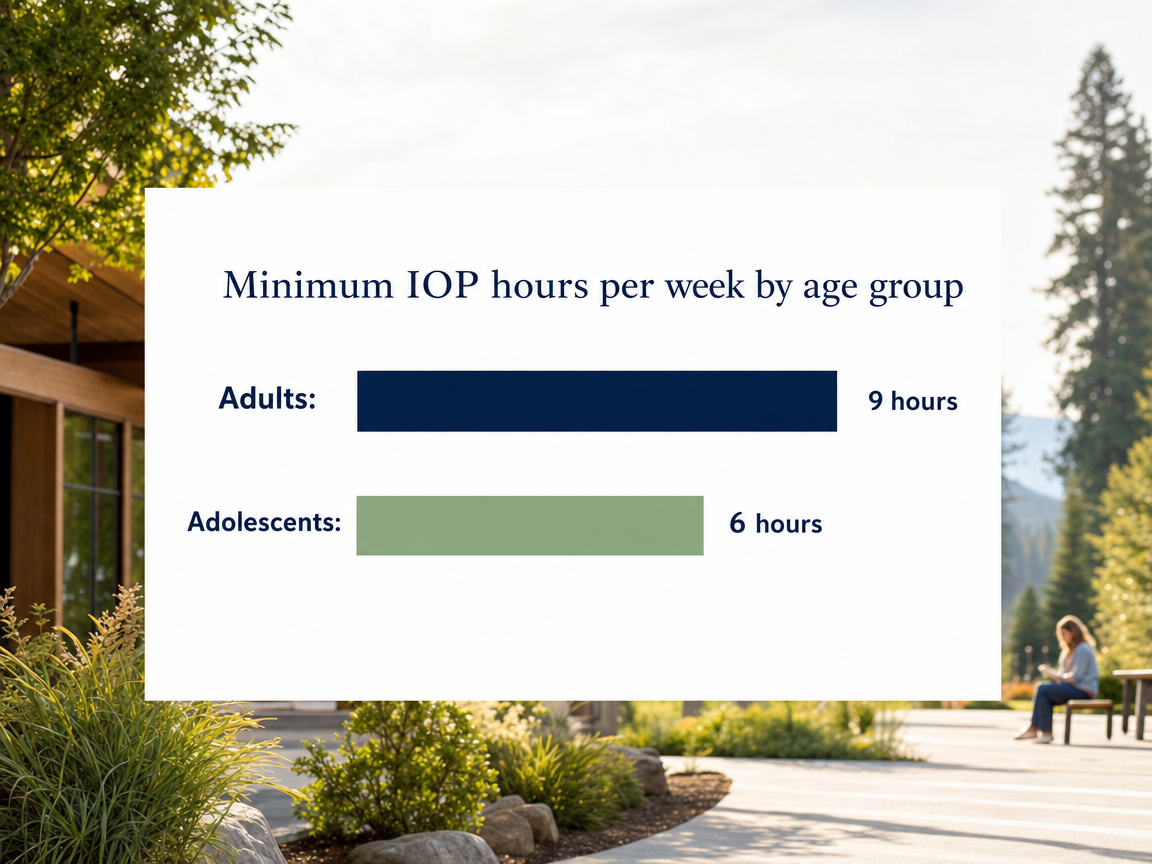
Intensive outpatient programs (IOP) sit in the middle and are the workhorse level for most working adults. SAMHSA defines an IOP as at least 9 hours of service per week for adults and 6 hours per week for adolescents, typically delivered across three or more days and paired with counseling, family psychoeducation, case management, and medication support when needed 2. That 9-hour floor is worth remembering; if a program calls itself "intensive" but only offers two 90-minute groups a week, it is not meeting the standard definition, and you should ask why.
Partial hospitalization (PHP) is the highest outpatient level, generally 20 or more hours a week, most days, with a heavier medical and psychiatric presence. It looks and feels closer to residential care, minus the overnight stay, and it is often used as a step down from inpatient or when someone needs more structure than IOP can provide but does not need 24-hour supervision.
When you call intake, ask for the exact hours-per-week, days-per-week, and length of each session. A real answer, not a range, tells you the program knows its own model.
Where Outpatient Sits in the Continuum: Detox, Residential, IOP, Aftercare
Outpatient is a chapter, not the whole book. Recovery for most people moves through a continuum: medical detox first if withdrawal is dangerous, then residential or PHP for stabilization, then IOP as life re-enters the picture, then standard outpatient and aftercare that can stretch for a year or longer. SAMHSA is explicit that IOP works best when it is embedded in this kind of continuum, with counseling, case management, mutual support, and medication options in the same plan 2.
You do not have to start at the top. If you are still using daily, or if withdrawal from alcohol or benzodiazepines could put you in the hospital, detox comes first, and reputable outpatient centers will tell you that on the intake call rather than take your money. If you have completed detox or a residential stay, IOP is usually the natural next step, giving you enough structure to hold gains while you go back to work, parenting, or school.
The evidence review on IOPs found that they can produce outcomes comparable to inpatient care for many people, provided the match to clinical severity is right 7. That word "match" is doing a lot of work. A well-placed IOP protects your progress. An under-placed one, where you needed residential first, tends to end in a relapse and a shame spiral. Ask the program directly where they think you should start, and listen for a clinical answer rather than a scheduling one.
Judging Clinical Quality Without a Brochure
Evidence-Based Therapies to Confirm Before You Enroll
Brochures love adjectives. "Holistic." "Personalized." "Cutting-edge." None of those words tell you what will actually happen in the room on a Wednesday night. Before you enroll, ask which specific therapies the clinicians are trained in and how often you will get them.
There is a short list worth confirming out loud. Cognitive behavioral therapy (CBT) and motivational interviewing should be baseline; if a program cannot name them, keep calling. Dialectical behavior therapy (DBT) skills help if you carry heavy emotion regulation or trauma alongside the substance use. For stimulant use in particular, ask whether the program offers contingency management, a structured reinforcement approach with some of the strongest evidence in the field for methamphetamine and cocaine use disorders 9. Not every Oregon program runs it, largely because of reimbursement barriers, so a yes here tells you something real about clinical seriousness.
Ask about medication too. For opioid use disorder, that means access to buprenorphine or naltrexone, either on-site or through a tight referral relationship. For alcohol, it means someone can prescribe naltrexone or acamprosate when clinically appropriate. And ask how the program supports connection to mutual-help groups; participation in 12-step or alternative peer communities is linked with improved outcomes across multiple clinical trials 8, and a good outpatient program treats those meetings as part of your plan rather than an afterthought.
Co-Occurring Mental Health and Polysubstance Care
Very few people walk into outpatient treatment with one clean diagnosis. Depression, anxiety, PTSD, and ADHD travel with substance use disorders constantly, and the substances themselves rarely stay in one lane. In 2024, 62% of overdose deaths in Oregon involved more than one substance, according to the Oregon Health Authority 3. That is not a footnote. It means any outpatient treatment center you consider in the Pacific Northwest has to be built for people who use, or have used, more than one thing.
Ask directly: does the program treat co-occurring mental health conditions alongside the substance use, or does it hand you a referral list and hope for the best? Integrated care means the same clinical team is tracking your mood, your sleep, your cravings, and your triggers together, not in separate offices that never talk. If you are pregnant or parenting, ask specifically about coordinated care with your medical team; CDC clinical guidance for opioid use disorder in pregnancy emphasizes that kind of tight coordination 6.
Polysubstance capability is a separate question. A program comfortable treating alcohol only is not the same as one that can hold someone using fentanyl and methamphetamine at the same time. Ask what percentage of current clients are on medication for opioid use disorder, and how the group content adapts when stimulants are the primary drug. Vague answers are answers.
Scheduling Treatment Around a Working Life
Evening, Early Morning, and Hybrid Schedules That Protect Your Paycheck
Your calendar is not a small detail. It is the single biggest predictor of whether you actually show up on week seven, when the initial motivation has worn off and your inbox is on fire. A program that meets from 10 a.m. to 1 p.m. on weekdays is functionally invisible to a nurse on twelves, a teacher, or a warehouse lead. So ask specifically: when do groups run, and how many tracks does the program operate?
Good outpatient treatment centers in Portland and across the Pacific Northwest tend to offer at least two shifts. Early morning tracks, often 7 to 10 a.m., let you finish before a standard workday. Evening tracks, usually 5:30 to 8:30 p.m. three days a week, are the most common working-adult option. Some programs also run a weekend intensive for people whose jobs will not bend at all. The 9-hour SAMHSA IOP floor still applies; the question is which nine hours 2.
Ask what happens when you have to miss a session for a work trip or a sick kid. A program that will not tell you its make-up policy on the phone is telling you something. Fit predicts completion 10, and the schedule is where fit starts.
Telehealth Honestly: Where It Helps and Where It Fails
Telehealth is not a magic wand, and it is not a downgrade. It is a tool that works well for some parts of outpatient care and poorly for others, and you deserve a straight answer about which is which. The peer-reviewed evidence describes virtual care as a real access strategy for substance use disorder treatment, particularly for working adults, people in rural counties, and anyone whose commute would otherwise cost them a job 12.
Where it helps: individual therapy, medication check-ins for buprenorphine or naltrexone, family sessions where a partner joins from home, and process groups for people who are already stable and self-directed. If you live in Central Oregon or eastern Washington and the nearest in-person IOP is 90 minutes away, hybrid programming can be the difference between finishing treatment and dropping out entirely.
Where it fails: early recovery for someone still using or newly detoxed, group work when your camera is off and your attention is not, and any situation where you do not have a private room. If your kids can hear the group, or your manager can walk past your screen, the clinical value collapses. The same review flags equity gaps too: unreliable broadband, shared devices, and limited digital literacy can turn telehealth into another barrier instead of a bridge 12.
A strong program lets you toggle. Ask whether you can start hybrid, shift to more in-person during rough weeks, and keep telehealth for maintenance later. That flexibility is what actually keeps you enrolled.
Real Recovery Starts in Portland, Oregon
Call now or verify insurance to take the first step toward lasting recovery in Portland.
Oregon and the Pacific Northwest: What Access Actually Looks Like
If you have ever called five outpatient treatment centers in a row and left five voicemails, you already know the local access story. It is not in your head. Oregon's own reporting confirms it: the Oregon Health Authority estimates a 49% gap in substance use disorder services across the full continuum of care, from detox through outpatient and recovery support 3. That gap is why the good programs have waitlists, why intake coordinators sound stretched, and why fit and retention matter so much once you do land a spot.
Workforce is the other half of the picture. Oregon's behavioral health provider capacity, measured as full-time equivalents per 1,000 people, grew from 1.15 in 2023 to 1.25 in 2024 4. That is real progress, and it is also a small number. Rural and remote parts of the state, including much of Central and Eastern Oregon, sit well below urban averages, and the workforce assessment is direct that telehealth alone does not close that gap when broadband, privacy, and language access are working against people 4. If you live outside the Portland metro, expect fewer choices, longer drives, and more hybrid programming.
There is a hopeful piece too. Oregon's overdose deaths fell 16% between 2023 and 2024, the first decline the state has seen since 2016 3. That number does not undo the losses, and it does not promise anything about next year, but it does tell you the continuum is starting to hold in more places. Your part in that is boring and important: pick an outpatient treatment center you can actually keep showing up to, and treat the first call as the start of a relationship, not a transaction. When you are quoted a two-week wait for intake, ask what you should be doing in the meantime, whether they can refer you to a bridge group, and how their waitlist actually moves. Programs that answer those questions cleanly are the ones worth waiting for.
Ten Questions to Ask an Intake Coordinator
The first phone call tells you more than any website ever will. Keep this list next to you, take notes, and pay attention to how the coordinator answers, not just what they say. Vague, defensive, or scripted responses are data. So is a coordinator who slows down and actually thinks with you.
- Exactly how many hours per week is your IOP, and across how many days? You want a specific number. The SAMHSA floor for adults is 9 hours a week 2; anything less should not be called intensive.
- What are my schedule options — early morning, evening, weekend, hybrid? If they run only one track, your job or your kids will eventually collide with it.
- Which evidence-based therapies do your clinicians actually deliver? Listen for CBT, DBT, motivational interviewing, and for stimulant use, contingency management 9.
- How do you handle medication for opioid or alcohol use disorder — on-site or by referral? Either can work; a shrug cannot.
- How do you treat co-occurring mental health conditions? Integrated is the answer you want, not "we'll refer you out."
- What is your make-up policy when I miss a group for work? Real programs have one.
- How long is the typical episode of care, and what does step-down look like? IOP works best inside a continuum, not as a stand-alone sprint 2.
- How do you connect clients to peer support and mutual-help communities? Participation is tied to better outcomes across clinical trials 8.
- What is your current waitlist, and what should I do in the meantime? A good coordinator has a bridge plan.
- Who will actually be my primary counselor, and can I meet them before I commit? Early fit predicts whether you finish 11.
If a program answers eight of these ten cleanly, you are probably in good hands. If they dodge more than three, keep dialing.
Stepping Down from Detox or Residential Without Losing Momentum
The two weeks after you leave detox or a residential bed are the most fragile stretch of the whole recovery journey. You are still healing, your routines have not rebuilt yet, and the ordinary friction of life — bills, group texts, a landlord — comes roaring back all at once. This is exactly the window IOP is designed for, which is why SAMHSA describes intensive outpatient care as a core piece of a continuum rather than a stand-alone treatment 2.
Watch for the momentum killers. A gap of even a week between residential discharge and the first IOP group is enough to unravel a lot of hard work; the evidence review on IOP outcomes is clear that appropriate matching and continuity, not the label on the door, drive results 7. If sober living is part of your plan, line up the housing before discharge, not after. If you are heading back to a home where someone still uses, tell your outpatient team on day one so they can build around it instead of finding out at week four.
Give yourself a soft landing at work too. A reduced schedule, a delayed return, or a shifted role for the first month is not weakness; it is how you protect the progress you already paid for.
Paying for Care: Insurance, OHP, and Private Pay in Plain Terms
Money questions get pushed to the last conversation, and they shouldn't. Ask about payment on the first call, right after schedule and clinical model, so a program you love doesn't fall apart at week two over a billing surprise.
Three basic paths cover most people. If you have commercial insurance through your job, ask the intake coordinator whether the program is in-network with your specific plan, what your deductible and co-pay per group session look like, and whether they will run a benefits check before you commit. If you are on the Oregon Health Plan, ask which coordinated care organization the program contracts with and whether prior authorization is needed for IOP. Private pay is the third path, sometimes used when insurance is between jobs or when someone wants to avoid a claim on their record; ask for the total episode cost in writing, not a per-day figure.
One more thing worth confirming: Medicaid quality reporting now tracks whether people actually start and stay in substance use treatment after an initial visit 1. Programs that take that measure seriously tend to have cleaner intake and follow-up processes, which is exactly what protects you when a billing question comes up mid-treatment.
Building an Aftercare Plan Before You Finish IOP
Aftercare should be written into your plan by week four of IOP, not scrambled together the week you graduate. The tapering-off phase is where a lot of hard-won progress quietly leaks away, and the antidote is a boring, specific plan you can hand to your future self on a bad Tuesday.
Ask your counselor to map the step-down with you: how many standard outpatient sessions per week, for how long, and with whom. Confirm your medication plan will continue without a gap, especially if you are on buprenorphine or naltrexone. Lock in at least two mutual-help meetings you actually like before your last IOP group, since regular participation is tied to better outcomes across clinical trials 8. If you are heading into or staying in sober living, put the house rules and check-in schedule in writing.
Then plan for the wobble. Name your top three relapse triggers, the person you call first, and the small daily habits — sleep, food, one walk — that keep you steady. Finishing IOP is a milestone worth celebrating, and it is also the moment your aftercare plan starts earning its keep.
Frequently Asked Questions
Can I keep working full-time while attending an outpatient treatment center?
Yes, and most people in IOP do. Programs built for working adults run early morning, evening, or weekend tracks, usually three days a week, so treatment fits around a standard shift. Tell the intake coordinator your work schedule on the first call and ask which track matches. Fit predicts whether you finish, so pick the schedule you can honestly protect 10.
How many hours per week should an intensive outpatient program (IOP) require?
SAMHSA defines an IOP as at least 9 hours per week for adults and 6 hours per week for adolescents, typically spread across three or more days with counseling, group work, family support, and medication access when needed 2. If a program calls itself "intensive" but only offers two short groups a week, it is not meeting the standard. Ask for exact hours before enrolling.
What is the difference between standard outpatient, IOP, and PHP?
Standard outpatient is usually one to a few hours a week, mostly individual therapy for people who are already stable. IOP sits in the middle at 9 or more hours weekly for adults, with structured groups 2. Partial hospitalization (PHP) is the highest outpatient level, generally 20-plus hours most days, close to residential without the overnight stay. Your clinical severity, not your preference, should drive the choice.
Is virtual or telehealth outpatient treatment as effective as in-person care?
For the right situations, yes. Peer-reviewed evidence treats telehealth as a real access strategy for substance use disorder care, especially for working adults and rural residents 12. It works well for individual therapy, medication check-ins, and maintenance groups. It struggles in early recovery, when you lack privacy, or when broadband is unreliable. A hybrid program you can toggle in and out of usually protects retention best.
How do I know if an outpatient program can handle co-occurring mental health conditions?
Ask whether the same clinical team treats your mental health and substance use together, or whether they refer you out. Integrated care means one team tracking mood, sleep, cravings, and triggers in a single plan. Ask about clinicians trained in trauma-informed therapies like CBT and DBT, and whether a prescriber is available for psychiatric medication. "We'll give you a referral list" is not integrated care.
Should I step down to outpatient after detox or residential, or start there directly?
It depends on clinical severity, not convenience. SAMHSA describes IOP as most effective inside a continuum, with detox or residential first when withdrawal or instability requires it 2. If you are using daily, facing dangerous withdrawal, or living somewhere unsafe, start higher and step down. If you have completed detox or residential, book your first IOP appointment within 72 hours of discharge to protect momentum.
References
- 2026 Core Set of Behavioral Health Measures for Medicaid and CHIP. https://www.medicaid.gov/medicaid/quality-of-care/downloads/2026-bh-core-set.pdf
- Clinical Issues in Intensive Outpatient Treatment for Substance Use Disorders. https://library.samhsa.gov/sites/default/files/pep20-02-01-021.pdf
- Substance Use Disorder Integration Report. https://www.oregon.gov/oha/HSD/AMH/DataReports/SUD-Integration-Report.pdf
- Oregon's Health Care Workforce Needs Assessment 2025. https://www.oregon.gov/oha/OHPB/MtgDocs/3.1%202025%20Health%20Care%20Workforce%20Needs%20Assessment%20report.pdf
- Drug Overdose Deaths in the United States, 2000–2024. https://www.cdc.gov/nchs/data/databriefs/db491.pdf
- Clinical Guidance for Treating Pregnant and Parenting People with OUD. https://www.cdc.gov/overdose-prevention/hcp/clinical-guidance/index.html
- Substance abuse intensive outpatient programs: Assessing the evidence. https://www.ncbi.nlm.nih.gov/pmc/articles/PMC4876331/
- Impact of 12-step mutual help groups on drug use disorder patients across six clinical trials. https://www.ncbi.nlm.nih.gov/pmc/articles/PMC7342783/
- Contingency Management for the Treatment of Substance Use Disorders: A Review of the Evidence. https://www.ncbi.nlm.nih.gov/pmc/articles/PMC10332532/
- Client preferences affect treatment satisfaction, completion, and clinical outcome: A meta-analysis. https://www.ncbi.nlm.nih.gov/pmc/articles/PMC8069291/
- Factors predicting satisfaction in outpatient substance abuse treatment: A prospective follow-up study. https://www.ncbi.nlm.nih.gov/pmc/articles/PMC7985673/
- The use of telehealth for substance use disorder treatment in the United States. https://www.ncbi.nlm.nih.gov/pmc/articles/PMC11169337/
Relapse Doesn't Mean the End Of Your Journey
Reach out today to explore programs that support real, long-term sobriety.