




Motivational Interviewing in Portland for Treatment Resistance

Key Takeaways
- Motivational interviewing shows a small-to-moderate benefit over no intervention (SMD 0.48) but roughly matches active treatment, making it most valuable for engagement and retention rather than as a stand-alone cure 1, 4.
- Effectiveness varies sharply by population: stronger evidence in alcohol use disorder and co-occurring anxiety, thin evidence in adolescents, and no group differences at follow-up in five RCTs with justice-involved adults 6, 5, 9, 8.
- Oregon requires no PCP referral for alcohol or drug treatment, so Portland clinicians can convert change talk into a same-week intake by calling IOP programs directly across the city's dense outpatient network 11, 12.
- Before acting, compare IOP versus residential realistically given constrained bed capacity, weigh whether co-occurring anxiety or psychiatric symptoms need parallel treatment, and standardize warm handoffs when coordinating across multiple programs 15, 5, 7.
What Ambivalence Actually Sounds Like in a Resistant Case
You already know the pattern. A client sits across from you, arms folded, and says some version of: "I know I drink too much, but I'm not like those people in rehab." Or: "My wife thinks I have a problem. I don't." Or the quieter one—the client who nods at everything you say, agrees treatment might help someday, and then no-shows the referral.
That is ambivalence, not refusal. And in the language of motivational interviewing, most of what you're hearing is sustain talk: reasons to stay the same, mixed with quiet flickers of change talk that get buried under the louder narrative. SAMHSA frames MI as a method to draw out and strengthen a person's own motivation for change, not to argue them into it 2.
Resistant cases rarely sound resistant in a clean, obvious way. You'll hear minimization ("it's just weekends"), externalizing ("if my job weren't so stressful"), and bargaining ("I'll cut back on my own first"). You'll also hear discord—pushback aimed at you, not at the substance—especially when a family member, probation officer, or ED social worker has already tried the direct-persuasion route and failed.
The work here is not to break through anything. It's to notice which utterances are sustain talk, which are change talk, and which are relational friction that needs repair before either of you can move. That distinction is what the rest of this article builds on.
The Evidence Base, Stated Honestly
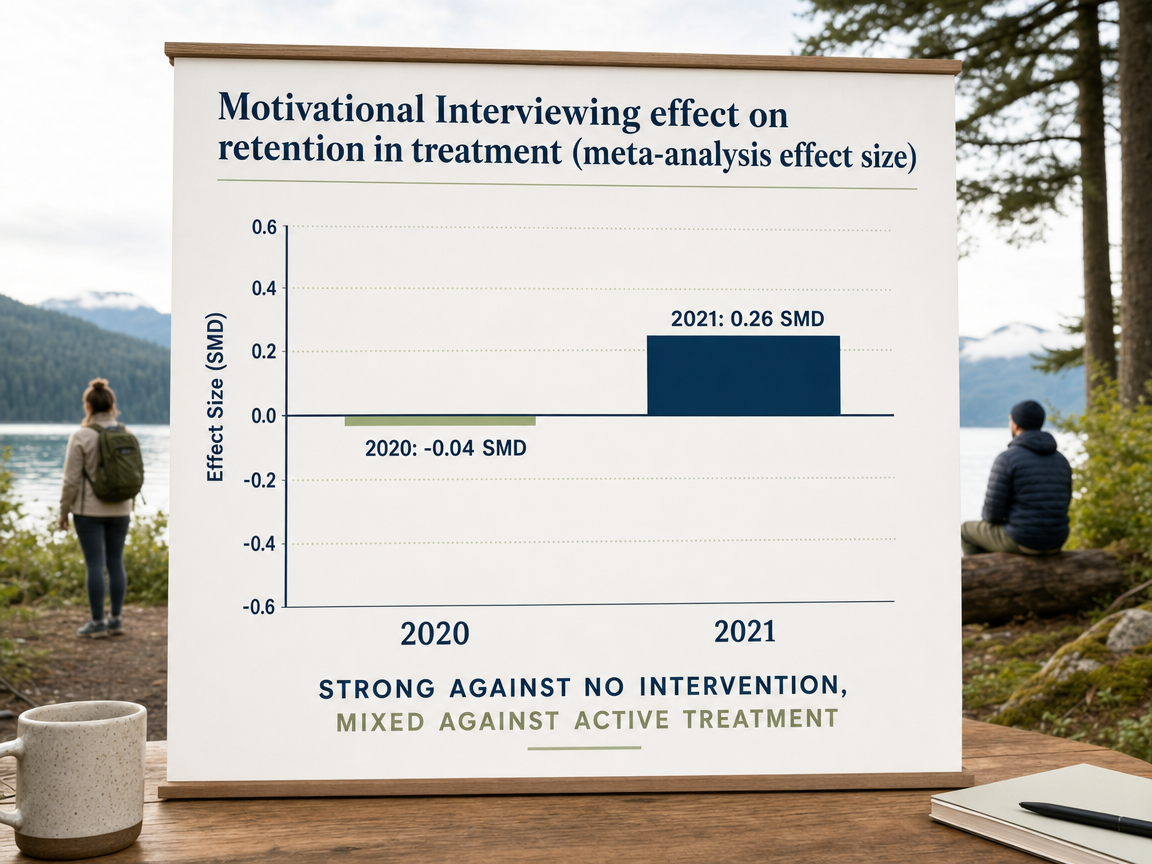
Strong Against No Intervention, Mixed Against Active Treatment
Here is the honest read of what motivational interviewing actually does, because if you are going to use it with a resistant client, you deserve accurate expectations rather than marketing.
The 2023 Cochrane review pooled 93 randomized controlled trials with 22,776 participants and found that MI produced a small-to-moderate benefit over no intervention post-treatment, with a standardized mean difference of 0.48 (95% CI 0.07 to 0.89) 1. That is a real effect, and it is the number people usually cite when they say MI "works." But look at the comparator. The strong showing is against doing nothing. When MI was compared with treatment as usual or another active intervention, the review found little to no difference in substance use outcomes, and the confidence in that body of evidence ranged from moderate to very low 1.
So when you deploy MI with a resistant person in Portland, you are buying entry, retention, and the space for other evidence-based care to do its job. That is enough. It is not everything.
Where MI Actually Works: Population-by-Population Calibration
The average effect size across all substance use trials hides real variation between populations. Before you rely on MI with a specific resistant case, calibrate your expectations to who is sitting across from you.
- General substance use.
- The Cochrane pooled estimate (SMD 0.48 versus no intervention) is where the average adult with an unspecified substance use disorder lives on the evidence map 1. A meaningful edge against non-engagement, roughly a wash against active treatment.
- Alcohol use disorder.
- A 2024 evidence review of MI and motivational enhancement therapy for AUD found that several studies reported significant reductions in overall alcohol use, binge or heavy drinking, and high treatment retention 6. AUD is where you can lean into MI with more confidence, particularly for the ambivalent professional or parent who insists their drinking is "just stress." Results were still mixed across studies, so treat MI as a strong opener rather than a complete treatment plan.
- Dual diagnosis.
- A 2025 systematic review of eight RCTs in co-occurring psychiatric and substance use conditions found relapse-related outcomes improved significantly in favor of MI in some studies, though heterogeneity and methodological limits kept the overall picture cautious 7. Translation: MI can help, but the co-occurring condition needs its own treatment plan running alongside.
- Co-occurring anxiety specifically.
- A 2024 review of MI-based interventions for people with co-occurring anxiety and substance misuse—covering both in-person and online delivery—reported promising reductions in both substance misuse and anxiety symptoms 5. If untreated anxiety is what your client is medicating, MI plus anxiety-focused care is a more realistic package than MI alone.
- Adolescents.
- This is where enthusiasm needs to come down. A meta-analysis of MI for illicit drug use in adolescents found no statistically significant effect on drug use behavior, though attitude change was significant 9. So you can move a teenager's stated position with MI. Getting the behavior to follow is a harder problem, and you should not promise families otherwise.
- Justice-involved adults.
- The strongest calibration point. A systematic review of MI with justice-involved adults identified five RCTs, and all five found no difference between groups at the latest follow-up 8. If you are working DUII cases, probation referrals, or drug court coordination in Multnomah County, do not oversell MI as the mechanism. Use it because it does not do harm and it can open a door. Do not use it because you expect it to change outcomes at follow-up in this specific population.

MI Mechanics You Can Deploy Tomorrow
Change Talk, Sustain Talk, and Discord: What to Reinforce, What to Sit With
You already have the skills. What sometimes slips in a resistant case is the discipline of what you reinforce and what you let breathe.
Change talk is any client utterance that points toward movement: desire ("I wish I slept better"), ability ("I could probably go a week without it"), reasons ("my daughter noticed"), need ("I can't keep doing this"), and the stronger commitment language that follows ("I'll try," "I'm going to," "I called my sister about it"). When you hear it, your job is to reflect it back, ask for elaboration, and let the client hear their own words again. That is the reinforcing move SAMHSA describes as the core operational skill of MI—drawing out and strengthening the person's own motivation rather than supplying yours 2.
Sustain talk is the mirror image: reasons to stay the same. "It helps me unwind." "I've tried before and it didn't work." "My friends all drink like this." The instinct is to argue. Don't. Sit with it. Reflect it accurately, sometimes with a slight amplification, and wait. When you argue against sustain talk, you take up the change-side of the ambivalence yourself, which frees the client to defend the other side more forcefully. You have probably watched this happen in real time and felt the room close.
Discord is different from sustain talk. Discord is friction between you and the client—defensiveness aimed at you, the referral source, or the family member who forced the appointment. Sustain talk is about the substance. Discord is about the relationship. You handle them differently. Sustain talk you reflect. Discord you repair, usually by naming it plainly, dropping the agenda for a moment, and reaffirming the client's autonomy. NIDA's implementation guidance specifically frames MI as an engagement and retention tool, which is exactly what discord repair protects 4.
One practical calibration: count your reflections against your questions in the next resistant session. If you are asking more than you are reflecting, you are probably driving. Slow down.
The Planning Phase Is the Bridge to Enrollment
Most MI training front-loads engaging, focusing, and evoking. The planning phase gets short shrift, and that is where resistant cases actually get lost.
Planning is the process you move into once change talk starts to consolidate—when the client's own reasons for change begin to outweigh their reasons to stay the same, and you hear commitment language rather than just possibility language. SAMHSA's advisory treats planning as a distinct MI process, not an afterthought, and describes it as the bridge between motivation and action 2. That framing matters because a resistant client who finally says "okay, maybe I should look into something" is not automatically going to a program. They are at the edge of a decision that can evaporate in the parking lot.
What planning looks like in practice: you shift from evoking to menu-building. You ask permission to share what options exist. You offer two or three concrete Portland-area pathways—an intensive outpatient program, a specific outpatient assessment appointment, a same-day OHP behavioral health enrollment call—and let the client choose. You write down the next step with them. You confirm who is making the call and when. You do not leave planning as a vague "I'll think about it."
The evidence supports this operational emphasis. NIDA's guidance highlights MI's specific role in engaging and retaining people in treatment, which is downstream of a concrete plan, not a stated intention 4. If change talk emerges and you do not translate it into a scheduled action within the same session, you have done half the work. The planning phase is where MI stops being a conversation and starts being a referral.
Real Recovery Starts in Portland, Oregon
Call now or verify insurance to take the first step toward lasting recovery in Portland.
The Portland Handoff: What to Do the Hour After Change Talk Appears
Oregon's No-Referral Access Mechanism
Here is the piece most out-of-state MI training misses: in Oregon, you do not have to route a client through a primary care provider to get them into behavioral health treatment. The Oregon Health Plan states it plainly—no referral is required from a PCP to access treatment, and specifically, no referral is required to get help for problems with alcohol or drugs 11. That single policy detail is why MI's planning phase can convert to enrollment inside a week in Portland, rather than stalling in a two-week authorization queue like it might in other states.
What that means operationally: when your client's ambivalence tips toward action, you are not calling their PCP. You are calling an outpatient program directly, or helping the client call, or scheduling an OHP behavioral health intake. The Oregon Substance Use Disorders Services Directory lists Portland-area programs across East Burnside, SE Division, NE MLK Jr. Boulevard, and west-side locations, which gives you geographic flexibility when a client's commute or transit access matters to whether they show up 12.
Use that density. If a client lives in Lents and works downtown, offer two options in each direction. Ambivalent clients look for reasons to postpone, and "it's too far" is a common one. Removing that friction is part of the plan you build together. This is the difference between MI as a conversation and MI as a referral that actually happens.
IOP, Step-Down, and Why Residential Is Rarely the Same-Day Answer
You may want to send a resistant client straight to residential care. Families often ask for it. Sometimes it is genuinely indicated. But if your MI session ends with an agreement to enter treatment this week, the realistic Portland pathway is almost always intensive outpatient, not a residential bed.
Oregon's Behavioral Health Residential Facility Study describes a system where residential capacity is constrained and demand outpaces availability 15. A same-day residential admission is uncommon. Waitlists, insurance coordination, and bed availability mean that a client who says "okay, I'll go" on Tuesday afternoon is not usually walking into a residential program on Wednesday morning. If you tell the family otherwise, you lose credibility the moment reality sets in—and you lose the client's fragile commitment along with it.
What works instead: build the plan around IOP, or around IOP as a step-down from a detox partnership when withdrawal risk requires medical stabilization first. Portland has a dense outpatient network across multiple neighborhoods 12, and IOP allows the client to keep working or maintaining custody arrangements while doing structured treatment three to five days a week.
Be honest with the family in the same conversation. "Residential may come later. Right now, the fastest evidence-based step is intensive outpatient this week." That framing holds the client accountable, respects their autonomy, and does not promise a bed you cannot deliver.
Co-Occurring Care When Anxiety or Untreated Psychiatric Symptoms Drive the Ambivalence
A lot of what looks like treatment resistance is actually untreated anxiety, PTSD, or depression running underneath the substance use. The client is not refusing help. They are self-medicating a symptom no one has addressed, and every conversation about giving up the substance sounds, to them, like being asked to give up the only thing that has ever quieted the noise.
MI helps here, but not alone. The 2024 review of MI-based interventions for people with co-occurring anxiety and substance misuse found promising reductions in both substance use and anxiety symptoms when MI was paired with anxiety-focused care, delivered either in person or online 5. The 2025 dual diagnosis review of eight RCTs likewise found relapse-related outcomes improved in some studies when MI was used within an integrated treatment approach 7. The pattern in both bodies of evidence: MI opens the door, but the co-occurring condition needs its own treatment plan running alongside.
When you build the planning-phase referral, ask about the psychiatric layer explicitly. Is the client already prescribed anything? Have they ever been assessed? A Portland IOP that includes co-occurring mental health support alongside SUD treatment is a more realistic fit than a substance-only program. If the ambivalence is being fed by an untreated symptom, the plan needs to address both, or the client will be back where they started within a month.
Urgency Framing Without the Drumbeat
You need urgency in the room, but not the kind that turns into a lecture. Statistics do not shift ambivalence. What they can do, used once and precisely, is give you an honest frame for why the window matters.
Oregon recorded 1,833 overdose deaths in 2023, 1,544 in 2024, and roughly 1,100 provisional deaths in 2025, per the Oregon Health Authority 13. That is a real decline, not a rounding artifact, though CDC notes provisional counts are subject to revision as reporting catches up 14. Two things are true at once: the trend is moving in the right direction, and mortality is still elevated enough that a resistant client's next six months are not a neutral variable.
Use that framing sparingly. Do not open the session with it. Do not repeat it every time sustain talk shows up. If it belongs anywhere, it belongs in a private conversation with the family or referring party who needs to understand why the planning phase cannot become a six-week negotiation. For the client, autonomy language works better than mortality language. The numbers are context for you, not ammunition for them.
Common MI Missteps in Resistant Cases
A few patterns show up over and over in resistant intakes, and most of them come from good clinicians pressing too hard.
- The first is arguing against sustain talk. You hear "it helps me relax" and reach for the counter-evidence. The moment you do, the client's role shifts to defending the substance, and the ambivalence you were trying to surface gets buried under debate. Reflect it, sit with it, wait for the other side to emerge on its own 2.
- The second is skipping the planning phase. Change talk appears, you feel the relief, and you end the session on "okay, think about it." A week later the client has not called anyone. Planning is a distinct MI process, not a wrap-up—write down the concrete next step before the client leaves the room 2.
- The third is overselling MI in populations where evidence is thin. In DUII and probation-referred cases, five RCTs found no group differences at latest follow-up 8. Use MI because it does not do harm and it opens doors. Do not promise the family a behavioral outcome the evidence does not support.
- The fourth is treating discord as sustain talk. When the client pushes back at you, not the substance, you repair the relationship first.
If You Coordinate Care Across Multiple Portland-Area Programs
A quick audience shift: this section is for readers whose job spans more than one program—drug court coordinators moving clients between DUII assessment and outpatient care, EAP counselors placing employees across east-side and west-side options, or interventionists managing handoffs between a detox partner and an IOP.
When you work across programs, MI's engagement gains can evaporate at the seams. A client who reached commitment language on Monday may lose it by Thursday if the receiving program's intake feels like starting over. Use the density of the Portland network to your advantage—East Burnside, SE Division, NE MLK Jr. Boulevard, west-side sites 12—but standardize the handoff itself. Share the MI-derived change goals with the receiving clinician in writing, so the next session opens where the last one closed rather than restarting the ambivalence conversation.
Frequently Asked Questions
Does motivational interviewing actually work for someone who refuses treatment?
Yes, but calibrate what "works" means. MI shows a small-to-moderate benefit over no intervention across 93 RCTs, and its clearest value is engaging and retaining people who would otherwise disengage entirely 1, 4. It is not a persuasion tool that flips refusal into consent. Think of it as the method most likely to keep the conversation open until change talk emerges.
How is MI different from confrontational intervention approaches?
Confrontational approaches supply the reasons for change from the outside. MI draws them out from the client. SAMHSA describes MI as a method for encouraging and strengthening a person's own motivation, not arguing against their position 2. In resistant cases, confrontation typically hardens sustain talk, while MI reflects it back and waits for the client's own change talk to surface.
Can a client start Portland outpatient treatment without a primary care referral?
Yes. The Oregon Health Plan explicitly states that no PCP referral is required to access behavioral health treatment, and specifically no referral is required for alcohol or drug problems 11. That is why MI's planning phase can convert to an intake within the same week in Portland. You or the client can call an outpatient program directly from the density of options listed in the state directory 12.
How well does MI work with justice-involved clients on probation or in DUII programs?
The evidence is thin. A systematic review of MI with justice-involved adults identified five RCTs, and all five found no group differences at latest follow-up 8. Use MI in DUII and probation contexts because it does not do harm and it can open a door to engagement. Do not promise the court, the family, or yourself a behavioral outcome the current evidence does not support in this population.
What should I do the moment change talk appears in a session?
Reflect it, ask for elaboration so the client hears their own words again, and then move into planning before the session ends 2. Offer two or three concrete Portland-area options—a specific IOP intake, an OHP behavioral health call, an outpatient assessment 11, 12. Write down who is calling whom and when. A vague "I'll think about it" usually evaporates by the next morning. Warm, scheduled next steps hold.
Is MI enough on its own when a client has untreated anxiety or another co-occurring condition?
No. MI can open the door, but the co-occurring condition needs its own treatment plan running alongside. A 2024 review found MI-based interventions for people with co-occurring anxiety and substance misuse produced promising reductions in both when paired with anxiety-focused care 5. Dual diagnosis reviews show a similar pattern—MI helps, but only within integrated care 7. Route the client toward a program offering co-occurring mental health support.
References
- Motivational interviewing for substance use reduction. https://pmc.ncbi.nlm.nih.gov/articles/PMC10714668/
- Using Motivational Interviewing in Substance Use Disorder Treatment. https://library.samhsa.gov/sites/default/files/PEP20-02-02-014.pdf
- Using Motivational Interviewing in Substance Use Disorder Treatment. https://www.samhsa.gov/resource/recovery/using-motivational-interviewing-substance-use-disorder-treatment
- Motivational Interviewing Assessment. https://nida.nih.gov/sites/default/files/MIA-STEP_Factsheet.pdf
- Motivational Interviewing-Based Interventions with Patients .... https://pmc.ncbi.nlm.nih.gov/articles/PMC11608130/
- Motivational interviewing and motivational enhancement therapy for the treatment of alcohol use disorders.. https://case.edu/socialwork/centerforebp/sites/default/files/2024-11/MI%20and%20MET%20for%20AUD%20Full%20Report-09242024-upd-11-15-2024.pdf
- Outcomes and Challenges of Motivational Interviewing in Dual Diagnosis Treatment-A Systematic Review. https://pubmed.ncbi.nlm.nih.gov/39798118/
- A Systematic Review of Motivational Interviewing to Address Substance Use with Justice-Involved Adults. https://pubmed.ncbi.nlm.nih.gov/33726607/
- Effectiveness of motivational interviewing to reduce illicit drug use in adolescents: a systematic review and meta-analysis. https://pubmed.ncbi.nlm.nih.gov/26687544/
- Motivational interviewing for substance use reduction. https://pubmed.ncbi.nlm.nih.gov/38084817/
- Oregon Health Plan (OHP) Behavioral Health Coverage. https://www.oregon.gov/oha/hsd/ohp/pages/behavioral-health.aspx
- Oregon Substance Use Disorders Services Directory. https://www.oregon.gov/oha/BH/Adults/Documents/provider-directory.pdf
- Oregon overdose deaths declined in 2024, 2025. https://www.oregon.gov/oha/erd/pages/oregon-overdose-deaths-declined-in-2024-2025-05.13.2026.aspx
- Provisional Drug Overdose Death Counts. https://www.cdc.gov/nchs/nvss/vsrr/drug-overdose-data.htm
- Oregon Behavioral Health Residential+ Facility Study. https://www.oregon.gov/oha/hsd/amh/DataReports/Behavioral-Health-Residential-Facility-Study-June-2024.pdf
- County Directory of Substance Use Disorder .... https://www.oregon.gov/oha/HSD/AMH/DataReports/SUD-Services-Directory-2023.pdf
Relapse Doesn't Mean the End Of Your Journey
Reach out today to explore programs that support real, long-term sobriety.