




How to Find the Most Effective Addiction Treatment Methods

Key Takeaways
- Effective addiction care is a deliberate stack: matched intensity, proven modalities, medications where indicated, and continuing support held together long enough for gains to hold 15, 9.
- Medications carry the strongest evidence tier—buprenorphine and methadone are first-line for opioid use disorder, and acamprosate, disulfiram, and naltrexone anchor alcohol pharmacotherapy 1, 9.
- CBT, motivational interviewing, contingency management, and relapse prevention share broad empirical support across substances; fidelity, dose, and fit matter more than picking one winner 8, 11.
- Mindfulness-Based Relapse Prevention shows meaningful short-term gains but decays without continued practice support, so build it in with continuity rather than as a one-time module 12.
- ASAM level-of-care matching depends on a multidimensional picture, not a single score—environmental scaffolding and co-occurring load shape whether a placement will actually hold 13, 2.
- Intensive outpatient is where recovery gets rehearsed against real life, producing outcomes comparable to residential once acuity is stabilized and skills get pressure-tested at home 10.
- Co-occurring capable programming—integrated screening, trauma-informed groups, and coordinated psychiatric care—outperforms siloed treatment, while acute psychiatric needs still require specialty referral 7, 13.
- Aftercare must be designed on day one: step-down cadence, continued pharmacotherapy, peer support, and housing scaffolding prevent the post-IOP skill decay that undoes clinical gains 12, 6, 14.
What 'Effective' Actually Means in Addiction Care
If you've spent any time in this work, you already know the word effective gets stretched thin. A weekend detox is called effective. A 28-day residential stay is called effective. A single CBT group is called effective. All of these can matter, but none of them alone carry a person from active use into a durable recovery.
The research is clearer than the marketing. NIDA's principles frame effective care as individualized, long enough to work, and built to address more than the substance use itself—medical, psychological, social, and legal needs sit inside the same plan 15. SAMHSA sharpens the point: for opioid and alcohol use disorders, the strongest outcomes come from combining medication with counseling and behavioral therapy in a whole-patient approach, with measurable gains in survival and treatment retention 9.
So when you evaluate a method, you're really evaluating a stack. Level of care matched to acuity. Medications where indicated. Psychosocial therapies with evidence behind them. Integrated attention to co-occurring conditions. Recovery support that continues after the structured phase ends. Oregon's Tri-County best-practice guidelines put it plainly for the Portland metro region: recovery is probable given the right treatment, support, and self-management skills, delivered with dignity and person-first language 14.
The Evidence-Graded Hierarchy of Treatment Methods
Strongest Evidence: MOUD and Alcohol Pharmacotherapy
If you have to point to one tier of treatment where the science is settled, it's medication. For opioid use disorder, the 2024 national guideline update names buprenorphine and methadone as equal first-line options and explicitly discourages withdrawal management alone, citing higher rates of relapse, morbidity, and mortality when medication is left out 1. That's not a soft recommendation—it's a redirection of decades of practice that treated detox as a finish line.
The FDA-approved medication list for opioid use disorder is short and clinically distinct:
- Buprenorphine (partial agonist, reduces withdrawal and craving, supports retention)
- Methadone (full agonist, delivered through licensed opioid treatment programs, strong evidence for reducing overdose mortality)
- Extended-release naltrexone (opioid antagonist, blocks the effect after full detoxification) 3
Each does something different, and matching the medication to the person's situation—prior treatment history, tolerance, housing stability, access to a dosing site—matters more than picking a favorite.
Alcohol use disorder has its own pharmacotherapy toolkit, often underused in outpatient design. SAMHSA identifies acamprosate, disulfiram, and naltrexone as the primary options, and frames the whole-patient model plainly: medications combined with counseling and behavioral therapies improve survival, increase treatment retention, and reduce illicit opioid use 9.
For program design, the operational takeaway is direct. If your IOP or continuum isn't set up to initiate, coordinate, or actively refer for MOUD and alcohol pharmacotherapy—including handling the referral warmth so people don't fall out between phone calls—you're missing the tier with the strongest evidence behind it. Everything else you build should sit on top of that layer, not around it.
Strong Evidence: CBT, MI, Contingency Management, and Relapse Prevention
The psychosocial tier is where most of the day-to-day work of an IOP actually happens, and the evidence here is broad rather than narrow. Cognitive-behavioral therapy, motivational interviewing, and relapse prevention training carry consistent empirical support across multiple substances—not just alcohol, not just opioids 8. That cross-substance durability is why these three show up in nearly every well-designed outpatient curriculum in the Pacific Northwest.
Contingency management sits alongside them with strong trial data, particularly for stimulants where pharmacotherapy options are limited. It's the modality most often left out of programs, usually for philosophical rather than evidentiary reasons—some clinicians resist paying incentives for negative screens, even though the trials keep pointing the same direction 11.
The NIDA/SAMHSA monograph on intensive outpatient approaches groups these methods together with 12-Step facilitation, the Matrix model, and community reinforcement, and offers a useful humility check: Project MATCH compared 12-Step facilitation, CBT, and motivational enhancement therapy, and found little difference in drinking outcomes by treatment type over one year, with only a slight longer-term edge for 12-Step facilitation 11. Translation: no single psychosocial method has earned the crown. What differentiates outcomes is fidelity, dose, and how well the modality fits the person in front of you.
For a peer designing programming, this changes the question. It's not which therapy is best—it's which combination is delivered with enough consistency to hold. A curriculum that runs CBT groups on Monday, MI-informed individual sessions midweek, relapse prevention skills training as its own track, and structured recovery-support integration on the back end is doing more than a program that picks one modality and stretches it across every slot. The Tri-County Oregon guidelines call this recovery-oriented, trauma-informed, person-first care—and they mean the whole stack, delivered together 14.
Emerging and Adjunctive: Mindfulness-Based Relapse Prevention
Mindfulness-Based Relapse Prevention sits in a different category than CBT or MOUD—not because it doesn't work, but because the evidence is narrower and the study designs are smaller. The most-cited trial is an 8-week pilot RCT of MBRP as aftercare for adults who had completed intensive inpatient or outpatient treatment, compared against treatment-as-usual 12-Step-oriented aftercare 12.
The headline result is striking: at 2 months post-intervention, MBRP participants reported 2.1 days of substance use versus 5.4 days in the treatment-as-usual group, along with lower craving and higher acceptance and acting-with-awareness scores 12. That's a meaningful gap in a short window.
Here's the part that keeps this modality in the emerging tier rather than the strongest one: those gains diminished by the 4-month follow-up, once participants returned to standard aftercare without continued mindfulness practice support 12. It was a pilot, the sample was limited, and the effect did not carry itself. That's not a reason to skip MBRP—it's a reason to build it in with continuity, not as a one-time 8-week module that ends and expects the benefit to hold.
For IOP and aftercare design in Portland and Central Oregon, the practical read is straightforward. Mindfulness-based work belongs in the mix as an adjunct to CBT and relapse prevention training, ideally with a plan for ongoing practice—drop-in groups, alumni sessions, or integrated mindfulness moments inside standard curricula—so the skill doesn't decay when the formal cohort ends.
Real Recovery Starts in Portland, Oregon
Call now or verify insurance to take the first step toward lasting recovery in Portland.
Matching People to Methods: The ASAM Continuum in Oregon Practice
How Level of Care Is Determined
Matching level of care is harder than the acronyms suggest. You already know the six ASAM dimensions—withdrawal risk, biomedical conditions, emotional/behavioral/cognitive conditions, readiness to change, relapse potential, and recovery environment. The Fourth Edition adds a person-centered considerations layer and treats co-occurring conditions as an expectation, not an exception 13. That framing changes what a competent assessment actually produces.
In practice, the number that comes out of the assessment isn't the point. The point is the multidimensional picture: someone with moderate opioid use disorder, stable housing, no acute withdrawal, a supportive partner, and a prior residential episode that didn't hold is a different clinical story than someone with the same substance profile who is unhoused, in early ambivalence, and coming off a jail release. Both may score into Level 2.1 on paper. Only one has the environmental scaffolding for it to work as written.
Oregon's regulatory framework backs this up. Division 019 aligns licensed SUD programs with ASAM criteria and specifies that intensive outpatient services generally provide nine or more hours per week of structured treatment and recovery support 2. But the rules don't tell you when to hold someone at Level 3 for another two weeks because Dimension 6 is unstable. That's clinical judgment, informed by the assessment, documented in the record.
The Tri-County Oregon guidelines add the ethical layer: person-first language, trauma-informed practice, and treating individuals seeking care with dignity 14. If your assessment process feels like a triage form rather than a conversation, the level-of-care decision that follows will be brittle—and the person will feel it before your quality reviewer does.
The Level-of-Care Matrix: Hours, Acuity, and Where Modalities Land
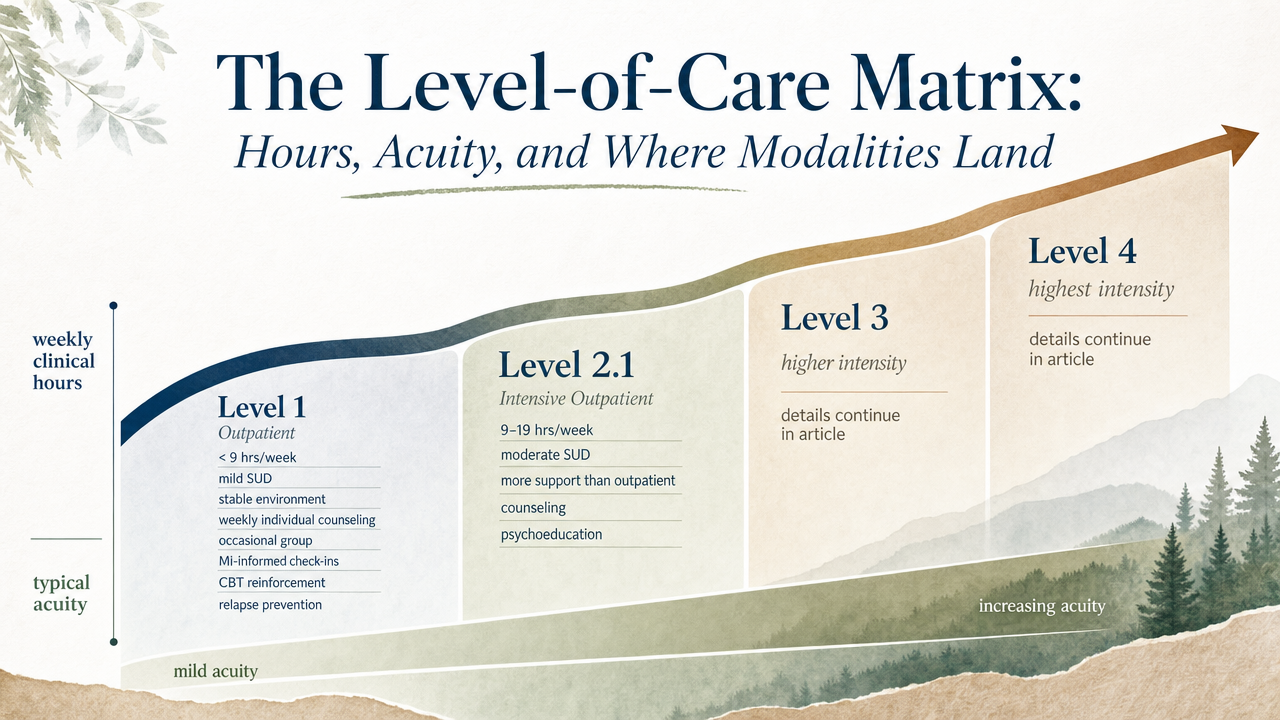
Here's the operational picture peer readers actually want on the wall. The ASAM Fourth Edition sets the intensity gradient by weekly clinical hours, and Oregon's Division 019 mirrors it in state rule 13, 2.
Level 1 Outpatient: fewer than 9 hours of clinical services per week. Typical acuity is mild SUD, stable environment, someone who can hold recovery gains with weekly individual counseling and occasional group work. Modalities here lean on MI-informed check-ins, CBT skills reinforcement, and relapse prevention maintenance.
Level 2.1 Intensive Outpatient: 9 to 19 hours of clinical services per week, delivered primarily through counseling and psychoeducation 13. The Oregon Governor's Office briefing describes the typical profile as moderate SUD with a need for more support than standard outpatient can provide, but with the capacity to live independently and engage in structured therapy, skill-building, peer support, and recovery support 5. This is where the bulk of the psychosocial stack lives—CBT groups, MI, relapse prevention training, contingency management where the program is set up for it, and integrated co-occurring capable care.
Level 2.5 High-Intensity Outpatient: higher weekly hours than 2.1, for people who need more clinical contact than standard IOP but don't require a residential bed. Common for individuals stepping down from residential with unresolved acuity in emotional/behavioral dimensions, or stepping up from Level 2.1 when relapse risk climbs.
Level 3 Residential: 24-hour structured setting, ranging from clinically managed low-intensity (3.1) through medically monitored (3.7). Modality delivery shifts to milieu-based work, daily group programming, and stabilization of Dimension 6 environmental factors that make outpatient nonviable.
Level 4 Medically Managed Inpatient: acute medical or psychiatric acuity requiring 24-hour physician availability. This is stabilization, not treatment completion.
For program design in the Pacific Northwest, the matrix is a placement tool and a step-planning tool at once. Someone finishing residential in Portland doesn't move to Level 1 on discharge day—they move to 2.1 or 2.5, where the relapse prevention curriculum can actually be delivered at the dose the research supports. Skipping the middle rungs is one of the most common reasons gains from residential don't hold.
Why Intensive Outpatient Carries the Durability of Recovery
Residential and detox stabilize. IOP is where recovery actually gets rehearsed against real life. That distinction matters more than the field usually admits, because it's the reason gains from a 30- or 60-day residential stay so often fade in the weeks after discharge—there was no structured setting to translate the skills into a Tuesday morning at work, a Friday night with old friends, a Sunday alone with a craving.
The systematic review evidence is direct about what IOP delivers when it's built well. Across randomized and quasi-experimental studies, outcomes for intensive outpatient programs are comparable to inpatient or residential treatment for most people, with consistent reductions in alcohol and drug use from baseline to follow-up 10. That's not a claim that IOP replaces residential for everyone—someone in acute withdrawal or without stable housing needs the higher level first. It's a claim that once acuity is managed, the outpatient setting is where durability is built, not sacrificed.
Three features separate a durability-generating IOP from a step-down box to check:
- Dose: nine to nineteen hours of clinical services weekly is enough time to run CBT groups, individual sessions, relapse prevention skills training, and integrated co-occurring work without collapsing them into a single track 13.
- Real-life application: people go home each night, encounter their actual triggers, and bring what happened back into group the next session. Skills get pressure-tested in the environment where they'll have to hold.
- Continuity: IOP is the phase where MOUD adherence, alcohol pharmacotherapy, and peer support get woven into a routine the person can carry forward.
For Oregon addiction treatment and programs across the Pacific Northwest, this reframes IOP's role. It's not the discount version of residential. It's the phase where relapse prevention stops being a curriculum and becomes a practice—the connective tissue that carries clinical gains into a life someone actually lives.
Integrated Co-Occurring Care Without Overreach
You already know that most people walking into SUD treatment carry more than the substance use. Depression, PTSD, anxiety, unprocessed grief—these sit in the same body as the opioid use disorder or the alcohol use disorder, and pretending otherwise breaks the treatment plan before it starts. The review evidence on integrated care is clear: coordinated psychosocial and pharmacologic treatment of substance use alongside co-occurring mental health conditions is associated with better substance use and psychiatric outcomes than treating them in separate silos 7.
That finding gets misread often, so it's worth stating plainly. Integrated does not mean an SUD program becomes a primary mental health clinic. It means the program is co-occurring capable—equipped to screen for depression, PTSD, and anxiety, to hold trauma-informed group work, to coordinate psychiatric medication management alongside MOUD, and to keep the mental health thread visible inside SUD sessions rather than farming it out and hoping the two clinicians talk. The ASAM Fourth Edition names this expectation directly: co-occurring conditions are the norm, not the exception, and programs should be built accordingly 13.
Aftercare and the Long Tail: What Sustains Gains After IOP
The weeks after IOP ends are where a lot of good clinical work quietly comes undone. Not because the person did anything wrong—because the scaffolding dropped. Group met three times a week, then it didn't. The individual counselor was in the calendar, then wasn't. That drop-off is a design problem, not a character flaw.
The mindfulness-based relapse prevention data makes the point concretely. In the pilot trial, aftercare participants who kept practicing showed meaningful reductions in use at two months, then those gains diminished by the four-month follow-up once they returned to standard aftercare without continued support 12. Skills decay when the container disappears. That pattern isn't unique to mindfulness work—it applies to CBT skills, relapse prevention rehearsal, and the routines around MOUD adherence too.
A functional aftercare plan in Oregon addiction treatment has a few moving parts:
- Step-down to Level 1 outpatient with a real cadence, not a courtesy check-in.
- Continued MOUD or alcohol pharmacotherapy management with a clear prescribing home, so no one runs out mid-transition 1.
- Peer support and recovery community integration—the CDC's summary lists this alongside medications and counseling for a reason 6.
- Sober living or structured housing when Dimension 6 environmental factors are still fragile.
- Alumni groups, drop-in relapse prevention sessions, and family involvement where appropriate.
The Tri-County Oregon guidelines call this a recovery-oriented system of care—coordinated support that follows the person across levels rather than dropping them at each discharge 14. Build the long tail into the treatment plan on day one, not as a discharge afterthought. That's what makes the gains hold.
A Decision Lens: Matching the Person to the Stack
Here's the shorthand peer readers can actually use at intake. Four variables move most placement decisions: acuity, co-occurring load, prior treatment history, and social supports. Run them together, not separately.
- Acuity.
- Withdrawal risk, medical instability, and severity of use set the floor. If someone needs medically monitored withdrawal management or has active suicidality, outpatient isn't the starting line—stabilization is 13. Once that's handled, MOUD initiation belongs in the plan on day one for opioid use disorder, not as a later add-on 1.
- Co-occurring load.
- Depression, PTSD, and anxiety are the norm, not the exception. Programs that are co-occurring capable produce better substance use and psychiatric outcomes than parallel silos 7. If the co-occurring picture crosses into primary severe mental illness, coordinate a mental health specialty referral and hold the SUD thread in parallel.
- Prior treatment history.
- A first episode looks different than a fifth. Someone with three residential stays that didn't hold usually needs a longer outpatient tail, not another residential round—the durability layer was missing, not the stabilization.
- Social supports.
- Housing, employment, family, sober community. When Dimension 6 is fragile, sober living or structured housing belongs in the stack alongside CBT groups and MOUD. That's the piece that keeps everything else standing.
Frequently Asked Questions
Which addiction treatment method has the strongest evidence behind it?
For opioid use disorder, medications carry the strongest evidence. The 2024 national guideline update names buprenorphine and methadone as first-line treatments and discourages withdrawal management alone because of higher relapse, morbidity, and mortality without medication 1. For alcohol use disorder, SAMHSA identifies acamprosate, disulfiram, and naltrexone, combined with counseling, as the whole-patient approach with the most consistent outcomes 9.
Is intensive outpatient treatment really as effective as residential care?
For most people whose acuity is already stabilized, yes. A systematic review of randomized and quasi-experimental studies found IOP outcomes comparable to inpatient or residential treatment, with consistent reductions in alcohol and drug use from baseline to follow-up 10. The caveat matters: someone in acute withdrawal, without stable housing, or with active suicidality needs the higher level of care first. IOP builds durability once stabilization is handled, not before.
Do people on MOUD still need counseling and behavioral therapy?
The 2024 guideline update is clear that psychosocial care should be offered but not required as a condition of MOUD access 1. That said, SAMHSA's whole-patient model shows medication combined with counseling and behavioral therapies improves survival and retention 9. Offer it, make it accessible, and honor the person's choice—do not gate life-saving medication behind counseling attendance.
How is the right ASAM level of care determined for someone entering treatment?
Through a multidimensional assessment across six ASAM dimensions plus the Fourth Edition's person-centered considerations layer, treating co-occurring conditions as an expectation rather than an exception 13. Withdrawal risk, medical and psychiatric status, readiness to change, relapse potential, and recovery environment all factor in. The Oregon Governor's Office briefing frames the same assessment for state-level placement, matching acuity to intensity across Levels 1 through 4 5.
What happens after IOP ends, and how do people sustain recovery long-term?
A functional aftercare plan includes step-down to Level 1 outpatient with a real cadence, continued MOUD or alcohol pharmacotherapy management, peer support, and sober living where the environment is fragile. The CDC groups medications, counseling, and peer support together for a reason 6. The Tri-County Oregon guidelines call this a recovery-oriented system of care—coordinated support that follows the person across levels rather than dropping them at discharge 14.
How are co-occurring mental health conditions addressed inside SUD treatment?
Through co-occurring capable programming—screening for depression, PTSD, and anxiety, holding trauma-informed groups, and coordinating psychiatric medication alongside SUD care. Integrated treatment is associated with better substance use and psychiatric outcomes than siloed care 7. Primary severe mental illness or acute psychiatric crises belong in the mental health specialty system, with warm handoff and continued SUD support running in parallel rather than one program trying to be everything.
References
- Management of opioid use disorder: 2024 update to the national guideline. https://pmc.ncbi.nlm.nih.gov/articles/PMC11573384/
- Oregon Administrative Rules – Division 019: Substance Use Disorders. https://www.oregon.gov/oha/HSD/HSDRules/Perm309-019.04072023.pdf
- Information about Medications for Opioid Use Disorder (MOUD). https://www.fda.gov/drugs/food-and-drug-administration-overdose-prevention-framework/information-about-medications-opioid-use-disorder-moud
- Substance Abuse Intensive Outpatient Programs: Assessing the Evidence. https://pmc.ncbi.nlm.nih.gov/articles/PMC4152944/
- Substance Use Disorder Process Addiction Treatment (Oregon Governor’s Office). https://www.oregon.gov/gov/policies/Documents/Substance%20Substance_Use_Disorder_Process_Addiction_Treatment.pptx
- Treatment and Recovery. https://www.cdc.gov/drugoverdose/featured-topics/treatment-recovery.html
- Integrated Treatment of Substance Use and Co-occurring Mental Disorders. https://pmc.ncbi.nlm.nih.gov/articles/PMC8296078/
- Evidence Based Psychosocial Interventions in Substance Use. https://pmc.ncbi.nlm.nih.gov/articles/PMC4031575/
- Treatment Options for Substance Use Disorder. https://www.samhsa.gov/substance-use/treatment/options
- Substance abuse intensive outpatient programs: assessing the evidence. https://pubmed.ncbi.nlm.nih.gov/24445620/
- Chapter 8. Intensive Outpatient Treatment Approaches. https://www.ncbi.nlm.nih.gov/books/NBK64102/
- Mindfulness-Based Relapse Prevention for Substance Use Disorders: A Pilot Efficacy Trial. https://pmc.ncbi.nlm.nih.gov/articles/PMC3280682/
- The ASAM Criteria: Fourth Edition – Summary. https://hcpf.colorado.gov/sites/hcpf/files/ASAM-Fourth-Ed-Disseminate-Summary.pdf
- Tri-County Oregon Substance Use Disorder Best Practice Guidelines. https://www.oregon.gov/oha/HSD/AMHPAC/Treatment%20Meeting%20Documents/DRAFT-SUD-Best-Practice-Guidelines-July-EDITS.pdf
- NIDA Principles of Drug Addiction Treatment: A Research-Based Guide (Third Edition). https://www.nida.nih.gov/publications/principles-drug-addiction-treatment-research-based-guide-third-edition
Relapse Doesn't Mean the End Of Your Journey
Reach out today to explore programs that support real, long-term sobriety.