




Men's Mental Health Awareness Month & Substance Use

Key Takeaways
- Traditional masculinity scripts that equate strength with silence drive lower help-seeking and higher self-stigma, contributing to a male suicide rate nearly four times that of women 5, 14.
- What men call unwinding—extra drinks, nightly weed, leftover pills—often masks untreated depression, anxiety, or trauma, and roughly 21.2 million U.S. adults live with co-occurring mental illness and substance use 1.
- Oregon and Wyoming stack the odds against men through rural distance, drinking culture, and high substance use prevalence, with more than one in five Oregonians reporting a substance use disorder in 2023 7.
- A real next step pairs medical detox through Pacific Crest Trail Detox with men's-specific, trauma-informed recovery support at Oregon Trail Recovery that treats substance use and co-occurring mental health together.
The Man Who Seems Fine
He shows up to work. He answers texts, mostly. He laughs at the right moments and changes the subject when someone asks how he's actually doing. Maybe he's your husband, your brother, your dad, your son. Maybe he's you.
From the outside, nothing looks wrong. The lawn gets mowed. The bills get paid. The beers after work turn into a six-pack, then a bottle of whiskey by the weekend, but he's handling it. He always has. That's the part that was supposed to be the answer, not the problem.
June is Men's Mental Health Awareness Month, and you're probably not reading this because you wanted a calendar reminder. You're reading because something has been off for a while. The sleep is bad. The anger comes too fast. The drinking, the weed, the pills someone gave you for your back—they started as relief and quietly became routine. Or you're watching someone you love disappear inside himself, one quiet weekend at a time.
This piece is for both of you. The man who learned, somewhere along the way, that strength meant silence. And the family member who can see what he can't yet say out loud. What follows is not a lecture. It's an honest look at why men's pain so often gets routed through a bottle or a pipe instead of a conversation—and what a real next step looks like here in Oregon, Wyoming, and across the Pacific Northwest.
Why Men Were Taught to Stay Quiet
The Script You Were Handed
You did not invent the way you handle hard things. Someone handed it to you, probably before you were old enough to question it. Be tough. Don't cry. Walk it off. Figure it out yourself. If you grew up with those lines on repeat, you learned early that emotions were a problem to manage in private, not something to share at the kitchen table.
Researchers have a name for this. They call it traditional masculinity norms—stoicism, emotional control, self-reliance—and a 2025 review in the American Journal of Men's Health found these norms are consistently linked to lower help-seeking and greater self-stigma around mental health among men 14. A separate qualitative study of boys and men across the lifespan reported the same theme in their own words: they avoided disclosing distress because they did not want to be seen as weak or less masculine 8.
That script made sense once. It probably helped you get through a tough childhood, a hard job, a deployment, a loss. The problem is not that you were strong. The problem is that the script only has one move—push it down—and it does not have an exit. So when the pain stacks up, you keep doing the only thing you were ever taught. You handle it. Alone. And the cost of that, over years, is not nothing. It is the thing this section is about.
What Stigma Actually Costs
Stigma is not just an uncomfortable feeling. It has a body count, and the numbers are not subtle.
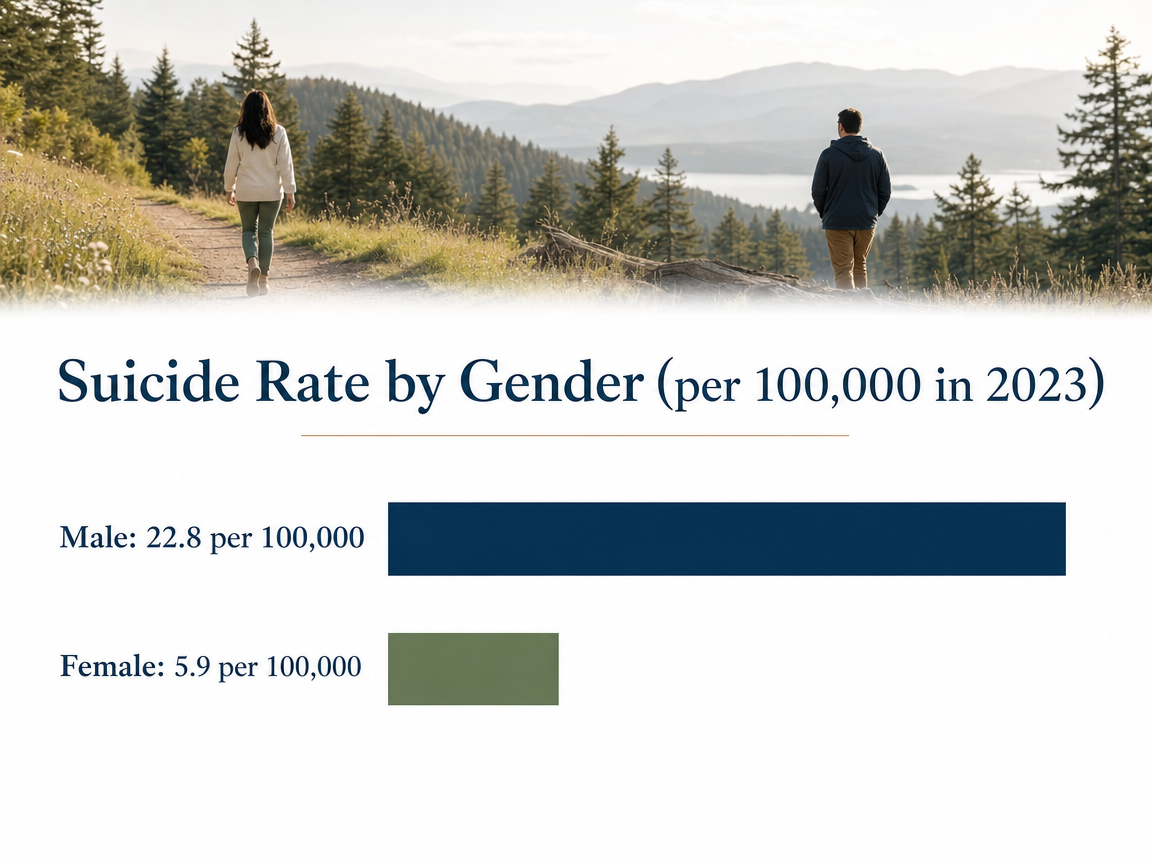
The National Institute of Mental Health reports that in 2023, the age-adjusted suicide rate among males was 22.8 per 100,000, compared with 5.9 per 100,000 among females—nearly four times higher 5. That gap is not a statistical quirk. It is what happens when half the population is taught, year after year, that asking for help is a kind of failure. The editorial literature on men and stigma points to the same root cause: acculturation to stoicism and the expectation of self-reliance lead to underuse of mental health services, even when symptoms are severe 9.
Here is what that looks like in real life. A man notices he is sleeping badly, snapping at his kids, drinking more on weeknights. He tells himself it is a phase. He tells himself work is stressful. He does not call his doctor, because what would he even say? He does not tell his partner, because she already has enough on her plate. Months pass. The phase does not end. The drinks do not stop at two anymore.
How Pain Gets Rerouted Into a Drink, a Pill, or a Joint
The Coping Patterns Most Men Don't Call Coping
Most men do not wake up one day and decide to start using substances to feel better. It happens quieter than that. It looks like staying late at the shop again because home feels too loud. It looks like two beers turning into five on a Tuesday because the day was long and you earned it. It looks like a few hits before bed because your brain will not stop running laps. It looks like getting angry instead of getting sad, because anger feels like something you are allowed to have.
If you grew up around drinking culture—and a lot of men in the Pacific Northwest and the Mountain West did—a weekend bender does not feel like a problem. It feels like Friday. Research on college men found that the masculine norm of drinking to excess was tied to every major reason men drink: to be social, to feel good, and to push down what they did not want to feel 11. That pattern does not stop at graduation. It follows men into job sites, marriages, and middle age.
Here is the part that matters: you probably do not call any of this coping. You call it unwinding. You call it sleeping pills that work. You call it being a guy. The Brown University School of Public Health put it bluntly in 2025—many young men avoid medical or mental health care and turn to drugs and alcohol to handle distress instead 10. The substance is not the disease. It is the thing standing in for a conversation you were never given permission to have.
If any of this sounds like your week, you are not broken. You are using what's available. That's an honest place to start from, not a shameful one.
When 'Handling It' Becomes a Co-Occurring Disorder
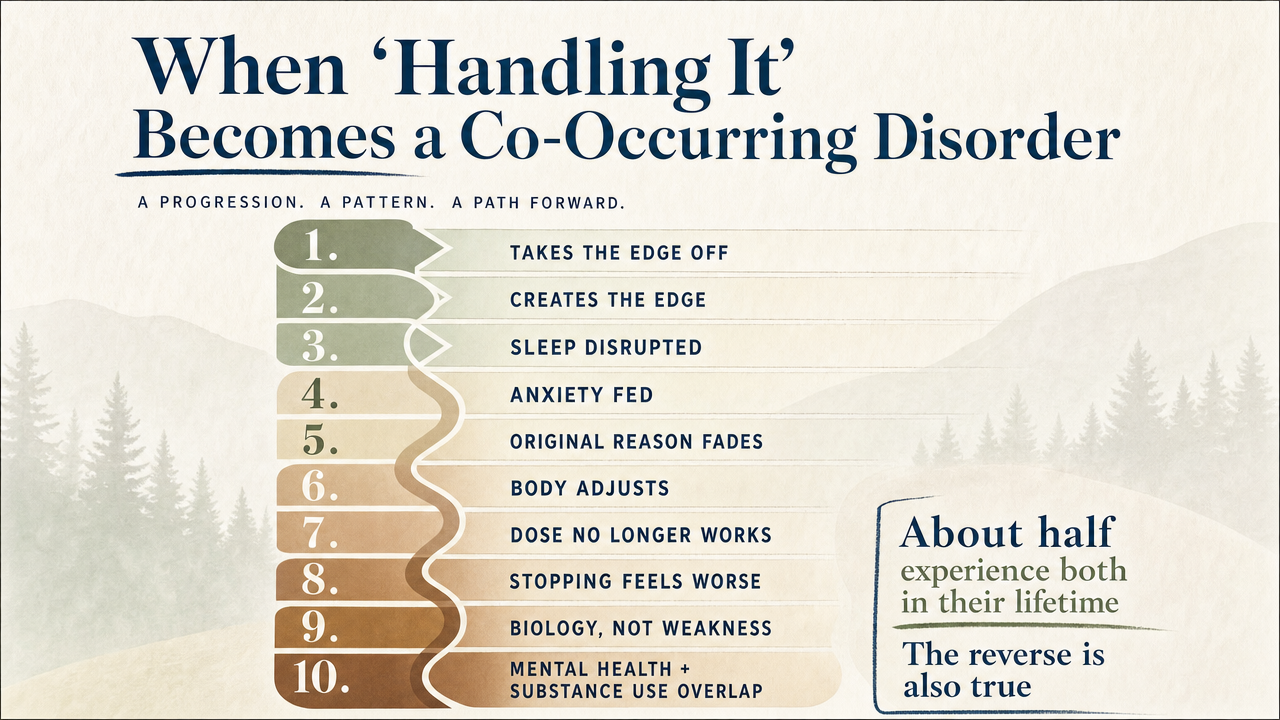
There is a moment, sometimes a year in, sometimes ten, when the thing that used to take the edge off becomes the thing creating the edge. The drinks no longer help you sleep—they wake you up at 3 a.m. The weed no longer quiets the anxiety—it feeds it. The pills you took for your back stopped being about your back a long time ago. Your body has adjusted. The dose that used to work does not, and stopping feels worse than continuing. That is not weakness. That is biology doing exactly what biology does.
This is also where mental health and substance use stop being two separate conversations. NIDA's research report on comorbidities found that about half of people who experience a mental illness during their lives will also experience a substance use disorder, and the reverse is true as well 16. SAMHSA's most recent data put a number on it: roughly 21.2 million U.S. adults are living with both a mental illness and a substance use disorder at the same time 1. You are not the only man whose depression and drinking arrived together. You are not the only one whose anxiety and cannabis use grew up side by side. The pattern is so common it has a clinical name—co-occurring disorders—and it is one of the most studied phenomena in addiction medicine.
The reason this matters for your next step is simple. If you only treat the substance use, the pain underneath does not go anywhere, and it pulls you back. If no one ever addresses the substance use, the mental health symptoms keep getting amplified by what you are drinking or smoking to manage them. SAMHSA's framing is that both conditions need to be addressed at the same time, by people who understand how they feed each other 1. Oregon Trail Recovery works inside that integrated model—treating the substance use disorder while supporting the co-occurring mental health piece, not as separate problems but as one tangled knot that has to be worked on together. You did not get here in a straight line. You will not get out in one either, and that is okay.
Real Recovery Starts in Portland, Oregon
Call now or verify insurance to take the first step toward lasting recovery in Portland.
Regional Stakes: Oregon, Wyoming, and the Pacific Northwest
This is not just a national story. The map matters. If you live in Oregon, Wyoming, or anywhere across the rural and small-city Pacific Northwest, the ground underneath you tilts the odds.
Start with Oregon. The state's Alcohol and Drug Policy Commission reported that more than one in five Oregonians had a substance use disorder in 2023—a prevalence rate that puts Oregon among the highest in the country 7. That is your neighbor, your coworker, the guy you played beer-league softball with last summer. It is also, statistically, a lot of men carrying something heavy and quiet. The same plan flags how thin the treatment pipeline still is across much of the state, especially outside the I-5 corridor, which means men in Central Oregon and along the coast often have farther to drive and longer to wait.
Suicide data tells a parallel story. The Oregon Health Authority reports that Oregon's youth suicide rate in 2022 was 14.2 per 100,000, still running above the national average for that age group 17. That number is not just about young people in isolation—it is a signal about how families and communities are doing, and a warning shot about what happens when distress goes unaddressed for years. CDC's state-level tables show the same pattern at the regional scale: many Western states, Oregon and Wyoming included, sit above the national age-adjusted suicide rate 6.
Wyoming carries its own weight. SAMHSA's 2021–2022 state tables document substantial substance use and mental health burden among Wyoming residents aged 12 and older, with rural geography making formal care harder to reach than the raw numbers suggest 12. When the nearest counselor is two hours away and the nearest detox bed is farther than that, "I'll handle it myself" stops being a personality trait and starts being the only option that feels available.
None of this means the Pacific Northwest is broken. It means the men living here are dealing with a stacked deck—long distances, hard winters, a drinking culture that calls excess normal, and a stoic streak that runs deep in logging towns, ranch country, and the small cities in between. If you have been quietly losing ground out here, you are not an outlier. You are part of a regional pattern that the data has been pointing at for years. The good news, and it is real news, is that the same region has been building out the recovery support to meet you where you are.
If You Love Someone Who Is Struggling
This section is for you—the partner, parent, sibling, or adult child watching a man you love slowly recede. You are not imagining it. The shorter sentences at dinner, the second drink that became a fifth, the bedroom door that stays closed longer each weekend. You have been tracking it for months, maybe years, and you have probably been told by someone well-meaning that he just needs space, or time, or a hobby. Your gut has been telling you something else.
First, the hard part: you cannot want his recovery more than he does, and you cannot force the conversation by ambushing him with what you've noticed. What you can do is stop pretending alongside him. The qualitative research on men and stigma is clear that one of the biggest barriers to disclosure is the fear of being seen as weak or less than 8. That fear gets louder when the people around him also avoid the topic, because his silence starts to feel like the only acceptable option. When you name what you see—gently, without an ultimatum attached the first time—you crack that silence open a little.
Try specifics instead of labels. "I've noticed you're not sleeping, and the drinking has picked up since your dad passed" lands differently than "I think you have a problem." One opens a door. The other slams one. Researchers studying men in behavioral health settings have found that men often carry trauma and PTSD alongside substance use, and those wounds shape how they hear concern from the people closest to them 13. Approach him as someone hurt, not someone broken.
Take care of yourself in the meantime. Al-Anon, family therapy, a counselor of your own—these are not betrayals of him. They are how you stay steady enough to keep showing up. And when he is ready, even a little, know that Oregon Trail Recovery works with families across Portland and the broader Pacific Northwest, because the man who walks through the door did not get there alone, and he will not heal alone either.
What a Real Next Step Looks Like
Detox Through Pacific Crest Trail Detox
If you have been drinking heavily for a long time, or using opioids, benzodiazepines, or a daily mix of substances, the first step is not willpower. It is medical safety. Stopping certain substances cold turkey can be dangerous on its own, and trying to white-knuckle it at home is how a lot of men end up either in an emergency room or back at the bottle by Tuesday night.
Oregon Trail Recovery does not run its own detox unit. For that piece, they partner with Pacific Crest Trail Detox, where the medical side gets handled by clinicians who do this every day. Withdrawal gets monitored. Medications are used when they help. You get to sleep, eat, and let your body reset in a place where someone is watching the vitals so you do not have to.
Detox is not treatment. It is the runway. It clears the substance out of your system so the deeper work has a chance to land. When that piece is done, the handoff into ongoing recovery support happens without you having to figure out the logistics in a fog. That is the point of the partnership—one step does not strand you before the next one starts.
Addiction Recovery Support at Oregon Trail Recovery
Once your body is stable, the real question is what holds you steady once you are back in your life. Oregon Trail Recovery is built for that stretch. Based in Portland and serving men from across Oregon, Wyoming, and the broader Pacific Northwest, the program offers a continuum of care designed for the months after detox, not just the first week.
That continuum includes residential treatment in upscale recovery homes, intensive outpatient programming for men who need structure without stepping away from work or family completely, sober living for the in-between season, and Wellbriety services for men who want a recovery path rooted in Native American traditions. The clinical work draws on cognitive behavioral therapy, dialectical behavior therapy, motivational interviewing, and trauma-informed approaches like Seeking Safety, because the research on men in substance use treatment is clear that trauma and PTSD often travel alongside the substance use itself 13.
Co-occurring mental health support is woven into the substance use care—not as a separate clinic you have to find on your own, but as part of how every plan gets built. SAMHSA's guidance is that both conditions need to be addressed together by people who understand how they interact 1. That is the model here. Employment and education assistance round it out, because recovery that does not include a way to pay rent and rebuild a life tends not to hold.
Why Men's-Specific and Trauma-Informed Care Matters
You may have tried a mixed-gender program before. A lot of men have. Some thrive there. Others sit in group and say roughly nothing for six weeks, because the script that told them not to cry in front of their wife also told them not to cry in front of strangers, and especially not in front of women. A 2025 review of gender-specific addiction research argues that the changing landscape of men's and women's substance use makes tailored treatment environments more important, not less 15.
A men's-only setting changes what gets said out loud. The conversation about your dad. The thing that happened in the service. The marriage that ended. The shame about the years your kids will not get back. Men in substance use treatment carry elevated rates of trauma and PTSD, and the clinical literature describes how concepts of masculinity shape whether a man can actually engage with care or just performs it 13. Trauma-informed care assumes that wound is there and works with it instead of around it.
This is not about being separated from women. It is about being in a room where, for once, you do not have to perform. That is where the work starts to stick.
Toughing It Out Is Not a Treatment Plan
You learned to handle things alone because, for a long stretch of your life, that's what the people around you needed from you. That part is real. So is this: the script ran out of pages somewhere back there, and what you've been calling toughness has quietly become a way of carrying pain you were never meant to carry by yourself.
June being Men's Mental Health Awareness Month does not fix any of that on its own. What it can do is give you a reason to stop, look at the drinking or the using or the long silences for what they actually are, and admit that the strategy is not working anymore. That admission is not weakness. It is the first honest move in a long time.
If you are in Portland, Central Oregon, somewhere out in Wyoming, or anywhere across the Pacific Northwest, Oregon Trail Recovery is here when you are ready—with detox handled through Pacific Crest Trail Detox and addiction recovery support that takes the mental health piece seriously alongside the substance use. You did not choose the pain. You do get to choose what happens next.
Frequently Asked Questions
Is it really a mental health problem if I just drink more than I used to?
Drinking more than you used to is rarely just about the drinks. It is usually about what the drinks are quieting—stress, grief, anxiety, sleep that will not come. About half of people with a mental illness will also experience a substance use disorder in their lifetime, and the two feed each other in ways that are hard to separate from the inside 16.
How do I talk to a man I love about his drinking or drug use without pushing him away?
Lead with what you've seen, not a label. "You haven't been sleeping, and the drinking has picked up since the layoff" lands better than "You have a problem." Men often avoid disclosing distress to avoid being seen as weak, so concern that respects his dignity is more likely to land 8. Pick a quiet moment, stay calm, and be ready to listen longer than you talk.
What's the difference between detox and addiction recovery support?
Detox is the medical piece—safely clearing alcohol, opioids, benzodiazepines, or other substances from your body while clinicians monitor withdrawal. Oregon Trail Recovery partners with Pacific Crest Trail Detox for that step. Addiction recovery support is what happens after: residential treatment, intensive outpatient, sober living, therapy, and co-occurring mental health care that helps you rebuild a life without the substance. One is the runway. The other is the flight.
Does Oregon Trail Recovery treat mental health conditions like depression, anxiety, or PTSD?
Oregon Trail Recovery is a substance use treatment center, not a primary mental health provider. What they offer is co-occurring mental health support alongside addiction care—so if you're dealing with depression, anxiety, or PTSD that is tangled up with your substance use, those pieces get addressed together inside the treatment plan 1. If you need standalone mental health care without a substance use component, your primary care doctor can refer you elsewhere.
What should I do if I'm in crisis or worried someone I love is thinking about suicide?
Call or text 988, the Suicide and Crisis Lifeline, anytime. It's free, confidential, and available 24/7 across the U.S., including Oregon and Wyoming. If there is immediate danger, call 911 or go to the nearest emergency room. Don't leave someone alone if you can help it, and remove access to firearms and large quantities of medication if you safely can. You do not have to handle this by yourself.
Why does a men's-specific treatment environment matter?
Many men carry trauma and PTSD alongside their substance use, and concepts of masculinity shape whether they actually engage in care or just perform compliance 13. In a men's-only setting, the things that usually go unsaid—about fathers, deployments, divorce, shame—have a better chance of coming up. Research on gender-specific addiction care argues this kind of tailored environment is more important now, not less 15. It is not separation. It is room to be honest.
References
- Co-Occurring Disorders and Other Health Conditions | SAMHSA. https://www.samhsa.gov/substance-use/treatment/co-occurring-disorders
- Co-Occurring Disorders and Health Conditions. https://nida.nih.gov/research-topics/co-occurring-disorders-health-conditions
- 2024 National Survey on Drug Use and Health (NSDUH) Releases. https://www.samhsa.gov/data/data-we-collect/nsduh-national-survey-drug-use-and-health/national-releases/2024
- Suicide Data and Statistics - CDC. https://www.cdc.gov/suicide/facts/data.html
- Suicide - National Institute of Mental Health (NIMH). https://www.nimh.nih.gov/health/statistics/suicide
- Suicide Rates by State - CDC. https://www.cdc.gov/suicide/facts/rates-by-state.html
- The 2026–2030 Comprehensive Plan (Oregon Alcohol and Drug Policy Commission). https://www.oregon.gov/adpc/pages/plan.aspx
- Men's Experiences of Mental Illness Stigma Across the Lifespan. https://pmc.ncbi.nlm.nih.gov/articles/PMC8832600/
- Males and Mental Health Stigma. https://pmc.ncbi.nlm.nih.gov/articles/PMC7444121/
- Men, masculinity and mental health | Brown University. https://sph.brown.edu/news/2025-07-24/men-masculinity
- Alcohol-Specific Masculine Norms and Drinking Motives among College Men. https://hecaod.osu.edu/alcohol-specific-masculine-norms-and-drinking-motives-among-college-men/
- WYOMING – 2022 NSDUH State Tables. https://www.samhsa.gov/data/sites/default/files/reports/rpt44486/2022-nsduh-sae-state-tables/NSDUHsaeWyoming2022.pdf
- Working With Specific Populations of Men in Behavioral Health Services. https://www.ncbi.nlm.nih.gov/books/NBK144297/
- Men's Mental Health Matters: The Impact of Traditional Masculinity Norms on Help-Seeking. https://pmc.ncbi.nlm.nih.gov/articles/PMC12117241/
- Gender-specific addiction research needed now more than ever. https://pmc.ncbi.nlm.nih.gov/articles/PMC12853563/
- Common Comorbidities with Substance Use Disorders Research Report. https://www.ncbi.nlm.nih.gov/books/NBK571451/
- Oregon Health Authority: Youth Suicide Prevention. https://www.oregon.gov/oha/hsd/bh-child-family/pages/youth-suicide-prevention.aspx
Relapse Doesn't Mean the End Of Your Journey
Reach out today to explore programs that support real, long-term sobriety.