




Medically-Supervised Detox Process in Portland, OR

Key Takeaways
- Portland's medically-supervised detox follows a three-part clinical model — evaluation, stabilization, and entry into ongoing treatment — with placement tiered under Oregon's ASAM levels from ambulatory to medically monitored inpatient 1.
- Unsupervised withdrawal is riskier now because 62.2% of Oregon's 2024 overdose deaths involved multiple substances, with fentanyl and methamphetamine driving most polysubstance fatalities 11.
- Clinicians match level of care using CIWA-Ar scores, co-occurring medical and psychiatric conditions, and home stability — not family preference or insurance defaults 7, 12.
- Before choosing a program, compare whether it offers all three components, uses buprenorphine or methadone bridges for opioid use disorder, and confirms a follow-up appointment within 24 to 72 hours of discharge 5, 14.
What Happens in the 72 Hours After Your Loved One Says Yes
You just heard the word you've been waiting months, maybe years, to hear. Your loved one said yes. Now the clock starts, and the next 72 hours will decide whether that fragile agreement turns into a supervised admission or dissolves back into another lost weekend.
Here's what actually happens next in Portland.
The first call is a clinical assessment, not a sales pitch. A licensed intake clinician will ask about substances used, amounts, timing of the last use, prior withdrawal history, medications, mental health diagnoses, and medical conditions. This conversation drives placement. Under Oregon's behavioral health rules, medically supervised withdrawal is not one service — it's a tiered set of levels of care, from ambulatory monitoring to medically monitored inpatient beds, and the assessment determines which one your loved one actually needs 1.
Within hours of that call, if the clinical picture supports it, a bed or an outpatient slot is arranged. Transportation gets coordinated. Someone in the family — often you — becomes the person who stays with them until admission, because ambivalence is loudest in the quiet hours before intake.
Then comes stabilization. Vital signs, withdrawal scales, medications to manage symptoms safely, and a treatment team watching for the complications that make unsupervised withdrawal dangerous. This is the piece families picture when they hear "detox."
What families often miss is the third piece — fostering entry into ongoing treatment. National clinical guidance is explicit: detox alone is not sufficient treatment, and the withdrawal window is when the handoff into residential care, intensive outpatient, or sober living has to be built 5. You are not just getting them through the shakes. You are getting them onto the next bridge.
Why 'Just Quitting at Home' Is More Dangerous in Portland Right Now
You might be tempted to skip the clinical piece. Your loved one wants to just go home, tough it out, drink a lot of water, and be done with it by Monday. You want to believe them. It would be cheaper, faster, less humiliating.
Here's the part you need to hear: the substance landscape in Portland in 2024 is not the substance landscape any of us grew up with. Cold-turkey math has changed.
In 2024, 1,544 people died of drug overdose in Oregon. That is down from 1,833 in 2023 — real progress, and a sign the system is finally moving. But of those 2024 deaths, 62.2% involved multiple substances, and 70% of those polysubstance deaths involved fentanyl and methamphetamine together 11. Portland is inside that data.
What this means practically: the person you love probably does not know exactly what is in their supply. Pressed pills sold as oxycodone or Xanax are frequently fentanyl. Methamphetamine is often circulating alongside it. When someone tries to stop at home, they are not just riding out withdrawal from one substance — they are managing the crash from stimulants, the rebound anxiety from benzodiazepine-contaminated pills, and the acute opioid withdrawal that drives most people back to use within 24 to 72 hours.
You are not being dramatic. You are being accurate. The reason medically supervised detox exists — the reason Oregon has expanded opioid treatment programs, telehealth medications for opioid use disorder, and naloxone distribution across the state — is that the risk profile of unsupervised withdrawal in the Pacific Northwest is genuinely worse than it was five years ago 10.
The good news buried in those same numbers: help works. Overdose deaths came down because more people got connected to real care. Your loved one saying yes is not a small thing. Getting them to a supervised admission instead of a bathroom floor is how that yes turns into a Tuesday, and then a week, and then a life.
The Three-Component Model: What 'Medically-Supervised' Actually Means
When a clinician says "medically-supervised detox," they are not describing a hotel room with a nurse. They are describing a specific, three-part clinical process — and if any one of those parts is missing, the care is considered incomplete 5.
Here is what those three parts actually look like when your loved one walks through the door.
Evaluation is the first component. This is more than the intake phone call. Once on-site, a clinician screens for substances currently in the person's system, measures the physical severity of withdrawal, and assesses co-occurring medical and psychiatric conditions that change the risk math — things like a history of seizures, cardiac issues, pregnancy, or acute suicidality. National guidance is explicit that a detox process without this full evaluation is considered inadequate 8. In Portland, that evaluation also determines whether the person can stay in a residential withdrawal-management bed or needs to route through a hospital first.
Stabilization is the middle piece — the part families picture. Medications to blunt withdrawal symptoms, hydration, sleep, nutrition, and continuous monitoring by a team that can respond if something changes at 3 a.m. This is where the physical crisis resolves.
Fostering entry into ongoing treatment is the third component, and it is the one that most home attempts skip entirely. While your loved one is stabilizing, the treatment team is already building the bridge — coordinating with intensive outpatient programs, residential treatment, sober living, or medications for opioid use disorder so that discharge day is not a cliff 5.
If a program offers stabilization without the other two, it is not medically-supervised detox in the clinical sense. It is a nap. The Oregon addiction treatment system is designed around all three, because withdrawal is the opening — the actual work starts the day after 6.
Level-of-Care Decisions Under Oregon's ASAM Framework
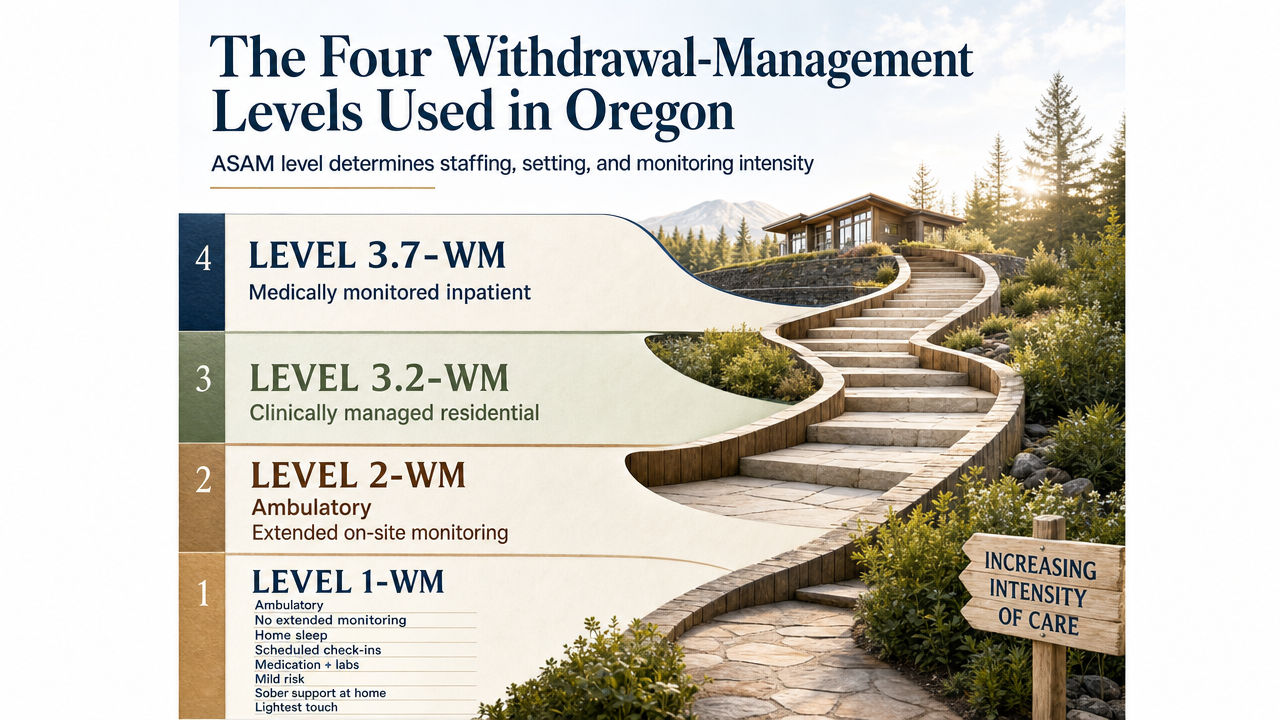
The Four Withdrawal-Management Levels Used in Oregon
Placement is not a guess. Oregon's behavioral health rules, Chapter 309, Division 018, tie every withdrawal-management admission to a specific ASAM level, and the level dictates the staffing, the setting, and the intensity of monitoring your loved one receives 1. You will hear these labels on the intake call. Knowing what they mean lets you ask better questions.
There are four levels you'll encounter in the Portland area:
- Level 1-WM (Ambulatory Withdrawal Management, no extended monitoring). Your loved one sleeps at home and comes into a clinic for scheduled check-ins, medication, and labs. This is the lightest touch. It works for adults with mild withdrawal risk, no serious co-occurring medical or psychiatric issues, and a sober support person at home.
- Level 2-WM (Ambulatory Withdrawal Management with extended on-site monitoring). Still outpatient, but the person spends several hours a day on-site being observed. More eyes, more medication management, more chances to catch a problem before it becomes an emergency.
- Level 3.2-WM (Clinically Managed Residential Withdrawal Management). This is a residential bed in a non-hospital setting, directed by non-physician addiction specialists — the level Oregon rules describe as "clinically managed services… directed by non-physician addiction specialists" 1. Staff monitor around the clock. Medical backup is available but not on-site 24/7. Most people picture this when they think "detox center."
- Level 3.7-WM (Medically Monitored Inpatient Withdrawal Management). Physician-directed, hospital-adjacent care for people whose withdrawal is severe enough — or whose medical picture is complicated enough — that they need a doctor on-site and full medical resources at hand. This is where cases with seizure history, delirium tremens risk, unstable cardiac status, or acute polysubstance crashes belong 1.
You are not choosing between these on a menu. A clinician does the matching, and the match can move — someone stable on 3.2-WM Monday can be transferred to 3.7-WM Wednesday if things escalate. The framework is designed to flex.
How Clinicians Decide: CIWA-Ar, Co-Occurring Conditions, and Social Stability
So how does a clinician actually pick a level? It is not a coin flip, and it is not driven by what insurance would rather pay for. It comes down to three questions.
- How bad is the withdrawal, physically? For alcohol, that measurement is usually the Clinical Institute Withdrawal Assessment for Alcohol, revised — CIWA-Ar. It scores tremor, sweating, nausea, agitation, hallucinations, and orientation. Emergency medicine literature is clear that validated scales like CIWA-Ar "improve risk stratification" and let teams use symptom-triggered medication instead of blanket dosing 12. A low score with no history of seizures can often be managed ambulatory. A rising score, or a history of complicated withdrawal, pushes the placement toward 3.2-WM or 3.7-WM.
- What else is going on medically and psychiatrically? National alcohol withdrawal guidance is specific — placement has to be individualized based on "severity of withdrawal symptoms, risk factors for complicated withdrawal, and the presence of co-occurring medical and psychiatric conditions" 7. Pregnancy, a history of seizures, unstable diabetes, cardiac disease, active suicidality, or an untreated psychotic disorder all shift the answer upward. So does polysubstance use — the reality for most people entering care in Portland right now.
- What is home going to look like for the next week? Ambulatory withdrawal only works when someone at home can watch for warning signs, drive to appointments, hold the medication, and call for help. Research on community-based ambulatory alcohol detox shows it can be safe and effective — but only "with careful selection and monitoring" of people who have mild to moderate withdrawal risk and stable social supports 13. If your loved one is couch-surfing, living alone with active use in the home, or has no one who can be present, that alone can move them into a residential bed.
You get to advocate here. If the intake team is leaning toward outpatient and you know the home situation is not what it looks like on paper, say so.
Alcohol Withdrawal: From Ambulatory Monitoring to the Emergency Department
Alcohol is the substance families most often underestimate. Someone can drink heavily for years, walk into an intake looking fine, and be in a life-threatening seizure by day two. That is why alcohol withdrawal has its own placement spectrum — and why the intake team asks so many questions about the last drink, prior withdrawal episodes, and any history of seizures or delirium tremens.
On the lighter end of the spectrum is supervised ambulatory withdrawal. Community-based studies show that for people with mild to moderate withdrawal risk, stable housing, and a sober support person, ambulatory alcohol detoxification can be safe and effective — but only with careful selection and monitoring 13. In practice, that looks like daily clinic visits, a scheduled benzodiazepine taper, hydration and thiamine, and a phone line your loved one can call at 2 a.m. if symptoms escalate.
The middle of the spectrum is Level 3.2-WM residential care. Symptom-triggered benzodiazepine dosing, driven by CIWA-Ar scores rather than a fixed schedule, is the current standard — an approach that can reduce total medication and shorten length of stay when a trained team is watching 12. Thiamine, folate, and fluids run alongside.
Then there is the emergency department. If your loved one presents with a CIWA-Ar score in the severe range, active seizures, signs of delirium tremens, chest pain, or acute suicidality, the ED is the right first stop — not a failure of planning. National alcohol withdrawal guidance is clear that placement must be individualized to withdrawal severity, complication risk, and co-occurring conditions 7. From the ED, patients are typically stabilized and then transferred into a Level 3.7-WM inpatient bed or, once stable, stepped down to residential withdrawal management.
If you are not sure where your loved one falls, call the intake line and describe what you are seeing. Do not guess. The spectrum exists so that clinicians — not families in a hallway — make that call.
Real Recovery Starts in Portland, Oregon
Call now or verify insurance to take the first step toward lasting recovery in Portland.
Opioid Withdrawal: Buprenorphine, Methadone, and the Bridge to MOUD
Opioid withdrawal will not kill most people the way severe alcohol withdrawal can. It will, however, make them want to run — and running usually means using again within hours. That is the practical problem medically supervised opioid detox is built to solve.
The clinical review literature is direct on this: buprenorphine is the preferred agent for managing opioid withdrawal, given its efficacy and safety profile 14. In a Portland detox setting, that means the treatment team is typically waiting for your loved one to reach a specific level of withdrawal — usually measured with the Clinical Opiate Withdrawal Scale — and then starting buprenorphine to blunt the sweating, cramping, restless legs, and gut symptoms that make people bolt.
Methadone is the other established option, but it is delivered under different rules. Methadone for opioid use disorder is dispensed through federally regulated opioid treatment programs, not general detox floors. For people with long histories of high-dose opioid use, complex pain, or prior failed buprenorphine trials, an OTP referral may be the better path — and Oregon has been expanding OTP capacity to make that referral easier.
Clonidine and other adjunctive medications are used to manage specific symptoms — blood pressure spikes, anxiety, sleep — alongside the primary agent 14. Clonidine on its own is not a substitute for buprenorphine or methadone in most cases. It is a supporting player.
If the program you are talking to treats withdrawal as the finish line instead of the starting block, keep calling.
Oregon's Regulatory Guardrails on Opioid Treatment Program Access
Opioid treatment programs — the OTPs that dispense methadone and, in many cases, buprenorphine — are not walk-in clinics. They operate under specific Oregon administrative rules that shape who can be admitted, when, and under what conditions. If your loved one needs methadone-based withdrawal management or long-term MOUD, these guardrails matter.
One rule surprises families every time. Under Oregon's OTP admission policies, a minor may be admitted to an opioid treatment program only if the program can document "two unsuccessful attempts at short-term medically supervised withdrawal or drug-free treatment within a 12-month period" 2. Read that twice. For an adolescent using fentanyl in Portland, that rule means the intake clinician has to look for a documented history of prior supervised attempts before methadone-based OTP care is on the table. It is a real access barrier, and one intervention teams working with young people should know about before the family walks in expecting immediate admission.
For adults, the rule set is less restrictive but still specific — documented history of dependence, informed consent, and defined circumstances under which admissions may be refused 2. None of this is meant to slow you down. It is meant to make sure the person walking in gets the level of care that matches their history, and that regulated medications are dispensed inside a system built to keep them safe.
How to Talk to a Resistant Loved One About What Will Actually Happen
Ambivalence is not a moral failure. It is a symptom. Your loved one can want help and want to run at the same time, and the words you use in the hours between yes and admission matter more than any brochure ever will.
Skip the abstractions. "You need help" and "this is for your own good" are true, and they also land like a slammed door. What works better is naming exactly what will happen, in order, in language a person in withdrawal can hold onto.
Try something closer to this. "A nurse is going to ask you questions for about 20 minutes. Then they'll check your blood pressure and pulse. If you're shaking, they can give you medication in the first hour that will take the edge off. You'll have your own bed. I'll drive you there and I'll be back tomorrow."
Notice what that does. It replaces the scary blank of "detox" with a sequence — assessment, vitals, medication, bed, visit. It answers the question underneath the resistance, which is almost never should I go and almost always what is going to happen to me.
Be honest about the hard part. The first 24 hours are the hardest, and pretending otherwise will cost you their trust the moment symptoms hit. What you can promise is that they will not be alone with it. National clinical guidance is built around continuous monitoring during stabilization precisely because unsupervised withdrawal is where people bolt or get hurt 5.
Two more things to say out loud. First: detox is not the finish line. If your loved one thinks they are agreeing to a lifetime of treatment in one conversation, they will refuse. Tell them the immediate ask is a supervised withdrawal — a few days of medical safety — and that decisions about what comes next get made with them, not to them. Second: for opioids, medications like buprenorphine continue after discharge, and staying on them is not weakness 14. Families sometimes accidentally shame their loved one out of the medications that keep them alive. Do not be that family.
If they say yes and then waver at the door, do not argue. Sit down. Wait. Ask what they are afraid of, and answer that specific fear. Then go.
The Handoff: From Detox Bed to Residential, IOP, and Sober Living
Discharge day is where a lot of families lose the thread. Your loved one feels better, the acute symptoms are gone, and the pull to go home and "take it from here" is enormous. This is the exact moment the plan you built during stabilization has to hold.
National clinical guidance names this as its own component of care — fostering entry into ongoing treatment — not an optional add-on 5. In practice, the strongest Portland detox teams start the handoff on day one, not day four. That means the case manager is already calling residential programs, intensive outpatient providers, sober living homes, and — for opioid use disorder — the ongoing MOUD prescriber before your loved one is even fully stable.
What that hand-off looks like depends on the clinical picture. Someone leaving a Level 3.2-WM bed with active co-occurring depression and no stable housing typically steps into residential treatment, where structure and clinical support continue around the clock. Someone with stable housing, employment, and family support often steps down into an intensive outpatient program — three to five days a week of group and individual therapy while sleeping at home. Sober living sits alongside IOP for many people, offering a substance-free residence during those first fragile months.
For opioid use disorder, the handoff includes medication continuity. Buprenorphine or methadone started in withdrawal management should not stop at the detox door — the evidence review is direct that short-term detox without ongoing MOUD carries high relapse risk 14. Oregon has been expanding this bridge, with more opioid treatment program sites and telehealth MOUD access statewide 10.
Ask the intake team on day one: what does the discharge appointment calendar look like? If the answer is vague, keep pushing. A confirmed appointment within 24 to 72 hours of discharge is what turns detox into the first step of Oregon addiction treatment instead of a reset button.
Frequently Asked Questions
How long does medically-supervised detox take in Portland?
Most stays run three to seven days, but the honest answer is: as long as your loved one's body needs. Alcohol withdrawal usually peaks between 24 and 72 hours. Opioid withdrawal from short-acting substances peaks in a similar window; methadone withdrawal takes longer. Length of stay flexes based on symptom trajectory, co-occurring conditions, and how the handoff into ongoing care is set up 5.
Is detox alone enough to treat alcohol or opioid use disorder?
No, and this is the piece families most need to hear. National clinical guidance is direct that detoxification alone is not sufficient treatment — the withdrawal window has to connect to ongoing care 5. For opioid use disorder specifically, short-term detox without continued medications like buprenorphine carries a high relapse risk 14. Detox is the doorway. What happens after it is where recovery actually gets built.
How do clinicians decide between outpatient, residential, or inpatient detox?
They use ASAM criteria matched to Oregon's rules. Placement depends on withdrawal severity, medical and psychiatric complications, and social stability at home 1. National alcohol guidance calls for individualization based on symptom severity, risk factors for complicated withdrawal, and co-occurring conditions 7. Ambulatory care fits mild cases with support; residential (3.2-WM) fits moderate cases needing 24/7 monitoring; medically monitored inpatient (3.7-WM) fits high-risk medical pictures.
Will insurance or Oregon Health Plan cover medically-supervised detox?
In most cases, yes. Oregon Health Plan (Medicaid), commercial insurance, and Medicare each cover medically supervised withdrawal management when it is clinically indicated, though prior authorization and network rules vary by plan. Oregon has also worked to remove prior authorization barriers for medications for opioid use disorder, easing the post-detox handoff 10. Call the intake line — they verify benefits before admission and walk you through self-pay options.
What happens if my loved one is using both fentanyl and other substances?
Polysubstance use is the norm now, not the exception, and detox teams plan for it. The intake assessment screens for every substance in play, and stabilization runs in parallel — buprenorphine for opioid withdrawal, symptom management for stimulant crashes, careful monitoring for benzodiazepine or alcohol overlap. Given how much of Oregon's overdose picture involves multiple substances 11, this is standard territory for Portland detox teams, not a complication that disqualifies your loved one.
What should we bring, and what happens right after detox ends?
Bring a photo ID, insurance card, current medication list, comfortable clothes for several days, and toiletries without alcohol. Leave phones, valuables, and outside substances at home per program policy. After discharge, your loved one should walk out with a confirmed appointment within 24 to 72 hours — residential, IOP, sober living, or MOUD follow-up. Programs like Oregon Trail Recovery pick up that thread after detox, keeping the momentum from stabilization into real recovery work.
References
- Health Systems Division: Behavioral Health Services – Chapter 309, Division 018. https://www.oregon.gov/oha/HSD/RAC/309-018.pdf
- Or. Admin. Code § 415-020-0025 – Admission Policies and Procedures (Opioid Treatment Programs). https://www.law.cornell.edu/regulations/oregon/Or-Admin-Code-SS-415-020-0025
- 2020 American Society of Addiction Medicine Clinical Practice Guideline on Alcohol Withdrawal Management. https://pubmed.ncbi.nlm.nih.gov/34910619/
- SAMHSA – ASAM Clinical Practice Guideline on Alcohol Withdrawal Management Pocket Guide. https://www.samhsa.gov/resource/ebp/asam-clinical-practice-guideline-alcohol-withdrawal-management-pocket-guide
- Detoxification and Substance Abuse Treatment (TIP 45) – NCBI Bookshelf. https://www.ncbi.nlm.nih.gov/books/NBK64115/
- Oregon Health Authority : Addiction Services. https://www.oregon.gov/oha/hsd/amh/pages/addictions.aspx
- Executive Summary of the American Society of Addiction Medicine (ASAM) Clinical Practice Guideline on Alcohol Withdrawal Management. https://pubmed.ncbi.nlm.nih.gov/32909985/
- Quick Guide for Clinicians Based on TIP 45—Detoxification and Substance Abuse Treatment. https://nida.nih.gov/sites/default/files/samhsa_detoxification_and_substance_abuse_treatment.pdf
- 2025 – Opioids and the Ongoing Drug Overdose Crisis in Oregon. https://www.oregon.gov/oha/PH/PREVENTIONWELLNESS/SUBSTANCEUSE/OPIOIDS/SiteAssets/Lists/feature/EditForm/2025%20Oregon%20Opioid%20Overdose%20Report.pdf
- Oregon overdose deaths are down, CDC data shows. https://www.oregon.gov/oha/erd/pages/oregon-overdose-deaths-are-down-cdc-data-shows.aspx
- Oregon overdose deaths declined in 2024, 2025. https://www.oregon.gov/oha/erd/pages/oregon-overdose-deaths-declined-in-2024-2025-05.13.2026.aspx
- Management of Alcohol Withdrawal Syndrome in the Emergency Department. https://pubmed.ncbi.nlm.nih.gov/28732618/
- Ambulatory Alcohol Detoxification: Outcomes and Safety in Community Settings. https://pubmed.ncbi.nlm.nih.gov/31431015/
- Clinical Management of Opioid Withdrawal: A Review of Evidence-Based Strategies. https://pubmed.ncbi.nlm.nih.gov/31842677/
Relapse Doesn't Mean the End Of Your Journey
Reach out today to explore programs that support real, long-term sobriety.