




What Does Heroin Addiction Treatment Involve?

Key Takeaways
- Heroin addiction treatment is a coordinated sequence of medically supervised withdrawal, medication for opioid use disorder, behavioral therapy, and long-term recovery support, not a single 30-day stay 1, 5, 6.
- Methadone, buprenorphine, and naltrexone each work differently and should be offered as first-line treatment with no clinical maximum duration; naloxone should be co-prescribed alongside them 2, 6.
- Intensive outpatient care paired with medication produces reductions in problem severity and days abstinent equivalent to residential treatment, making IOP a legitimate primary phase rather than a step down 7, 8.
- Focus next on how a program handles detox handoffs, medication coordination, CBT and contingency management delivery, and family therapy involvement through the high-risk first six months 10, 12.
What You're Actually Looking At When You Search for Help
If you're reading this at 2 a.m. after another hard phone call, take a breath. You're trying to understand something that even seasoned clinicians describe as layered and non-linear, and wanting a clear picture is the right instinct.
Heroin addiction is treated clinically as an opioid use disorder, and the care your adult child needs is not a single stay at a single facility. It's a coordinated sequence: medically supervised withdrawal, medication for opioid use disorder (methadone, buprenorphine, or naltrexone), behavioral therapy like CBT and contingency management, and long-term recovery support delivered across outpatient, intensive outpatient, or residential settings 1, 5, 6. Each phase has a job. Skipping any of them tends to make the next one harder.
This guide walks you through that sequence the way a good clinical team would explain it to a family sitting in an intake office in Portland or anywhere in the Pacific Northwest. You'll see what the research actually says, where families genuinely matter, and what recovery tends to look like month by month, so you can support your adult child without guessing.
The Treatment Continuum: A Sequence, Not a Single Event
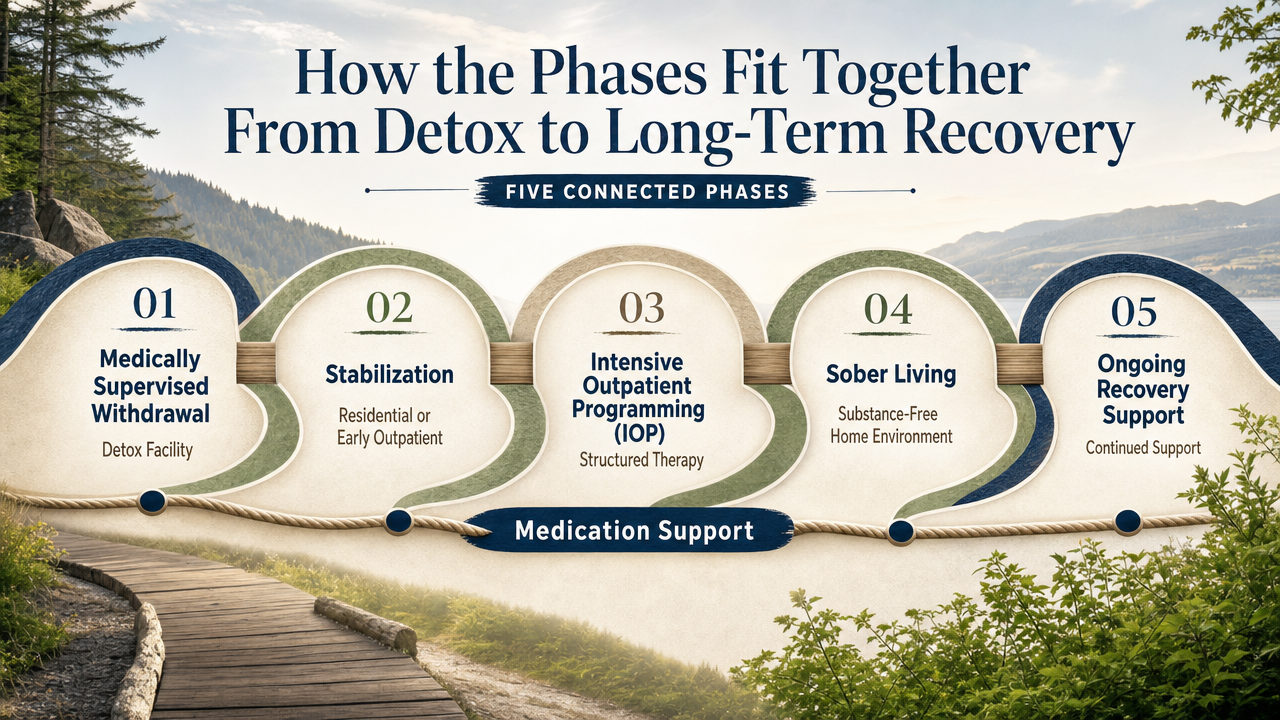
How the Phases Fit Together From Detox to Long-Term Recovery
When you picture heroin treatment, you might picture a single 30-day stay somewhere and a return home. That's not what modern care looks like, and understanding the actual shape of it will save you a lot of second-guessing.
Think of treatment as five connected phases.
- Medically supervised withdrawal, usually at a dedicated detox facility, gets your adult child through the acute physical symptoms safely.
- A stabilization period, either in residential care or through early outpatient contact, helps them settle into a medication regimen and start therapy.
- Intensive outpatient programming (IOP) provides several hours of structured therapy per week while they begin practicing life outside a controlled setting.
- Sober living offers a substance-free home environment during the fragile months when work, school, and old triggers all return at once.
- Ongoing recovery support, whether outpatient therapy, mutual-help groups, or continued medication, carries the work forward for as long as it's needed 1, 4.
Medication for opioid use disorder threads through nearly every phase. Methadone, buprenorphine, and naltrexone are all FDA-approved for opioid use disorder, and SAMHSA's guidance is explicit that patients in outpatient, intensive outpatient, inpatient, and long-term therapeutic community settings should have access to these medications 4. In Oregon, methadone is dispensed only through approved opioid treatment programs, while buprenorphine and naltrexone can be prescribed in office-based settings and continued as your adult child moves between levels of care 14.
The phases are not rigid boxes. Someone might start in detox, skip residential, and move directly into IOP with buprenorphine. Someone else might need residential stabilization first. The sequence adapts to the person.
Why Oregon Programs Often Partner With Dedicated Detox Facilities
You may notice that many Oregon addiction treatment centers don't handle detox themselves. That's intentional, and it's a good sign, not a gap.
Opioid withdrawal is medically demanding. Your adult child will likely need 24-hour monitoring, medications to manage symptoms, and a clinical team trained specifically in acute stabilization. Dedicated detox facilities do that work all day, every day. Treatment programs focused on residential and intensive outpatient care partner with those facilities so each setting can do what it does best, rather than trying to be everything at once.
The handoff matters. A well-designed partnership means your adult child isn't discharged from detox into a parking lot with a phone number. They move directly into the next phase, often with medication already initiated. ASAM guidance recommends that buprenorphine be started only after objective signs of opioid withdrawal appear, which is one reason detox and the receiving program need to coordinate closely on timing 3.
Medications for Opioid Use Disorder: The Clinical Foundation
Methadone, Buprenorphine, and Naltrexone Explained for Families
Here's the piece that surprises most parents: for opioid use disorder, medication is not a crutch or an optional add-on. NIDA's guidance is direct on this. When treating addiction to opioids like heroin or fentanyl, medication should be the first line of treatment, usually combined with counseling or behavioral therapy 6. If a program tells you medication isn't necessary or frames it as trading one drug for another, that's a red flag worth taking seriously.
Three medications are FDA-approved for opioid use disorder, and each works differently 1, 5.
- Methadone
- A long-acting opioid agonist. It occupies the same brain receptors heroin does, but slowly and steadily, which quiets cravings and prevents withdrawal without producing a high at a properly stabilized dose. It has the longest track record of any MOUD and is often the right choice for people with severe, long-standing opioid use disorder.
- Buprenorphine
- Often prescribed as Suboxone when combined with naloxone, buprenorphine is a partial opioid agonist. It activates those same receptors, but only partially, which lowers overdose risk and creates a ceiling on its effects. ASAM guidance is specific here: for someone currently opioid dependent, buprenorphine should not be started until objective signs of withdrawal appear, which is why induction timing after detox matters so much 3.
- Naltrexone
- Usually the monthly injectable Vivitrol, naltrexone is different. It's an opioid antagonist, meaning it blocks the receptors entirely. Your adult child needs to be fully detoxed before starting it, or it will trigger severe withdrawal. Naltrexone can be a strong fit for someone who has completed detox and prefers a non-opioid medication.
None of these are one-size-fits-all. A good clinical team will walk your adult child through the risks and benefits of each, including the option of treatment without medication, so the choice is informed 4.

How Oregon Regulates Where Each Medication Is Prescribed
Where your adult child receives each medication depends on Oregon regulations, and knowing the map will save you confusion later.
Methadone for opioid use disorder can only be dispensed at an approved, regulated opioid treatment program (OTP) 14. That means daily or near-daily visits to a licensed clinic, especially early on. It's a commitment, and for many people it becomes the anchor of their week.
Buprenorphine and naltrexone work differently. Both can be prescribed by a physician for use outside an office setting, which means your adult child can pick them up at a pharmacy and take them at home 14. This is why so many Oregon addiction treatment programs, including intensive outpatient providers across Portland and the broader Pacific Northwest, coordinate with office-based prescribers rather than dispensing on-site.
Oregon's framework treats medication-assisted treatment as one piece of a broader plan that also includes case management and counseling 14. When you're evaluating a program, ask how they handle prescriber coordination, refill continuity, and communication between the counseling team and the medical team. Those handoffs are where care can quietly fall apart.
Duration, Naloxone Co-Prescription, and the Question of 'How Long'
Almost every parent asks the same question eventually: how long will my adult child need to be on medication?
One more thing to know: ASAM now recommends that naloxone be co-prescribed to patients receiving MOUD to reduce overdose mortality 2. If your adult child is on medication, ask whether they have naloxone (Narcan) at home, and whether you should have it too. Keeping it accessible isn't pessimism. It's the same reasoning as keeping a fire extinguisher in the kitchen.
Real Recovery Starts in Portland, Oregon
Call now or verify insurance to take the first step toward lasting recovery in Portland.
Intensive Outpatient: The Connective Tissue of Recovery
Here's where the shape of modern heroin treatment surprises most parents. You probably assume residential care is the gold standard and outpatient is the budget alternative. The evidence tells a different story.
A review of randomized and quasi-experimental studies found that intensive outpatient programs produce equivalent reductions in problem severity and equivalent increases in days abstinent at follow-up compared with inpatient or residential care 7. That's not a marketing claim from a treatment center. That's the pattern across multiple controlled comparisons of adults receiving structured outpatient care versus a residential stay. Both settings produced substantial reductions in substance use between baseline and follow-up. The difference between them, on the outcomes that matter most, was not statistically meaningful for many patients.
A separate randomized trial went further and tested whether more counseling hours produced better opioid outcomes within outpatient care itself. Adults receiving buprenorphine were assigned either to intensive outpatient (nine or more counseling hours per week) or standard outpatient (two to eight hours per week). There were no statistically significant differences in opioid outcomes between the two groups 8. Both improved substantially. The medication plus structured counseling was doing the work.
What this means for your adult child: IOP is not a step down. It's often the phase where recovery actually gets built. Residential care can stabilize someone. IOP is where they practice sobriety while living in the real world, with real triggers, a real job or school schedule, and a real home life. Several hours a week of group therapy, individual counseling, relapse prevention skills, and medication management, delivered while they sleep in their own bed or a sober living home, is closer to the life they need to sustain long-term.
For Oregon families, this also matters practically. An intensive outpatient program in Portland or elsewhere in the Pacific Northwest can coordinate with a buprenorphine or naltrexone prescriber, integrate co-occurring mental health support, and hold your adult child accountable through structured attendance, urine drug screening, and weekly clinical contact, without pulling them out of their life for 30 or 60 days 14. For someone finishing detox or residential care, IOP is the bridge that keeps early sobriety from collapsing under the weight of a sudden return to daily responsibilities.
Ask any program you're considering how many hours per week their IOP runs, how they handle medication coordination, and how they respond when someone misses group or tests positive. Those answers tell you whether the connective tissue is strong.
The Behavioral Therapies That Do the Real Work
Cognitive Behavioral Therapy and Where Its Effects Show Up
Medication quiets the cravings. Behavioral therapy teaches your adult child what to do with the rest of their life. Both matter, and neither works as well alone.
Cognitive behavioral therapy, or CBT, is the most studied talk therapy for substance use disorders, and the evidence is clear enough that clinical bodies treat it as a foundation, not an experiment. A 2023 meta-analysis of CBT for substance use disorders found that it produced small to moderate effects on substance use compared with inactive treatment, and the effects were strongest at early follow-up, specifically the one to six months after treatment ended. The authors issued a strong recommendation for CBT as an empirically supported treatment for SUD based on those effects, the quality of the evidence, and contextual factors 10.
That timing detail matters more than it sounds. The window when CBT shows its biggest measurable benefit, roughly the first six months after your adult child finishes an episode of treatment, is exactly when a lot of families breathe out and step back. It's also when relapse risk is highest and when aftercare, whether that's continued IOP, individual therapy, or a strong sober living structure, does the most work. The therapy doesn't vanish after discharge. It sits with your adult child as a set of tools, and those tools get sharper the more they're used in real situations.
What CBT actually teaches is straightforward on paper and hard in practice. Your adult child learns to notice the thoughts and feelings that precede a craving, question the ones that lead toward use, and rehearse specific responses to high-risk situations before those situations arrive 11, 13. A birthday party. A payday. A run-in with an old friend from the using days. The point isn't willpower. The point is preparation.
Contingency Management and Coping Skills Training
CBT rarely travels alone in a good program. Two companions show up alongside it: contingency management and coping skills training.
Contingency management sounds clinical, but the idea is simple. Your adult child earns a small, tangible reward, often a voucher or a low-value prize, each time they demonstrate abstinence, usually through a negative urine drug screen 11. It feels almost too plain to work. It works anyway. Reviews of the evidence document robust positive outcomes for contingency management in combined opioid and cocaine use disorders, and NIDA lists it alongside CBT as an effective behavioral treatment for heroin use disorder, especially when paired with medication 5, 13. The rewards aren't the point. The consistent, external signal that sobriety is being noticed and reinforced is.
Coping skills training is the other half. Your adult child practices concrete responses to cravings, conflict, stress, and boredom, the four states that tend to precede a return to use. Refusal skills for social pressure. Sleep and routine. A plan for what to do in the first ten minutes of a craving before the urge peaks and passes. Delivered inside an intensive outpatient program in Portland or elsewhere in the Pacific Northwest, these skills get rehearsed weekly and tested between sessions. That's the loop that turns therapy into behavior change.
Family Therapy Is Clinical, Not Optional
You may have been told, gently, that recovery is your adult child's job and not yours. That's true about the daily work. It's not the whole picture, and the research is clear enough that clinicians treat family involvement as a therapeutic intervention, not a courtesy.
A review of behavioral therapies for drug abuse places couples and family therapy alongside CBT and contingency management as potent interventions for several forms of drug addiction 12. That word choice matters. Family therapy is not on the list because it feels nice. It's on the list because the outcomes hold up.
In practice, family therapy inside a heroin treatment plan does specific things. It helps you and your adult child rebuild communication after years of broken promises, missed calls, and money conversations that went sideways. It sorts out where support ends and where enabling begins. It gives everyone in the household a shared language for what a craving looks like, what a relapse warning sign looks like, and what to do when either one shows up. Sessions are often held weekly or biweekly, sometimes with the whole family, sometimes with just you and your adult child, depending on what the clinical team recommends.
One caveat worth naming. Family therapy is a component of substance use treatment, not primary mental healthcare. If you're carrying your own depression, anxiety, or trauma from these years, and many parents are, you'll want your own therapist outside the treatment program. That's not weakness. That's how you stay steady enough to be useful.
What to Expect Month by Month During Your Adult Child's Treatment
Recovery has a rhythm. Knowing it in advance won't spare you the hard moments, but it will help you stop panicking when normal-hard things happen.
Month one is stabilization. Your adult child is finishing detox, starting or adjusting medication, and beginning residential care or IOP. Sleep is off. Appetite is off. Emotions swing. Expect flat affect one day and tears the next. This is the brain recalibrating, not a warning sign. If they're on buprenorphine or methadone, dose adjustments are common in the first few weeks 1, 3.
Months two and three are the honeymoon that isn't. Physical withdrawal is behind them. Cravings soften. Therapy is in full swing, and CBT skills are being rehearsed weekly 10. Many families exhale here. Don't fully. This is also when overconfidence creeps in, and it's often when someone decides they don't really need the medication or the group anymore. Hold the structure.
Months four through six are where the real work shows. Your adult child is likely in IOP or stepping down from it, possibly living in a sober living home, returning to work or school. Old triggers arrive on schedule: paydays, holidays, the anniversary of something painful. This is the CBT follow-up window where behavioral change is most measurable 10, and it's the window where continued medication, weekly counseling, and family therapy earn their keep 12.
Months seven through twelve are consolidation. Attendance tapers to what fits the life being rebuilt. Medication continues for as long as the clinical team recommends, with no arbitrary end date 2. Your adult child starts sounding like themselves again, only steadier. That's not the finish line. It's the point where recovery becomes something they carry, rather than something being done to them.
Sober Living, Aftercare, and What 'Recovery' Actually Looks Like
Recovery doesn't end when the formal program does. It changes shape.
Sober living homes give your adult child a substance-free environment during the months when work, school, and old relationships all come back online. Rent is paid. Rules are clear. Drug screening is routine. For someone stepping out of residential care or tapering down from an intensive outpatient program in Portland or elsewhere in the Pacific Northwest, that structure can be the difference between a wobble and a fall.
Aftercare is the quieter version of the same idea. Weekly or biweekly counseling. Continued medication for as long as the clinical team recommends 2. Mutual-help groups. A standing family therapy check-in 12. Recovery, in the honest clinical sense, is a long process, not a graduation 6. Your adult child will still be your adult child, only steadier, more accountable, and slowly rebuilding a life that belongs to them. That's what programs like Oregon Trail Recovery aim to make possible: not a finish line, but a foundation that holds.
Frequently Asked Questions
How long does heroin addiction treatment usually take?
Plan for a full year of active engagement, not a 30-day fix. Detox takes days, residential or stabilization runs weeks, and intensive outpatient often spans three to six months, followed by aftercare and sober living. Medication for opioid use disorder can continue for months or years, with no clinical maximum duration 2. Recovery itself is a long process 6.
Does my adult child have to take medication, or can they get sober without it?
Medication is not required, but it should be offered and seriously considered. For opioid use disorders, medication should be the first line of treatment, usually combined with counseling 6. Your adult child has the right to be informed about methadone, buprenorphine, naltrexone, treatment without medication, and no treatment 4. A program that refuses to offer MOUD isn't following current standards.
Is residential treatment better than intensive outpatient for heroin use disorder?
Not automatically. Randomized and quasi-experimental studies show intensive outpatient programs produce equivalent reductions in problem severity and equivalent gains in days abstinent at follow-up compared with residential care 7. Residential can help someone whose home environment isn't safe or whose medical needs are complex. For many people, IOP paired with MOUD does the same work while keeping their life intact.
What role should I play as a parent during my adult child's treatment?
Show up for the family therapy sessions the program invites you to. Couples and family therapy is documented as a potent intervention for drug addiction, not a courtesy 12. Beyond that, hold healthy boundaries, keep naloxone accessible, and get your own therapist to carry what you've been carrying. You're a partner in recovery, not the case manager.
What happens if my adult child relapses during or after treatment?
Relapse is a signal, not a verdict. The clinical team adjusts the plan: medication dose, therapy intensity, level of care, or living situation. Naloxone matters here, which is why ASAM now recommends co-prescribing it to patients receiving MOUD to reduce overdose mortality 2. Call the treatment team the same day. Don't wait for a bigger crisis to justify the phone call.
Where does detox happen, and why do Oregon programs use partner facilities?
Opioid detox needs 24-hour medical monitoring, which dedicated detox facilities provide as their core work. Many Oregon addiction treatment programs partner with those facilities so each setting does what it does best. Buprenorphine is only started after objective signs of withdrawal appear, so timing between detox and the receiving program matters 3. Ask how the handoff is coordinated before admission.
References
- TIP 63: Medications for Opioid Use Disorder. https://library.samhsa.gov/product/tip-63-medications-opioid-use-disorder/pep21-02-01-002
- The ASAM National Practice Guideline for the Treatment of Opioid Use Disorder: 2020 Focused Update. https://pubmed.ncbi.nlm.nih.gov/32511106/
- ASAM National Practice Guideline (Part 1 PDF). https://sites.rutgers.edu/mat-coe/wp-content/uploads/sites/473/2021/11/COPY-ASAM-National-Practice-Guideline-OUD-2020-Focused-Update_Part1.pdf
- Medications for Opioid Use Disorder: Executive Summary (TIP 63). https://www.ncbi.nlm.nih.gov/sites/books/NBK574916/
- What are the treatments for heroin use disorder?. https://nida.nih.gov/publications/research-reports/heroin/what-are-treatments-heroin-use-disorder
- Treatment and Recovery (Drugs, Brains, and Behavior: The Science of Addiction). https://nida.nih.gov/publications/drugs-brains-behavior-science-addiction/treatment-recovery
- Substance Abuse Intensive Outpatient Programs: Assessing the Evidence. https://pmc.ncbi.nlm.nih.gov/articles/PMC4152944/
- A randomized trial of intensive outpatient vs. standard outpatient buprenorphine treatment for opioid dependence. https://pmc.ncbi.nlm.nih.gov/articles/PMC3561484/
- Intensive Outpatient Versus Standard Outpatient Buprenorphine Treatment (NCT01096550). https://clinicaltrials.gov/study/NCT01096550
- An Evaluation of Cognitive Behavioral Therapy for Substance Use Disorders. https://pmc.ncbi.nlm.nih.gov/articles/PMC10572095/
- Cognitive-Behavioral Therapy for Substance Use Disorders. https://pmc.ncbi.nlm.nih.gov/articles/PMC2897895/
- Behavioral therapies for drug abuse. https://pubmed.ncbi.nlm.nih.gov/16055766/
- Evidence-based practices for substance use disorders. https://pmc.ncbi.nlm.nih.gov/articles/PMC3678283/
- Medication-Assisted Treatment for Opioid Use Disorder (Oregon Health Authority). https://www.oregon.gov/oha/hsd/amh/pages/mat.aspx
Relapse Doesn't Mean the End Of Your Journey
Reach out today to explore programs that support real, long-term sobriety.