





Can Addiction Be Genetic?

Key Takeaways
- Addiction has a strong inherited component, with genetics explaining roughly 39% to 72% of vulnerability depending on the substance, though heritability describes population variation, not individual fate 1.
- A 2023 genome-wide study of over one million people found 19 variants tied to general addiction risk plus 47 substance-specific variants, helping explain polysubstance patterns across generations 6.
- Current genetic tests cannot reliably predict who will develop a substance use disorder, and SAMHSA advises against using them as stand-alone screening tools 10.
- Inherited risk raises the value of longer structured outpatient care, integrated treatment for co-occurring conditions, and active family involvement, since post-treatment environment shapes outcomes alongside biology 5.
The Question Underneath the Question
When you type "can addiction be genetic" into a search bar at midnight, you're rarely asking a neutral science question. You're asking whether you did this. Whether the drinking that ran through your father's side, or the anxiety that ran through yours, quietly wired something into your adult child that they never had a fair shot at outrunning.
So let's start there, honestly. Yes, addiction has a strong inherited component. Depending on the substance and how researchers measure it, genetics explains somewhere between roughly 39% and 72% of the vulnerability 1. That's a real number, and it deserves to be taken seriously rather than softened.
But heritability is not the same thing as fate, and it isn't the same thing as fault. Genes shape how a nervous system responds to a substance, how quickly tolerance builds, how loud a craving gets. Environment, timing, trauma, and the quality of care shape what happens next 5.
If you're a parent in Portland, Bend, or somewhere quieter in the Pacific Northwest watching your adult child try to build a life after detox or residential care, the useful question isn't whose fault. It's what does inherited risk change about how we help now. That's what the rest of this article is about.
How Much of Addiction Is Actually Inherited?
The Range Twin Studies Actually Show
You've probably seen the shorthand: addiction is about 50% genetic. That's close enough for a bumper sticker, but the actual picture is more textured, and the texture matters when you're trying to make sense of what your family has been through.
Twin studies, which compare identical twins (who share nearly all their DNA) with fraternal twins (who share about half), have given researchers the clearest window into how much of addiction risk is inherited. When those studies are pooled across substances, heritability estimates land in a range from roughly 39% for hallucinogens on the low end to about 72% for cocaine on the high end, with alcohol, cannabis, opioids, and nicotine falling in between 1. Cocaine and stimulants tend to cluster near the top of that range. Hallucinogens sit near the bottom.
Read that again slowly if you need to. Cocaine dependence, in the populations studied, is more heritable than many conditions parents worry about passing down, including some forms of hypertension. Alcohol use disorder, depending on how it's measured, is roughly as heritable as adult height is influenced by non-genetic factors.
Why the spread? A few reasons. The pharmacology of each substance interacts with the body differently, so the specific genes that matter (how you metabolize alcohol, how nicotine clears your system, how your opioid receptors respond) vary by drug 1. Access and social exposure also differ. Cocaine and hallucinogens don't sit on every corner store shelf the way alcohol and nicotine do, which changes how genetic vulnerability gets expressed in the population.
For you, sitting with what you know about your family, the takeaway is straightforward: the honest answer isn't 50%. It's somewhere between roughly 4 and 7 out of every 10 units of risk, depending on what your adult child has been using and how researchers defined the outcome 12.

Why the 50% Figure Keeps Coming Up
So where does the tidy 50% number come from, if the real range is wider?
It's the middle of the road, and it's a useful one. A 2021 review in the NIH library, synthesizing decades of family, twin, and adoption studies across alcohol, nicotine, cannabis, opioid, and cocaine use disorders, landed on roughly 50% as the average genetic contribution to substance use disorder risk when you smooth across substances and populations 2. That figure is what gets quoted in most news articles and clinician handouts because it's an honest average, not a headline.
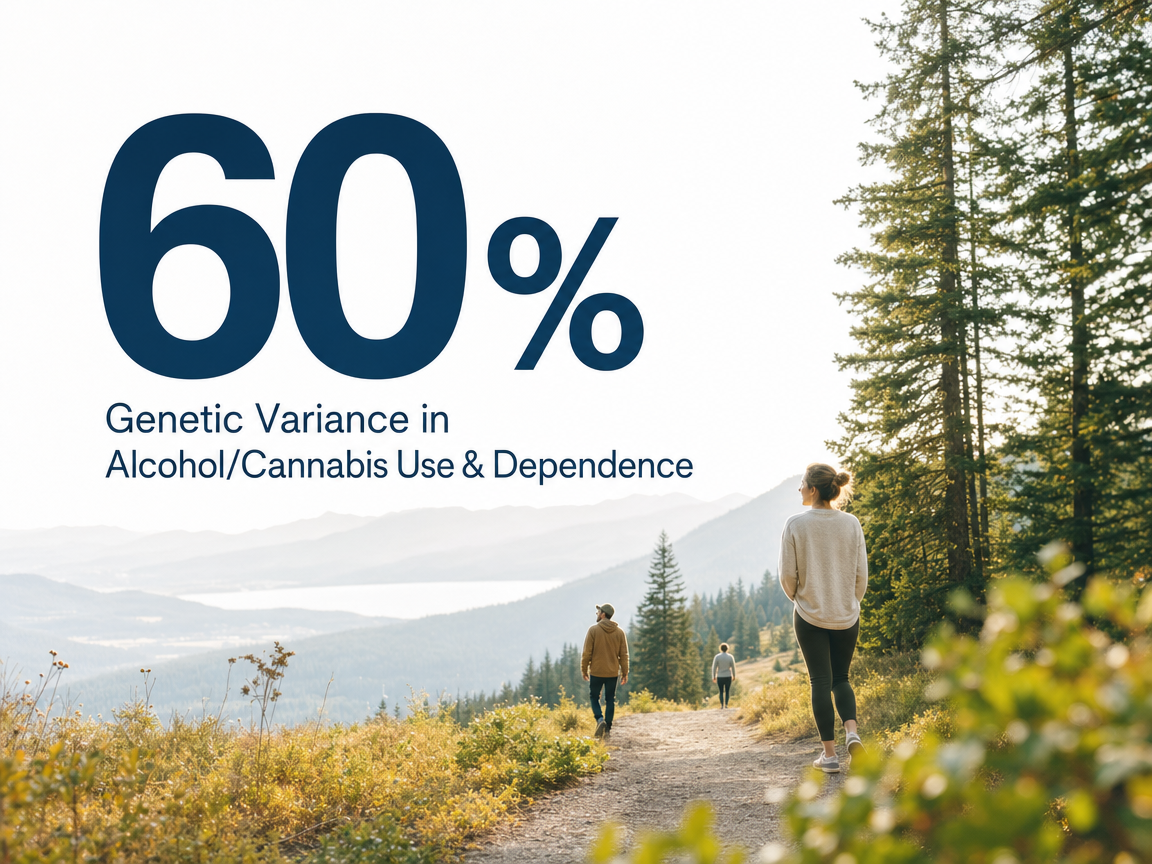
Some substances pull the average up. Others pull it down. Some outcomes (regular use vs. dependence vs. treatment response) are more heritable than others. A twin study of alcohol and cannabis, for example, found that over 60% of the variance in how much people used was genetic, but just under 50% of the variance in dependence symptoms was 3. Using and struggling are related, but they're not the same trait.
Half is a fair place to start a conversation. It just shouldn't be where the conversation ends.
What Heritability Does Not Mean
Here's the part that gets misread most often, and it's worth slowing down for.
What heritability also doesn't mean: inevitability. Higher concordance for substance use disorders in identical twins compared to fraternal twins is real evidence that genes matter, but identical twins are not identical in their outcomes 13. One twin can develop a severe alcohol use disorder while the other never does. Same DNA. Different lives, different exposures, different moments of care or its absence.
If genes were destiny, we wouldn't see that. What we see instead is vulnerability, tilted by biology and then shaped by everything that happens after. Which is exactly where treatment gets its leverage.
What the 2023 Genome Study Changed
Shared Risk Across Substances, and Substance-Specific Signatures
For a long time, addiction research told a substance-by-substance story. Alcohol had its genes. Nicotine had its genes. Opioids had theirs. Families sometimes noticed that the same household would produce a grandparent who drank, an uncle who smoked heavily, a cousin who struggled with prescription painkillers, but the science couldn't quite explain why those patterns kept showing up together.
In 2023, a genome-wide association study pooled data from more than one million people and did something the older, smaller studies couldn't. It looked for genetic signals that cut across substances, not just within them. The result: researchers identified 19 genetic variants tied to a general risk of developing any substance use disorder, alongside 47 additional variants that were specific to alcohol, tobacco, cannabis, or opioids 6. Many of the strongest signals mapped to regions of the genome that regulate dopamine, the neurotransmitter that governs how the brain assigns value and reinforcement 7.
Put more plainly: there appears to be an underlying inherited vulnerability to addiction as a category, and then a second layer of genetic influence that shapes which substance a person is most likely to struggle with 14. Two separate systems, working together.
This helps explain something you may have watched unfold in your own extended family. The vulnerability isn't always to the same drug across generations. It's often to something, and the something depends on what was available, what was normalized, and what the individual's specific biology responded to most strongly 4.
Why This Matters for Polysubstance Patterns in Families
If you've watched your adult child use more than one substance, or switch between substances during different stretches of their life, this is where the science starts to feel useful rather than abstract.
A shared genetic risk factor means that the same underlying biology which made alcohol hard to put down at 22 can also make nicotine hard to release at 28, or opioids dangerous after a surgery at 35 7. It isn't a lack of discipline reshuffling itself. It's the same dopamine-regulation vulnerability finding a new outlet.
For treatment planning, this changes things in a real way. An assessment that only screens for the presenting substance can miss the fuller picture. A person with strong general-addiction risk who quits drinking without addressing nicotine, cannabis, or benzodiazepine use often finds that one of those steps in and takes the place of another 4.
Good intensive outpatient care in the Pacific Northwest has been catching up to this. The programs that hold up best over time screen for cross-substance patterns from intake forward and build relapse prevention around the whole system, not just the drug that brought your child through the door.
Trauma Travels Through Families Too
The Epigenetic Layer: What the Syrian Refugee Studies Found
Genes aren't the only thing that gets handed down. There's a second layer of biology, called epigenetics, that sits on top of the DNA sequence and controls which genes get switched on, when, and how loudly. Life experience can leave marks on that layer. And in some cases, those marks appear to travel from one generation to the next.
The clearest recent evidence in humans comes from a study of Syrian families affected by generations of violence. Researchers compared grandmothers who were pregnant during the 1982 Hama massacre, mothers who were pregnant during the more recent Syrian civil war, and the children born from those pregnancies. In people who directly experienced violence, they found 21 sites on the genome where methylation patterns had shifted 8. In grandchildren of women exposed to violence while pregnant, they found 14 sites where similar patterns showed up, even though those grandchildren had never lived through the violence themselves 9.
This work isn't about addiction specifically. It's about how the biological signature of severe stress can persist across three generations of human beings. But the implication for families who have lived with addiction, domestic violence, or chronic instability is hard to miss. If your grandmother survived something no one talked about, if your parents grew up in a home where the drinking never really stopped, the nervous system your adult child inherited may have been shaped by more than the sequence of letters in the DNA itself. It may carry a stress signature that was set down long before they were born.
Holding This Without Self-Blame
Reading that paragraph, some parents will feel the guilt spiral start up again. If you're one of them, pause here for a second.
Epigenetic research does not say that anything you did or didn't do caused your adult child's substance use disorder. What it says is that the human body carries the biological echoes of what earlier generations lived through, and that those echoes are one thread among many in a person's overall risk. Genetics is another thread. Peer environment, age of first use, mental health, and access to care are others 5.
The reason to know about the epigenetic layer isn't to assign blame backward. It's to understand why healing environments matter so much in recovery. A stress-shaped nervous system responds to safety, structure, and consistency, and it responds to their absence. That's not a metaphor. It's the point where biology and treatment actually meet.
When Genes Meet Environment: Age, Access, and Adolescence
Genes don't act in a vacuum. They act on a specific person, at a specific age, in a specific place, with specific things within reach. Change any of those variables and the same inherited risk can produce very different outcomes.
Age of first use is one of the biggest levers. Adolescence is a developmental window when the brain's reward and impulse-control systems are still being wired, and heritability analyses show that generalized risk for problem behaviors is primarily driven by genetic factors during those years, with non-shared environmental influences taking on more weight later in adulthood 16. In practice, this means a teenager with strong inherited vulnerability who starts drinking heavily at 14 is on a very different trajectory than the same person would be if they hadn't encountered alcohol until 22.
Access matters too. Genetic vulnerability to opioids can sit dormant in a nervous system that never encounters them. A post-surgical prescription, a friend's medicine cabinet, a legalization shift for cannabis in the Pacific Northwest, all of these change whether inherited risk gets a chance to express itself 5.
The encouraging part: because environment carries real weight, the environment your adult child is in now, structured, sober, supported, is not a small factor. It's one of the largest ones still on the table.
Real Recovery Starts in Portland, Oregon
Call now or verify insurance to take the first step toward lasting recovery in Portland.
Should You Get Genetically Tested?
It's a fair question, especially if you're the kind of parent who wants data before decisions. If addiction is this heritable, wouldn't a saliva test tell you what your adult child is up against?
At-home kits marketed for addiction risk fall even further short. They can't tell you whether your son will relapse, whether your daughter should avoid certain medications, or whether your grandchildren carry vulnerability. What they can do, unfortunately, is create false certainty in either direction, either false alarm or false comfort 15.
The better use of that same energy: a thorough clinical assessment with a provider who takes a real family history, screens for co-occurring conditions, and builds a treatment plan around what's actually in front of your child.
What Inherited Risk Should Change About Treatment
The Case for Longer, Structured Outpatient Care
Here's where the science becomes practical. If your adult child carries higher inherited vulnerability, the short-stay model of care, a detox, a 28-day residential, and then home, is often not enough on its own. Not because your child hasn't worked hard. Because the biology underneath the surface is still calibrating.
Twin and family research consistently shows that both genetic risk and post-treatment environment shape outcomes together, which means the weeks and months after the acute phase are where trajectory really gets set 5. An intensive outpatient program that runs several days a week over several months gives a genetically vulnerable nervous system what a shorter stay can't: repeated exposure to relapse prevention skills, coping strategies for cravings that don't stay quiet, and the daily practice of applying those skills to real life while support is still close at hand.
In the Pacific Northwest, the strongest outpatient programs treat the length of care as a clinical variable, not a scheduling one. If your child is transitioning out of residential treatment or detox through a partner like Pacific Crest Trail Detox, the handoff into a structured 3-to-6-month IOP is doing the biological work that a shorter arc can't finish.
Integrated Care for Co-Occurring Conditions
The same genetic signature that raises addiction risk often raises the risk of other conditions alongside it. The 2023 GWAS identified variants linked not just to substance use disorders but to bipolar disorder, heart disease, and other health problems that tend to cluster in the same families 7. Anxiety and depression sit in that overlap too.
What this means at the treatment level is that screening only for the substance in front of you leaves half the picture out. SAMHSA is direct about this: when a mental health condition and a substance use disorder coexist, they need to be treated together, not in sequence 17. Sending your adult child to address the drinking first and the depression later, or vice versa, tends to produce worse outcomes than integrated care that works both angles at once.
For families with visible mental health patterns across generations, this is not a nice-to-have. It's the piece that keeps recovery from unraveling six months in when an untreated mood disorder starts pushing back. Ask any program you're considering how they screen for and treat co-occurring conditions, and whether that treatment happens inside the same clinical team.
Where Families Fit In
You've probably wondered, more than once, whether you should be more involved or less. The honest answer is that families are not optional in this work, and SAMHSA specifically recommends integrating family involvement into how SUD risk and recovery are addressed 15.
Family therapy isn't about assigning fault for what was inherited. It's about changing the environment your adult child returns to between sessions, and the environment you're living in while they recover. When inherited risk is real, the household patterns around stress, communication, and boundaries become part of the treatment, not a backdrop to it.
Practically, this looks like scheduled family sessions, guidance on what to say when a craving surfaces at Sunday dinner, and honest conversations about your own coping. You don't have to be a therapist. You have to be willing to show up, learn a different set of responses, and let the clinical team coach you when the old patterns tug. That work is part of what modifies how genetic risk plays out from here.
A Note to Parents in the Pacific Northwest
If you're reading this from Portland, the Gorge, Central Oregon, or somewhere across the state line, the practical picture looks like this. Your adult child's inherited risk is real, and it's a reason to invest in more care, not less. A structured intensive outpatient program that runs several months after detox or residential treatment gives their nervous system time to steady while relapse prevention skills become automatic. Look for a Pacific Northwest program that screens for co-occurring conditions from the first intake, coordinates cleanly with detox partners like Pacific Crest Trail Detox, and treats family involvement as clinical work rather than an afterthought.
You didn't cause the biology your child inherited. What you can influence, starting now, is the environment recovery unfolds inside. Programs like Oregon Trail Recovery are built for exactly this longer arc, and your steady presence in it matters more than any test result ever will.
Frequently Asked Questions
If addiction runs in our family, is my adult child destined to relapse?
No. Inherited risk raises vulnerability, not certainty. Identical twins with the same DNA often have different outcomes, which is direct evidence that biology tilts the odds but doesn't set them 13. What tends to change the trajectory is length and quality of care, treatment of any co-occurring conditions, and the environment your child returns to between sessions.
Did I cause my child's addiction by passing down my genes?
You didn't choose which variants to hand down, and heritability is a population statistic, not a personal verdict. It describes variation across groups, not the cause of any one person's substance use disorder 16. Genes are one input among many, including age of first use, peer environment, trauma, and access. Blame isn't the useful frame here.
Should we order an at-home DNA test to see if my child has the addiction gene?
SAMHSA's 2025 clinical advisory is direct: current genetic tests do not reliably predict who will develop a substance use disorder and should not be used as stand-alone screening 10. There's no single "addiction gene." A thorough clinical assessment that includes family history and screens for co-occurring conditions gives you far more useful information than any saliva kit.
Why does my child use multiple substances instead of just one?
Because there appears to be a shared inherited vulnerability that cuts across substances. A 2023 genome-wide study of over one million people identified 19 variants tied to general addiction risk plus 47 substance-specific variants, many linked to dopamine regulation 6. The same underlying biology can express itself through different drugs across a lifetime, which is why comprehensive screening matters.
How does inherited risk change what kind of treatment my child needs?
It raises the value of longer, structured outpatient care after the acute phase. Both genetic risk and post-treatment environment shape outcomes together, so the months following detox or residential care are where trajectory really gets set 5. Look for a program that runs several months, screens for co-occurring conditions, and involves family in the clinical work.
Do my other children have the same risk of developing a substance use disorder?
They share some inherited vulnerability, but not identical risk. Roughly half of overall SUD risk is genetic on average, with the rest shaped by environment, timing, and individual biology 2. Siblings differ in age of first exposure, peer groups, and mental health history, which is why one child may struggle while another doesn't. Early conversations and support help.
References
- The genetic basis of addictive disorders. https://pubmed.ncbi.nlm.nih.gov/22640768/
- Genetics of substance use disorders: a review. https://pmc.ncbi.nlm.nih.gov/articles/PMC8477224/
- Common Genetic Contributions to Alcohol and Cannabis Use and Dependence Symptoms. https://pmc.ncbi.nlm.nih.gov/articles/PMC3089946/
- Multivariate genome-wide association meta-analysis of over 1 million subjects identifies loci underlying multiple substance use disorders. https://pmc.ncbi.nlm.nih.gov/articles/PMC10217792/
- Genetic and environmental risk factors for adolescent substance use. https://pubmed.ncbi.nlm.nih.gov/20682215/
- New NIH study reveals shared genetic markers underlying substance use disorders. https://nida.nih.gov/news-events/news-releases/2023/03/new-nih-study-reveals-shared-genetic-markers-underlying-substance-use-disorders
- Multiple substance use disorders may share inherited genetic signature. https://medicine.washu.edu/news/multiple-substance-use-disorders-may-share-inherited-genetic-signature/
- Violent experiences alter the genome in ways that persist for generations. https://news.yale.edu/2025/03/06/violent-experiences-alter-genome-ways-persist-generations
- Violence alters human genomes for generations, researchers discover. https://news.ufl.edu/2025/02/syrian-violence-epigenetics/
- SAMHSA Clinical Advisory: Considerations for Genetic Testing in the Assessment of Substance Use Disorder Vulnerability. https://www.samhsa.gov/resource/ebp/samhsa-clinical-advisory-considerations-genetic-testing-assessment-substance-use
- Considerations for Genetic Testing in the Assessment of Substance Use Disorder Vulnerability. https://pmc.ncbi.nlm.nih.gov/articles/PMC11781156/
- The Genetic Basis of Addictive Disorders. https://pmc.ncbi.nlm.nih.gov/articles/PMC3506170/
- Genetics of addiction: Twin studies. https://news.vcu.edu/article/genetics_of_addiction_twin_studies
- NIH study reveals shared genetic markers underlying substance use disorders. https://nih.gov/news-events/news-releases/nih-study-reveals-shared-genetic-markers-underlying-substance-use-disorders
- Considerations for Genetic Testing in the Context of Substance Use Disorder Risk. https://library.samhsa.gov/sites/default/files/genetic-testing-sud-risk-pep24-02-014.pdf
- Genetic Influence/Heritability. https://mctfr.psych.umn.edu/genetic-influenceheritability
- Co-Occurring Disorders and Other Health Conditions. https://www.samhsa.gov/substance-use/treatment/co-occurring-disorders
Relapse Doesn't Mean the End Of Your Journey
Reach out today to explore programs that support real, long-term sobriety.