





How Alcohol Treatment Medicine Supports Your Recovery

Key Takeaways
- Four FDA-approved medications treat alcohol use disorder—acamprosate, disulfiram, oral naltrexone, and extended-release injectable naltrexone—each targeting a different part of the drinking cycle, none of them addictive.3
- Match the medicine to a specific goal: acamprosate leans toward promoting abstinence, while naltrexone leans toward reducing heavy drinking days, with modest effect sizes across pooled trials.4
- For dual diagnosis clients, integrated care that treats alcohol use and mental health together outperforms siloed approaches, and Oregon's COD framework and HB 2086 back that standard structurally.6, 8
- Medication is most effective inside a treatment program that includes therapy, peer support, and structure—especially during the vulnerable handoff from detox or residential care into outpatient work.1
The Underused Tool in Alcohol Recovery
If you've spent time in recovery spaces, you already know the standard toolkit: therapy, peer support, structure, honesty with yourself. What often gets left out of that conversation is medicine. Not as a shortcut, and not as a replacement for the harder work, but as an actual clinical tool with decades of evidence behind it.
There are four FDA-approved medications for alcohol use disorder: acamprosate, disulfiram, oral naltrexone, and extended-release injectable naltrexone. They reduce cravings, blunt the reward of drinking, or make drinking physically unpleasant, depending on which one fits your situation. None of them are addictive, and any general healthcare clinician can prescribe them.3
And yet, most people who could benefit from these medicines never take them. That gap is especially frustrating if you're managing a co-occurring condition like depression, anxiety, or trauma, because integrated care, where the mental health piece and the alcohol piece get treated together, is where medication tends to earn its keep.6
This guide walks through what each medication actually does, how to match it to your recovery goal, and where it fits alongside therapy and outpatient care in the Pacific Northwest. You've likely done the hard reading already. Here's the clinical picture, without the sales pitch.
The Four FDA-Approved Medications for Alcohol Use Disorder
What Each Medication Actually Does
Each of the four FDA-approved medicines works on a different part of the drinking cycle. Knowing which lever each one pulls is the first step in figuring out which might fit your recovery.
Acamprosate targets the post-drinking rebound. After long-term heavy drinking, your brain's glutamate system gets stuck in an overexcited state, which shows up as anxiety, sleep problems, and that raw, restless feeling many people describe in early recovery. Acamprosate helps quiet that system down. It's typically taken as two pills, three times a day, and it doesn't cause a reaction if you drink on it, which means a slip doesn't derail the medication.3
Disulfiram takes the opposite approach. Instead of easing cravings, it makes drinking physically unpleasant, sometimes severely so, by blocking the enzyme that breaks down alcohol. If you drink while on it, you can expect flushing, nausea, and a racing heart. That deterrent effect is why disulfiram works best for people who are already committed to abstinence and willing to take it under some form of supervision, whether that's a partner, a sponsor, or a clinician.2
Oral naltrexone blocks opioid receptors, which blunts the reward you get from alcohol. Drinking still happens on naltrexone if you choose it, but the buzz is dampened, which tends to reduce heavy drinking days over time. It's a daily pill, and clinicians usually check liver function before and during treatment.2
Extended-release injectable naltrexone (XR-naltrexone) is the same molecule delivered as a once-monthly injection. It removes the daily adherence question, which matters if remembering a pill every morning feels like one more thing your brain doesn't have bandwidth for right now. Both naltrexone formulations are indicated for people who can abstain from alcohol in an outpatient setting before starting treatment.2
None of these medicines are addictive, and any general healthcare clinician can prescribe them, which makes them more accessible than many people realize.3The right choice depends on your goal, your medical history, and how your life is structured, not on which medicine has the loudest reputation.

Where Off-Label Options Like Topiramate and Gabapentin Fit
The four FDA-approved medications aren't the only tools clinicians use. Topiramate and gabapentin show up frequently in alcohol use disorder treatment as off-label options, meaning they're prescribed for AUD even though the FDA approved them for other conditions.
Both have evidence behind them, particularly for people who haven't responded to first-line medications or who have specific co-occurring issues. Topiramate has been studied for reducing heavy drinking and craving intensity. Gabapentin has drawn interest for people who also struggle with the anxiety, insomnia, and protracted withdrawal symptoms that can drag on for weeks after your last drink.5
The honest picture: evidence for these off-label options varies, and clinical guidelines still position them as second-line or adjunctive rather than first-choice.5They tend to enter the conversation when acamprosate or naltrexone hasn't worked, when there's a specific reason to avoid the FDA-approved options, or when a co-occurring condition, like migraine or a seizure history, makes an off-label medicine do double duty.
If you're already in outpatient care and someone brings up topiramate or gabapentin, that's not a red flag. It usually means your prescriber is thinking carefully about your whole clinical picture rather than defaulting to a script. Ask what problem the medicine is meant to solve, and how you'll know whether it's working, so you're a partner in the decision instead of just a recipient of it.
Matching Medicine to Your Recovery Goal
Abstinence vs. Reducing Heavy Drinking Days
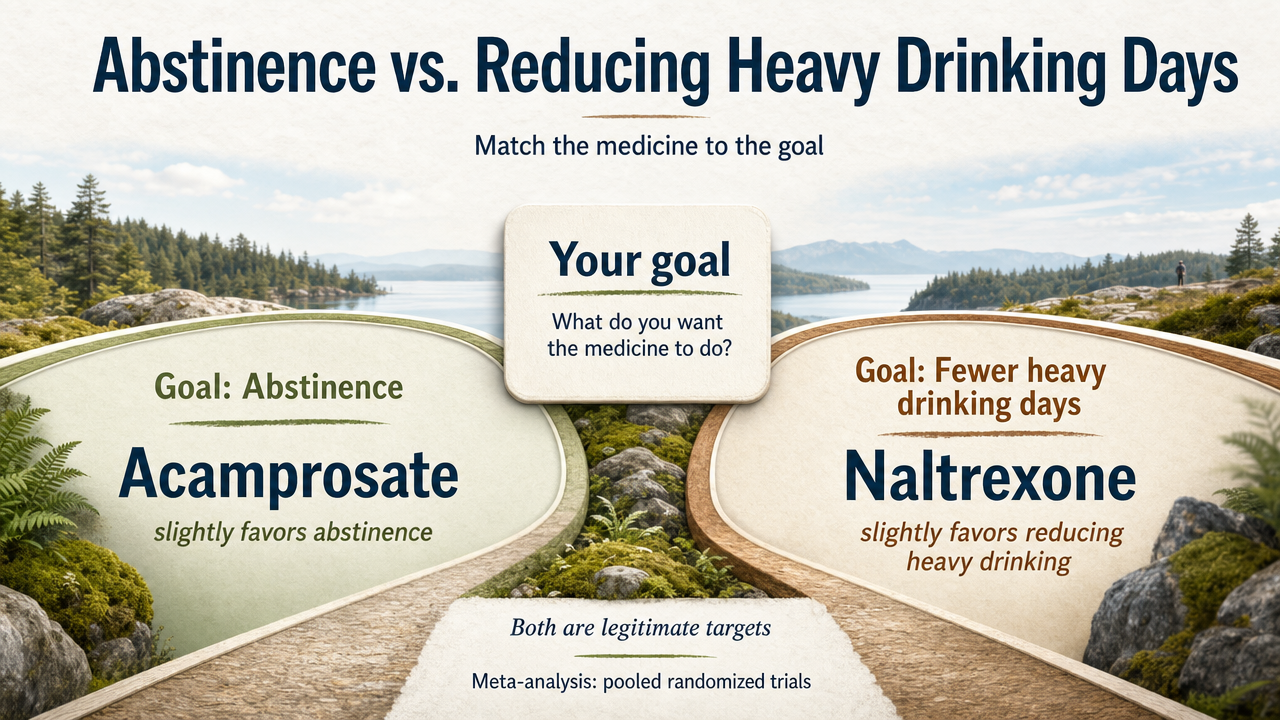
One of the most useful questions your prescriber can ask you is also the one that gets skipped most often: what do you actually want the medicine to do? Recovery is not a single destination. For some people, the goal is full abstinence, and staying at zero is the only outcome that feels safe. For others, especially earlier in the process, the meaningful win is cutting the heavy drinking days, the blackout nights, the mornings that steal your week. Both are legitimate targets, and the medicine you choose should match the goal you're actually working toward.
A meta-analysis pooling data from multiple randomized trials found that acamprosate is slightly more effective at promoting abstinence, while naltrexone is slightly more effective at reducing heavy drinking.4That's the hinge finding worth sitting with. The scope matters: these are pooled results across different study populations, effect sizes are modest, and there's real heterogeneity between the trials that went into the analysis.4Nobody in that data set walked away with a guaranteed outcome. What the evidence gives you is a directional lean, not a promise.
Read that lean carefully. If your goal is to stop drinking entirely and stay stopped, acamprosate tends to be the option built for that lane, because it works on the post-drinking rebound that makes early abstinence so uncomfortable. If your goal is to keep drinking from turning into a five-day bender, naltrexone tends to fit better, because it blunts the reward that keeps one drink turning into eight.
The practical takeaway: bring your actual goal into the prescribing conversation, in specific language. Not "I want to do better," but "I want to get to zero heavy drinking days a month," or "I want thirty days abstinent and then I'll reassess." A goal that specific lets your prescriber match the medicine to the outcome instead of defaulting to whatever they wrote last week. And if the first choice doesn't move the needle after a fair trial, that's information, not failure. Switching medications, or adding one, is a normal part of the process.
Where AUD Severity Changes the Conversation
Severity shifts the calculus. Alcohol use disorder sits on a spectrum, from mild to moderate to severe, and where you land on that spectrum changes what medication is likely to help and how urgently it belongs in the plan.5
For mild AUD, medication may still be worth discussing, but it's often one option among several, and behavioral treatment alone can carry a lot of weight. For moderate to severe AUD, the case for pharmacotherapy gets stronger. Cravings tend to be more intense, withdrawal is more likely to be a real medical event, and the neurological changes that keep drinking sticky are more entrenched. That's the territory where acamprosate and naltrexone earn their reputation, and where clinicians more often bring topiramate or gabapentin into the conversation for people who haven't responded to first-line options.5
Severity also shapes the sequence. If you're coming out of detox or a residential stay for severe AUD, starting medication before you step down into outpatient care is often the right move, because the vulnerable weeks after discharge are exactly when cravings peak and structure thins out. If you're earlier in the process and drinking heavily but functioning, medication can still be part of the plan, but the timing and choice may look different.
Honest answer to the internal question you might be sitting with: yes, severity matters, and no, it doesn't disqualify you from treatment at either end of the scale.
Oral vs. Extended-Release Naltrexone: A Practical Decision
If naltrexone lands on your short list, the next fork in the road is format. Same molecule, same mechanism, two different delivery systems, and the choice usually comes down to how your daily life is actually running right now.
Oral naltrexone is a pill you take every day. That daily rhythm is either a feature or a friction depending on where you are. If you already have a morning routine that holds, adding a pill to it is straightforward. If your mornings are chaotic, or if remembering medication has been a struggle in the past, that daily decision point can quietly become the place where the treatment falls apart.
Extended-release injectable naltrexone (XR-naltrexone) is the same medicine as a once-monthly injection given by a clinician. You show up, get the shot, and the medication is working in the background for the next four weeks. No pill to remember, no daily internal negotiation about whether to take it.
Two studies help make this decision less abstract. A pragmatic randomized controlled trial in a primary care setting compared the two formulations in community-dwelling adults and found that the extended-release injection was potentially more effective, more feasible, and more cost-effective than the daily pill for people being treated in that outpatient context.9The ADOPT study, published more recently, compared the two formulations in hospitalized patients with alcohol use disorder and tracked how each held up in the weeks after discharge, using a good clinical outcome defined as abstinence or moderate drinking.10
Both studies point in the same practical direction: the monthly injection tends to help people stay connected to treatment during the exact stretches when adherence usually slips, whether that's the fragile weeks after a hospital stay or the early months of outpatient recovery.9, 10The scope is worth naming honestly. These are two different populations, hospitalized patients in one trial and community-dwelling adults in the other, and effect sizes are not dramatic.
A few real-world factors that should weigh into the conversation with your prescriber: insurance coverage for the injection, whether you have a reliable clinic to receive it monthly, needle comfort, and how you feel about giving up the option to stop the medication instantly if a side effect shows up. The pill lets you pause tomorrow. The injection commits you to about a month. Both are legitimate trade-offs, and neither answer is wrong.
Real Recovery Starts in Portland, Oregon
Call now or verify insurance to take the first step toward lasting recovery in Portland.
When Alcohol Use Disorder Meets Depression, Anxiety, or Trauma
Why Integrated Care Changes What Medication Can Do
Alcohol rarely shows up alone. If you've been drinking to manage depression that started years before the drinking got bad, or to quiet an anxiety response your body learned in childhood, or to blunt trauma memories that don't stay put, you already know the medicine has more than one job to do. It has to hold up against the reason you started drinking, not just the drinking itself.
That's why integrated care matters, and why alcohol treatment medicine tends to work better inside it. When alcohol use disorder and a mental health condition get treated together, in the same plan, by teams that talk to each other, outcomes improve compared to sequential or siloed approaches. The evidence base for integrated treatment is grounded in exactly this population, people whose two conditions feed each other, and it supports combining pharmacotherapy for AUD with psychotherapy and, when appropriate, psychopharmacology for mood or anxiety symptoms.6
The practical version of this: naltrexone or acamprosate can quiet the alcohol side of the equation, which then gives the antidepressant, the trauma therapy, or the anxiety work a fair chance to land. When you're drinking heavily, an SSRI is fighting uphill. When cravings are unmanaged, a trauma session on Tuesday gets undone by Friday night. Take one piece off the board and the others get room to work.
SAMHSA's guidance reinforces the same principle from a screening angle: if you show up for mental health care, you should be screened for substance use, and vice versa, regardless of which door you walked through first.7That "no wrong door" idea matters here because dual diagnosis clients often get bounced between systems that each want the other one solved first. A good integrated plan stops that ping-pong and treats what's actually in front of you at the same time.
The Oregon Context: Integrated COD Program and HB 2086
If you're getting care in Oregon, the policy landscape actually works in your favor here, which is not something you get to say about many parts of the health system.
The Oregon Health Authority runs an Integrated Co-occurring Disorders (COD) Program built on the expectation that concurrent treatment, meaning mental health and substance use addressed at the same time by coordinated providers, is the standard of care rather than an upgrade.8That language matters. It means providers in Oregon aren't supposed to send you to "get the alcohol handled first, then come back for the depression." The system is set up, on paper, to treat both together.
House Bill 2086 backs that expectation with structure. The bill directs enhanced reimbursement rates for COD treatment, provides start-up funding for programs building integrated capacity, and creates an endorsement pathway for providers who deliver integrated COD care.8Translated: the state has put money and credentialing behind the idea that your prescriber, your therapist, and your outpatient team should be operating from the same treatment plan, not three different ones.
What Medication Cannot Do On Its Own
Here's the part that gets glossed over in a lot of medication marketing: none of these medicines are a cure. Acamprosate, disulfiram, and naltrexone are the most common medications for alcohol use disorder, and they are most effective for people who are also participating in a treatment program.1That is not fine print. That is the finding.
What medication actually does is narrow. It quiets cravings. It blunts reward. It takes the edge off the post-drinking rebound so the first weeks feel survivable. Those are real, meaningful effects, and they can be the difference between a Wednesday night that holds and one that unravels. But medicine does not teach you what to do at 7 p.m. on a Tuesday when the shape of your old routine is still sitting there waiting. It does not repair the relationships drinking damaged. It does not process the grief, or the trauma, or the reason you started reaching for a bottle in the first place.
That's the work therapy does. Cognitive behavioral work on the thoughts that lead to a drink. Trauma-focused therapy on the memories that keep firing. Group work with people who actually understand what you're describing, because they've said the same sentences from the same chair. Peer support that holds you accountable in a way a pill cannot.
And it's the work structure does. A schedule that puts something in the space drinking used to fill. Regular check-ins that catch a slip early. A treatment plan that keeps moving when your motivation dips, because motivation is not going to be evenly available across a year of recovery.
So when you hear that medication works best inside a treatment program, that isn't a disclaimer someone tacked on for liability. It's the finding itself. The medicine is a tool that makes the rest of the work possible, not a substitute for it.
Bringing Medication Into Outpatient Care
The handoff is where a lot of good plans quietly come apart. You finish detox, or you step down from a residential stay, and suddenly the structure that was holding you steady thins out. Mornings get unscripted. Evenings get long. Cravings show up right on cue, usually around the times of day drinking used to fill.
That transition is exactly where alcohol treatment medicine tends to matter most. Starting naltrexone or acamprosate before you leave a higher level of care, or in the first days of an intensive outpatient program, means the medicine is already working when the environmental supports pull back. If detox happened through a partner like Pacific Crest Trail Detox, the practical move is making sure your outpatient team knows what was started, what was considered, and what wasn't tried yet, so you're not repeating conversations from a folder that's already been written.
Inside an IOP, medication becomes one input alongside the therapy schedule, group work, and check-ins. Your prescriber tracks side effects and whether the medicine is doing what you both agreed it should do. Your therapist works on the reasons drinking got its hooks in. Your peers in group notice things you won't notice about yourself. When those pieces are talking to each other, medication does what it's supposed to do, which is take enough edge off the craving that the rest of the work becomes possible.1
A reasonable expectation: give any medication a fair trial, usually several weeks, before deciding whether it's helping. If it isn't, that's data. Switching to a different FDA-approved option, or moving from a daily pill to the monthly injection, is a normal part of the process, not a setback. What you're building in an outpatient setting is not a perfect first draft. It's a plan that adjusts as you learn what your recovery actually needs. Programs like Oregon Trail Recovery in Portland are built around that kind of continuity, where medication decisions stay connected to therapy, peer support, and the co-occurring mental health work you're already doing.
Frequently Asked Questions
Which medications are FDA-approved to treat alcohol use disorder?
Four medications have FDA approval for alcohol use disorder: acamprosate, disulfiram, oral naltrexone, and extended-release injectable naltrexone. They work through different mechanisms, none of them are addictive, and any general healthcare clinician can prescribe them.3Off-label options like topiramate and gabapentin also come up in clinical practice, usually as second-line or when a co-occurring condition makes them do double duty.5
Do I have to be fully abstinent before starting alcohol treatment medicine?
It depends on the medication. Both oral and extended-release naltrexone are indicated for people who can abstain from alcohol in an outpatient setting before starting treatment, and disulfiram works best for people already committed to abstinence.2Acamprosate is different; a slip doesn't cause a reaction and doesn't derail the medication.3So the honest answer is that some medicines require abstinence up front, and others are more forgiving of a stumble.
How do I decide between oral naltrexone and the monthly injection?
Same molecule, two delivery systems. The daily pill gives you the option to pause tomorrow if a side effect appears. The monthly injection removes the daily adherence question, which matters when mornings are chaotic. Research in a primary care setting found extended-release naltrexone was potentially more effective, feasible, and cost-effective than the oral version for community-dwelling adults.9Insurance coverage, clinic access for monthly visits, and needle comfort all belong in the conversation.
Can I take AUD medication if I'm also being treated for depression, anxiety, or trauma?
Yes, and combining them is often the point. Integrated treatment models support combining pharmacotherapy for alcohol use disorder with psychotherapy and, when appropriate, psychopharmacology for mood or anxiety symptoms.6SAMHSA recommends screening for both conditions regardless of which door you walk through first.7Practically, quieting the alcohol side gives the antidepressant or trauma work a fair chance to land. Your prescriber and mental health team should be coordinating, not working in separate lanes.
Will medication work if my goal is to reduce heavy drinking rather than quit completely?
Yes. Reducing heavy drinking days is a legitimate clinical target, and naltrexone has been shown to be slightly more effective for that outcome, while acamprosate leans toward promoting abstinence.4Bring the specific goal into the prescribing conversation. Saying you want zero heavy drinking days a month, or a specific reduction, lets your prescriber match the medicine to the outcome. Reduction can be a stopping point or a step toward abstinence later.
Does alcohol treatment medicine replace therapy or an outpatient program?
No. Acamprosate, disulfiram, and naltrexone are the most common medicines for alcohol use disorder, and they are most effective for people who also participate in a treatment program.1Medicine quiets cravings and blunts reward, which is real and useful. It doesn't repair relationships, process trauma, or teach you what to do at 7 p.m. on a Tuesday. Therapy, group work, peer support, and structure do that work. The medication makes the rest possible.
References
- Treatment Options for Substance Use Disorder. https://www.samhsa.gov/substance-use/treatment/options
- Medication for the Treatment of Alcohol Use Disorder: A Brief Guide. https://library.samhsa.gov/product/medication-treatment-alcohol-use-disorder-brief-guide/sma15-4907
- Prescribing Pharmacotherapies for Patients with Alcohol Use Disorder. https://library.samhsa.gov/sites/default/files/PEP20-02-02-015.pdf
- Meta-analysis of naltrexone and acamprosate for treating alcohol use disorders. https://pmc.ncbi.nlm.nih.gov/articles/PMC3970823/
- Treatment of Alcohol Use Disorder. https://www.ncbi.nlm.nih.gov/books/NBK561234/
- Integrating Treatment for Co-Occurring Mental Health Conditions and Alcohol Use Disorder. https://pmc.ncbi.nlm.nih.gov/articles/PMC6799972/
- Managing Life with Co-Occurring Disorders. https://www.samhsa.gov/mental-health/serious-mental-illness/co-occurring-disorders
- Integrated Co-occurring Disorders Program. https://www.oregon.gov/oha/hsd/amh/pages/co-occurring.aspx
- Extended-release vs. oral naltrexone for alcohol dependence treatment in primary care. https://pubmed.ncbi.nlm.nih.gov/30986535/
- Oral vs Extended-Release Injectable Naltrexone for Hospitalized Patients with Alcohol Use Disorder (ADOPT Study). https://pmc.ncbi.nlm.nih.gov/articles/PMC12013356/
Relapse Doesn't Mean the End Of Your Journey
Reach out today to explore programs that support real, long-term sobriety.