




Portland, OR Addiction Recovery Programs for Long-Term Sobriety

Key Takeaways
- The first 90 days after detox carry the highest overdose risk because tolerance drops while cravings and old environmental cues remain intact 5.
- Portland's strongest post-detox path layers intensive outpatient treatment, certified recovery housing, and work or school re-entry, funded together through OHP and Oregon's 1115 SUD waiver 1, 2.
- Before enrolling, compare weekly contact hours against SAMHSA's 9-hour adult floor, ask how co-occurring mental health care is delivered, and confirm what step-down after 90 days looks like 3.
- Leave detox carrying two doses of naloxone, confirm neighborhood access and language fit at any program you consider, and choose housing that's certified with active clinical linkage 8, 11.
The First 90 Days After Detox Decide Everything
You've already done something most people never do. Detox is over. Your body has stopped fighting the acute physical crisis, and you're standing at the edge of what comes next. That next stretch — the first three months after you walk out of a stabilization bed — is where long-term sobriety actually gets built or lost.
This isn't dramatic language. It's what the research keeps showing. Overdose risk stays elevated after detox because tolerance drops fast while cravings don't 5. Old routines are still wired into old neighborhoods, old phone contacts, old stress responses. And the structure that held you steady during withdrawal — the staff, the schedule, the locked door between you and a use decision — is suddenly gone.
What replaces that structure matters more than which detox you completed. In Portland, the strongest path forward pairs intensive outpatient treatment with certified recovery housing and a real plan for work or school, all held together by Oregon's Medicaid-funded continuum 1, 2. Not one piece. All of them, layered.
The next sections map that handoff — what a clinically sound step-down looks like, how to read whether you're ready for outpatient versus more residential time, and how to build the first 90 days so they hold.
Mapping the Step-Down Continuum in Portland
From Stabilization to Structure: What Comes After Detox
Detox does one job well: it gets you through the acute physical crisis safely. It doesn't teach you how to sit with a craving on a Tuesday afternoon, or how to answer when your old roommate texts, or how to sleep without something in your system. That work happens later, and it happens in stages.
Here's how the step-down actually sequences in Portland when it's built right. After medical detox stabilizes you, the next layer is intensive outpatient treatment — SAMHSA's guidance calls for 6 to 30 contact hours per week over a minimum of 90 days, with step-up and step-down flexibility as your stability changes 3. IOP runs parallel to recovery housing for most people, because a certified sober living environment gives you a place to practice what you're learning between sessions. From there, employment or education re-entry gets folded in, followed by lower-intensity outpatient care that can extend for months or longer.
The reason this stack works in Oregon specifically is money and access. The Oregon Health Plan covers substance use treatment, residential care, medication-assisted treatment, and counseling without requiring a referral 1. The state's 1115 SUD demonstration waiver goes further — it funds all residential facilities through Medicaid and adds Community Integration Services that pay for housing and employment support alongside clinical treatment 2.
That funding lane matters. It means the continuum you actually need — clinical care plus a safe place to live plus help getting back to work — is treated as one connected recovery episode, not four separate bills you can't afford.
Reading the Clinical Signals: IOP vs. Continued Residential vs. Sober Living Alone
Not everyone leaving detox belongs in the same next step. The honest question isn't which level of care sounds most reassuring — it's which one matches where your body and life actually are right now.
Intensive outpatient makes clinical sense when withdrawal is fully resolved, when you have somewhere stable to sleep tonight (your own place, family, or recovery housing), and when you can get to sessions three to five days a week without your environment pulling you back into use within hours of leaving. Peer-reviewed research on IOP finds substantial reductions in alcohol and drug use, with outcomes often comparable to inpatient or residential care when patient selection is right 13. The catch is in that phrase — patient selection. IOP assumes you can handle unstructured hours between sessions.
Continued residential treatment is the better fit when detox stabilized you medically but your home environment is still an active trigger, when cravings are intense enough that unsupervised evenings feel dangerous, or when co-occurring mental health symptoms haven't stabilized. SAMHSA explicitly warns that clients still needing withdrawal management should complete it before moving into full IOP intensity 3.
Sober living alone — without a clinical program attached — is almost never the right answer directly after detox. Housing without treatment gives you the environment but none of the skill-building, therapy, or accountability structure that actually reduces relapse risk. If you're weighing that option because cost or scheduling feels impossible, know that OHP covers the outpatient piece without a referral 1, and the 1115 waiver can fund housing supports alongside it 2. The step-down is designed to layer, not to be picked apart.
How IOP Actually Works in Portland
The Weekly Structure: Contact Hours, Duration, and What Sessions Look Like
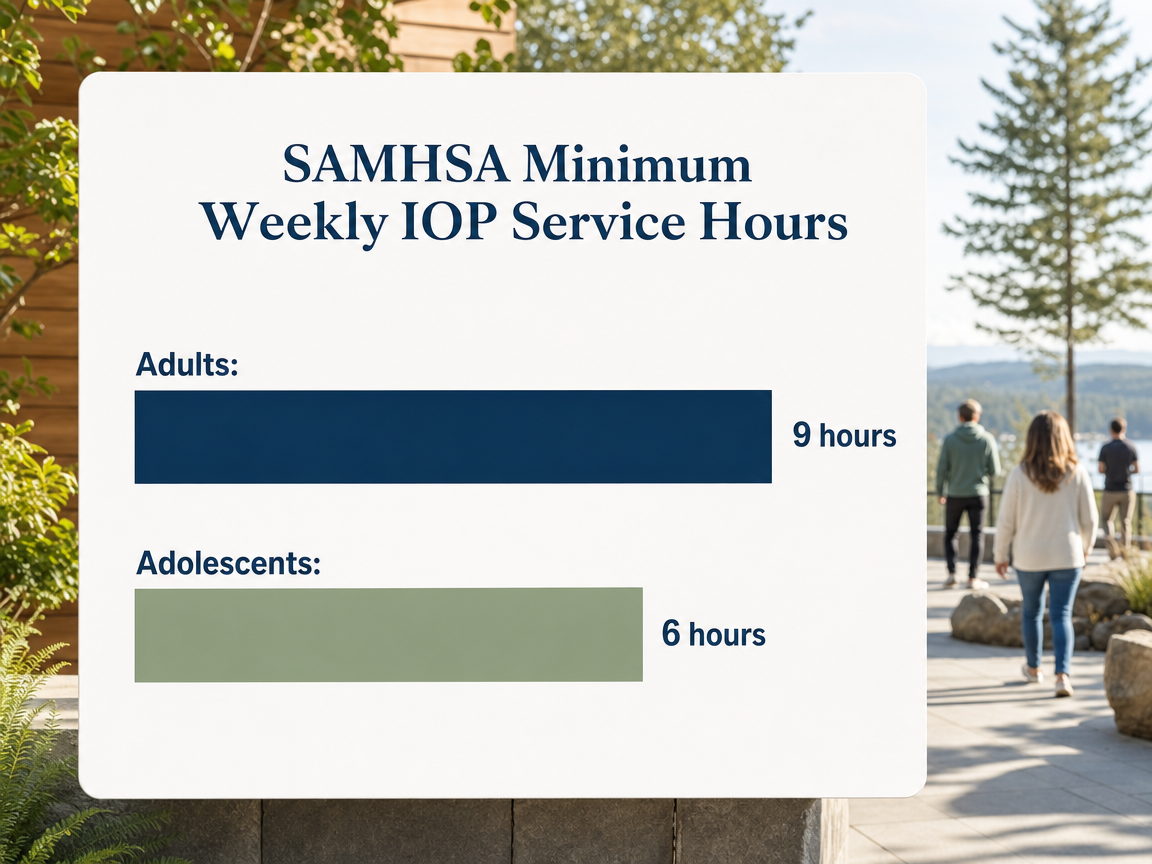
Here's the yardstick worth memorizing before you tour a single Portland program. SAMHSA's TIP 47 defines intensive outpatient treatment as 6 to 30 contact hours per week for a minimum of 90 days, with a 9-hour weekly floor for adults and a 6-hour floor for adolescents 3. That range isn't arbitrary. It's the intensity clinicians have found sufficient to disrupt use patterns while still letting you keep a job, a lease, and a family life.
What that looks like on a real week: three to five days of programming, most often in three-hour blocks scheduled morning, afternoon, or evening so you can work around them. A typical block combines group therapy (the largest chunk), an individual session on a weekly or biweekly cadence, and skills work — relapse prevention, cognitive behavioral strategies, sometimes dialectical behavior therapy for emotion regulation. Family sessions get folded in when they help.
The 90-day minimum matters more than people expect. Shorter courses feel like a win because they end faster, but the research the guidance rests on shows that duration is one of the strongest predictors of durable outcomes 3. Programs that let you step down to lower intensity after your first 90 days — moving from five days a week to three, then to weekly outpatient — are doing this correctly.
If a Portland program pitches you fewer than 9 weekly hours as "IOP," or promises a 30-day version, that's a different level of care wearing the wrong label. Ask directly: how many contact hours, how many weeks, and what does step-down look like?
Co-occurring Mental Health Support Inside SUD Treatment
Most people leaving detox aren't dealing with substance use alone. Depression, anxiety, PTSD, and trauma histories travel with addiction more often than not, and pretending otherwise is one of the fastest routes back to a use decision. The question isn't whether you have co-occurring symptoms — it's whether your program is built to treat them alongside the substance work.
Integrated IOP handles both in the same treatment plan rather than sending you to two disconnected providers who never talk. Research on co-occurring care shows this integration can improve substance use outcomes, increase abstinence, and reduce psychological symptoms and distress at the same time 14. That's a different result than treating each condition in isolation and hoping they don't destabilize each other.
Worth naming plainly: co-occurring support inside a SUD program is not the same as primary psychiatric care. If your primary concern is severe, unstable mental illness — active psychosis, acute suicidality that hasn't stabilized — you need a psychiatric setting first, then the SUD continuum. But for the far more common overlap of depression, anxiety, and trauma responses that get louder in early sobriety, integrated IOP is where that work belongs.
When you're evaluating a program, ask who provides the mental health piece, how often you'll see them, and how the therapy modality (CBT, DBT, trauma-focused approaches) matches what you're carrying.
Real Recovery Starts in Portland, Oregon
Call now or verify insurance to take the first step toward lasting recovery in Portland.
Recovery Housing: Where Sobriety Gets Practiced Daily
What Certified Recovery Housing Provides
A certified recovery house isn't a dorm and it isn't a treatment facility. It's a residence with a specific job: keep the environment sober, keep the accountability structure alive between clinical sessions, and let you practice the skills you're learning in IOP where you actually live.
SAMHSA's best-practice guidance describes what a well-run recovery house looks like in daily operation — clear resident safety rules, drug and alcohol testing, house meetings, peer support, connections to co-occurring care, and cultural competence built into how residents are welcomed and treated 11. Certification matters here because it separates houses operating to those standards from unregulated homes marketed as "sober living" without the accountability that makes the label meaningful.
What you'll actually experience day to day: a lease or resident agreement, a house schedule that includes chores and meetings, curfews in early stages, required attendance at your outpatient program, and peers at various stages of recovery living in the same rooms and kitchen. The friction of shared living is part of the point. Learning to handle a roommate's bad mood without reaching for a substance is a repeatable skill that inpatient walls can't teach you.
Outcomes Evidence and Its Limits
Recovery housing has better evidence behind it than the recovery world usually acknowledges — and thinner evidence than marketing pages suggest. Both things are true, and you deserve the honest version.
A 2025 systematic review found that people living in recovery housing did better than those receiving usual care across four outcomes that matter: abstinence, income, employment, and criminal charges 12. That's a meaningful cluster. It says the environment doesn't just help you not use — it helps you earn, work, and stay out of the legal system while you rebuild. Those outcomes travel together in real life, and a housing model that moves all four in the right direction is doing structural work that outpatient sessions alone can't replicate.
Here's the limit worth holding in the same breath: that review rests on only five original studies 12. The findings point in a consistent direction, but the total evidence base is still narrow, and results vary across housing models. Findings for incarceration specifically were mixed. What that means practically: recovery housing is a strong bet backed by real data, not a guaranteed outcome. The variation across houses is part of why certification, house culture, and clinical linkage matter so much when you're choosing where to live.
Read the evidence as directional. A certified house paired with active IOP participation gives you a stronger position than either piece alone — and better than most alternatives available after detox.
Gender-Specific and Culturally Responsive Housing Options
Who you live with in early recovery shapes what you can talk about, what you can practice, and what you can heal. Gender-specific housing isn't a preference — for many people leaving detox it's a clinical fit issue. Trauma histories, safety in shared spaces, and the specific relational patterns tied to substance use often surface faster and get worked on more honestly in men's houses or women's houses than in mixed settings.
Cultural responsiveness matters the same way. SAMHSA's recovery housing guidance names cultural competence as a core best practice, not a soft add-on 11. For Native residents, Wellbriety-informed approaches that draw on Indigenous healing traditions can carry weight that a generic 12-step framework doesn't. For Spanish-speaking residents or people from other language communities across Portland's neighborhoods, being able to speak your first language in group and in the kitchen is part of what makes a house feel like recovery instead of exile.
Ask a house directly: who lives here, who runs house meetings, what languages are spoken, and what cultural or spiritual practices are welcomed. The right fit accelerates the work.
Overdose Safety Planning During the Transition Window
Carry naloxone. Not eventually — the day you leave detox. CDC guidance is direct: naloxone can restore normal breathing within 2 to 3 minutes if opioids are involved, and it should be given immediately when overdose is suspected 7. With fentanyl in the picture, more than one dose is often needed to reverse an overdose, so having two doses on hand is the standard, not the exception 8. Oregon law also requires certain facilities to provide opioid overdose reversal medication at discharge in specific situations 15— if you weren't sent home with naloxone, ask before you leave, and ask again at your first IOP intake.
Make sure the people around you know where the naloxone is and how to use it. A roommate, a housemate at your recovery residence, a partner, a sponsor. Naloxone in a drawer that nobody else can find during those few minutes is naloxone that can't help.
Then plan for the moment you don't want to plan for. If you use again, use with someone present, not alone behind a locked door. Call 911 without hesitation — Oregon's Good Samaritan protections exist so that fear of arrest doesn't cost someone their life. A relapse isn't the end of your recovery. Dying is.
Paying for the Continuum: OHP, the 1115 Waiver, and Access Realities
What Oregon Medicaid Actually Covers Without a Referral
Cost is the reason a lot of people stall between detox and what comes next. Here's the part worth knowing before you start calling programs: if you're on the Oregon Health Plan, you don't need a referral to get help for substance use. You can call an outpatient program directly and start intake 1.
OHP's behavioral health coverage includes the pieces that make up a real continuum — substance use treatment, detoxification, residential treatment, counseling, medication-assisted treatment, and peer-delivered services 1. That's the outpatient work, the medication if you need it, and the peer support that shows up in group and in recovery housing.
Oregon's 1115 SUD demonstration waiver adds the layer most states don't fund. It pays all residential facilities through Medicaid and covers Community Integration Services — the housing and employment supports that keep the clinical work from collapsing the moment you leave a session 2. The current demonstration runs through March 31, 2026, with a temporary extension into September 2026 2.
Practical translation: call the program, say you're on OHP, and ask what their intake process looks like this week. Don't wait for a referral that isn't required.
Neighborhood Access, Transportation, and Language Fit
Coverage on paper only helps if you can actually get to the building three to five days a week. Portland spans 94 neighborhoods with real differences in rent burden, language, food access, and life expectancy — the kinds of daily-life factors that shape whether a program across town is realistic or just theoretical 9, 10.
If you're in outer East Portland and the IOP you're considering is in the Pearl, the commute alone can burn two hours of a day you also need for work, meetings, and sleep. OHP-covered non-emergent medical transportation exists for a reason — ask the program's intake team how their clients typically get there, and whether they help coordinate rides. A closer program with fewer amenities often beats a fancier one you'll stop showing up to by week six.
Language fit matters the same way. Portland has significant Spanish-speaking, Vietnamese-speaking, and Russian-speaking communities across specific neighborhoods 9. If English isn't the language you think in when you're stressed, ask directly what languages are spoken in group, whether interpretation is available, and whether any staff share your background. That's not a preference — it's whether the therapy can reach you.
Rebuilding Work, School, and Daily Life Alongside Treatment
One of the quiet reasons IOP works better than shorter, more intensive models is that it doesn't ask you to disappear from your life. You keep the job. You keep the class schedule. You keep showing up for your kids. And you do the recovery work in the hours that wrap around all of it.
That's the design, not a compromise. Programming scheduled in morning, afternoon, or evening blocks is built so a warehouse shift, a nursing rotation, or a community college semester can survive the first 90 days of treatment. If you're returning to an employer, you don't always have to explain the diagnosis — you can request a modified schedule or use FMLA-protected time for medical appointments without disclosing the specifics. If you're job searching, Oregon's 1115 waiver funds Community Integration Services that include employment support alongside the clinical care, so resume help, interview coaching, and connections to workforce programs can be part of your recovery plan rather than something you piece together alone 2.
Same principle for school. Portland Community College, PSU, and the trade programs across the metro all have accommodations processes that don't require you to hand over your treatment history.
Structure is the point. A week with an IOP schedule, a shift, a class, and a house meeting is a week that doesn't have room for the old routine.
Choosing a Portland Program Without Falling for the Pitch
Every treatment website in Portland uses the same words: compassionate, evidence-based, individualized. That vocabulary tells you almost nothing. What tells you something is what a program will say plainly when you ask specific questions on the phone.
Ask how many contact hours per week their IOP runs, and how many weeks. If the answer is vague or lands below the 9-hour adult floor SAMHSA sets, you're looking at a lighter level of care with an IOP label on it 3. Ask what step-down looks like after your first 90 days, not just what the first month includes. Ask who provides the co-occurring mental health work, how often you'll see them, and which therapy modalities they actually practice — not a list of acronyms on a website.
Ask about recovery housing linkage. Is it certified. Who lives there. What happens if you relapse — do you lose your bed, or is there a clinical response. Ask about OHP intake timelines this week, not in theory 1. Ask whether you'll leave with naloxone and a safety plan 15.
A program that answers directly is showing you how it will treat you. Oregon Trail Recovery and any other Portland option worth your time will welcome those questions.
Frequently Asked Questions
How long should I stay in an addiction recovery program after detox in Portland?
Plan on a minimum of 90 days of structured programming, with lower-intensity outpatient care continuing for months after that. Ninety days is the floor SAMHSA guidance sets for intensive outpatient treatment, and duration is one of the strongest predictors of whether the work sticks 3. Shorter feels faster. Longer holds better.
Does the Oregon Health Plan cover IOP and recovery housing?
Yes, with important nuance. OHP covers substance use treatment, counseling, medication-assisted treatment, residential care, and peer-delivered services as part of behavioral health benefits 1. Oregon's 1115 SUD demonstration waiver adds funding for residential facilities and Community Integration Services that cover housing and employment supports alongside clinical treatment 2. Ask each program how they bill.
Do I need a referral to start a Portland IOP if I'm on OHP?
No. OHP is explicit that you do not need a referral to get help for problems with alcohol or drugs 1. You can call an intensive outpatient program directly, ask about their intake process this week, and start. Don't let anyone tell you a referral is required before you can be seen.
How do I decide between IOP, continued residential treatment, and sober living alone?
Match the level of care to your clinical stability, not to what sounds most reassuring. IOP fits when withdrawal is fully resolved and you have somewhere safe to sleep 13. Continued residential fits when your home environment is still an active trigger or co-occurring symptoms haven't stabilized. Sober living without a clinical program attached is rarely enough right after detox — housing needs treatment paired with it.
Can I work or go to school while attending an IOP in Portland?
Yes — that's part of why IOP exists. Programs schedule sessions in morning, afternoon, or evening blocks so a work shift or class schedule can survive treatment. Oregon's 1115 waiver also funds employment support as part of Community Integration Services, so resume help and workforce connections can be built into your recovery plan rather than pieced together alone 2.
What overdose safety steps should I take when leaving detox?
Carry naloxone the day you leave, and carry two doses — fentanyl often requires more than one to reverse an overdose 8. Given immediately, naloxone can restore normal breathing within 2 to 3 minutes 7. Oregon law requires certain facilities to provide overdose reversal medication at discharge in specific situations, so ask before you walk out 15.
References
- Oregon Health Plan (OHP) Behavioral Health Coverage. https://www.oregon.gov/oha/hsd/ohp/pages/behavioral-health.aspx
- Substance Use Disorder 1115 Demonstration Waiver. https://www.oregon.gov/oha/hsd/medicaid-policy/pages/sud-waiver.aspx
- Clinical Issues in Intensive Outpatient Treatment. https://library.samhsa.gov/sites/default/files/sma13-4182.pdf
- TIP 47 - Clinical Issues in Intensive Outpatient Treatment. https://www.samhsa.gov/resource/ebp/tip-47-substance-abuse-clinical-issues-intensive-outpatient-treatment
- Overdose Prevention Data Channel. https://www.cdc.gov/overdose-prevention/data-channel/index.html
- DOSE-DIS Dashboard: Nonfatal Overdose Emergency Department and Inpatient Hospitalization Discharge Data. https://www.cdc.gov/overdose-prevention/data-research/facts-stats/dose-dis-accessible.html
- 5 Things to Know About Naloxone. https://www.cdc.gov/overdose-prevention/reversing-overdose/about-naloxone.html
- Lifesaving Naloxone. https://www.cdc.gov/stop-overdose/caring/naloxone.html
- Neighborhood Demographic Profiles. https://www.portland.gov/civic/myneighborhood/neighborhood-profile-maps
- Portland Data Map Tool. https://www.portland.gov/civic/data-map-tool
- Best Practices for Recovery Housing. https://library.samhsa.gov/product/best-practices-recovery-housing/pep23-10-00-002
- Recovery housing for substance use disorder. https://pmc.ncbi.nlm.nih.gov/articles/PMC11922849/
- Substance Abuse Intensive Outpatient Programs. https://pmc.ncbi.nlm.nih.gov/articles/PMC4152944/
- Chapter 7—Treatment Models and Settings for People With Co-Occurring Disorders. https://www.ncbi.nlm.nih.gov/books/NBK571024/
- ORS 430.735 - Oregon Revised Statutes. https://www.oregonlegislature.gov/bills_laws/ors/ors430.html
Relapse Doesn't Mean the End Of Your Journey
Reach out today to explore programs that support real, long-term sobriety.